
The biggest lie you will hear about new residency programs is, “We’re building something special—come be a pioneer.”
Sometimes that is true. Often it is code for “We have no idea what we’re doing yet, and you will pay for it.”
You have a real problem: your top interview (by prestige, location, or specialty fit) is a brand‑new program you do not fully trust. You like the name, the city, the dream. But your gut is uneasy.
Here is how you deal with that—systematically, not emotionally.
Step 1: Name the Real Risk You’re Worried About
You are not just “a little nervous.” You are worried about specific, concrete things. Spell them out or you will make a fuzzy decision.
Common, very real risks with brand‑new residencies:
- Accreditation instability
- Weak or chaotic education structure
- Poor supervision / service-heavy with no learning
- Weak board pass outcomes in the first cohort
- Bad reputation with fellowship directors and future employers
- Toxic culture that goes unchecked because there is no track record
- Leadership turnover that leaves you stranded
Write down your top 3 fears. Literally. On paper.
Examples I see constantly:
- “I am scared they will lose accreditation and I will be stuck.”
- “I am worried I will be cheap labor, not a trainee.”
- “I do not trust that people will know or respect this program when I graduate.”
You cannot fix a vague feeling. You can build a plan around specific risks.
Step 2: Do a Hard Background Check on the Program
You must investigate this program like you are about to invest five years of your life in a start‑up. Because you are.
A. Look up ACGME and institutional history
You are checking two things: stability and experience.
Minimum checks:
- Is the sponsoring institution (the main hospital/health system) long‑standing or also new?
- Does this institution already sponsor other residency programs? If yes, how are those doing?
- Who is the Designated Institutional Official (DIO), and do they have a real GME track record or are they an administrator slapped into the role?
If a hospital has run a solid IM or surgery residency for 20 years, a new EM or psych program is less scary. They at least know what GME is.
If everything is new—hospital, GME office, admin leadership—your risk profile just went up.
B. Deep Google on the PD and core faculty
You want data, not the glossy brochure lines.
Look for:
- Prior roles: Program Director, APD, Clerkship Director, core faculty
- Prior institutions: anything reputable? Or a string of no‑name jobs with short stays?
- Publications: not about prestige—about seriousness. Are they academically engaged at all?
- Any public red flags: lawsuits, public sanctions, major complaints
Red flag patterns I have actually seen:
- PD with no previous leadership role and less than 5 years at any job
- Faculty list with 80% new grads from the same institution, no senior backbone
- “Core faculty” who are 0.1 FTE on paper but clinically slammed full‑time
Reasonable pattern:
- PD/APDs who have clearly run or helped run another established ACGME program
- Mix of junior and senior faculty with real educational titles (not just “likes teaching”)
Step 3: Forensic Analysis of the Interview Day
Most applicants walk through interview day like tourists. You cannot afford that here. You are on fact‑finding duty.
Here is the lens you use:
Is there a coherent, believable system here, or is this vibes and marketing?
A. Questions to ask faculty (and what good vs bad answers look like)
You are not just collecting words; you are stress‑testing the program’s architecture.
Ask:
“What does a typical week look like on your busiest inpatient rotation?”
- Good: detailed schedule, caps, call structure, team composition, how teaching is built in.
- Bad: hand‑wavy “It depends, we are still finalizing a lot, but there will be plenty of support.”
“How were residents involved in designing the curriculum?”
- Good: specific examples—“Our current class pushed for X rotation,” “We added a dedicated didactics half‑day because they were drowning on wards.”
- Bad: “We plan to involve residents a lot once things get going.”
“What formal feedback mechanisms exist for residents to give input and see changes?”
- Good: structured CCC, PEC, anonymous surveys plus “Here are two changes we made last year based on feedback.”
- Bad: generic “Our door is always open.”
“What is your strategy for getting graduates into strong fellowships/jobs in the first few years?”
- Good: clear plan—mentorship, letters from known faculty, affiliations, research or away rotations.
- Bad: “Our hospital is very well known locally; I’m sure it will be fine.”
“What worried you most as you were starting this program, and how did you address it?”
- Good: honest acknowledgment of real risks and concrete mitigation.
- Bad: “We have not had any major concerns; everything has gone smoothly.”
You are listening for specifics. Real examples. If everything sounds like marketing, assume they have not actually done the work yet.
B. Questions for current residents (or promised incoming class)
If they have no residents yet, that is another layer of risk. If they do, you interrogate (politely).
Ask different questions in the formal session and any unofficial chats.
On the record:
- “How many hours a week are you averaging on your busiest rotations?”
- “Have you ever felt unsafe in terms of supervision or workload?”
- “Tell me about a time leadership listened and made a change.”
Off the record (email, text, post‑interview call):
- “What do you wish you had known before ranking this program?”
- “If you had to do it again, would you rank it in the same spot?”
- “Who here actually protects you when things get crazy?”
A resident pausing for three seconds and then giving a canned line? That is not a great sign.
Step 4: Quantify the Risk–Reward Tradeoff
You are trying to decide: Is this worth ranking highly or not?
Let us put structure on it.
A. Score the program explicitly
You are going to rate each program in a few key domains from 1–5. Do not overcomplicate it.
| Domain | Weight (1-3) | New Program Score (1-5) | Established Program Score (1-5) |
|---|---|---|---|
| Training quality | 3 | 3 | 4 |
| Name/reputation | 2 | 4 | 3 |
| Location / personal life | 3 | 5 | 2 |
| Stability / accreditation | 3 | 2 | 5 |
| Culture / support | 2 | 3 | 4 |
Multiply and compare. It will not make the decision for you, but it will reveal where you are trading away stability for prestige or geography.
B. Visualize how much of your list is “high risk”
If you are ranking multiple new programs, you should know exactly how much of your rank list is loaded with that risk.
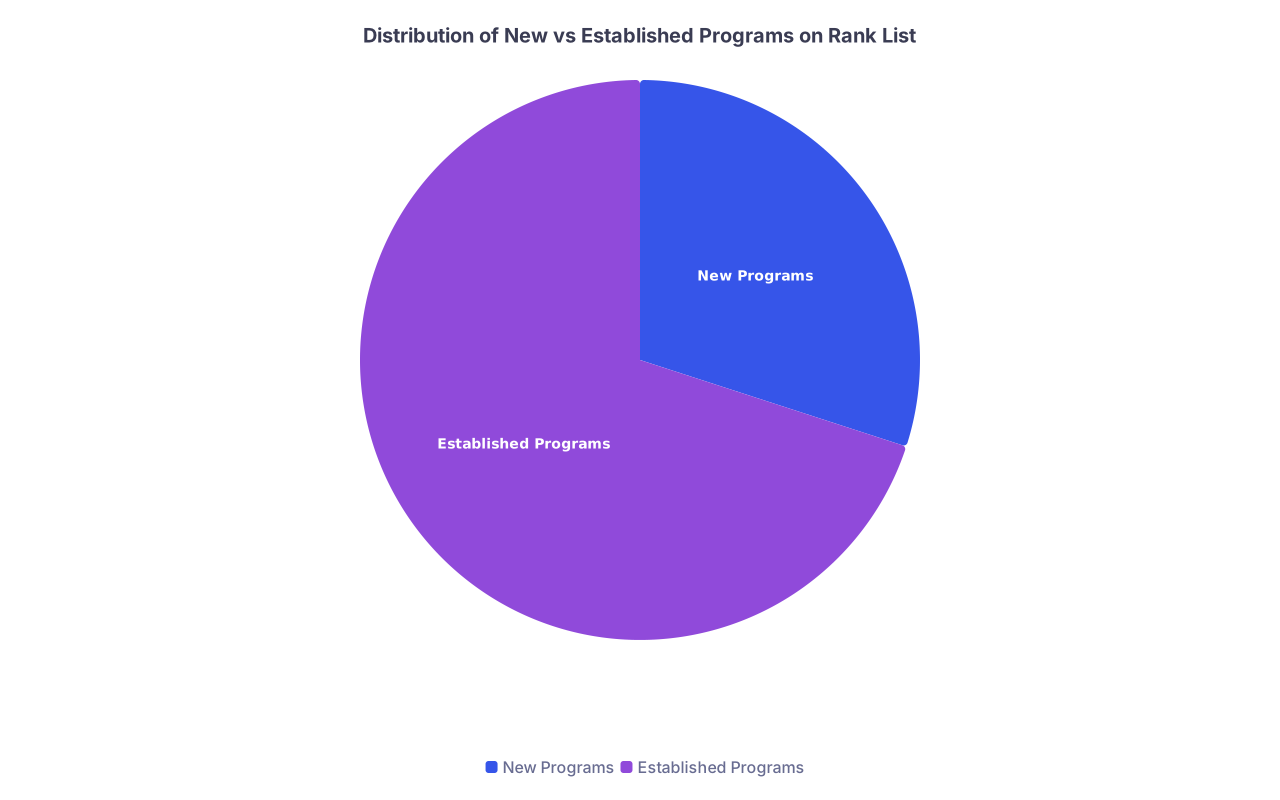
| Category | Value |
|---|---|
| New Programs | 30 |
| Established Programs | 70 |
If your pie chart is 70% “new and unproven,” you are gambling more than you probably think. Some people are fine with that. Most are not.
Step 5: Recalibrate How You Think About “Top” Programs
A hard truth: Many applicants define “top” completely wrong.
Your “top interview” might be:
- Big‑name health system
- Dream city
- Brand‑new program in a competitive specialty
- Gorgeous facilities, slick website
That does not automatically make it a “top program” for you.
For residency, “top” should mean:
- You will be trained well enough to pass boards easily
- You will not be abused or chronically unsafe
- You will graduate employable and competitive for what you want next
- You can tolerate living there for 3–7 years
New programs can hit these. But they often miss one or more in the early years.
Stop asking, “Is this my most prestigious interview?”
Ask, “Is this the best bet for the career and life I actually want?”
Step 6: Make the Interview Day Work for You, Not Them
You are not just auditioning for them. You are pressure‑testing their infrastructure.
A. Go in with a written checklist
Before you step into Zoom or onto campus, write down:
- 5 must‑have answers (non‑negotiables)
- 5 nice‑to‑have answers
- 3 absolute deal‑breakers
Examples of must‑haves:
- Clear evidence of solid supervision on nights
- Protected didactics that actually happen
- Real GME office with other functioning programs
Examples of deal‑breakers:
- PD dodges every pointed question
- Residents describe chronic unsafe volume
- No one can name a single tangible change made from resident feedback
If you walk out without answers to your must‑haves, do not magically fill in the gaps with optimism. Assume the worst until proven otherwise.
B. Ask the same question to multiple people
This is key.
Ask the PD: “How is duty hour compliance monitored?”
Ask the chief: same question.
Ask a PGY‑1: same question.
If you get three different worlds, someone is lying or the system is chaos. Both are bad.
Step 7: Post‑Interview Reality Check (Not Fantasy)
Right after the interview, while your memory is fresh, you do three things.
Write a brutally honest debrief
- What impressed you specifically?
- What scared you specifically?
- Any direct contradictions in what you were told?
Convert your feelings into concrete statements
Instead of “vibes were off,” write:- “No resident could describe a clear curriculum.”
- “PD said schedule is still being written for next year.”
Compare that list against an established program you trust more
Actually side‑by‑side it.
| Factor | New Program | Established Program |
|---|---|---|
| Defined curriculum | Partial | Clear and stable |
| Resident supervision | Vague | Well described |
| Board pass track record | None | 95% over 5 years |
| Fellowship outcomes | Unknown | Strong |
| Leadership stability | New team | Long‑serving PD/APD |
Looking at that table after the emotion of the interview wears off usually tells you the answer you already knew.
Step 8: Rank List Strategy When You Do Not Fully Trust the Program
Here is where people sabotage themselves. They fall in love with the idea of a place and then over‑rank a new, shaky program because “It felt right.”
You need a strategy.
A. Understand how the Match actually works
Program rank does not change your chance of matching somewhere—it changes where you match. Over‑ranking a risky program can absolutely land you there even when safer options would have taken you.
So the real question:
“Would I rather not match than train here?”
If the honest answer is yes—this is a back‑up of last resort, not a dream.
B. Concrete ranking rules for a new program you doubt
Use these rules of thumb:
- Never rank a brand‑new program you actively distrust above a solid, established program you would be okay living in.
- If you would be miserable or unsafe there, do not rank it at all. Matching to a bad fit is worse than not matching in several specialties.
- If the new program is:
- Strong institution
- Experienced PD/faculty
- Clear plan, honest about challenges
Then it can reasonably be ranked in the middle of your list, not at the very top.
Your list should generally look like:
- Established programs you like and trust
- Strong‑looking new programs with clear upside and believable leadership
- Only then: more questionable new programs or marginal options
- Leave off any place where your gut and your evidence both say “no”
Step 9: Plan B If You Decide Not to Trust It
Sometimes the conclusion is simple: this shiny new program is not worth the risk. That is not failure. That is good judgment.
Then what?
A. Tighten up your applications to safer options
If you are early enough:
- Add more community or mid‑tier academic programs with solid track records
- Email programs where you have a geographic or personal connection to flag interest
- Fix glaring weaknesses (personal statement disaster, no letters from your specialty) before the next cycle if reapplication is likely
B. Mentally accept the possibility of a second cycle
For some competitive specialties (derm, ortho, plastics, ENT), walking away from a sketchy new program may mean:
- Research year
- SOAP into a prelim/transitional year
- Reapplication with stronger letters, publications, or away rotations
Brutal? Yes. Better than three to seven years in a chaotic, poorly run, possibly doomed program? Also yes.
Step 10: How to Judge a New Program That Might Actually Be Worth It
Not every new program is a trap. Some are genuinely excellent opportunities. You need markers for those, too.
Good signs I have seen in high‑functioning new programs:
- PD/APDs with long, successful history at respected programs, recruited specifically to build this one
- Clear, detailed curriculum already implemented, not theoretical
- Real, functioning GME infrastructure with other residencies thriving
- Residents who speak candidly—they admit early bumps but describe specific improvements
- Affiliations with well‑known academic centers, even if the main hospital is community‑based
- Transparency about board pass prep, research opportunities, and fellowships
These programs still have some risk—but it is more like joining a well‑funded startup led by experienced people, not a garage operation.
Here is what that contrast often looks like:
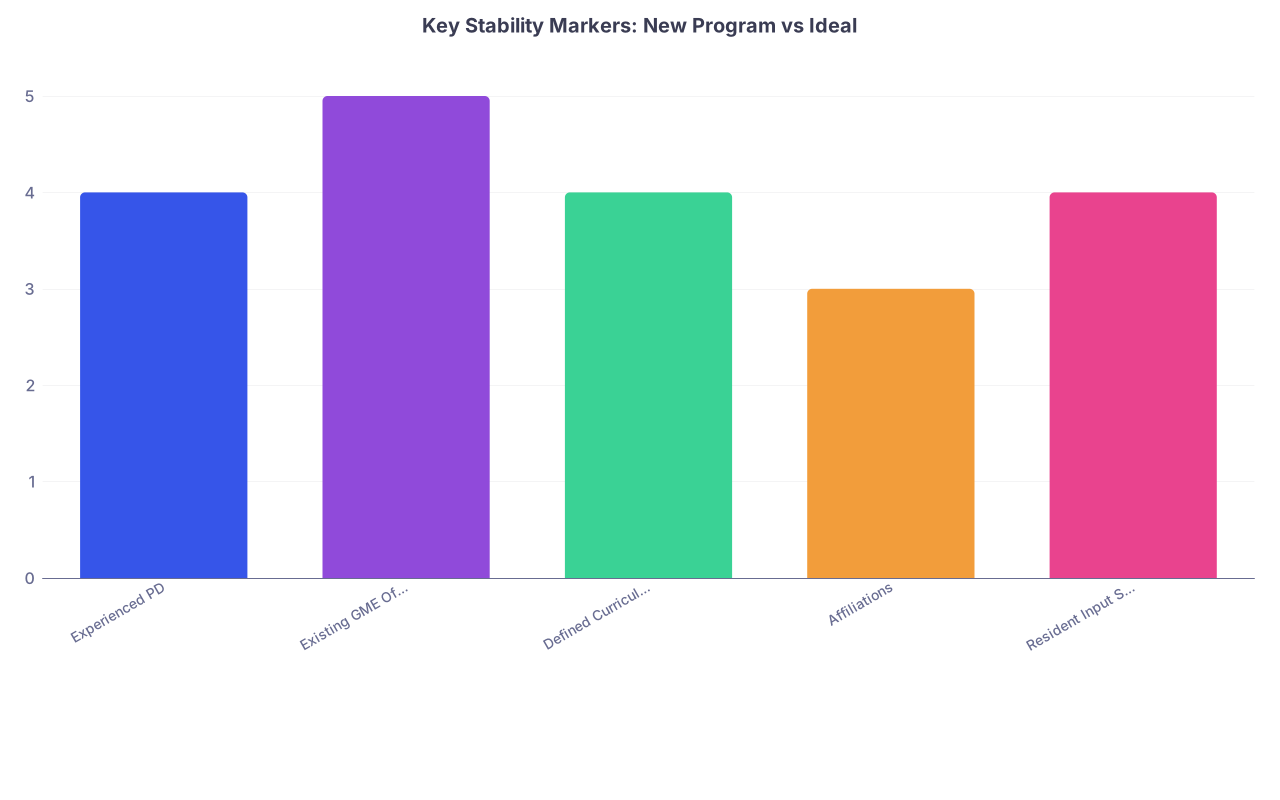
| Category | Value |
|---|---|
| Experienced PD | 4 |
| Existing GME Office | 5 |
| Defined Curriculum | 4 |
| Affiliations | 3 |
| Resident Input System | 4 |
(Think of 5 as “ideal established program.” A new program scoring mostly 3–4’s on your internal scale is not a bad bet.)
A Quick Mental Flowchart You Can Use
This is the decision path I walk students through when they call me in panic about a shiny but sketchy new program.

| Step | Description |
|---|---|
| Step 1 | Interviewed at new program |
| Step 2 | Rank low or do not rank |
| Step 3 | Rank below all trusted programs |
| Step 4 | Rank among top choices |
| Step 5 | Do you trust leadership? |
| Step 6 | Is supervision and workload clear and safe? |
| Step 7 | Would you train here over solid established options? |
If at any “trust” or “safety” node your answer is no, you do not put that program at the top of your list. Period.
The Psychology Trap: Do Not Let Scarcity Panic Make Your Decision
Interview season messes with your head. You are exhausted, everyone is talking numbers and odds, and then a big‑name brand new program in your dream city shows you attention. Easy to feel like you “have to” rank it high because “What if that is my only shot?”
Here is the reality:
- One bad choice can cost you years.
- Name alone does not protect you from poor training or misery.
- If multiple independent signals (your gut, residents’ tone, vague answers) all say “not safe,” believe them.
You cannot control the Match. You can control who you allow to be in a position to own your next 3–7 years.
Do not hand that over to a program you would not honestly recommend to a close friend.