
What if your entire future in medicine comes down to one interview… at a program that literally didn’t exist three years ago?
Because that’s what this feels like, right? ERAS season ends, Interview Broker is a graveyard, your email is silent except for spam and loan reminders—and then out of nowhere: one invite. From a brand-new residency program you had to Google three times just to figure out if it’s real.
And now your brain is doing what it does best: spiraling.
1. The Terrifying Reality: One Interview. New Program. That’s It.
Let me just say the quiet part out loud: yes, this is scary.
You’re probably thinking some version of:
- “If they’re new, are they desperate enough to take anyone who fogs a mirror?”
- “What if the program collapses and I end up unemployable with half a residency?”
- “Am I about to gamble my whole career on the medical education equivalent of a startup?”
You see established places: Mayo, MGH, UCSF. 20+ years of graduates. People who can say, “When I was a resident back in 2004…”
Your one shot? A program that had its first intern class… last year.
And here’s the really messed up part: this might be your best shot at matching. Maybe your only shot.
That tension—“I don’t fully trust this, but I also can’t afford to lose it”—is what keeps people up at 2 a.m. stalking FREIDA, Reddit, and Doximity like it’s a full‑time job.
You’re not crazy. The anxiety is rational. But it’s not the full story.
Let’s ground this a bit.
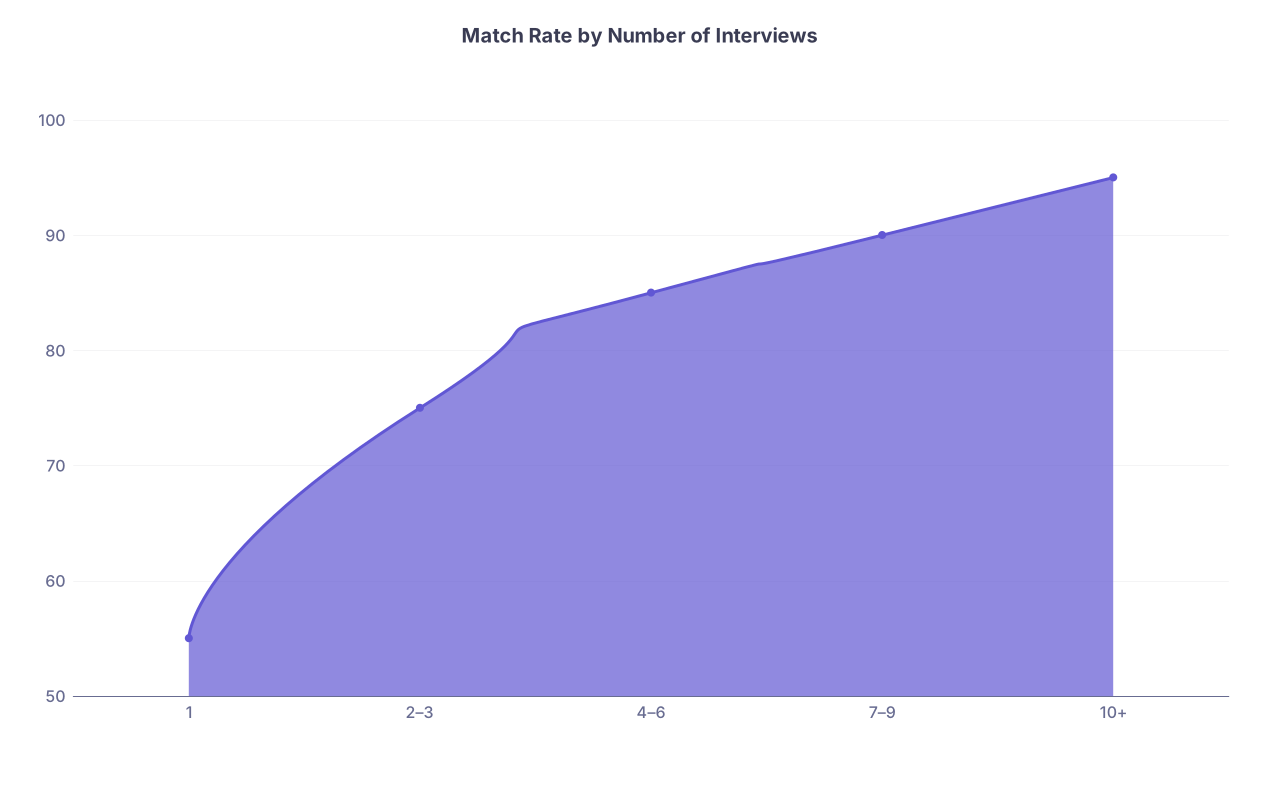
| Category | Value |
|---|---|
| 1 | 55 |
| 2–3 | 75 |
| 4–6 | 85 |
| 7–9 | 90 |
| 10+ | 95 |
Is this exact NRMP data? No. But directionally, it matches what we see: even one interview gives you a non-trivial chance of matching. Not guaranteed. But not hopeless either.
One interview is terrifying. It’s also not the same as zero.
2. Are New Residency Programs Automatically Sketchy?
Short answer: no. But they’re risky in specific ways you need to understand.
Here’s the thing nobody tells you when you first start hearing “new program”: a lot of new programs are created for very different reasons.
Some are legit:
- Big health systems expanding (think large community hospitals affiliated with big-name universities).
- Areas with real workforce needs (primary care in underserved regions).
- Hospital systems that already host students and fellows and are now adding a residency.
Some are… less inspiring:
- Hospitals chasing cheap labor and prestige without really understanding GME.
- Leadership doing it as a vanity project.
- Places that have never taught anyone anything and suddenly want 10 residents per year.
So no, “new” doesn’t automatically mean “bad.” But it does mean the burden’s on you to dig harder than you would for a 30‑year‑old program.
You can’t just trust the website with the stock photos of “diverse smiling residents” that don’t actually exist yet.

3. The Real Risks of New Programs (And Which Ones Actually Matter)
Let’s just list the nightmares, because I know you’re already doing it in your head.
3.1 What if they lose accreditation?
This is the big monster under the bed.
Here’s the reality:
- Brand-new ACGME-accredited programs go through continued accreditation reviews.
- If things are bad, they can get warnings, probation, or in extreme cases, withdrawal of accreditation.
The part people forget: the ACGME usually cares a lot about residents not getting screwed. When accreditation is withdrawn, there’s typically a plan to let current residents finish or transfer. It’s not like they snap their fingers and everyone’s just out on the street.
Is that still messy and stressful? Completely. Is it the same as “your career is over”? No.
3.2 Weak education and no structure
This one’s more common. I’ve seen this up close.
Things that go wrong:
- No clear curriculum. Lectures scheduled “when we can.”
- Faculty who’ve never been attendings before and don’t know how to teach—or how to let you actually do things.
- Constant schedule chaos because “we’re still figuring things out.”
You sometimes end up being the guinea pig class. You’re training them how to run a program while they’re supposed to be training you.
This is very real. And this is where you need to be ruthlessly honest with yourself about your specialty and your tolerance for chaos.
3.3 Reputation and fellowship prospects
You’re probably wondering: “If I train here, will anyone take me seriously?”
For primary care–heavy fields (FM, IM where you want to be a hospitalist, Psych, Peds in some settings), a solid community-based new program can be perfectly fine.
If you’re dreaming of GI, Derm, Ortho, Rad Onc—then yeah, being the first class at a brand-new, unknown program can absolutely make the uphill climb steeper.
Not impossible. Just steeper.
| Factor | Established Program | New Program |
|---|---|---|
| Curriculum | Refined, stable | Evolving, sometimes chaotic |
| Reputation | Known by fellowship PDs | Mostly unknown |
| Alumni Network | Large, active | Nonexistent or tiny |
| Systems/Logistics | Worked-out workflows | Trial-and-error phase |
| Risk of Instability | Lower | Higher |
4. Red Flags vs Yellow Flags: What Should Actually Scare You?
Here’s where you stop doomscrolling and start investigating like your life depends on it. Because yeah, it kind of does.
Red flags (these should make you very cautious)
- They don’t have ACGME accreditation yet, only “planning to apply.”
- No clear info on who the Program Director is, or the PD is clearly brand new with no prior GME role and no strong support structure.
- Nobody will let you talk to current residents. Or there are no residents and they dodge the question about how many have signed.
- On interview day, you hear a lot of “We’re still figuring that out” about key things: call schedule, elective structure, board prep.
- Hospital has no history of medical education—no students, no other residencies, no fellowships—and no academic affiliation.
- The vibe is “service first, education maybe later.” Heavy talk about “we’re so busy” and “we really need help covering the floors.”
Those are the “you might still go, but your eyes better be wide open” signs.
Yellow flags (concerning, but sometimes manageable)
- PD is relatively new but has clear mentorship from seasoned GME leadership.
- Curriculum is still being built, but they show you actual documents, not just vibes.
- Faculty come from decent training backgrounds but haven’t worked together long.
- Call schedule is in flux but they’re transparent and asking resident input.
- They admit, “We had some issues year 1 with X, here’s what we changed.”
Honesty goes a long way. “We messed this up, here’s how we fixed it” is way better than glossy perfection.
5. The Ugly Math: Is One New Program Better Than Not Matching?
Here’s the question that keeps circling back: “Should I rank this program high just because it’s my only shot?”
I’m going to be blunt.
For most people, matching to a residency—even a brand‑new, imperfect one—is better than:
- Not matching
- Scrambling into SOAP chaos year after year
- Delaying your career with no clear plan
Especially in fields like IM, FM, Psych, Peds, EM (some markets), where you can still build a solid career out of a less‑fancy program.
But there are exceptions. Situations where pausing and reapplying might be smarter than locking yourself into a truly dysfunctional new program.
Watch out if:
- You have decent stats and clearly under-applied or applied late.
- There are major, obvious structural problems with the new program (unsafe workload, no supervision, scary gossip from people who rotated there).
- Your mental health is already shredded, and being in a chaotic, unsupported environment may break you.
Reapplying isn’t fun. But being trapped for 3+ years in a place that feels unsafe or abusive? That can be worse.
6. How to Actually Evaluate This Program on Interview Day
You can’t control that you only have one interview. You can control how prepared you are walking into it.
Think like someone investigating a startup you’re about to invest your entire future into. Because that’s what this is.
Here are questions to ask—out loud and in your head:
“Tell me about your first class—what’s gone well and what’s been challenging?”
You’re listening for: self-awareness vs delusion.“How much protected didactic time do residents actually get, and is it really protected?”
If people laugh nervously or say “it’s improving,” that’s data.“What kind of graduates are you hoping to produce? Community-focused? Fellowship-bound?”
You want their goals to match your goals.“Who actually supervises on nights? In-house attendings or cross-cover?”
“Do you have any residents applying to fellowship yet? How are you supporting them?”
Pay attention to the residents’ faces more than their words. You will absolutely see micro‑expressions that say more than the canned lines.
If there are no residents yet, that’s tougher. Then you judge:
- PD’s background and honesty level.
- Stability and reputation of the hospital.
- Presence of any other training programs (med students, other residencies, fellowships).
If you leave interview day with that gnawing “something’s off” feeling—trust that.

| Step | Description |
|---|---|
| Step 1 | Only Interview at New Program |
| Step 2 | Consider Reapplying |
| Step 3 | Rank but not at top in mixed list |
| Step 4 | Rank High as Best Available Option |
| Step 5 | Accredited and Stable Hospital |
| Step 6 | Reasonable Education and Supervision |
| Step 7 | Goals Align with Your Career Plans |
7. Worst-Case Scenarios vs What Usually Happens
Let’s walk through the horror stories your brain is feeding you and reality‑check them.
“I’ll match here and never get a job/fellowship.”
More likely:
- If you’re in a core specialty and you do solid work, pass your boards, and get decent letters, you’ll find a job.
- Fellowship? From a totally unknown new program, it’s harder, yes. You’ll have to hustle. Maybe do research, away rotations, network harder. But it’s not some automatic door slam.
“The program will collapse and I’ll be stuck.”
Could accreditation get shaky? Yes. Especially if leadership is weak or turnover is high.
Most often, what happens is:
- Growing pains.
- Moderately chaotic first couple of classes.
- Gradual improvement with feedback and ACGME pressure.
The true total‑collapse stories are rarer. But those are the ones everyone whispers about, so they sound louder than they statistically are.
“If I don’t match this year, I’ll never match.”
Not automatically true.
But the further you get from graduation, the steeper the hill. You’d need a very clear plan:
- What will you do this next year to improve your application concretely?
- Are you willing to reapply more broadly? Different specialties? Different geographic targets?
- Are there visa, financial, or personal constraints that make another cycle unrealistic?
This is where you sit down and get brutally honest with yourself, maybe with a trusted advisor who isn’t sugarcoating anything.
8. How to Rank a Brand-New Program When It’s Your Only Interview
Let’s assume you go, you interview, you don’t see blazing flaming red flags, just “new and imperfect.” Now what?
Here’s the uncomfortable truth: if it’s your only interview, you should probably rank it. High. Like… #1 high.
The NRMP algorithm works in your favor if you prefer it. Not ranking it because “I only want to match somewhere perfect” is a luxury most of us don’t actually have.
But here’s the nuance: matching there doesn’t mean you’re locked into that identity forever.
You can:
- Be the resident who helps shape the program into something better.
- Transfer later, in rare cases, if spots open elsewhere (happens more than people think, though still not common).
- Use your time there to build a strong CV for fellowship or future jobs.
It won’t be the glossy, Instagram-friendly residency experience some of your classmates have. But it can still be enough to build an actual career.
And that’s the real point.
FAQ (Exactly 6 Questions)
1. Should I even go to the interview if it’s my only one and it’s a new program?
Yes. Go. Unless you already have hard evidence the place is unsafe or totally fraudulent, you go. An interview is information. You can always choose not to rank them if it’s truly awful, but skipping means you’re deciding in the dark that zero options are better than one imperfect one.
2. Is it true that new programs use residents as cheap labor and don’t care about education?
Some do lean that way, especially in understaffed community hospitals that opened a residency mainly to fill coverage gaps. But not all. Your job on interview day is to figure out which category they’re in. Ask about didactics, supervision, evaluation, wellness, and how they protect residents from unsafe workloads. If every answer is “we’re working on it,” that’s a problem.
3. How can I tell if the PD is actually strong enough to build a good program?
Look at their track record. Have they been core faculty or APD somewhere reputable? Do they speak concretely about curriculum and accreditation, or in vague motivational slogans? Do residents (if present) talk about them with real respect or just politeness? A PD with prior GME experience and a clear vision is gold in a new program.
4. What if I want a competitive fellowship from a brand-new program?
You’re signing up for an uphill climb. Not impossible, but you’ll likely need to overcompensate: strong board scores, research (even small projects), networking at conferences, maybe an away rotation at a known center. If your heart is set on ultra-competitive subspecialties, you need to weigh whether reapplying with a stronger application might be smarter than locking into an unknown program.
5. If I match there and it’s bad, can I transfer to another residency?
Sometimes. Transfers happen when other programs lose residents, expand, or have unexpected openings. But there are no guarantees, and it’s competitive. If you start planning a transfer from day one, that’s a sign you probably shouldn’t rank the place unless your alternative is not matching at all. You want to assume you’ll be there for the full duration and be okay with that.
6. Is matching at a brand-new residency program career-ending or “second-class”?
No. It’s not a death sentence. It might not be the flex you dreamed of on Match Day, but a lot of solid physicians trained at places you and I have never heard of. If the program can make you competent, help you pass boards, and not destroy you in the process, you can build a real career from there. It’s not glamorous, but it’s enough—and enough is a lot when the alternative is not matching at all.
Key points:
- A single interview at a new program is scary, but it’s still a real shot at matching—better than none.
- New doesn’t equal doomed; your job is to separate “growing pains” from true dysfunction.
- If it’s your only interview and not blatantly unsafe, ranking it high is usually rational, even if it’s not the prestige story you imagined for yourself.