
Last month, a PGY-1 at a brand‑new internal medicine program emailed me at 2 a.m. She’d just seen a LinkedIn post: “Only candidates from established programs, please.” Her first thought wasn’t “That’s annoying.” It was, “Did I just screw up my entire future by matching at a new residency?”
If you’re reading this, I’m guessing some version of that same thought is sitting in your chest like a rock: What if my program’s reputation quietly kills every job or fellowship application I send for the next decade?
Let’s walk straight into that fear instead of dancing around it.
The Ugly Truth First: Yes, Reputation Can Matter
I’m not going to sugar‑coat this: program reputation can absolutely play a role in fellowship and job decisions.
I’ve seen it. Hiring committees skimming CVs and saying things like, “Remind me, where is that program again?” or “Is that a new one?” before they even look at anything else. A few subspecialty fellowship PDs keeping a mental “tier list” of programs. It’s real.
Some of the concrete ways it can hurt you:
- You may have to explain what your program is and where it sits (community vs university, new vs established) more often than your friends from big‑name places.
- Certain hyper‑competitive fellowships might default to familiar names because they’re lazy, risk‑averse, or both.
- Local hospitals who’ve never had a grad from your program may wait a cycle or two to see how your program’s alumni perform before they fully trust the “brand.”
And yes, that feels unfair.
But here’s the part your anxiety keeps skipping: most of this is overcome‑able if you know what to expect and how to compensate.
How Much Do Jobs Really Care About Program Name?
Let’s separate mythology from reality.
For most generalist jobs (primary care IM/FM, general peds, hospitalist, EM in many regions), employers tend to care more about:
- Are you board‑eligible/board‑certified?
- Do your references say you’re safe, pleasant, and not a disaster?
- Are you geographically tied to the area (less likely to leave in a year)?
- Do you have any red flags? (disciplinary stuff, repeated failures, awful reputation)
The logo on your residency certificate? It’s not irrelevant, but it’s nowhere near the top of that list.
Where program name can matter more:
- Ultra competitive fellowships (cards, GI, ortho sports, derm, rad onc, ENT, etc.)
- Academic jobs in big‑name institutions where pedigree still impresses old‑guard faculty
- Niche or saturated markets (think “everyone wants to work here” cities)
But even then, it’s not binary. It’s not “top‑10 program or doomed.” It’s “top‑10 program gets you a little automatic benefit of the doubt; new program means you have to show your work more.”
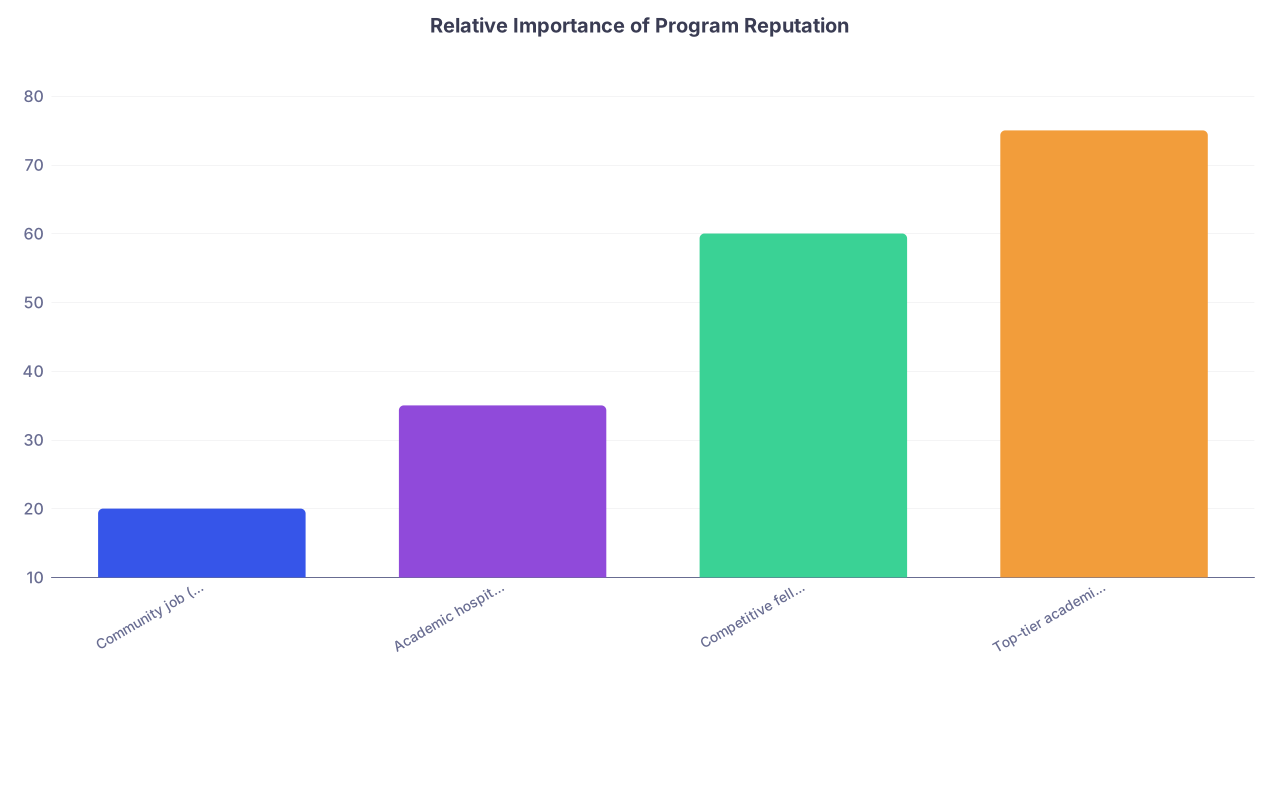
Here’s a rough sense of how much program reputation weighs in different scenarios:
| Category | Value |
|---|---|
| Community job (IM/FM) | 20 |
| Academic hospitalist | 35 |
| Competitive fellowship | 60 |
| Top-tier academic faculty | 75 |
Those numbers aren’t exact, obviously. But that’s the vibe. For many jobs, it’s one factor in a crowded field—not the verdict.
What Actually Scares Employers About New Programs
This is the part nobody tells you when you open that congratulatory email from NRMP.
Hiring people and fellowships don’t fear “new” just because it’s new. They fear uncertainty. Things like:
- No track record: No history of how grads perform on boards, in practice, or in fellowship.
- Unknown quality of training: Are you getting enough procedures? Enough volume? Enough supervision?
- Variable culture: New PDs and chairs can change tone quickly; systems may not be stable.
- Weak name recognition: They simply might not know your hospital or sponsoring institution.
So their internal monologue is not, “New program = bad doctor.” It’s, “I don’t know what to expect, and I don’t have time to investigate every detail of every program.”
Your job—annoying as it is—is to make yourself easier to understand and trust than your CV alone might suggest.
Where Being from a New Program Helps You (Yes, Really)
Let me say something your anxiety doesn’t want to believe: I’ve seen grads from new programs out‑compete big‑name residents for jobs and fellowships.
Why?
Because new programs often force you to develop things that older, coasting programs neglect:
- You learn to advocate for yourself early: procedures, rotations, research, letters.
- You get more direct contact with leadership; your PD actually knows you as a human.
- You may have more autonomy sooner, especially at community‑based or hybrid sites.
- You stand out because your story isn’t cookie‑cutter: “I helped build this program from the ground up.”
I’ve watched hiring committees perk up when someone talks—clearly and specifically—about how they helped design a QI curriculum or build a night‑float system in a brand‑new program. That screams leadership and problem‑solving, not “backup choice.”
The problem is you rarely see those stories on Reddit. You see the horror ones.
Red Flags That Actually Hurt You From a New Program
Let’s talk worst‑case, since that’s where your brain lives anyway.
These are the things that truly damage job and fellowship apps—and yes, they’re more common in shaky new programs:
- Poor board pass rates: If your co‑residents keep failing boards, that stains the program.
- Constant leadership turnover: PDs or chairs leaving every year screams instability.
- Lack of core experiences: No ICU time, limited subspecialty exposure, low volume ED, etc.
- Toxic culture: Documented ACGME citations, wellness disasters, high attrition.
Those are reputation killers. Not “founded in 2023.” But “fundamentally not training people well.”
If your program is spiraling in some of those ways, it can affect how people view your training. Not because they hate new programs, but because they rightfully worry you didn’t get what you needed.
The good news: you’re not powerless if that’s happening.
Concrete Ways to Protect Yourself While in a New Program
Now the part you actually care about: what can you do to keep this “new” label from biting you two, five, ten years from now?
1. Build an Individual Reputation That Outweighs the Program’s
Every program has a brand. So do you.
You want people saying your name with phrases like:
“Super reliable.”
“Excellent clinician.”
“One of our best residents—definitely fellowship material.”
That’s built in specific, boring ways:
- Crush your rotations. Be the resident attendings ask for by name.
- Volunteer (strategically) for visible work: curriculum projects, QI leadership, committee roles.
- Ask explicitly for feedback—and then actually fix what they mention.
One strong, detailed letter from a respected faculty member can neutralize a lot of “Never heard of that program” energy.
2. Make Your Training Look Tangible, Not Vague
On CVs and in interviews, vague = weak. Specific = safe.
Instead of just “Internal Medicine Residency – NewTown Medical Center,” you want to signal real content:
- Mention ICU and subspecialty coverage.
- Highlight procedure logs if relevant.
- Show continuity clinic volume or ED shifts.
- Include any affiliations (e.g., “Community program affiliated with State University School of Medicine”).
You’re basically proving: “I didn’t just survive three years in a building with ‘residency’ on the door. I trained.”

3. Borrow Reputation from Elsewhere
If your program doesn’t have its own clout yet, you can “borrow” some.
Ways to do that:
- Do away rotations or electives at better‑known centers and get letters from there.
- Collaborate on research or QI with faculty at larger academic hospitals (multi‑site projects).
- Present posters at national conferences (ACP, AAFP, ATS, AHA, specialty societies).
Those lines on your CV tell a story: people outside your hospital have seen your work and thought it was worth platforming.
I’ve watched selection committees relax a little when they see a new‑program grad with, say, an abstract at CHEST and a letter from a known intensivist at a regional referral center.
4. Be Ready With a Confident, Non‑Defensive Explanation
You will get some version of this question:
“So tell me about your residency program—it’s relatively new, right?”
Do not ramble. Do not apologize for existing. Have a 30–45 second, calm answer ready. Something like:
“Yes, it’s a newer ACGME‑accredited program based at a busy community hospital with strong ties to [X University]. Being one of the early classes actually meant I had a lot of hands‑on experience and close mentorship—our faculty‑to‑resident ratio is high, and I’ve had significant autonomy in [ICU/ED/OR/etc.]. I also helped develop [specific project or curriculum], which has been rewarding and pushed me to grow faster.”
That does two things: it signals you’re not insecure about your background, and it reframes “new” as “opportunity.”
If you sound embarrassed by your own training, employers will assume they should be wary too.
Are You Totally Screwed for Competitive Fellowship?
This is the nightmare question, right?
The annoying answer: it’s harder, but not impossible. I’ve watched people from newer community‑based programs match into:
- Cards at mid‑tier university programs
- GI at strong regional centers
- Heme/Onc at academic programs
- Critical care at well‑known institutions
How did they do it?
They were the rockstars at their program. Top evaluations, chief positions, research with publication, letters from people with recognizable names, and often an away rotation at the fellowship’s own institution where they proved themselves live.
Will it be harder than if you were at Mayo or MGH with a pipeline already built? Yes. Anyone who says otherwise is lying to you.
But “harder” is not the same as “hopeless.” The gap can be closed if you treat fellowship as a 3‑year strategic project, not a vague wish.
Long‑Term Reality Check: Does This Follow Me Forever?
Your brain loves the forever narrative: “Because I matched at X, my entire career arc is permanently capped.”
No.
As you move further out—five, ten years post‑residency—what actually sticks to your name are things like:
- Board certification and recertification
- Clinical reputation locally (“patients like you, colleagues trust you”)
- Any leadership roles you’ve held
- Your productivity (clinic volumes, procedural competence, academic or QI output)
- Whether you’re known as the person who gets things done or the one everyone avoids
At that point, “new” vs “old” residency is background noise. It’s a line on page 2 of your CV that nobody even questions much anymore.
You feel the weight of it most right now because you’re living in it. But your entire career will not be defined by the year your program started accepting residents.
When You Should Actually Consider Leaving a New Program
Sometimes the anxiety isn’t paranoia. Sometimes the program really is that bad.
I’ve told residents flat‑out to consider transferring when:
- Multiple residents failed boards and leadership shrugged.
- There were serious ACGME citations with no real remediation plan.
- Key rotations were disappearing with no replacement (e.g., lost ICU, no subspecialty support).
- The environment was unsafe—patient safety issues, bullying, total lack of supervision.
If your program is truly crumbling and it’s early enough, looking for a transfer might be rational, not anxious. Not because “new is bad,” but because “this is not a viable training environment.”
But be honest with yourself: is that your situation, or is your brain going straight to catastrophe because one attending said, “Oh, never heard of that place”?
Quick Reality Snapshot: New vs Established Programs
Just so you have a simple mental picture:
| Factor | New Program | Established Program |
|---|---|---|
| Name recognition | Low to moderate | Moderate to high |
| Flexibility | High (room to shape things) | Lower (systems already set) |
| Faculty attention | Often higher per resident | Variable, sometimes lower |
| Systems stability | Variable, can be shaky early | Usually more stable |
| Alumni network | Minimal at first | Larger, can open doors |
You’re trading some built‑in prestige and stability for flexibility and visibility. That trade can absolutely work in your favor if you’re intentional.
FAQs
1. Will employers automatically reject me because my residency is new?
No, not automatically. Most employers don’t have the time or energy to maintain a blacklist of “new programs.” They look at the whole package: your references, interview, board status, and how you present yourself. A new program might mean they ask more questions, but it’s rarely the sole reason for rejection. Sloppy interviewing, weak letters, or poor communication kill far more offers than the age of your program.
2. Should I hide that my program is new or downplay it on my CV?
You can’t really hide it—people can Google. And trying to obscure it makes you look insecure. Instead, be straightforward on paper and strategic in how you talk about it. Highlight affiliations, case volume, and unique opportunities you’ve had. You’re better off owning it confidently than hoping no one notices.
3. Do I have to do research or away rotations to overcome my program’s lack of reputation?
You don’t “have to” for many community jobs or less competitive fellowships, but they help a lot if you’re aiming high or worried about perception. Research and away rotations give you external validators—people and institutions outside your home program who can vouch for you. If you’re even vaguely interested in competitive fellowship, assume you should be doing at least some scholarly work and, ideally, an away.
4. If I realized I matched into a shaky new program, is it already too late to fix my future?
It’s not too late. Even as a PGY‑2 or PGY‑3, you can still salvage a lot by tightening your clinical reputation, seeking strong letters, doing targeted electives or away rotations, and being smart about where you apply. Transferring is an option in extreme cases, but most people don’t need to blow everything up. They need a plan, not a panic move.
Key points, so your brain has something solid to hold onto:
- Being at a new residency can make some doors harder to open, but it does not lock them.
- Your personal performance, letters, and what you build on top of that training matter more over time than the program’s birth year.
- You’re not doomed; you’re just going to have to be a little more deliberate than the person cruising on a famous name—and that’s something you can actually control.