
Yes—graduates of new residencies absolutely can match competitive fellowships. But only if they and their programs play the game strategically from day one.
Let me be blunt. The bias is real. Program directors do sort applicants by brand name. If you are at a brand-new residency and you want cards, GI, heme/onc, ortho sports, derm, or any other “shiny” fellowship, you cannot just be “solid.” You have to be obviously excellent on paper and unmistakably driven in real life.
The good news: I’ve seen residents from no-name and new programs match at very competitive fellowships—Flagship academic centers, top 10-20 name brands, high-demand regions. It is doable. But it is not automatic.
Here’s how to think about it.
How Fellowship Directors Actually Evaluate You
Forget the marketing talk. Here’s what matters to fellowship program directors for competitive spots:
- Board scores (especially Step 2/Level 2, and sometimes in‑training)
- Strength and specificity of letters of recommendation
- Research and scholarly output
- Reputation of your mentors and letter writers
- Perceived rigor of your clinical training
- Interview performance and clear fit with the field
- Signals of genuine commitment to that specialty
Notice what’s not at the top of the list: the age of your residency program.
Age and name of the residency are proxies. Shortcut signals. If a fellowship PD has never heard of your program, they’ll look harder at the other signals. That’s all. You aren’t doomed; you’re just under more scrutiny.
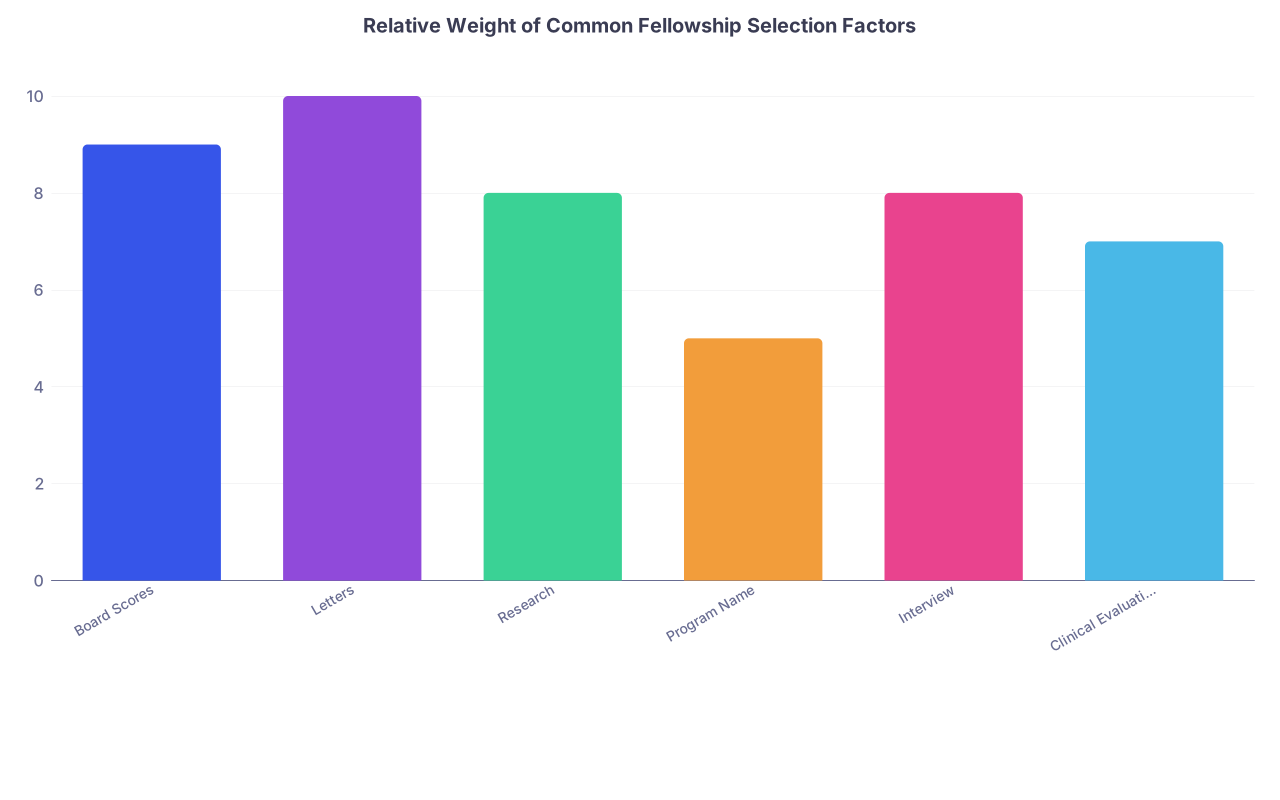
| Category | Value |
|---|---|
| Board Scores | 9 |
| Letters | 10 |
| Research | 8 |
| Program Name | 5 |
| Interview | 8 |
| Clinical Evaluations | 7 |
Roughly how PDs say they think (on surveys and in meetings), on a 1–10 importance scale. Is it perfect science? No. But it tracks reality.
How Being at a New Residency Actually Helps and Hurts
New residencies are not automatically worse. They’re just unknown. That cuts both ways.
Built‑in disadvantages
Here’s what you’re up against at a new program:
No track record.
Fellowship PDs can’t say, “We’ve taken residents from there before and they were strong.” You’re the guinea pig.Weaker name recognition.
Your program director might introduce themselves at a conference and get, “Where is that again?” Not ideal.Fewer alumni in fellowships.
Nobody at Fellowship X remembers “that fantastic resident from your program last year” because there wasn’t one.Early systems chaos.
New rotations still being built, evaluation systems clunky, conference schedule evolving. You might be the generation that gets the kinks, not the benefits.
Underrated advantages
Do not ignore the upside:
More responsibility, earlier.
New and growing services mean more autonomy. PDs at fellowships know that residents from lean programs often become very independent.Easier access to leadership.
You want a meeting with the PD? At a huge, established program you’re in line. At a new one, you might be in their office this afternoon.Ability to shape your niche.
You want to build a cardiology interest group, start a QI project, or set up a research registry? You can often just say, “I’ll do it” and you’re now “the cardiology resident.”Program leadership needs you to succeed.
Early fellowship matches are marketing. Your PD and chair know that one person matching cards at a big-name institution is gold. They are often unusually motivated to help you.
The Formula for Matching a Competitive Fellowship from a New Program
Let me give you a concrete, no‑nonsense framework. This is what I tell PGY‑1s who quietly tell me, “I want GI or cards, but I’m worried my program is too new.”
Step 1: Dominate the controllables early
PGY‑1 is not a “figure it out later” year if you want competitive fields.
You need:
Strong Step 2/Level 2 or equivalent exam history
If Step 1 is pass/fail, Step 2 becomes even more important. For competitive fellowships, you want to be clearly above average for your specialty. If you don’t know those numbers—ask your PD directly.Top‑tier in‑training exam scores
Especially for IM, EM, surgery, anesthesia. Fellowship PDs like to see you consistently scoring high for your PGY level.Clean evaluations with clear “top resident” language
You want phrases like “among the best residents I’ve supervised in the last 5 years,” not just “meets expectations.”
If your early performance is shaky, you can still recover—but then you need an even stronger story everywhere else.
Step 2: Lock onto a specialty by mid‑PGY‑1 (and say it out loud)
You don’t have to tattoo it on your forehead, but you do need to decide.
“I might do cards or GI or heme/onc or maybe hospitalist” doesn’t read as “flexible.” It reads as “unfocused” when fellowship season arrives. The competitive people usually pick a lane by end of PGY‑1 and build a coherent narrative around it.
Once you know your direction, literally say this sentence to your PD and associate PDs:
“I’m very interested in [cards/GI/onc/etc.]. I want to be competitive nationally. What do I need to do here to be in the top group of applicants?”
If your leadership gives you vague answers or seems uncomfortable, that’s data about how much support you’ll get. Push politely until you get specifics.
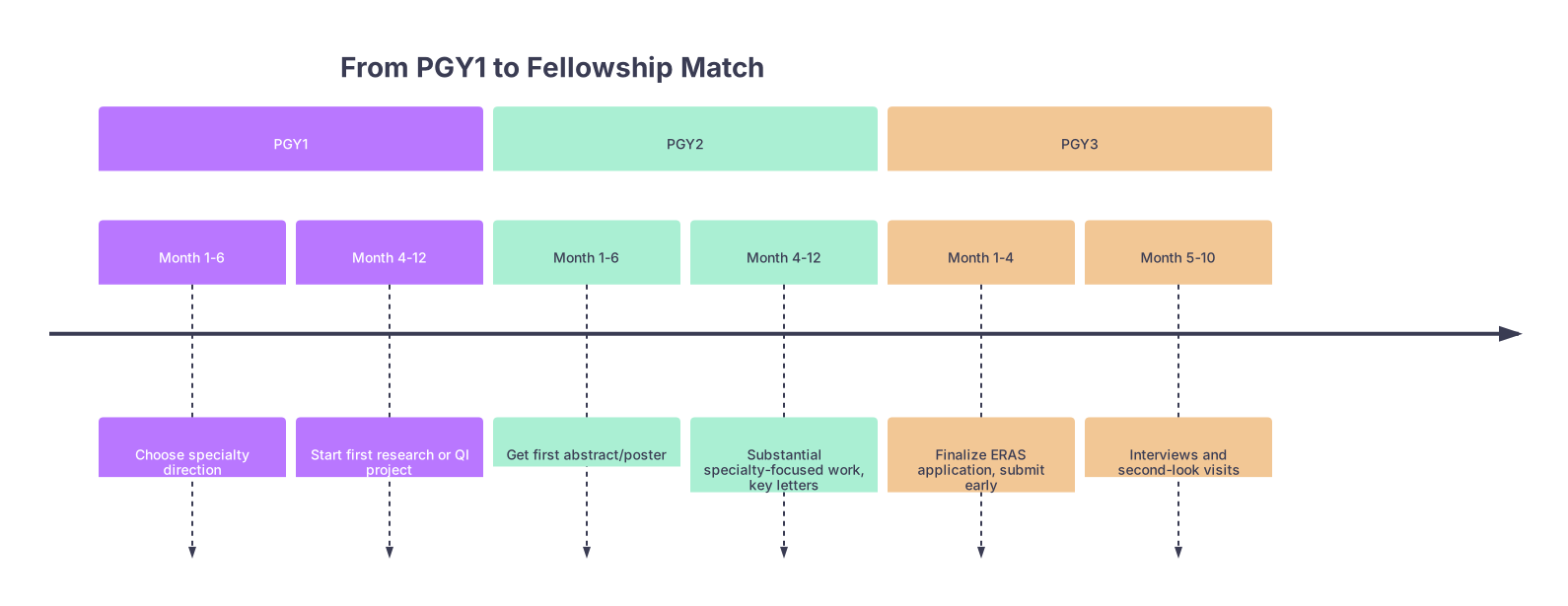
| Period | Event |
|---|---|
| PGY1 - Month 1-6 | Choose specialty direction |
| PGY1 - Month 4-12 | Start first research or QI project |
| PGY2 - Month 1-6 | Get first abstract/poster |
| PGY2 - Month 4-12 | Substantial specialty-focused work, key letters |
| PGY3 - Month 1-4 | Finalize ERAS application, submit early |
| PGY3 - Month 5-10 | Interviews and second-look visits |
The Three Pillars You Must Over‑Deliver On
At a brand‑new residency, you cannot be average on these and still expect a top fellowship.
1. Letters of Recommendation that actually say something
Generic letters kill applications, especially from unknown programs.
You need:
- At least one letter from a subspecialist in your target field who knows you very well
- Ideally one from your program director or chair making a clear, strong statement
- Specific, comparative language:
“Top 5% of residents I’ve worked with in 15 years”
“The strongest applicant from our program this year for subspecialty training”
If your letter writers are unknown nationally, that is not fatal—but the content must be unmistakably strong.
Your job is to:
- Work closely with letter writers on real clinical and/or research projects
- Meet with them early (PGY‑2) and clearly state your goals
- Provide them with an updated CV, draft personal statement, and a bullet list of things you hope they can speak to
Weak move: “Hey, can you write me a letter?”
Strong move: “I’m applying to cardiology fellowships, aiming for academically strong programs. I’d be honored if you could comment specifically on my independent management of complex patients on CCU, my call performance, and my work on the heart failure QI project.”
2. Research and scholarly work with a story
No, you do not need a PhD or 12 first‑author publications. But for the most competitive fellowships, you do need something that shows you’re academically serious.
Realistically, you want at least 2–4 meaningful items by application time:
- One or more posters or abstracts at regional/national conferences in your field
- A publication (case report, review, retrospective study—start somewhere)
- A QI or systems project that actually changed something and can be presented
Crucial detail for new programs: sometimes your institution won’t have built fancy research infrastructure yet. So you:
- Attach yourself to the attendings who already publish (every new program has at least a couple)
- Join multicenter projects, registries, or trials as a site coordinator or data collector
- Say yes to “small” projects early; they often spin into bigger work
Your research doesn’t have to be at NEJM level. But it should be consistent, visible, and clearly tied to your future field.
3. Clinical reputation that precedes you
From a fellowship PD’s standpoint, this is non‑negotiable:
“Can this person safely and independently take care of patients in my subspecialty, on day one of fellowship, without hand‑holding?”
At a new program, your clinical volume may be evolving. You fix that by:
- Taking ownership on rounds. Know your patients better than anyone else.
- Volunteering for difficult cases and consults in your area of interest.
- Asking your chiefs and attendings directly, “Where do I stand compared to my class in terms of readiness for fellowship‑level work?”
Sound abrasive? Maybe. But I promise you, the residents who ask that out loud end up getting the blunt feedback early enough to fix things.
How Much Does the Program’s “Name” Actually Matter?
Let’s be precise. There are tiers of competitive outcomes.
| Residency Type | Competitive Fellowship Outcome Likelihood* |
|---|---|
| Elite, long-established academic | High if you're solid |
| Solid mid‑tier academic | Good with above-average record |
| Community with strong subspecialty ties | Moderate, requires standout profile |
| New/unproven residency | Variable, depends entirely on individual |
*We’re talking roughly: top‑tier academic cardiology/GI/onc vs community‑based or less competitive locations.
From a brand‑new residency:
- Top 5–10 programs in a super‑competitive field: possible, but you need a clearly elite application
- Strong academic fellowships (not just the top 10): very realistic if the pillars above are strong
- Solid regional fellowships: absolutely realistic, often easier once a couple of alumni establish the pipeline
Fellowship PDs care more about trajectory and evidence than age of program. If your new IM program is clearly busy, staffed with sharp attendings, and producing residents with strong letters and solid research, the skepticism fades fast.
Smart Moves Residents at New Programs Often Miss
A few tactics I’ve watched make a big difference:
Use away rotations and electives strategically
One month at a known academic center in your desired field can do more than 10 emails. If they like you there, that often becomes a letter and an inside champion.Present everywhere
Local grand rounds, state ACP, specialty society regional meetings. The more your name shows up associated with your field, the better.Get your PD out of the dark
Some PDs underestimate your ambition. Tell them explicitly: “I want to match at a high-volume academic GI program. I’m willing to do the work. Please tell me if I’m on track or not.”Meet fellowship PDs at conferences
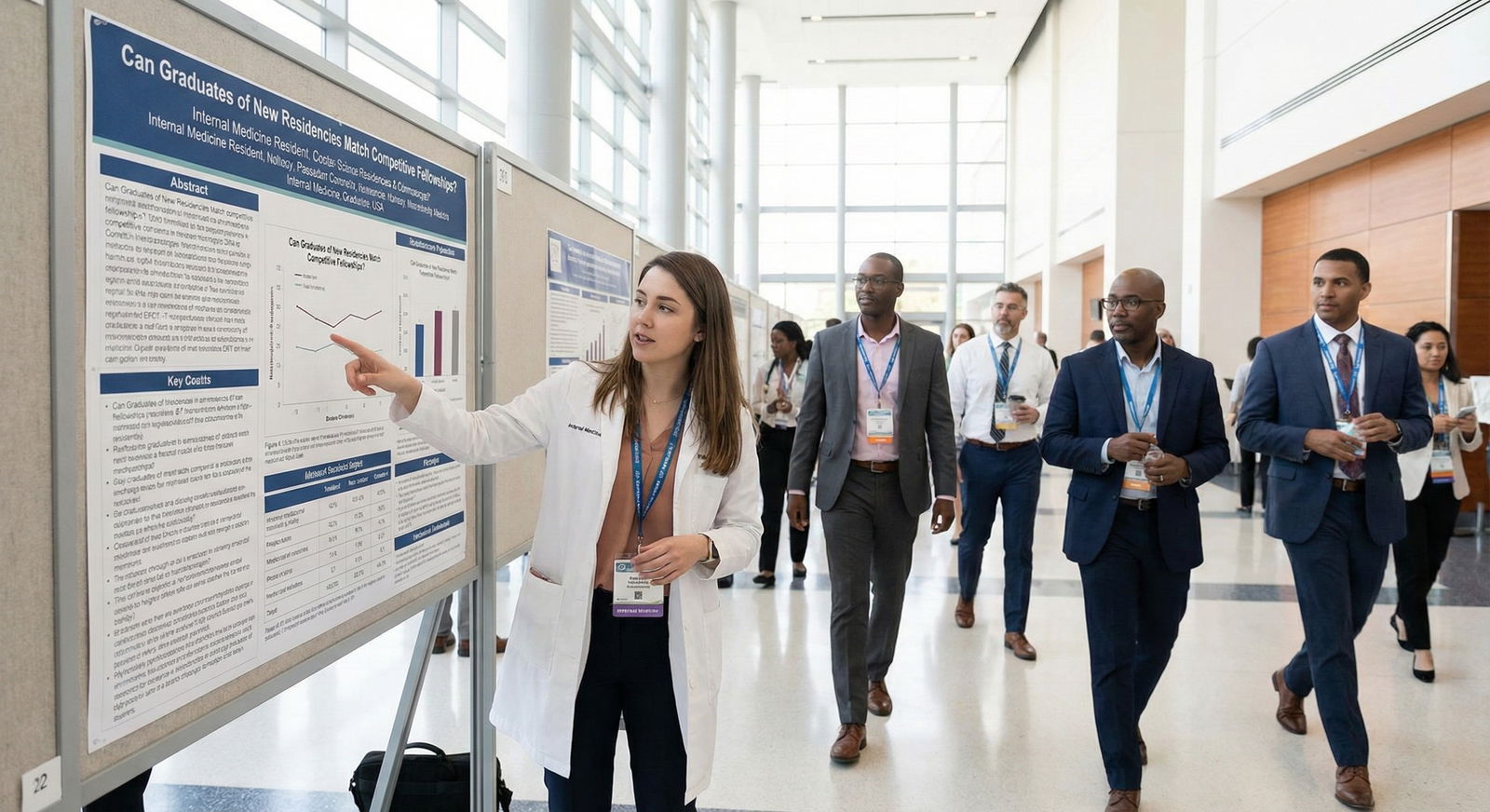
You do not need to be weird about it. If you have a poster, introduce yourself:
“Hi Dr. X, I’m Y from [New Program]. We’re a newer residency. I’m very interested in your field and wanted to say I appreciated your talk on [topic].”Keep your application clean and early
ERAS: complete, polished, error‑free, submitted early in cycle. No drama, no late LoRs, no half‑finished experiences.
How To Assess Whether Your New Program Can Get You There
Not all new programs are created equal. Some are future powerhouses. Others… are service mills slapped together to staff a hospital.
You want to ask yourself:
- Do I have attendings who are well‑connected in my target subspecialty?
- Have any residents (even older transfers or prelims) matched strong fellowships yet?
- Do we have access to sick, complex patients in my field of interest?
- Is there protected time or at least support for research and QI?
- Does my PD talk about fellowship placement like it actually matters?
If the answer is “no” to most of those and you’re early enough in your training, you may consider:
- Strategically using away rotations
- Aggressively networking outside your home institution
- In some cases, transferring residency if clearly misaligned with your goals (rare, but it happens)

Examples: What This Looks Like in Real Life
I’ve seen variations of these real scenarios:
New community‑based IM program, PGY‑3 wants cardiology.
High in‑training scores, did a cardiology elective at a university hospital, 2 posters at ACC, strong letter from outside cardiologist: matched a solid university‑based cards fellowship in the same region.New academic IM program, PGY‑2 wants GI.
Average Step 2, no research, PD letter says “reliable and pleasant.” Applied broadly: ended up with a few interviews, matched GI but at a smaller, less competitive program in a different region.Brand‑new EM program, resident wants critical care.
Took on every sick ICU patient, worked on sepsis QI, co‑authored a paper with intensivist mentor, did away rotation at a name‑brand MICU, got national abstract: matched at a top‑tier anesthesia/CC fellowship.
Pattern: the program age was a footnote. The individual profile drove the outcome.

Quick Reality Check: Are You On Track?
Ask yourself, honestly, by mid‑PGY‑2:
- Do I have at least one subspecialist mentor who knows me well?
- Is there at least one concrete scholarly product either done or clearly in progress?
- Would my PD describe me as one of the top residents in my class?
- Do I have a coherent story about why I want this fellowship and what I’ll do with it?
If your answer is “no” on multiple fronts, you’re not doomed. But you need to treat this like a priority project, not a vague hope.
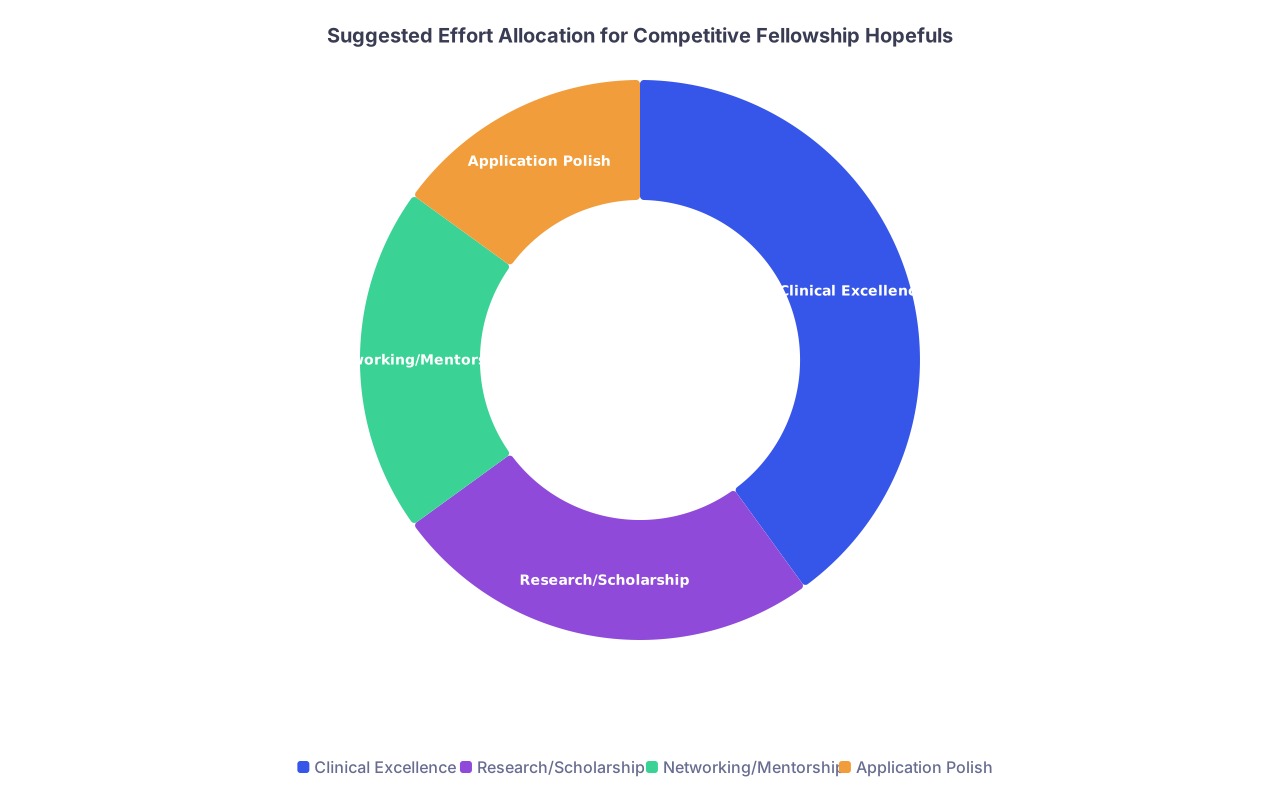
| Category | Value |
|---|---|
| Clinical Excellence | 40 |
| Research/Scholarship | 25 |
| Networking/Mentorship | 20 |
| Application Polish | 15 |
FAQ: New Residency → Competitive Fellowship
1. Do fellowship programs look down on new residencies?
Some are skeptical at first because they don’t know the training environment. But they don’t automatically blacklist you. Once they see strong letters, real research, and solid board/in‑training scores, the “new program” concern fades quickly.
2. How many publications do I need for a competitive fellowship?
There’s no magic number, but for the most competitive fields (cards, GI, heme/onc, some surgical subspecialties), 2–4 meaningful scholarly items (posters, abstracts, papers) with clear relevance to the field puts you in the serious category. Quality and coherence with your story beat raw quantity.
3. Can an away rotation really offset a lesser‑known residency?
It can help a lot—if you treat it like a month‑long audition. Show up early, work hard, present something, and build a relationship with at least one potential letter writer. Many residents from newer programs have essentially “bought their way in” to top fellowships via a stellar away rotation.
4. What if my program has almost no research infrastructure?
You get creative. Join multicenter projects, volunteer for QI initiatives that can be turned into abstracts, collaborate with nearby universities or VA hospitals, and leverage online networks and specialty societies. Having some structured scholarly output is still expected for very competitive spots, even from resource‑limited programs.
5. Are community fellowships easier to get from a new residency than academic ones?
Generally yes, but it’s not that simple. Many community fellowships are excellent and still selective. From a new residency, you can absolutely reach both community and academic fellowships. The difference is that top‑tier academic fellowships usually require a stronger research and letter profile.
6. Bottom line—can I match a top fellowship from a brand‑new residency?
Yes, you can. But you must be clearly in the top tier of your class, have strong specialty‑specific mentorship and letters, show concrete academic engagement in your field, and present a clean, focused application. The age of your residency program becomes background noise if you give fellowship PDs enough reasons to say “yes.”
Key points to walk away with:
- New residency grads can match competitive fellowships—but you need to over‑deliver on letters, scholarly work, and clinical performance.
- Program age is a minor factor compared to your individual record, your mentors, and how clearly you show commitment to your chosen field.