
Is a New Residency Program Worth the Risk? A Structured Decision Guide
What do you do when your best interview day is at a brand‑new residency program… and everyone you trust tells you to be scared of “new”?
Let me be direct: a new residency program is neither automatically a golden opportunity nor an automatic disaster. It’s a leverage play. High upside, real downside. The people who get burned are the ones who treat it like any other program and fail to interrogate the risk.
You’re smarter than that. So we’ll walk through a structured way to decide: is this specific new residency program worth your risk?
Step 1: Understand the Real Risks (Not the Vague Horror Stories)
People throw around “risky” like it’s a single thing. It’s not. New programs have several distinct risk categories. You need to know exactly what you’re betting on.
Here are the big ones:
Accreditation and closure risk
- Is this program still “initial accreditation” with the ACGME? Yes, that’s standard for new programs.
- The real risk: will they maintain accreditation and keep enough funding and faculty to finish your training?
Board eligibility and reputation risk
- If the program is brand new, there’s no board pass history. No alumni. No word of mouth.
- You’re trusting future performance on essentially zero track record.
Training quality risk
- Patient volume and acuity: will you see enough cases?
- Faculty teaching culture: are these real clinician‑educators or just warm bodies to meet ACGME numbers?
- Systems: is the program organized or chaos?
Match competitiveness and future fellowship/job prospects
- Some fellowships and employers hesitate with new programs because they don’t know what they’re getting.
- You’ll be the experiment. That’s not always bad. But it is a factor.
Lifestyle and support risk
- New programs often underestimate the admin load, onboarding chaos, and lack of resident support structures (mentorship, wellness, backup call systems).
- You might be writing the handbook as you go.
Notice what’s missing? “New = bad.” That’s lazy thinking. I’ve seen residents absolutely thrive in brand‑new programs when they picked carefully and walked in with eyes open.
Step 2: Anchor on the One Non‑Negotiable Question
Ask this and don’t compromise:
“If the program never got any better than it is in year 1, could I still become a competent, board‑certified physician in my specialty?”
If the honest answer is no, you rank them low or not at all. Full stop.
Everything else—prestige, location, shiny new hospital—comes after that single question. A new residency is not a 3‑year experiment. It’s your one shot at training in that specialty.
To answer that question intelligently, you need structure. So let’s build it.
Step 3: Score the Program Across 6 Critical Domains
I’m going to give you a simple, ruthless scoring framework. 1–5 scale for each category:
- 1 = Major concern / red flag
- 3 = Acceptable but unproven / neutral
- 5 = Strong reassuring evidence
You want an overall picture, not perfection in every box. But if you see multiple 1s, that’s a problem.
1. Hospital and Institutional Strength
You’re not really betting on “the program.” You’re betting on the hospital and system behind it.
Ask and check:
- Is this a long‑standing, busy hospital or a tiny community add‑on no one’s heard of?
- Academic affiliation: do they have a real relationship with a med school (e.g., “major teaching site for X School of Medicine”) or just a loose “affiliated” sticker?
- Existing residencies/fellowships: do they already run other successful programs?
| Factor | Strong (Score 5) | Weak (Score 1–2) |
|---|---|---|
| Hospital Volume | Level 1 trauma / tertiary center | Low-acuity community only |
| Academic Affiliation | Core or major teaching site | No real academic connection |
| Existing Programs | Multiple stable residencies | Brand new to GME entirely |
If the hospital has decades of serious clinical volume and other accredited residencies, you’re not as “new” as it sounds. You’re just the new specialty in an established ecosystem.
If the institution is new to GME altogether? That’s a different level of risk.
2. Accreditation, Leadership, and Funding
This is the “will this place still exist in 5 years?” section.
You want to know:
- Accreditation status: Initial accreditation is fine; any warnings or citations are not.
- Program Director’s background: Have they previously been core faculty or PD at a well‑run program?
- GME infrastructure: Is there a DIO (Designated Institutional Official), GME office, and experienced coordinators… or is everyone learning on the job?
- Funding source: Is this backed by hospital system commitment, CMS funding, or temporary grant money?
Questions to ask on interview day or via email:
- “What’s the long‑term funding plan for this program?”
- “How many years of GME infrastructure has your institution had?”
- “Where did the PD and core faculty train and teach previously?”
If those answers are vague, defensive, or full of buzzwords with no specifics, I’d drop that score.
3. Patient Volume, Case Mix, and Clinical Breadth
All the branding in the world doesn’t matter if you’re not seeing patients.
You need:
- Solid inpatient census
- Real variety (not just bread‑and‑butter, not just low‑acuity)
- Enough procedures (for procedural fields) or complexity (for cognitive fields)
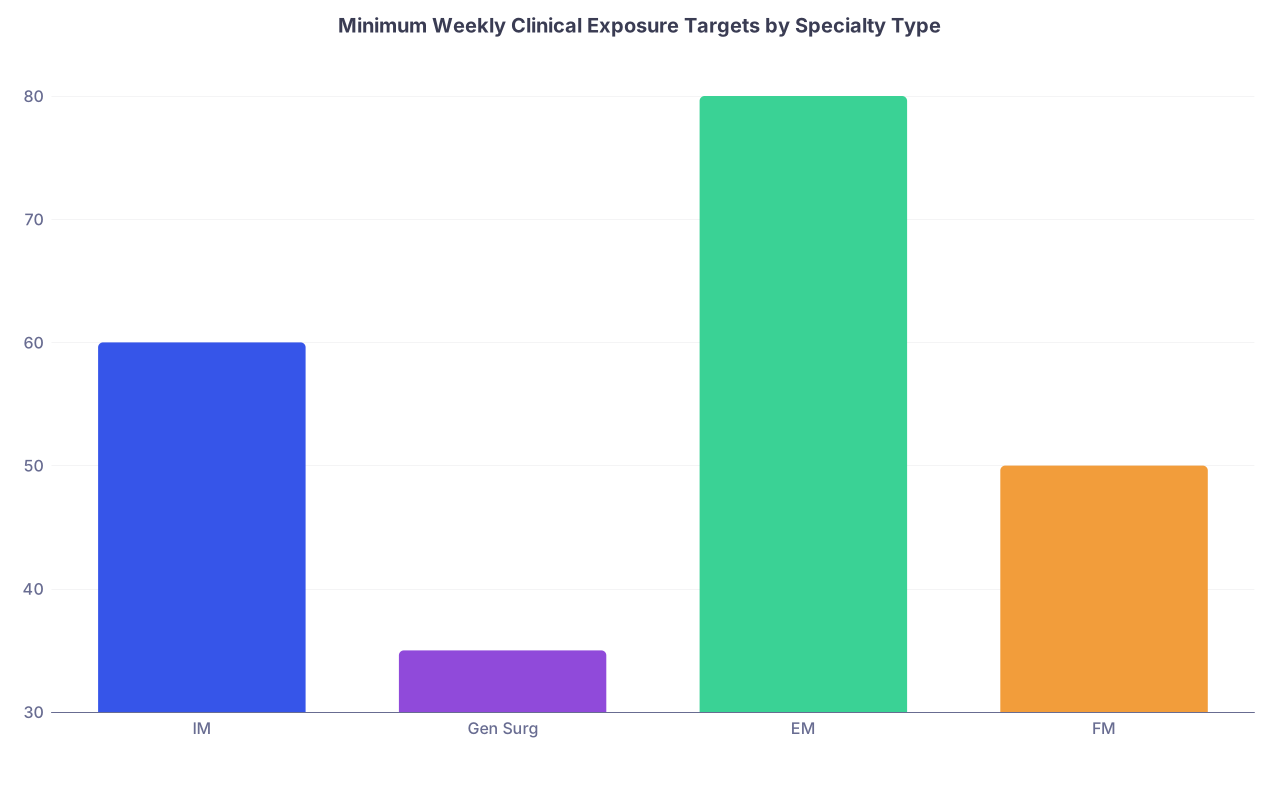
| Category | Value |
|---|---|
| IM | 60 |
| Gen Surg | 35 |
| EM | 80 |
| FM | 50 |
Think in rough terms:
- Internal Medicine: 50–70 patients/week across teams, mix of ICU and floor, subspecialty presence
- Surgery: consistent OR time, emergencies, not just elective easy cases
- EM: busy ED with real trauma/critical care exposure or strong transfer relationships
- FM: solid continuity clinic + inpatient peds/OB/geri exposure
Hard questions to ask:
- “What was last year’s inpatient census on the teaching service?”
- “How will you ensure residents get enough [ICU/OR/procedures] in the early years?”
- “Which services are currently staffed by APPs vs residents, and will that change?”
If they can’t answer with numbers or a clear plan, your training quality is a gamble.
4. Faculty Depth and Culture
This is where new programs either punch above their weight or implode.
Signs of a strong new program:
- Faculty with experience at respected programs (e.g., “Our PD was APD at X, core faculty at Y”).
- Reasonable faculty‑to‑resident ratio, not just barely meeting ACGME minimums.
- Faculty talking about concrete teaching practices: morning reports, feedback structure, evaluation tools, mentorship assignments.
Red flags I’ve seen repeatedly:
- Faculty who don’t know basic ACGME language (milestones, CCC, PEC, etc.).
- PD says things like “We’re still figuring that out” to every operational question.
- No clear plan for didactics beyond “We’ll have lectures.”
On interview day, ask:
- “What does a typical academic half‑day or didactic schedule look like?”
- “Who will be my main mentors in [subfield you care about]?”
- “How many hours/week of protected education are residents guaranteed?”
If the faculty light up when talking teaching, that matters. If they seem annoyed you even asked, that also matters.
5. Early Outcomes and External Perception
For the very first class, you won’t have this. For classes 2–3, you might.
Look for:
- Any data on board pass rates (even preliminary)
- Where recent grads matched for fellowship or took jobs
- Informal reputation: what do attending physicians at other hospitals say about this place?
If you’re early enough that data doesn’t exist, reframe: Do the inputs look like residents who will do well? Strong applicants. Dedicated faculty. Systems that make success likely.
And be honest with yourself about fellowship aspirations. If you’re gunning for super competitive fellowships (Derm, Ortho, GI, Cards, etc.), a brand‑new program is a higher bar to justify. Not impossible. But harder.
6. Resident Role, Autonomy, and Growing Pains
One under‑discussed reality: in a new program, you’re not just learning medicine. You’re building the program.
That can be amazing. Or exhausting. Or both.
Know what you’re signing up for:
- You’ll likely help create schedules, call systems, wellness initiatives, rotation tweaks.
- You’ll sometimes be the first person to realize “there’s no policy for this yet.”
- You may have more autonomy earlier—sometimes before things are fully ironed out.
Ask residents (or PD if there are no residents yet):
- “Give me an example of something residents have changed this year.”
- “What’s one thing that’s not working well yet?” (If they claim everything is perfect, they’re lying or clueless.)
- “How is backup handled if a resident is sick or overwhelmed?”
You want signs of responsive leadership and a culture that actually listens to residents—not just uses them as free admin labor.
Step 4: Compare New vs Established – Honestly, Not Emotionally
Take your rank list candidates and compare them on the same dimensions. New vs established is not a binary; it’s a tradeoff.
Here’s how the tradeoff usually looks:
| Factor | Strong New Program | Average Established Program |
|---|---|---|
| Individual Attention | Very high (small classes) | Moderate |
| Flexibility | High, residents shape program | Lower, systems already set |
| Reputation | Low but growing | Stable, known quantity |
| Chaos Level | Higher, more change and uncertainty | Lower, more predictable |
| Leadership Access | Easier to reach PD/Chair | Depends, often more layers |
Then ask yourself candidly:
Would I rather be in a top‑tier new program at a strong hospital than a bottom‑tier established program in a weak hospital?
For many people, the answer is yes.
But:
Would I rather be in a brand‑new unknown program than a solid mid‑tier established academic program with proven outcomes?
Often, no.
This is why you need that 1–5 scoring. It forces you to see past your emotional pull to geography or flattery you heard on interview day.
Step 5: Watch for True Red Flags vs Normal “New” Issues
Some things are simply part of being new:
- Schedules and rotations still being adjusted
- Processes rough around the edges (onboarding, EMR templates, call rooms)
- First class doing more “committee” work than usual
Those are acceptable if leadership is responsive.
But these? These are not “normal new” problems:
- PD or leadership cannot clearly describe how you’ll meet ACGME case/procedure/log requirements.
- No one seems to know who is actually responsible for resident wellness, discipline, or remediation.
- Repeated vague answers like “We’re still working on that” for fundamental questions: call burden, vacation, evaluation, supervision.
- You hear phrases like “We’ll probably get that figured out once you start.”
If you’re hearing those, the risk spikes.
Step 6: Factor In Your Personal Situation and Risk Tolerance
Two applicants, same program, different correct answer.
You should lean toward a strong new program if:
- You’re entrepreneurial, like building systems, and do not want a cookie‑cutter experience.
- You’re less fellowship‑dependent (e.g., happy with general IM/FM/EM practice and a decent job market).
- You value attention from faculty and leadership over brand name.
You should be more cautious if:
- You’re aiming for ultra‑competitive fellowships or academic careers that depend heavily on pedigree and connections.
- You’ve had a very chaotic med school experience and need structure, not more experimentation.
- You have major life stressors (family, finances, health) and want predictability above all.
Be honest: are you drawn to the program because it’s actually good, or because you feel flattered they love you?
That distinction matters.
Step 7: Quick Decision Framework You Can Use Today
Here’s the blunt “should I rank this new program highly?” test:
- Hospital/institution is strong (score ≥4)
- Leadership and funding are credible (score ≥4)
- Clinical volume and case mix look solid (score ≥3, ideally 4–5)
- Faculty depth and teaching culture feel real, not performative (score ≥3–4)
- No glaring red flags about accreditation, supervision, or board eligibility
- Your career goals don’t absolutely demand a big‑name, long‑established program
If you hit those, a new program can absolutely be worth ranking aggressively—sometimes even over mediocre established programs.
If two or more of those are weak (scores 1–2), you’re not “being bold” by ranking it high. You’re gambling your career.
Step 8: How to Actually Gather the Intel (Not Just Vibes)
You can’t score what you don’t investigate. So:
- Read the ACGME program page: Look up accreditation status, sponsoring institution, and any publicly available information.
- Check the hospital’s other residencies: If they run a respected IM or Surgery program already, that’s a big plus.
- Use alumni networks: Ask attendings or fellows, “Have you heard anything concrete about X’s new program?”
- Email the coordinator/PD: Ask 3–4 pointed questions about volume, supervision, and didactics. Their clarity and tone tell you a lot.
- On interview day, you’re not there just to impress them. You’re there to interrogate the program.

Step 9: Looking Ahead – The Future of New Residency Programs
The number of new residency programs has exploded in the last decade, especially in community hospitals and smaller health systems. This will not slow down. Why?
- Systems want more cheap labor and pipeline physicians.
- Communities need more doctors.
- GME funding rules incentivize early resident caps.
What that means for you: you will see more and more “new” on your interview list. You won’t be able to avoid them entirely, especially in certain regions or specialties.
The winners will be the applicants who learn how to evaluate these programs surgically, not emotionally. The people who can look past the polished website and ask, “Can this place truly train me to the level I need?”
That’s the whole game.
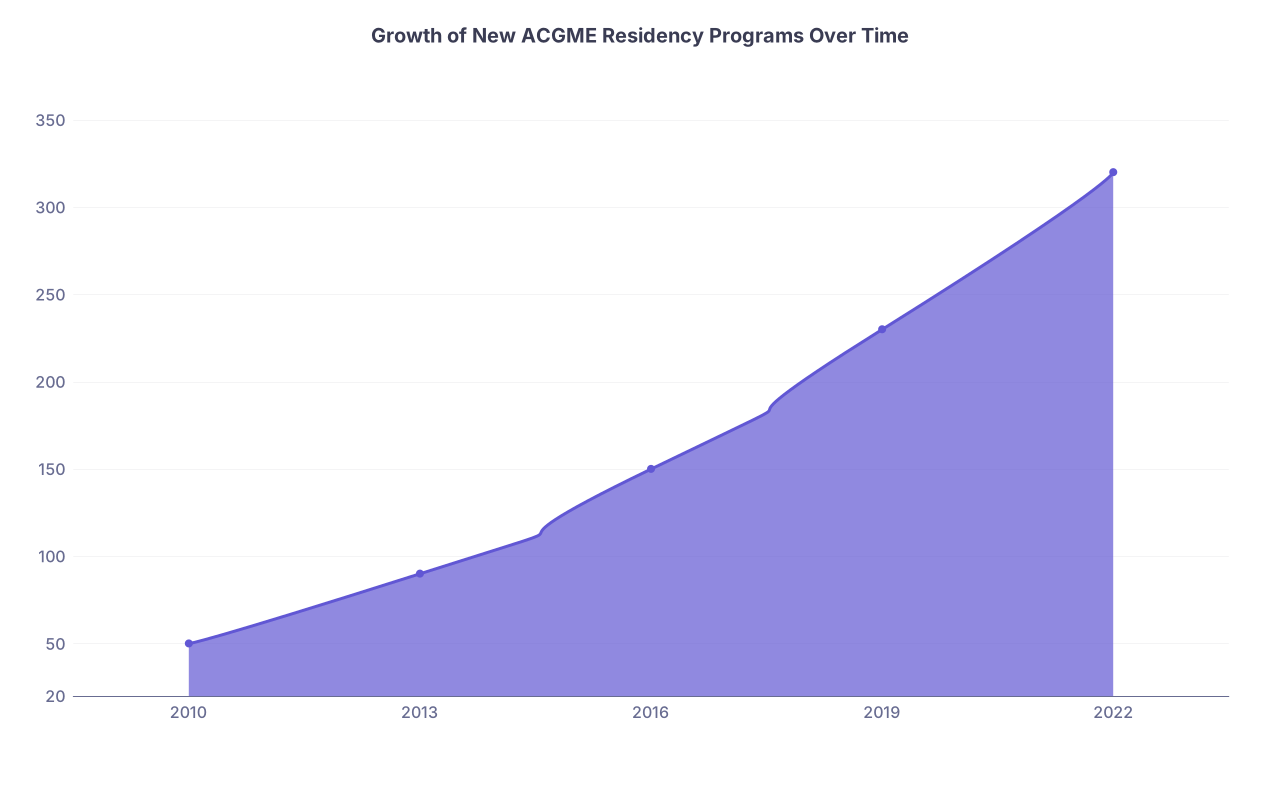
| Category | Value |
|---|---|
| 2010 | 50 |
| 2013 | 90 |
| 2016 | 150 |
| 2019 | 230 |
| 2022 | 320 |

Your Immediate Next Step
Right now, pick one new residency program you’re considering and do this:
Grab a piece of paper (or a notes app) and score it 1–5 in these six areas:
Institution strength, leadership/funding, clinical volume, faculty culture, early outcomes/perception, resident role/support.
Add brief bullets under each score with the evidence you have—not just impressions.
If you can’t justify at least a 3 in most boxes with concrete facts, not feelings, you don’t have enough data yet. Send two specific questions to the program coordinator or PD today and see how they respond.