
The shiniest new residency program is not automatically better than the scrappy community one down the road. Or vice versa. If you compare them on the wrong things, you’ll make a bad decision and only realize it halfway through PGY‑1.
Here’s how to compare a new academic program vs an older community one in a way that actually predicts your training and career.
Step 1: Get Clear on What You Want Long-Term
Before you compare anything, you need a target.
Ask yourself three blunt questions:
- Do you care about a fellowship or academic career?
- How much do you care about hands-on autonomy vs being in a big-name place?
- What kind of life do you want for the next 3–5 years (location, workload, culture)?
If your honest answers are:
- “Yes, I want a competitive fellowship or maybe academic medicine” → academic programs (even new ones) get a strong bump.
- “I just want to be a strong, independent clinician and have a normal life” → a solid community program can easily be the better play.
- “I’m not sure” → you need a program that doesn’t close doors: decent research access, some specialty exposure, strong clinical volume.
Write those answers down. Literally. Then use them as a filter for everything that follows.
Step 2: Understand the Built-In Advantages and Risks
You’re comparing two different species: a new academic residency vs an established community one. They come with predictable pros and cons.
| Factor | New Academic Program | Older Community Program |
|---|---|---|
| Brand name | Depends on parent school | Usually local/regional only |
| Systems & curriculum | Still being built/refined | Stable, well-tested |
| Faculty depth | Often limited, still recruiting | Established, know how to teach residents |
| Autonomy | Often higher early (fewer fellows) | High, especially in bread-and-butter cases |
| Research | Better access if tied to med school | Variable, often limited but possible |
| Fellowship placement | Early years: unknown, case-by-case | Clear track record (or clear that it’s weak) |
New Academic Program: What’s Really Going On
The word “academic” seduces applicants. But a brand-new academic residency has growing pains:
Upsides:
- Access to university faculty, conferences, maybe an affiliated med school.
- Often fewer fellows at the start → more procedures and cases for residents.
- Leadership is usually highly motivated; they’re trying to prove themselves.
- New facilities, EMR, and infrastructure in some cases.
Downsides:
- No real track record: no board pass history, no fellowship match history.
- Curriculum, call schedules, rotations are in flux. You’re the beta tester.
- Faculty turnover can be high early on while they “figure out the team.”
- Name recognition for the residency is basically zero at the start.
Older Community Program: Less Flash, Often More Substance
Community programs get underrated by students who are obsessed with logos.
Upsides:
- Stable systems: schedules, didactics, workflow, culture → they know who they are.
- Program director and faculty usually know how to train residents efficiently.
- Often tons of autonomy and procedural experience, especially in IM, FM, EM, Surgery.
- Strong local reputation with hospital administration and regional employers.
Downsides:
- Less research, fewer NIH grants, fewer PhD collaborators.
- Weaker national name (doesn’t impress your non-med friends).
- May have fewer subspecialty services on-site.
- Fellowship match may be more regional and less competitive, depending on program.
You’re not choosing “academic vs community” in the abstract. You’re choosing this new academic program vs that specific older community one. The rest of the article is how to do that properly.
Step 3: Non-Negotiables – Things You Should Not Compromise On
Some things are optional. These are not.
1. ACGME Status and Citations
You want:
- Full accreditation (not just initial) if possible.
- If it’s new, initial accreditation is normal, but ask: any citations? What for?
- Multiple major citations in core areas (patient safety, supervision, duty hours).
- PD or residents seem evasive when you ask.
2. Volume and Case Mix
A residency lives or dies on patient volume and variety.
Ask:
- “How many admissions per resident per month on the inpatient service?”
- “What’s your ICU volume like?”
- “Is there enough procedural volume that every resident gets X per year?” (central lines, intubations, scopes, deliveries, whatever is relevant.)
If the new academic site is at a small hospital with “future plans” to expand services, be careful. Future plans don’t teach you how to manage a crashing patient today.
3. Supervision and Safety Culture
You need enough autonomy to grow, but enough backup to not drown.
Questions:
- “Who’s physically in-house overnight? Attending coverage? Senior residents?”
- “Tell me about a time a resident felt unsafe with their workload. What changed?”
- “How often do residents escalate to attendings? Is that culturally supported or frowned upon?”
If the answer sounds like, “You’re basically the only doctor here at night, but it’s a great learning experience,” run.
Step 4: How to Score a New Academic Program
Here’s the lens I’d use for a new academic residency.
Anchor 1: Who’s Behind It?
Key questions:
- Is this attached to a well-known university or health system (e.g., a new IM program at a Mayo satellite vs a random standalone hospital)?
- What’s the chair and PD’s background? Where did they train? Where have they worked?
- Have they successfully built or led a program before?
A strong PD + strong sponsoring institution can make a new program very safe. A brand-new PD at a small academic-ish hospital with no history of GME is a bigger gamble.
Anchor 2: Early Outcomes and Real Trajectory
For very new programs (first 1–3 classes) you obviously won’t see board pass rates yet. Still, you can look at trajectory indicators.
Ask:
- “Where did your first couple of graduates go?” (Even just jobs is helpful.)
- “Any fellowships yet? Where?”
- “What’s changed in the last 2 years based on resident feedback?”
You’re looking for:
- Clear, concrete changes: “We moved our ICU rotation to the tertiary site because the volume here was too low.”
- Early fellowship matches in reasonable spots for the program’s tier, not fantasy.
Anchor 3: Faculty Depth and Subspecialty Support
An academic label without true subspecialty depth isn’t that academic.
Look at:
- How many core faculty? How many are part-time vs full-time?
- Are there actual subspecialists on-site or just “affiliated” across town?
- Are residents actually rotating where the action is (tertiary center, subspecialty clinics)?
If research and specialized exposure matter to you, ask who will mentor you specifically. Names, not just “we have plenty of opportunities.”
Step 5: How to Score an Older Community Program
With an older community program, you do have a track record. Use it.
Check 1: Fellowship and Job Outcomes
This is the big one.
Ask:
- “Can you show me where grads from the last 5 years ended up?”
- “For people who wanted fellowships, what percentage matched, and where?”
- “For people who wanted to be hospitalists/outpatient docs, how were job offers?”
You’re not looking for all Harvard fellowships. You’re looking for:
- Consistent matches in reasonable fellowships for that program’s level.
- People getting the jobs and locations they wanted.
If they can’t or won’t show you a list, that’s information.
Check 2: Resident Autonomy vs Support
Older community programs can be amazing for independence. Or they can be unsafe dumping grounds.
Talk to residents (without attendings around):
- “When you’re on nights, do you feel overwhelmed or reasonably stretched?”
- “Have you ever felt you were asked to do something beyond your training without backup?”
- “How comfortable did you feel starting attending life compared to your friends at other programs?”
You want high confidence + stories of good backup, not heroic war stories.
Check 3: Reputation in the Local Medical Community
Ask around:
- Local attendings not in the program: “How are the residents from [hospital]?”
- Subspecialists who work with multiple programs: Who sends them well-prepared fellows? Who doesn’t?
If students and nurses say, “Those residents are solid,” that matters more than whether U.S. News has heard of the place.
Step 6: Put Programs Side-by-Side on the Right Metrics
Here’s a simple structure to avoid getting blinded by logos or shiny new buildings.
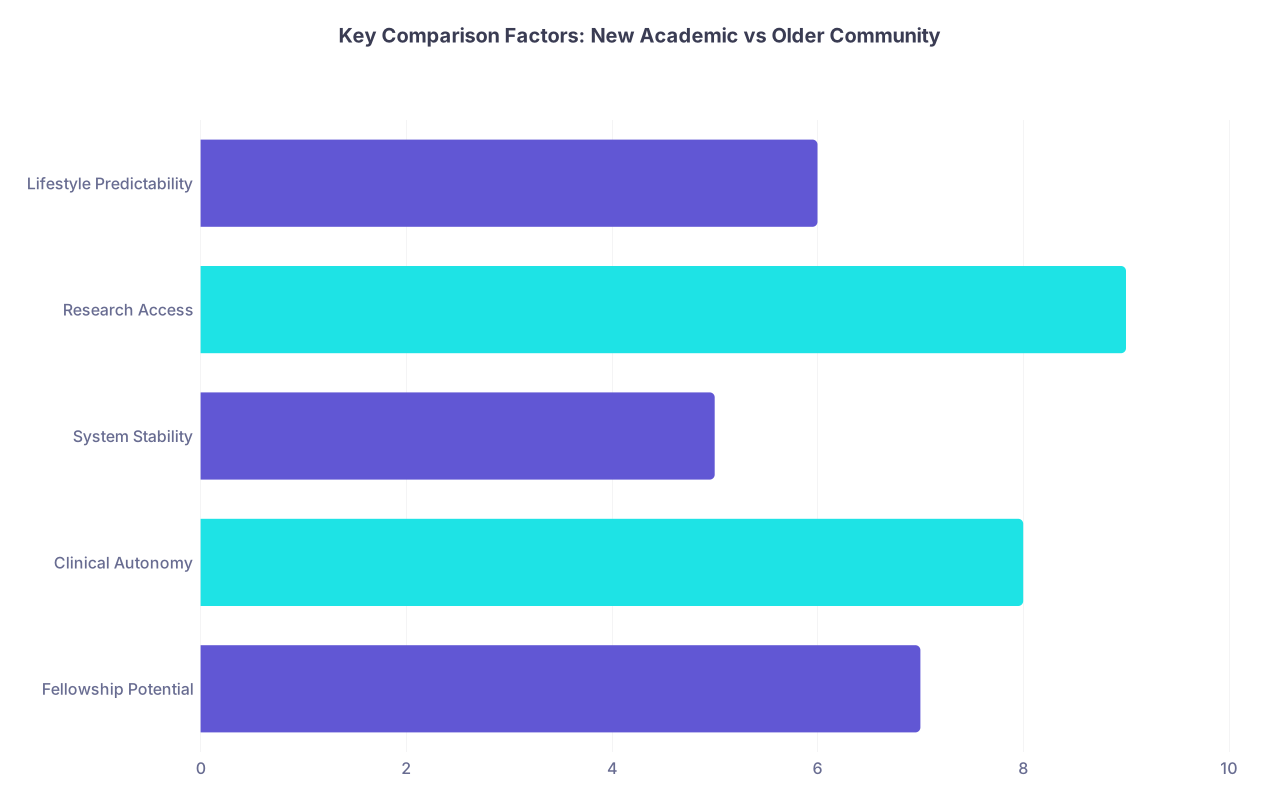
| Category | Value |
|---|---|
| Fellowship Potential | 7 |
| Clinical Autonomy | 8 |
| System Stability | 5 |
| Research Access | 9 |
| Lifestyle Predictability | 6 |
Ignore the exact numbers; think of it as a template. For each program, score (1–10) on:
- Clinical training strength
- Volume, acuity, procedures, ICU exposure.
- Outcomes
- Fellowship/job placement, board pass support (older program) or early trajectory (new program).
- Faculty and mentorship
- Approachability, teaching culture, subspecialty access.
- Academic infrastructure
- Research, QI projects, conferences, people who will pick up the phone for you.
- Culture and lifestyle
- Resident happiness, burnout, schedule, how people talk about their days.
If a new academic program massively beats the community option on mentorship and academic infrastructure, and you care about fellowship, that may justify taking a chance on some growing pains.
If the community program crushes the new one on clinical volume, system stability, and resident happiness—and you’re leaning toward being a clinician—choose the less flashy but more reliable option.
Step 7: Red Flags That Should Outweigh “Academic vs Community”
Some negatives trump everything:
- High resident attrition (people leaving or transferring out).
- Consistent stories of retaliation when residents give feedback.
- Chronic understaffing or unsafe workloads.
- PD or chair turnover every 1–2 years.
- Nobody can clearly explain how graduates did in the last few years.
If you hear versions of, “We’re working on that” for everything—and there are no concrete changes or timelines—treat that as a hard warning, especially at a new program.
Step 8: Use Residents as Your Reality Check
Talk to multiple residents. Junior and senior. At both kinds of programs.
- “What’s one thing you wish you’d known before ranking this place?”
- “If you had to rank again, would you still put this #1? Why or why not?”
- “Who are the 1–2 faculty who’ve actually moved the needle for you the most? How?”
Then pay attention not just to their words, but their tone. Jaded, exhausted, “it’s fine I guess” is a signal. So is “it’s not perfect, but I’d still choose it again.”
Simple Decision Framework
If you’re torn, use this blunt rule of thumb:
Strong interest in competitive fellowship/academics + new academic program backed by a reputable institution, with motivated leadership and reasonable clinical volume → It’s often worth the gamble over a very average community program.
Unclear about fellowship or leaning toward clinical practice + older community program with excellent hands-on training, stable leadership, strong local reputation → Don’t let academic FOMO push you into a fragile new program.
If one program clearly has safety/culture red flags → Pick the safer one, period. You can’t learn or thrive in a toxic or unsafe environment, no matter the branding.

| Step | Description |
|---|---|
| Step 1 | Start Comparison |
| Step 2 | Lean to new academic |
| Step 3 | Lean to older community |
| Step 4 | Lean to older community |
| Step 5 | Reevaluate both or look elsewhere |
| Step 6 | Rank higher |
| Step 7 | Need fellowship or academic career? |
| Step 8 | New academic backed by strong institution? |
| Step 9 | Community program strong clinically? |
| Step 10 | Any major red flags? |
FAQ (Exactly 6 Questions)
1. Is a new academic residency program “safer” for fellowship than an established community one?
Not automatically. A big-name university affiliation helps, but fellowship directors care about how you perform, your letters, your research or projects, and your program’s reputation within the specialty. A well-known community program with a consistent track record sending people to solid fellowships can be a better bet than a brand-new academic program with zero history. Look at actual outcomes, not just logos.
2. How new is “too new” for a residency program to feel comfortable ranking it highly?
The riskiest moment is when there are no graduates yet and systems are still in flux. That doesn’t mean you should automatically avoid it, but you should demand more from the leadership: clear curriculum, strong institutional support, transparent answers about what’s still evolving. If the first class is still PGY‑1 and you’re not getting specific, confident answers, I’d think very hard before ranking it over a strong, established community program.
3. Will training at a community program hurt my chances at an academic or university hospital job later?
Usually not, if you’re strong and intentional. People do this all the time: solid community residency → fellowship at an academic center → academic job. You’ll just need to be proactive: find research or QI projects, attend conferences, get to know academic attendings, and secure strong letters. The bigger limitation is your own effort and mentorship, not the word “community” on your badge.
4. Are research opportunities at community programs basically nonexistent?
No. They’re often less structured and less abundant, but not nonexistent. I’ve seen residents at small community programs publish case series, retrospective chart reviews, and QI projects that were more than enough for competitive fellowships. You won’t have a giant research machine pushing projects at you, so you’ll need a motivated mentor and some initiative. Ask specifically: “How many residents presented at national conferences last year, and in what venues?”
5. What if the new academic program uses a big tertiary center as a rotation site—does that change things?
Yes, and usually in a good way. If your home base is a smaller hospital but you have guaranteed, structured rotations at a large tertiary or quaternary center (with subspecialties, transplant, advanced ICU, etc.), that can give you the best of both worlds: autonomy and intimacy at the smaller site, plus high-level exposure and connections at the big center. Verify the details: how many months, which years, and what your role is there.
6. Should I ever rank a shiny new academic program over a truly strong, well-known community program?
Yes, but only when it lines up with your goals and the fundamentals check out. For example, if you’re aiming for a niche subspecialty and the new academic program gives you direct access to leaders in that field, real research infrastructure, and reasonable clinical training, it can be worth the risk. But if the community program has clearly stronger clinical training, happier residents, and a solid track record, and you’re not dead-set on academics, the “boring” choice is often the smarter one.
Key takeaways:
- Don’t compare “academic vs community” in the abstract—compare this new academic program vs that specific older community one on clinical training, outcomes, mentorship, and culture.
- Use residents’ real experiences and hard data (volume, outcomes, stability) over branding or buildings.
- Align your choice with your actual goals: fellowship/academics vs strong, stable clinical training and a livable residency.