
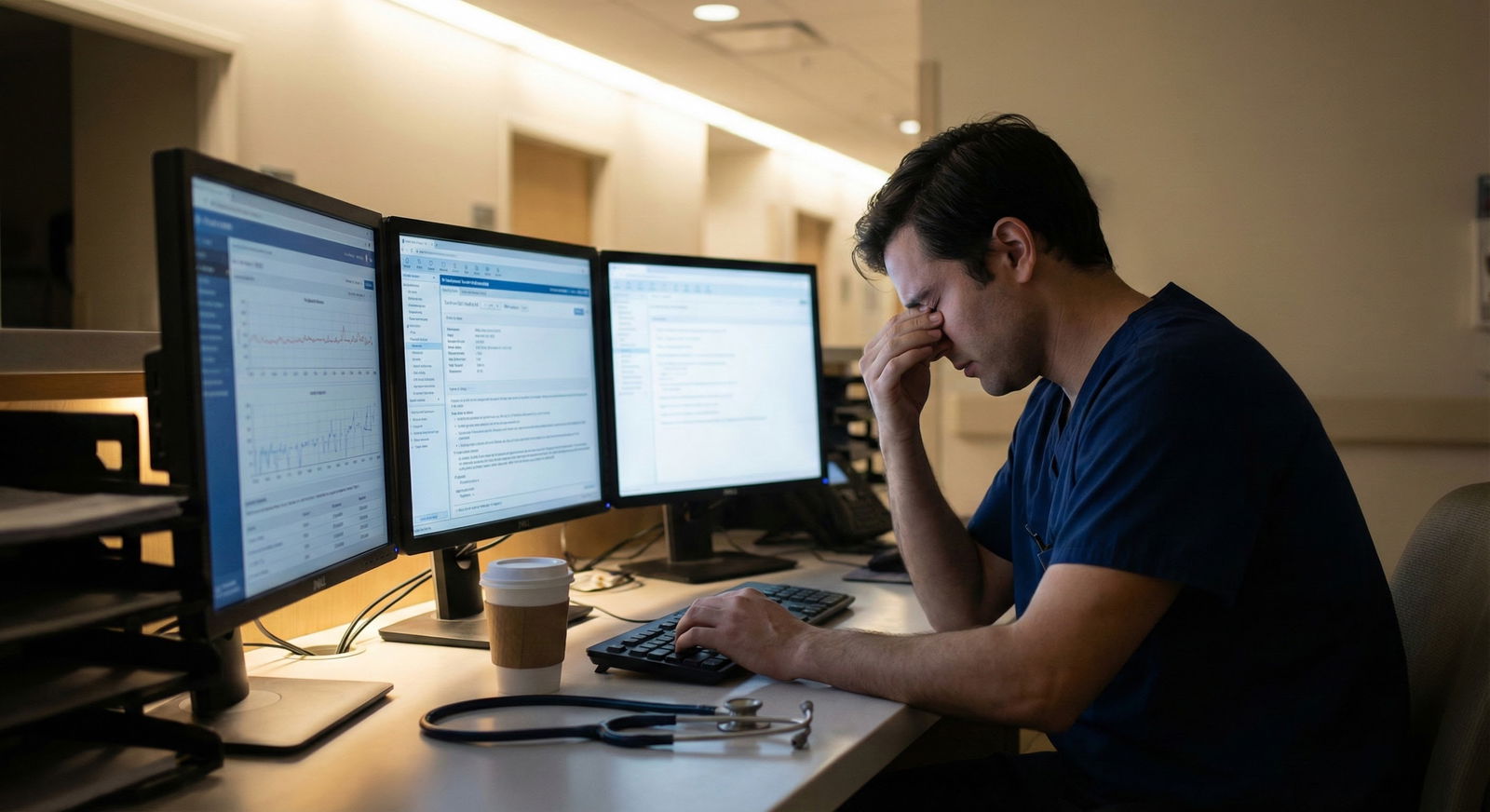
You've been there. Clock hits 3:07 AM. The pager screams. You're the night float. You open the chart of the patient who's coding, or almost coding, and realize the day team's "signout" left you with nothing but fog. No contingency. No red flags. Just a shrug dressed up as a handoff. That near-miss should haunt you. It haunts me every time I watch a new intern accept a dump-and-run without pushing back.
This piece is for educational purposes only. It is not legal advice and not financial advice. Figures vary by institution; consult a qualified professional for your specific situation. Not tax advice either, this is about keeping patients safe and you out of trouble.
The 3 AM Crunch: A Night Float Near-Miss That Should Haunt You
Picture this. Anonymized, but real enough that my stomach still tightens. Night float intern, call her Maya, takes signout at 6:45 PM. Senior resident is already halfway out the door, coffee in one hand, backpack in the other. "Mr. Alvarez, room 412, CHF, stable, just keep an eye." That's it. No weight trend. No last potassium. No "if he desats, do this." Maya nods because she doesn't want to look needy. She has 28 other patients. She writes "stable CHF" on her scrap paper and moves on.
At 3:12 AM the nurse pages: respiratory rate 28, O2 sat dipping to 88% on 2 liters. Maya sprints. Chart dive. Turns out Mr. Alvarez gained 5.2 pounds since morning admission. Potassium was 6.1 at 4 PM, never repeated. Metformin still on the active list despite rising creatinine. The day team "knew." They just never said it out loud in a way that stuck. Maya orders the right things, calls the senior, dodges the code. Patient lives. Barely. The near-miss report gets filed and quietly buried under "communication issue."
That's the Swiss cheese model in living color. Every layer, labs, nursing, pharmacy, attending oversight, had holes. The handoff was the final slice. When that layer fails, the error tunnels straight into the patient. Near-misses are not cute learning moments. They're the canary in the coal mine for sentinel events. I've watched programs treat them like background noise until a family is sitting in a conference room with risk management. Don't be the resident who shrugged because "everyone signs out like that."
You will be tired. You will be rushed. You will want to believe the person leaving is competent and complete. That belief is exactly how patients get hurt on your watch.
Why Unstructured Handoffs Are a Walking Malpractice Risk
The "dump and run" is still the default in too many programs. Day team talks for four minutes about the interesting cases, mumbles through the rest, and vanishes. What's missing is the only data that matters at 2 AM: what will crash tonight, and what you should do when it does.
Common errors I see on every rotation:
- Assuming a shared mental model. You think they know what "watcher" means. They think you can read their mind.
- Skipping contingency plans because "he's been fine all day."
- The courtesy bias trap. You don't challenge a vague signout because you don't want to be "that difficult intern." Silence here is complicity.
Dangerous example burned into my brain: "Mr. Smith is stable." Full stop. Except Mr. Smith has a new 5 lb weight gain, a potassium of 6.1, and an active order for potassium replacement still sitting in the chart. "Stable" is not a clinical assessment. It's a hope. Hope is not a strategy when you're the one holding the bag at 4 AM.
Look at those numbers. Simulation data, repeated across multiple teaching hospitals. Unstructured handoffs omit critical data 43% of the time. Miss the contingency plan 37% of the time. IPASS cuts both into the single digits. That gap is the difference between a quiet night and a root-cause analysis with your name on it. Unstructured handoffs are not "efficient." They are a walking malpractice risk dressed up as tradition. Stop defending them.
The Life-Saving Anatomy of a Structured Handoff: IPASS the Baton
IPASS exists because people like Maya kept almost losing patients. Learn it. Use it. Force it.
- I, Illness severity: Stable / Watcher / Unstable. Say the word out loud. If they're a watcher, the receiver's brain needs to lock on.
- P, Patient summary: One tight paragraph, events of the day, relevant PMH, current assessment. Not the entire H&P.
- A, Action list: To-dos plus the if-then contingency. This is the money section.
- S, Situational awareness / synthesis by receiver: What could go wrong? What's the backup plan?
- S, Synthesis (read-back): The receiver says it back. This is the step everyone skips. It's also the step that catches the near-miss before it leaves the room.
Synthesis is the most commonly skipped step because it feels awkward and slows the exit. Do it anyway. I've watched seniors try to bolt the second they finish talking. Block the door with your body if you have to. A concrete script that actually works:
"For Mr. Smith: watcher, CHF exacerbation, up 4 pounds, K was 5.8 this afternoon. Action list: hold metformin if creatinine climbs above 1.8, repeat BMP at midnight. Contingency: if respiratory rate spikes above 24 or he needs more than 4 liters, call me and I'll walk you through IV lasix and whether we need BiPAP. Your turn, read back the watchers."
That thirty seconds of read-back has saved more sleep and more licenses than any wellness lecture I've ever sat through.
Print that flow. Tape it inside your brain. If the handoff ends without the last two boxes checked, you do not have a handoff. You have a liability transfer.
The Hidden Pitfalls of Structured Handoffs (Yes, It Can Fail Too)
Don't get cocky just because you memorized a mnemonic. Structured handoffs fail in predictable, ugly ways.
Checkbox syndrome is the big one. Residents race through IPASS like they're clearing a video game level, boxes ticked, zero actual thinking. The words come out, the mental model never transfers. I've seen perfect IPASS forms and still watched the night intern freeze when the patient tanked because nobody synthesized.
There's also over-attachment to the template. You become so married to the script that you ignore the human standing in front of you who has been awake 28 hours and just needs the three things that will kill someone before sunrise. Structure is a tool, not a religion.
Red flag that should stop you cold: the handoff ends and the receiver says nothing. No "I got it." No clarifying question. Just a nod and a "thanks." That silence is the loudest warning you'll get. If they didn't ask one question, they didn't absorb it.
How you avoid the trap: always end with the same line, "What keeps you up at night about this list?" Force the sender to name their fear. Force the receiver to own it. If that question produces a blank stare, the handoff failed. Restart it.
Implementation Triage: How to Push for Structure Without Being the 'Protocol Cop'
You can't walk onto a service and announce "We're doing IPASS now or I'm calling the PD." You'll get labeled and ignored. Political navigation matters.
Start with the soft buy-in. Tell the attending or senior: "I'm going to read back the plan on the watchers so I don't miss anything overnight, that cool?" Most will say yes because it makes them look safer. Once they feel the reduction in 2 AM panic pages, they stop fighting you.
Start small. Don't boil the ocean. Introduce full IPASS only for the watcher patients, the ones who could actually crumble before morning. Rock-stable post-op day 3 cholecystectomy gets a one-liner. The new heart failure admit with climbing creatinine gets the full treatment. People accept structure when it clearly targets risk instead of dogma.
Make yourself a laminated "Handoff Checklist" card for your white coat pocket. Illness severity. Three-line summary. Action + contingency. Read-back prompt. When others see you using it and not drowning, curiosity beats resistance.
Here's the pregnancy test for your system: if a code is called in the first hour of the night shift, would the oncoming team already know why that patient was high-risk? If the answer is "probably not," your handoff culture is broken. Escalate. Chiefs and program directors hate preventable codes more than they hate new checklists.
Near-Miss Autopsy: One Chart Review That Changed Our Protocol
De-identified, but I lived adjacent to it. Mid-sized academic program. Night float near-miss rate was ugly, roughly two significant events per week. Wrong insulin dose because "sliding scale, you'll figure it out." Missed early sepsis because the day team never said the patient had been spiking quietly since noon and the lactate was already 3.1.
They rolled out IPASS. Mandatory training. Templates in the EHR. Six months later the near-miss rate for teams that actually enforced read-back dropped to zero. Zero. The teams that treated IPASS like optional paperwork? Same old bleeding. Structure without culture is just paperwork that lets administrators check a box while patients still get hurt.
Lesson I took personally: the mnemonic is necessary but not sufficient. The read-back and the shared anxiety about "what keeps you up" are what close the holes in the cheese.
Key Takeaways
- Unstructured handoffs are the #1 preventable cause of night float near-misses, the dump-and-run error will eventually harm a patient.
- IPASS works, but only if you embrace Synthesis (read-back) and kill the checkbox mentality.
- Never accept a signout where the receiver doesn't ask a single question, that silence is the loudest red flag.
- Create contingency plans for every watcher patient. If you don't know what could go wrong in the next 12 hours, you aren't ready to hand off.
Stop accepting fog at 6:45 PM. The patient who almost dies at 3 AM is the one who will teach you, too late, that "stable" was a lie. Protect them. Protect your license. Protect the intern who comes after you. Start tonight: pick your three watchers, force the contingency, demand the read-back. Then go home knowing you didn't just pass a list, you passed a real plan.