
You just finished a solid month on inpatient medicine. You finally got comfortable with 8 am rounds, thoughtful notes, and med rec novels. You knew all your CHFers’ dry weights. You could rattle off MELD scores half-asleep.
Now it’s 4:45 am on day one of your surgical month. You’re staring at a list of 25 post-ops and 6 “add-ons,” your senior just said “we round fast, like actually fast,” and you’re realizing: your internal medicine workflow is about to get you smoked.
You do not have three weeks to slowly adjust. You have one day. Maybe two. After that, you’re either keeping up or you’re that intern everyone is quietly annoyed with.
Here’s how to flip the switch quickly.
1. Understand the Mindset Shift: Medicine vs Surgery
Before you mess with checklists and templates, you need to change your brain.
On medicine month, your job:
- Build the full story.
- Adjust 18 meds.
- Think in systems and trajectories.
- Write long, reasoned notes.
On surgery month, your job:
- Keep the surgeon’s patients safe.
- Know if they can cut, if they can discharge, or if they’re crashing.
- Move the list forward fast.
- Document exactly what they need, no more.
Think of it like this:
| Aspect | Medicine Month Focus | Surgical Month Focus |
|---|---|---|
| Rounds Style | Long discussions, teaching | Rapid, problem-focused |
| Note Length | Detailed H&P, full A/P | Concise, op- and problem-focused |
| Time Pressure | Moderate, spread over day | Extreme early, OR schedule-driven |
| Data Priority | Trends + differential | Actionable: bleeding, leaking, blocked, infected |
| Main Question | Why is this happening? | Is this patient safe and progressing? |
If you try to round like medicine on a surgery service, you’ll drown.
So the internal script in your head needs to change. On medicine: “What’s the full picture?” On surgery: “Are they stable, can they eat/walk/poop, and can they go home or to the OR?”
That’s it. That mental filter alone will cut your pre-rounding time in half.
2. Day 1: Build a Surgical-Style Pre-Round Routine
Your first surgical pre-round should be ruthlessly standardized. Do not improvise. Do not “just see how it goes.”
You’re aiming for 2–3 minutes of chart review + 2–4 minutes at bedside per patient. Faster on the stable, older post-ops; slower on anyone even slightly worrisome.
Here’s the template in your head:
- Night events?
- Vitals/lines/oxygen?
- Output (urine, drains, ostomy, NG)?
- Labs that matter for this service?
- Pain, nausea, PO intake, mobilization?
- Wounds and drains?
That’s surgical medicine.
Create a “3-Question” Script per Patient
When you open the chart, you’re hunting for answers to three things:
- Are they hemodynamically and respiratory stable?
- Is their post-op course on track vs off-track?
- What concrete decisions need to be made today? (PCA to PO, advance diet, remove Foley, PT/OT, imaging, discharge)
Everything else is noise unless flagged as a problem.
3. What to Actually Check: Fast Surgical Chart Review
On surgery, the order of data matters. The “medicine order” (HPI, meds, problem list, vitals, labs) is too slow.
Use this order for each patient:
Nursing overnight note and flowsheet
- Look for: hypotension, tachy episodes, desats, high pain scores, refusing to walk, vomiting, fever spike.
Vitals and trends
- BP, HR, RR, temp, O2 requirement.
- On surgery, a new 38.3°C and HR 110 on POD2 from colectomy? Your radar should go up immediately.
Intake/Output with focus on:
- Urine output rate (cc/hr or cc/kg/hr).
- Drain outputs (cc, character: serous vs sanguineous vs bilious vs stool-like).
- NG tube output, ostomy output (amount, character).
Labs: prioritize what your service cares about:
- General surgery: CBC, BMP, lactate, LFTs if biliary, CRP sometimes.
- Vascular: Hgb, platelets, coagulation, creatinine.
- Ortho: CBC, BMP, maybe CRP/ESR for infection.
- Neurosurg: Na, osm, maybe anti-seizure levels, etc.
Imaging or consult notes from overnight
- CTs, KUBs, Dopplers, CT-PEs, new cardiology recs.
Orders and scheduled events
- NPO for OR? Time?
- PT/OT notes and recs.
- Pain regimen: PCA or epidural changes.
You are not reading entire consult notes in the morning. Scan the Impression/Recommendations and move on.
4. Transforming Your Notes: From Medicine Essay to Surgical Snapshot
This is where medicine interns look bad on surgery: they write novels. Nobody has time to read them, and frankly, nobody wants to.
Your surgical daily note needs to be a one-glance status board, not a chapter.
Skeleton structure (SOAP-ish but trimmed):
- S: Pain, nausea, PO intake, ambulation, bowel/bladder.
- O: Vitals, I/O, exam with special emphasis on wound and drains.
- A: POD#, brief summary line.
- P: Today’s moves: diet, pain, abx, lines, imaging, dispo.
Example of a good surgical progress note for a stable patient:
S: POD2 s/p laparoscopic appendectomy. Pain well controlled on PO meds, no nausea, tolerating regular diet, ambulating in hall. No chest pain or SOB. Passed flatus, no BM yet.
O: T 37.2, HR 88, BP 122/70, RR 16, RA. UOP 0.8 cc/kg/hr. No drains. Incisions clean/dry/intact, mild tenderness appropriate to exam, no erythema or drainage. Lungs clear. Abd soft, nondistended.
A: POD2 s/p lap appy, uncomplicated course, recovering appropriately.
P: Continue regular diet. Transition to PRN PO pain meds only. Bowel regimen. Encourage ambulation TID. Anticipate discharge this afternoon if continues to tolerate PO and ambulates with PT.
That’s it. Notice what’s not here:
- Full past medical history.
- Long list of chronic meds.
- Unrelated problems that aren’t changing management on this service.
You can keep that in your brain or in the chart; it doesn’t belong in the daily surgical note unless it’s impacting today’s plan.
5. Pre-Round Bedside Workflow: What to Physically Do
This is where you’ll either gain or lose time. The trick is to standardize your bedside sequence.
For each patient:
Quick open:
“Hi, I’m Dr. X, one of the residents on the surgery team. Just checking how you did overnight.”Hit the four big symptom domains:
- Pain: location, controlled enough to breathe/cough/walk?
- Nausea/vomiting: any overnight? tolerating PO?
- Respiratory: SOB, cough, using incentive spirometer?
- GI/GU: passing gas, BM, urinating ok, any issues with catheter/ostomy?
Quick focused exam:
- General: do they look sick or fine?
- Lungs/heart if relevant but do not do a full 12-point exam on every stable post-op.
- Abdomen/wound: look at incision, palpate quickly, check drains.
- Extremities: check for edema, calf tenderness only if indicated or high risk.
Confirm lines/tubes/drains present:
- Foley? Drains? NG? Central lines? Epidural?
- Start mentally tagging which can come out soon.
Close with expectation setting:
- “Plan today will likely be advancing your diet and getting you walking more. We’ll round with the whole team later this morning.”
Do not linger. Document immediately if you know you’ll forget details.
6. Managing the List: Your Real Boss This Month
The attending isn’t your real boss. The list is. If you don’t keep the list accurate, your day will fall apart.
You want a list that:
- Has POD number.
- Has key devices (Foley, central line, drains) visible.
- Shows “Today’s Goals” in 3–5 words.
Example columns that actually help:
| Column | Example Entry |
|---|---|
| Name / Room | Smith, John / 7-321 |
| Dx / Procedure | POD2 s/p lap sigmoid colect |
| POD | 2 |
| Devices | Foley, JP x2, PIV |
| Diet | CLD → advance? |
| Plan Today | Remove Foley, advance diet, PT for dispo |
Update the list during pre-rounding:
- Make quick “to-do” notes per patient as you go.
- Mark stars or highlights for “talk to attending about X.”
You should walk into rounds with:
- All vitals, maps, and overnight issues known.
- Your list annotated enough that you can speak without re-opening the EMR for every single patient.
7. Handling the OR + Floor Split Without Drowning
Surgical days are weird if you’re used to medicine. The whole team might disappear into the OR at 7:30 am and then text you from there with “Can you check on bed 12?” every 20 minutes.
You need a fast system for this.
At the start of the day, clarify:
- “Who owns pages about floor issues during cases?”
- “What are your thresholds for calling you out of the OR vs updating you later?”
- “Any critically sick patients where you want immediate notification of any change?”
Most reasonable seniors will tell you something like:
- Call me for: hypotension, tachy >130, desat, new chest pain, acute mental status change, high drain output, concern for bleeding/sepsis.
- Text/update later for: mild pain control issues, routine requests, discharge questions.
When pages come in:
Use a simple mental triage:
Is this life-threatening in the next 30 minutes?
- Yes → evaluate immediately, call senior from bedside.
- No → write down, batch non-urgent calls.
Can nursing adjust this within existing orders?
- Pain 4/10 but asking for more meds? Check MAR and PRNs first.
- Nausea? See if antiemetics are ordered.
After evaluating, document a one-liner plan and, if needed, text senior with:
- Bed, POD, core issue, what you’re seeing, what you propose.
Example text:
“Bed 12, POD1 s/p open hernia. Tachy 120, BP 100/60, T 38.2, pain 8/10. Incision clean, soft abdomen, no peritoneal signs, UOP 0.6 cc/kg/hr. Gave 500 cc LR and IV morphine, HR now 105. Will recheck in 30. Good with this?”
That kind of structure makes seniors trust you very fast.
8. Common Medicine-to-Surgery Mistakes (And How to Fix Them)
I’ve watched a lot of interns transition from medicine to surgery. The same errors happen over and over.
Mistake 1: Over-documenting and under-deciding
They write long notes and have no idea if the Foley can come out or if the patient can eat.
Fix:
For every patient, you must be able to answer, without looking anything up:
- Can they advance diet?
- Can they walk more?
- Can we pull any devices today?
- Are they stable for discharge (or what’s blocking discharge)?
If your note doesn’t capture those decision points, it’s not a surgical note.
Mistake 2: Ignoring drains/outputs
Medicine brain: “I/O is kind of important.”
Surgery brain: “Output is how we know if stuff is bleeding, leaking, or obstructed.”
Fix:
Make this part of your autopilot:
- Note drain outputs trend.
- Character change (serous → bloody, clear → bilious) is a big deal.
- Any sudden increase or new blood/clot from drains should be flagged on rounds.
Mistake 3: Treating vitals as an afterthought
You can get away with slightly lazy vitals reading on medicine. On surgery, subtle early changes are everything.
Fix:
During pre-round, force yourself to think “trend,” not “snapshot.”
- POD1: mild tachycardia may be pain/volume.
- POD3: new tachycardia and borderline BP? Worry more.
- New fevers after 48 hours? Infection until proven otherwise.
9. Adjusting Your Personal Workflow: Sleep, Food, and Sanity
Surgical hours hit different. Especially if you got used to medicine’s later start.
Here’s the blunt version:
- You’ll be getting up earlier.
- You’ll likely be eating worse.
- You’ll be on your feet more.
So you have to be less stupid with your off-hours.
Three non-negotiables if you want to survive a surgical month:
Pack food.
If you rely on “grabbing something between cases,” you’ll end up living on vending machine carbs and terrible coffee. Pack protein-heavy snacks you can eat in 30 seconds.Front-load sleep.
This isn’t the month to scroll your phone until midnight. If your alarm is at 4:30, you need to treat 9–9:30 pm as hard stop. You’ll feel the difference by day 3.Batch errands and life tasks.
You don’t have multiple little gaps like on medicine. Pick one afternoon a week (post-call or lighter day) to do laundry, groceries, etc.
10. Make the First 72 Hours a “Sprint of Learning”
The fastest way to not suffer all month is to be hyper-intentional for the first 3 days. That’s your on-ramp. After that, most people either cope or flounder.
For days 1–3:
Keep a small pocket list of the 5–10 most common scenarios:
- POD1 tachycardia.
- Low urine output.
- High drain output.
- Post-op ileus vs early obstruction.
- Post-op fever.
Watch exactly how your senior and attending respond.
Write down their patterns. Do they fluid challenge before imaging? Do they pull Foleys aggressively? How conservative are they with diet?Build mini-algorithms in your head:
Example – low UOP POD1:
- Check vitals and exam.
- Review I/O; are they dry?
- Bladder scan.
- Consider 500–1000 cc bolus if hypovolemic and no contraindication.
- Reassess UOP.
- Escalate if still low or if vitals deteriorating.
Once you internalize a few of these, you stop feeling like you’re reacting blindly and start feeling like you have a playbook.
11. Quick Visual: Your Day on Surgery vs Medicine
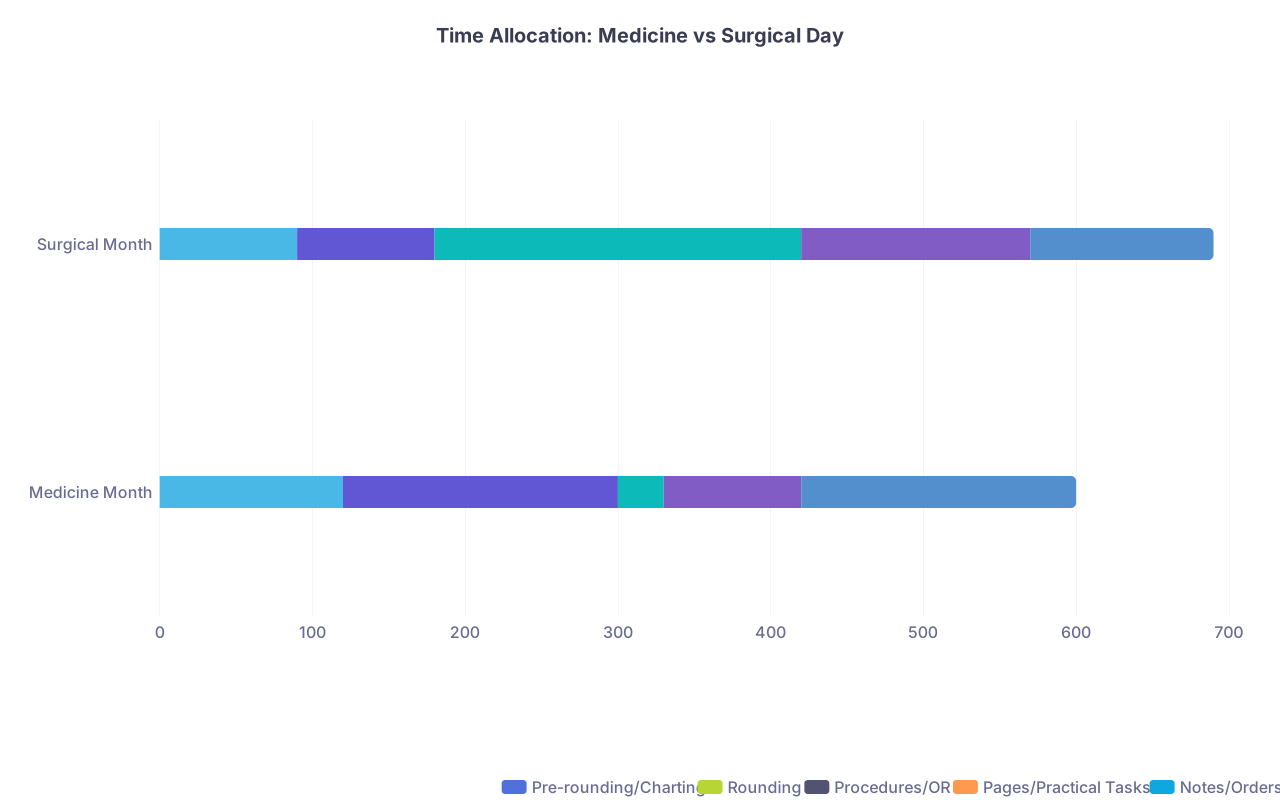
| Category | Pre-rounding/Charting | Rounding | Procedures/OR | Pages/Practical Tasks | Notes/Orders |
|---|---|---|---|---|---|
| Medicine Month | 120 | 180 | 30 | 90 | 180 |
| Surgical Month | 90 | 90 | 240 | 150 | 120 |
You can see the basic pattern: more OR/procedure time, less prolonged rounding and essay-writing. Your workflow has to match that.
12. Simple Flow for Your Morning (Use This)
Here’s a quick process map you can mentally follow each early morning.

| Step | Description |
|---|---|
| Step 1 | Arrive 4 -45-5 -15 |
| Step 2 | Print/Update List |
| Step 3 | Scan Overnight Events and Orders |
| Step 4 | Pre-round Chart Review Per Patient |
| Step 5 | Bedside Checks - Symptoms and Exam |
| Step 6 | Annotate List with To Dos |
| Step 7 | Enter Quick Orders that Are Obvious |
| Step 8 | Pre-round Huddle with Senior |
| Step 9 | Team Rounds |
| Step 10 | Update Orders and Notes |
If you just follow that loop every morning for the first week, you’ll settle into a rhythm much faster.
FAQ (Exactly 5 Questions)
1. How early should I arrive on my surgical month?
Earlier than feels comfortable, at least for the first week. If rounds are at 6:30, most interns need to be physically in the hospital by 4:45–5:00 to pre-round properly on a typical 15–25 patient list. Once you get faster with your review and notes, you might shave 15–20 minutes off, but do not be the person racing to finish pre-rounding during rounds. That reputation sticks.
2. Do I really have to examine every wound and drain myself?
Yes, unless your team explicitly says otherwise. Wounds and drains are core surgical data, not optional extras. You do not need a detailed 5-minute abdomen exam for every stable patient, but you must lay eyes on incisions and drains. A nurse telling you “looks fine” is not enough when the attending asks, “What does the wound look like? How much in the JP in the last 24 hours?”
3. What if my notes are too short and attendings complain?
Then you adjust, but don’t default back to medicine-length novels. Ask directly: “What do you want to consistently see in daily notes?” Then build a template that covers those points but stays concise. Many attendings care less about length and more about: clear POD status, relevant vitals/labs, wound/drains, and a specific plan. If they want a systems-based A/P, you can still keep each system to a line or two.
4. How do I keep from looking clueless when I don’t know surgical details (like specific procedures)?
You’re not expected to operate like a fellow, but you are expected to know what was done in broad strokes. Before rounds, skim the operative note summary: “laparoscopic vs open, what they removed or repaired, any complications, special instructions.” Write a 1-line summary in your list. When you present, say: “POD2 s/p lap sigmoid colectomy for diverticulitis, no intra-op complications.” That alone shows you’ve done the minimum homework.
5. I’m overwhelmed by pages during the OR block—how do I stay afloat?
Create your own triage rules and confirm them with your senior. Keep a running list of pages and handle in batches whenever safe. For each page, quickly decide: (1) go now (unstable), (2) give a nursing phone order if appropriate, or (3) add to “floor sweep” and hit them systematically. When in doubt, go see the patient, but don’t let yourself get jerked around without a plan. Over time, you’ll recognize patterns and handle most pages in under 2–3 minutes.
Key points to carry with you:
- Switch your brain from “explain everything” to “is the post-op course safe and progressing?” That mindset change is half the battle.
- Standardize your mornings: fast chart review, focused bedside checks, annotated list, then efficient notes and orders. No improvising at 5 am.
- Treat the first 72 hours as a learning sprint—copy your seniors’ patterns for common post-op issues, and you’ll stop feeling like a medicine intern lost on a surgical island.