
Most residents are using SBAR and I-PASS incorrectly—and it is costing them time, clarity, and sometimes patient safety.
Let me break down how to actually weaponize these tools, not just recite them for a safety module.
Why Your Current Sign-Out Is Weaker Than You Think
Every resident thinks their sign-out is “pretty good.” Then a night float calls three times about the same patient because the anticipatory guidance was garbage. Or worse, a cross-cover misses a critical action item because it was buried in a paragraph of noise.
The core problems I see over and over:
- People use SBAR and I-PASS as checklists, not as communication structures.
- They ignore local workflow realities: EMR constraints, team size, night float coverage, ICU vs floor.
- They do not separate “must know to keep this patient alive tonight” from “nice background data”.
- They do not tailor their handoff to who is receiving it (intern vs senior, night float vs day float, ED vs ICU).
You fix those, and suddenly your sign-out becomes faster, safer, and far less annoying.
We will go through:
- What SBAR and I-PASS are actually good for.
- How to build advanced, layered sign-out structures.
- Real-world modifications that make sense on busy services.
- Specialty-specific tweaks (medicine, surgery, ICU, ED).
- A practical template you can start using tomorrow.
Core Frameworks: SBAR vs I-PASS (What They’re Actually For)
Let’s start clean. These are different tools. Stop trying to use I-PASS for a rapid escalation conversation and SBAR for a complex night float handoff.
SBAR – The “Acute Situation” Framework
SBAR = Situation, Background, Assessment, Recommendation.
SBAR is ideal for:
- Rapid escalation: “I need you to come now.”
- Brief cross-disciplinary calls: ED → medicine, ward → ICU, nurse → resident.
- Micro-handoffs during a shift: “Can you follow up this potassium I ordered?”
Example of effective SBAR from a resident to ICU fellow:
- S (Situation): “This is the night float on 7B. I am calling about Mr. James Carter in 732, becoming hypotensive now—BP 78/40.”
- B (Background): “Admitted today with septic shock from pneumonia, already on broad-spectrum antibiotics, s/p 2.5 L fluids, was stable for several hours.”
- A (Assessment): “He is altered from baseline, new lactate 4.2 from 2.1, urine output has dropped, MAP has been trending down over the last 30 minutes despite more fluids.”
- R (Recommendation): “I think he needs pressors and ICU transfer. Can you come evaluate at bedside now?”
SBAR is short, pointed, and action-oriented. No one wants a novel here.
I-PASS – The “Longitudinal Handoff” Framework
I-PASS = Illness severity, Patient summary, Action list, Situation awareness/contingency planning, Synthesis by receiver.
I-PASS is ideal for:
- End-of-shift sign-out (day team → night team).
- Longitudinal patient handoff (vacation coverage, switching rotations).
- Teaching structured thinking to interns and students.
Example of standard I-PASS for one patient:
- I (Illness severity): “Watcher.”
- P (Patient summary): “68-year-old male with CHF, CKD, and DM admitted 2 days ago with acute decompensated heart failure, now diuresing well, on 2 L NC, net negative 1.5 L today.”
- A (Action list): “Recheck BMP at 22:00, page cardiology in the morning with updated weights, continue strict I/O.”
- S (Situation awareness / contingency): “If he gets more short of breath or needs more than 4 L O2, get a STAT CXR, ABG, and call me; he has a tenuous EF of 20%.”
- S (Synthesis by receiver): Receiver re-states key tasks: “So tonight I need to watch his O2 needs, repeat a BMP at 10 pm, and if he needs higher O2 or looks worse, get CXR/ABG and call you.”
I-PASS is about shared mental models and future planning, not only checklists.
The Real Constraint: You Do Not Have Time for Pure I-PASS on 20–30 Patients
Here is the part the patient safety committee will not say out loud: if you have 25 patients and 15 minutes to sign out, pure textbook I-PASS per patient is fantasy.
So you need layered structure:
- Macro-level structure – how your whole list is organized.
- Micro-level structure – how you sign out each individual patient.
- Priority tiers – how much time and detail each patient actually gets.
Let us build that.
Step 1: Build a Tiered Illness Severity System That Actually Works
“Illness severity” in I-PASS is too vague when people say “stable” for almost everyone. That is useless.
You want a tiered, behavior-linked system so the night team instantly knows where to focus.
Here is a practical 4-tier system that works on real wards:
| Tier | Label | What It Really Means |
|---|---|---|
| 1 | Critical | Might crash, needs active watching |
| 2 | Watcher | Could decompensate, specific worries |
| 3 | Stable | Routine, low risk overnight |
| 4 | Dispo | Medically stable, mainly dispo issues |
Now tie behavior to each tier.
Critical:
Needs: detailed I-PASS, explicit contingencies, active tasks, likely calls overnight. Example: new GI bleed, septic shock, new arrhythmia.Watcher:
Needs: medium-depth summary, 1–3 concrete tasks, one clear “if X then Y” statement.Stable:
Needs: very concise summary, only active tasks, no biography. No one cares about their MI in 2014 for tonight’s cross-cover.Dispo:
Needs: social and logistical info + what must be done so they can leave.
Now your first pass through the list at sign-out is not data—it is triage:
- “We have 3 critical, 7 watchers, 10 stable, 5 dispo. Let us start with the top 10 and go deeper; the stable group will be much tighter.”
Step 2: Hybridizing SBAR + I-PASS for Real-World Use
The best sign-outs I have heard combine the clarity of SBAR with the structure of I-PASS. Especially for your highest-risk patients.
For Critical / High-Risk Patients: SBAR-I-PASS Hybrid
Use a short SBAR to front-load urgency, then I-PASS for details.
Example for a tenuous septic shock step-down patient:
- S (Situation): “This is Ms. Lopez in 514. She is a critical patient—septic shock from pyelonephritis, just downgraded from ICU, still high risk of decompensating.”
- B (Background): “ICU for 3 days on pressors, off vasopressors since this morning, now on 3 L NC, MAP has been stable but borderline at times.”
- A (Assessment): “She is improving overall, but still early in her course. Creatinine 2.4 from baseline 1.0, on broad-spectrum antibiotics, lactate normalized.”
- R (Recommendation): “I want a low threshold to call if her MAP drops or O2 demands go up.”
Then immediately drop into abbreviated I-PASS elements:
- Illness severity: “Critical.”
- Action list: “Check a BMP at midnight, repeat lactate if she looks worse, titrate fluids cautiously because of renal function.”
- Situation awareness / contingency: “If her MAP < 65 despite a 500 mL bolus, call rapid response and consider ICU consult. If O2 need > 5 L or she looks more dyspneic, get a STAT CXR.”
- Synthesis by receiver: Make sure the night resident repeats back the thresholds and triggers.
This is overkill for everyone. But for the 3–5 patients who might try to die on you overnight, overkill is correct.
Step 3: Micro-Structures by Tier
You should not talk about every patient the same way. That is how you waste time and lose attention.
Template for “Critical” Patients (2–4 per list)
Aim for 60–90 seconds each.
- One-line SBAR-style opener: “Why do I care about this patient tonight?”
- Focused summary: 2–3 lines, present tense, anchored to the current problem.
- Explicit action list, chronological if possible.
- Clear “if-then” contingencies (not generic “call if concerned” fluff).
- Synthesis by receiver. Especially for new interns or rotating residents.
Example:
“Ms. Lee in 721 is critical. She is a 45-year-old with DKA, just came out of the ICU, still acidotic but improving. Gap is downtrending but not closed, on insulin drip transitioning to subcutaneous tomorrow.
Tonight:
- Recheck BMP at 23:00 and 03:00.
- Keep her NPO till we confirm she can transition off drip.
If her anion gap starts rising again or she becomes more altered, call me and get a VBG and serum ketones. If she vomits, watch closely for aspiration and call rapid if she desats.
Can you repeat her key labs and what you are watching for?”
That last line forces active listening.
Template for “Watcher” Patients (5–10 per list)
Aim for 30–45 seconds each.
- Illness severity + core problem: “Watcher—post-op day 1 from bowel resection, risk for bleeding.”
- One sentence of relevant summary (what changed today).
- 1–3 action items.
- One specific contingency.
Example:
“Mr. Patel in 630 is a watcher. POD1 from right hemicolectomy, Hgb dropped from 12 to 9.5, but stable, vitals OK, good urine output.
Tasks: repeat CBC at 02:00, keep NPO after midnight.
If his Hgb drops below 8 or his systolic BP stays below 90 despite fluids, call surgery senior—this could be a post-op bleed.”
Template for “Stable” Patients (the bulk)
Aim for 10–20 seconds each, truly.
- One-liner: ID + current problem + hospital day.
- Only active tasks or “no tasks”.
- At most one contingency if there is something non-obvious.
Example:
“Ms. Gonzales in 618 is stable. 72-year-old with community-acquired pneumonia, HD3, improving, on 2 L NC.
Only task: check 06:00 BMP already ordered.
If she spikes a new fever after 24 hours afebrile, just get cultures and lactate and let me know.”
And for a truly stable, no-work patient:
“Mr. Yang in 620 is stable, awaiting placement, no tasks, no contingencies.”
Do not waste airtime.
Template for “Dispo” Patients
These are the ones who can clog your list for days if you do not sign out the social/logistical reality.
- Short medical one-liner.
- Disposition barrier in plain language.
- What exactly needs to happen and who is responsible.
Example:
“Mr. Davis in 512 is a dispo patient. Medical issues resolved after CHF exacerbation. He needs SNF, but insurance is pending.
Tasks: none tonight.
Tomorrow the day team needs to call case management and recheck SNF bed availability. If family calls overnight asking, you can tell them we are just waiting on placement, he is otherwise stable.”
Step 4: Modifying Sign-Out by Setting and Specialty
Different settings demand different emphases. If you sign out ICU the same way you sign out gen med, you will miss the point.
Medicine Wards
Priorities:
- Current clinical trajectory (“turning the corner” vs “teetering”).
- Anticipated overnight labs and imaging.
- High-yield contingencies: chest pain, confusion, new fevers, O2 changes.
Modifications:
- Use illness severity tiers aggressively.
- For complex multi-morbidity patients, collapse the past medical history into “what matters tonight.”
Do: “CAD with stents, EF 25%, CKD IV, insulin-dependent DM.”
Do NOT: read the entire problem list.
Surgery
Priorities:
- Post-op day, procedure, and surgeon.
- Expected course vs red flags: ileus, leaks, bleeding, wound issues.
- Drain outputs, NGT status, anticoagulation, pain control.
Modifications:
- Use consistent language for POD and status: “POD1 uncomplicated lap chole vs POD3 bowel resection, concern for ileus.”
- Action items: labs, imaging, dressing/wound checks, drain pulls.
- Contingencies: tachycardia, hypotension, Hgb drops, sudden increase in abdominal pain.
Example:
“Mr. Ramos in 710, watcher. POD2 from sigmoid colectomy. Has not passed flatus yet, some distension.
Tasks: keep NPO except sips, continue IVF, call surgery if he vomits or develops significant abdominal pain.
If HR stays > 110 or his belly becomes rigid, that is not normal—call the surgery senior immediately.”
ICU
ICU sign-out is its own beast. You are not just listing problems; you are handing over a plan for each organ system.
Priorities:
- Ventilator/respiratory status.
- Hemodynamics / pressors.
- Lines, tubes, drains, and sedation.
- Time-sensitive labs and interventions.
Modifications:
Think in systems:
- “Resp: Intubated, volume control, PEEP 8, FiO2 40%, stable plateau pressures.”
- “CV: On norepi at 0.05, MAP goal ≥ 65, lactate trending down.”
- “Renal: CRRT started 2 hours ago, watch filter pressures, fluid removal rate set low overnight.”
You still apply I-PASS concepts, but the “Patient summary” becomes organ-system oriented, and “Action list” is often very specific: titration rules, weaning attempts, scheduled imaging.
ED
ED “sign-out” is shift-based and often chaotic. Patients are incomplete stories.
Priorities:
- Disposition trajectory: likely discharge, likely admit, or “workup pending.”
- Bottlenecks: waiting on CT, troponin, consult.
- Time bombs: chest pain, abdominal pain, altered mental status without diagnosis.
Modifications:
Your structure looks more like:
- “ID + chief complaint + most concerning diagnosis on your radar.”
- “What is done, what is pending, and what will you do with results.”
- “What would make you change direction.” (e.g., “If CT is negative but pain persists, consider ultrasound / surgical consult.”)
Step 5: Embedding Sign-Out in Your Workflow (So It Is Not a 30-Minute Nightmare)
The best sign-outs are mostly prepared before sign-out. They are built in real time on rounds and throughout the day.
Use Your EMR SmartPhrases Properly
Most EMRs let you create smart phrases or templates. Use them to pre-structure your sign-out note.
Build something like:
- “.IPASS”
- I:
- P:
- A:
- S:
- S:
Then modify by tier. For stable patients you might only fill P + A. For critical ones, you fill the whole thing.
Many services also add fields like:
- Code status.
- Primary contact and phone.
- Consults involved.
You do not need to speak all of that at sign-out, but having it visible during cross-cover is huge.
Pre-Round Micro-Edits
During the day, as plans change, update the EMR sign-out area in real time:
- You hold a family meeting and shift from “full code + everything” to “DNR / DNI, focus on comfort.” Update illness severity and contingencies.
- You add a new 22:00 BMP. Add it to the action list as you order it.
By 5 pm, you are not creating sign-out. You are reviewing and prioritizing what is already written.
Visual: How Your Time Should Be Distributed
Most residents accidentally spend more time talking about stable, interesting patients and rush through the truly dangerous ones.
Flip that.
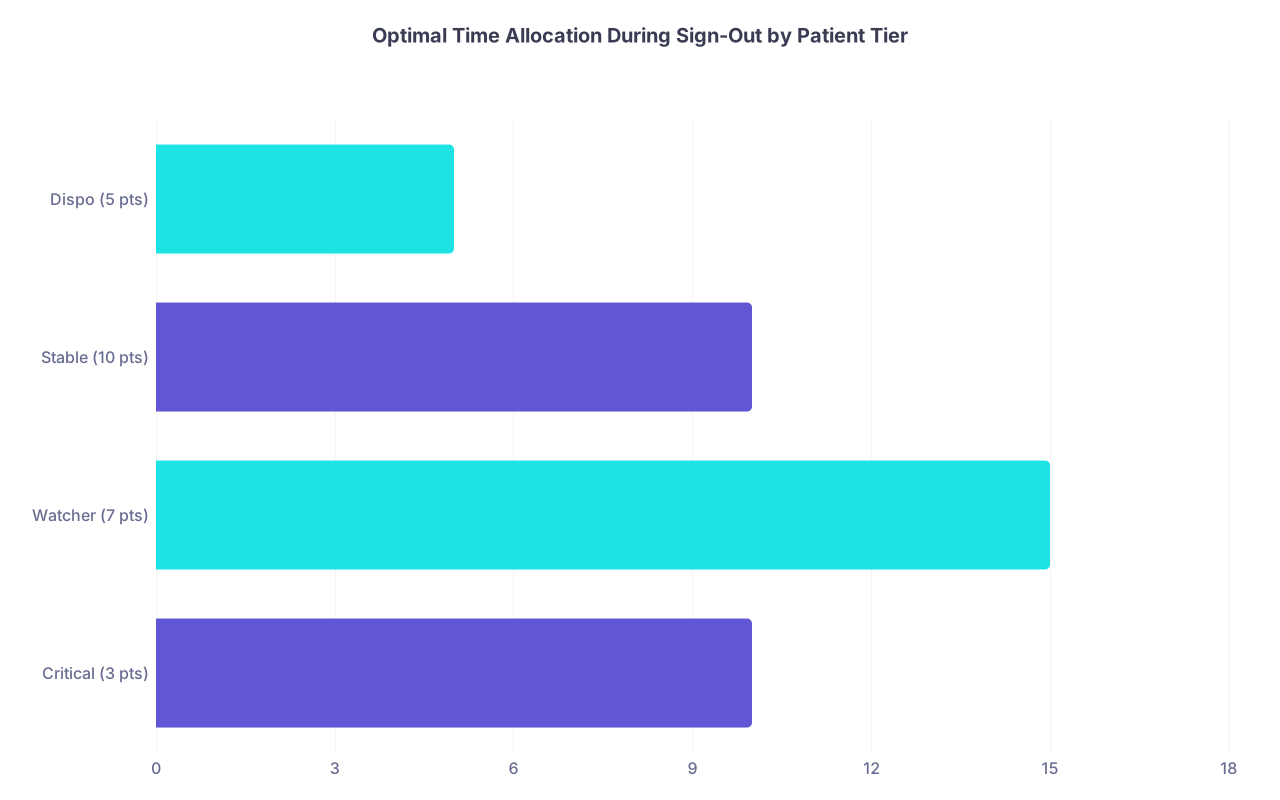
| Category | Value |
|---|---|
| Critical (3 pts) | 10 |
| Watcher (7 pts) | 15 |
| Stable (10 pts) | 10 |
| Dispo (5 pts) | 5 |
Example: For a 25-patient list and 40-minute sign-out:
- 10 minutes total on 3 critical.
- 15 minutes total on 7 watchers.
- 10 minutes total on 10 stable.
- 5 minutes total on 5 dispo.
You do not have to hit these numbers perfectly, but the concept matters: attention follows risk, not intellectual curiosity.
Step 6: Forcing Synthesis by Receiver Without Making Everyone Hate You
The last “S” in I-PASS (Synthesis by receiver) is usually ignored. Mostly because people are tired and do not want to role-play.
Use it selectively:
- With new interns or rotators.
- For truly high-risk or complex patients.
- When you can tell the receiver is drifting.
You do not need a script. Keep it short:
- “Can you repeat the two big things you are watching for on Ms. Lee?”
- “What are you doing if his BP drops again?”
If they cannot tell you, your sign-out failed. Fix it right there, not at 3 am.
Common Failure Modes and How to Fix Them
Let me call out the patterns I see that consistently hurt.
Failure Mode 1: Narrating the Entire Hospitalization
You: “He came in 5 days ago with chest pain, then day 2 he had some diarrhea, then day 3 nephrology saw him…”
Night float: “I do not care. What about tonight?”
Fix: Force yourself to answer this sentence in your own head before you speak:
“Tonight, what can reasonably go wrong with this patient and what do I need my cross-cover to know or do?”
If something in your sign-out does not serve that, cut it.
Failure Mode 2: Vague Contingencies
“Just call me if he looks worse.” That tells nobody anything.
Fix: Always pair a specific trigger with a specific action.
Bad: “If his breathing worsens, call me.”
Better: “If he needs more than 4 L NC OR his respiratory rate stays > 28, get a CXR, ABG, and call me.”
Failure Mode 3: Dumping Tasks With No Prioritization
Listing every order as equally important is noise.
Fix: Explicitly flag:
- “Must be done tonight” vs “If time” tasks.
- Time-sensitive vs whenever tasks.
You can literally say: “Two must-do’s: BMP at 22:00, troponin at midnight. If there is time, recheck stool output and document in the note, but that is non-urgent.”
Failure Mode 4: Zero Update to Sign-Out After Major Events
Code status changes. New rapid response. New imaging that flips the plan. Labs that completely change your differential.
Then sign-out still says “stable, no major overnight issues.”
Fix: Every significant event during the day should trigger a 30-second EMR sign-out edit. Develop this reflex.
A Concrete Composite Example: Good vs Bad
Let me put this into one side-by-side comparison for a single complex watcher.
Bad Sign-Out
“Mr. Johnson in 724. He is a 64-year-old male with a history of HTN, DM2, CKD, hyperlipidemia, prior MI in 2014, COPD, came in 3 days ago with shortness of breath and cough. He was found to have pneumonia; we started ceftriaxone and azithro, he was on 4 L, now on 3. He had some AKI on CKD, creatinine was 2.1 from 1.4 baseline, but this morning it was 1.8. Chest X-ray yesterday still shows infiltrate, but slightly improved. Pulm saw him. He is eating OK, still has a cough. So yeah, he is kind of stable. Just keep an eye on him.”
No explicit tasks. No contingencies. A lot of past tense.
Good Sign-Out (Watcher Tier, 35 seconds)
“Mr. Johnson in 724 is a watcher. 64-year-old with COPD and CKD, HD3 for community-acquired pneumonia, improving but with marginal respiratory reserve.
Tonight you need to:
- Recheck BMP at 22:00, already ordered, to follow his AKI.
- Keep him on 3 L NC, goal sat 90–94 because of COPD.
If he needs more than 5 L O2 or his work of breathing clearly increases—accessory muscles, cannot finish sentences—get a STAT CXR and ABG and page me. Given his COPD and CKD, he can crash quickly.”
That is advanced sign-out. Short, targeted, actionable.
Visual: Advanced Handoff Workflow
Here is how the overall workflow of an “advanced” handoff structure looks over a 24-hour cycle.

| Step | Description |
|---|---|
| Step 1 | Morning Rounds |
| Step 2 | Update EMR Sign-Out Fields |
| Step 3 | Midday Events - Edit Sign-Out After Major Changes |
| Step 4 | Pre-Sign-Out Triage by Illness Tier |
| Step 5 | In-Person Verbal Handoff Using Tiered Scripts |
| Step 6 | Night Team Clarifies and Synthesizes Key Patients |
| Step 7 | Night Documentation and Task Completion |
| Step 8 | Morning Feedback from Night to Day Team |
Specialty / Service Comparison at a Glance
Just to crystallize how the emphasis shifts by service:
| Service | Highest Priority Elements | Typical Pain Point |
|---|---|---|
| Medicine | Illness trajectory, contingencies, labs | Overlong histories, vague plans |
| Surgery | POD, complications, drains, bleeding risks | Under-communicated red flags |
| ICU | Organ systems, titration rules, time-critical tasks | Cognitive overload, too much data |
| ED | Disposition trajectory, pending results, time bombs | Unclear “what next if X” |
| Pediatrics | Parents, feeding, fluids, infection focus | Missing social context and follow-up |
Two Real-World Modifications That Quietly Change Everything
If you remember nothing else, do these two:
Write your contingency plans as orders to a tired future version of yourself.
Ask: “If I were half-asleep at 3 am, what EXACT sequence of actions would I want written down?”Say illness severity out loud for each patient.
“Critical / watcher / stable / dispo” at the start of every sign-out line.
It trains your brain. It guides the listener. It sharpens your own risk assessment.
Small language shifts like that are what separate average residents from the ones everyone trusts.

FAQ (5 Questions)
1. Should I literally say every letter of I-PASS for every patient?
No. That is how you end up with an hour-long sign-out that everyone hates. Use the concepts of I-PASS, not the rigid script. For critical and watcher patients, you hit most elements explicitly. For stable patients, you mainly cover patient summary + action list, with contingencies only if something non-obvious could happen. The framework is a scaffold, not a legal requirement.
2. How do I handle sign-out for patients I barely know (post-call, new admission)?
Be honest and structured. Start with: “New admit, I have limited familiarity.” Then give the core: reason for admission, highest-risk issue, immediate tasks, and contingencies based on what you do know. Use the EMR sign-out section aggressively—copy the ED or consult note one-liner, document what labs/imaging are pending, and what you expect to do with results. Clarity about uncertainty is safer than pretending you know more than you do.
3. What about phone sign-out when we cannot meet in person?
You tighten even more. Use a consistent pattern so your co-resident’s brain can auto-parse it. For example per patient: “Severity, one-liner, 1–2 key tasks, 1 contingency.” After going through the list, pause and ask: “Who do you want me to repeat in more detail?” Also, be disciplined about updating EMR sign-out so they have a reference while you talk. Phone handoff without written backup is a setup for mistakes.
4. How can I practice giving better sign-out without annoying my co-residents?
Pick one or two micro-skills at a time instead of overhauling everything. For a week, focus only on making your contingencies specific and your illness severity explicit. The next week, refine your “stable” patient sign-outs to be 10–15 seconds max. Ask one trusted senior for pointed feedback: “Were there 1–2 patients tonight whose sign-out was unclear or too long?” Residents are usually happy to help if you are precise about what you want.
5. Is it worth enforcing synthesis by receiver with experienced seniors?
With seniors you trust, use it sparingly and only for the hairiest cases. You do not need them to parrot back a stable COPD admission. But for a critical GI bleed, a tenuous post-op, or a complex ICU transfer, a 5–10 second synthesis (“So I am watching X and Y, and doing Z if A happens”) prevents catastrophic miscommunication. Think of it as a safety check, not a teaching exercise, and people tolerate it much better.
Key points, bluntly:
- SBAR is for acute, action-driven communication; I-PASS is for structured, anticipatory handoff. Do not mix them blindly.
- Tier your patients (critical / watcher / stable / dispo) and allocate time and detail based on risk, not habit.
- Make your sign-out explicitly actionable: concrete tasks, clear contingencies, and, for high-risk patients, a short synthesis by the receiver.