
63% of internal medicine residents report that “keeping track of everything” with multimorbid patients is harder than the actual medical decision making.
They are not wrong.
The complexity is not just the disease burden. It is the information burden. Ten problems, four consultants, twenty meds, a social mess, and discharge “for tomorrow” that never actually happens. If you try to hold that in your head, the ward will eat you alive.
You need a system. One that works at 6:30 a.m. on post-call day when your brain is oatmeal.
Let me lay out a systematic, reproducible method to organize multimorbid patients on ward rotations. This is not theory. This is the pattern the efficient seniors and early attendings quietly use while the rest of the team drowns in Epic tabs.
1. The Core Framework: One Primary Problem, Three Buckets
Multimorbid patients feel chaotic because everything looks equally important. It is not.
If you remember only one principle, use this:
Every complex inpatient = 1 primary problem + 3 buckets: Acute, Chronic, Disposition.
Step 1: Name the primary problem in one sentence
Force yourself to write a single, honest, non-fluffy line at the top of your note or list:
“Decompensated HFrEF with cardiorenal syndrome in a patient with poorly controlled T2DM and COPD.”
Not:
“58-year-old male with history of HTN, DM, COPD, HFrEF, CKD, depression who presents with…”
That second one is an autobiography. Not a problem list.
The primary problem:
- Drives your daily priority.
- Anchors the rest of your reasoning.
- Makes sign-out comprehensible.
If you cannot say it in one sentence, you do not understand the admission yet. That is your first task on pre-rounds.
Step 2: Sort everything into three buckets
For each patient, anything you are thinking about must fit into:
- Acute / Active problems (today’s survival and major trajectory)
- Chronic / Background disease (matters for context and meds, but not driving today)
- Disposition / Systems issues (where they are going and what is blocking that)
That’s it. No more than three buckets. If you need more, you are hiding fuzziness behind complexity.
Here is how that feels in practice for a truly messy patient:
Primary problem: Septic shock from pneumonia in a patient with advanced COPD, CKD4, CAD, and dementia.
Acute/Active:
- Septic shock – day 2, off pressors 6 hours.
- Hypoxic respiratory failure – high-flow nasal cannula.
- AKI on CKD – creatinine 3.2 from baseline 2.0.
- New-onset AF with RVR – rate-controlled on metoprolol.
Chronic/Background:
- CAD with prior stent (Plavix, statin).
- Advanced COPD on home oxygen.
- Dementia, baseline oriented x1–2.
Disposition/Systems:
- PT/OT eval pending for rehab vs SNF.
- Daughter requesting family meeting about goals of care.
- Awaiting insurance authorization for rehab.
You can scan that in 15 seconds and actually know what is going on. More important: you now know what today has to target.
2. Designing a Daily “Cognitive Cockpit” for Multimorbid Patients
The EHR is not designed around how you think. It is designed around billing, compliance, and medicolegal cover. If you use it “as is,” you will miss things, repeat labs, and forget which consultant actually said what.
You need your own cockpit: a standardized way you see every patient. Same structure, every day.
The 7-line skeleton for each patient
I recommend forcing yourself into a compact structure that you can see on one screen or one index card.
For each patient, in your personal list (paper, OneNote, Notability, Excel, whatever), use:
- ID + Hospital day + Code status
- Primary problem (1 sentence)
- Today’s goals (max 3, actionable)
- Acute/Active problems (numbered, each with status)
- Key meds / drips / infusions (only what matters for decisions)
- Consultants + their current plan in one line each
- Disposition target + barriers
Looks like this in real life:
Mr. J, 72M, HD#5, DNR-CCA
Primary: Acute decompensated HFrEF with cardiorenal syndrome.
Today: 1) Transition from IV to PO diuretics. 2) Clarify discharge destination. 3) Reassess renal function trend.
Acute: (1) Volume overload – improving, net -1.5 L yesterday, exam still with JVD and 2+ edema. (2) AKI on CKD – Cr 2.8 (baseline 2.0), stable x24h. (3) Hypotension – SBP 90–100, asymptomatic.
Key meds: Lasix gtt 5 mg/hr, metoprolol 25 BID, hold ACEi.
Consultants: Cards – agrees with continued aggressive diuresis, no cath. Nephro – ok up to Cr 3 if still volume overloaded.
Dispo: Likely home with home health vs SNF. PT/OT eval pending; lives alone with 3rd-floor walk-up.
Notice the discipline:
- Today’s goals are explicit.
- Acute problems are current status, not history summaries.
- Consultants are translated into actual decisions.
- Disposition is not some vague “dispo: TBD.” You name it and you name the barriers.
If you keep this format stable, you stop reinventing the wheel mentally 14 times every morning.
3. Problem List Triage: Not All Problems Deserve Equal Attention
Multimorbid patients come with impressive problem lists. I have seen attendings proudly carry over 27 medical problems from note to note like baseball stats. Useless.
Your job on wards is triage: decide what actually matters today and what can be safely parked.
The 4-level priority scale
For each problem (especially in multimorbid patients), decide where it sits:
P1 – Critical today
Life-threatening or trajectory-changing today; must move during this shift.- Examples: septic shock, active GI bleed, rapid AF with RVR causing hypotension, DKA, status asthmaticus.
P2 – Needs movement this admission
If you ignore this until discharge, it will bite you or the patient.- Examples: new diagnosis of severe AS, uncontrolled diabetes (A1c 11%) requiring regimen change, recurrent falls needing eval, new O2 requirement needing workup.
P3 – Chronic / background, maintain
Should be considered in orders, but no major active changes this admission.- Examples: stable CAD on appropriate therapy, well-controlled hypertension, stable dementia.
P4 – Historical / irrelevant now
Belongs in history, not active problem list.- Examples: pneumonia 5 years ago, prior surgery with no sequelae, “history of anemia” when Hgb has been normal for years.
Your note and your sign-out should be dominated by P1 and P2. P3 is almost always a single line. P4 should be purged ruthlessly.
| Priority | Definition | Typical Action |
|---|---|---|
| P1 | Critical today | Hour-by-hour tracking |
| P2 | Important this admission | Daily active plan |
| P3 | Chronic, stable | Maintain meds / awareness |
| P4 | Historical, not relevant now | Move to past history only |
This triage step is where many interns fail. Their “Assessment/Plan” reads like a past medical history plus yesterday’s labs. No priorities. No urgency.
You fix that by forcing yourself: label each problem P1–P4 in your own working list. Even a small “(P2)” at the end of the line changes how you think.
4. Integrating Labs, Imaging, and Consultant Noise Without Drowning
Multimorbid patients generate ridiculous amounts of data. Daily labs, new troponins “just in case,” repeat CXRs, 3 consultants each leaving a novella in the chart.
You need a method to:
- Stop scrolling through 50 tabs.
- Avoid re-ordering labs you already have.
- Actually act on consult recommendations.
The 24-hour window: What changed?
For each patient, limit your daily data review to a 24-hour window first. Yesterday 7 a.m. to today 7 a.m. This is the block that matters for “what happened since I last saw them.”
Ask yourself, in this order:
- Vitals: any instability, trend, or escalation in support?
- I/O: net fluid and route (IV vs PO), especially in cardiac/renal/liver patients.
- Labs: which values are moving in a meaningful way (not noise)?
- Imaging: any new studies reported?
- Consultants: any new notes or updated recs?
Then you park anything older unless you specifically need it (e.g., baseline creatinine, old echo).
Build a “trend box” for key metrics
For multimorbid patients with longer stays, you need quick access to trends, not single numbers. I like creating a mini 3–5 day trend “box” for a few variables:
- Creatinine / BUN
- Hgb
- WBC
- Key vitals (RR, SpO2, BP) if relevant
- Net I/O
You can write it in very small text on your own sheet or note. For example:
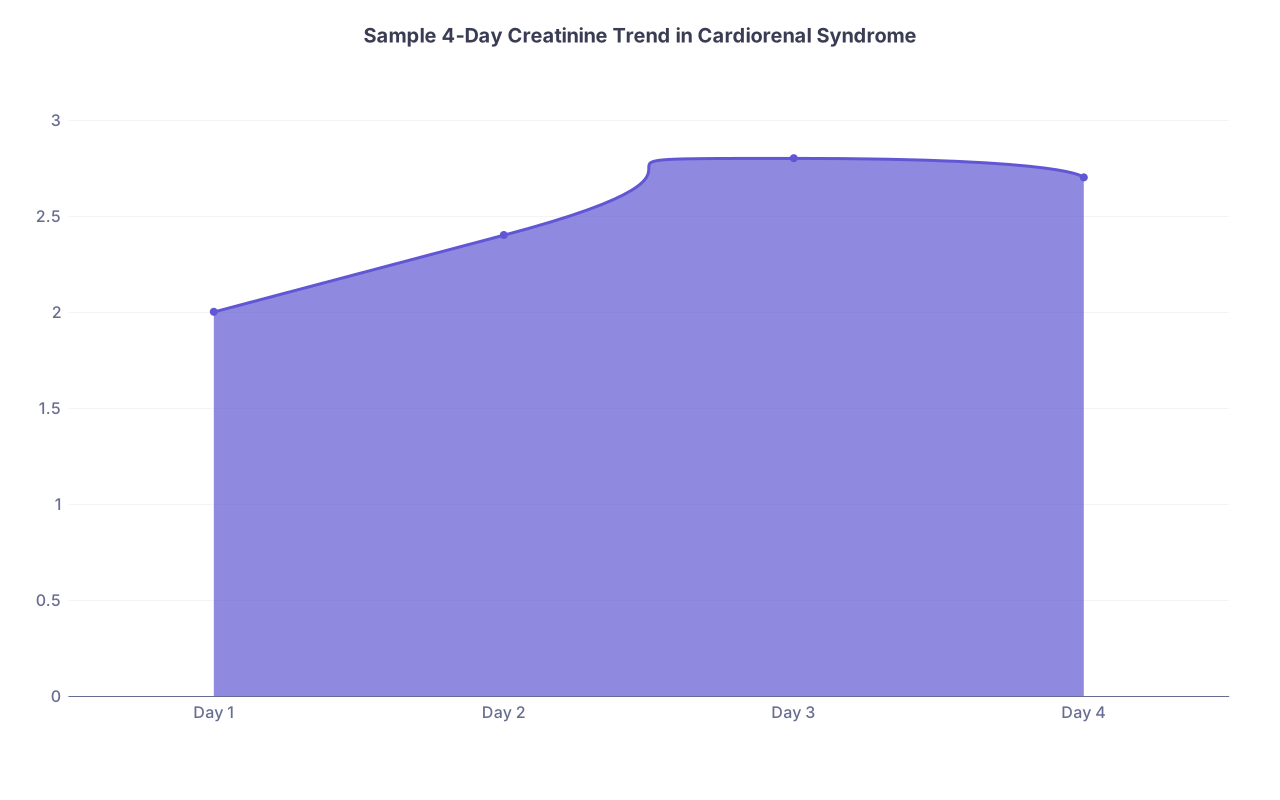
Cr: 2.0 → 2.4 → 2.8 → 2.7
WBC: 16 → 13 → 11 → 10
Hgb: 8.9 → 8.2 → 8.1 → 8.0
Net: -0.5L → -1.2L → -1.5L → -0.7L
You can see at a glance: creatinine peaked and is flattening, WBC trending down, Hgb stable-ish, diuresis slowing.
| Category | Value |
|---|---|
| Day 1 | 2 |
| Day 2 | 2.4 |
| Day 3 | 2.8 |
| Day 4 | 2.7 |
Compressing consultant notes into actual decisions
Consult notes in complex patients are notorious for:
- Repeating your entire H&P.
- Rewriting the plan in 3 paragraphs of hedging.
- Burying the one concrete recommendation in the middle.
Your method:
- Scroll to the bottom of the note.
- Find the “Impression/Recommendations” section.
- Extract only the actual changes they are recommending, in plain language.
For example, renally complex patient:
Renal note might say (buried):
- “Continue IV Lasix 40 mg BID; acceptable for creatinine to rise up to 3.0 if volume status is still overloaded. Avoid ACEi/ARB at this time. Reassess diuresis daily with weights and I/O.”
Your cockpit summary:
Nephro: ok with diuresis up to Cr 3.0; hold ACEi/ARB; daily weight/I&O.
That is all you need to remember. Everything else is background.
You also add a simple deadline. What are they asking you to reassess? “Reassess TTE in ~3 months” is not your problem during this stay. “Reassess volume daily” is.
5. Time-Boxing: Pre-rounding and Notes on 10+ Complex Patients
The fastest way to be crushed by multimorbidity is trying to give every patient equal time and equal documentation effort.
You cannot. You should not.
You need to time-box.
Pre-rounding with intent
Let’s say you have 12 patients, 8 of them multimorbid nightmares. You have 90 minutes before rounds.
You do not get 7.5 minutes per patient. That is a fantasy.
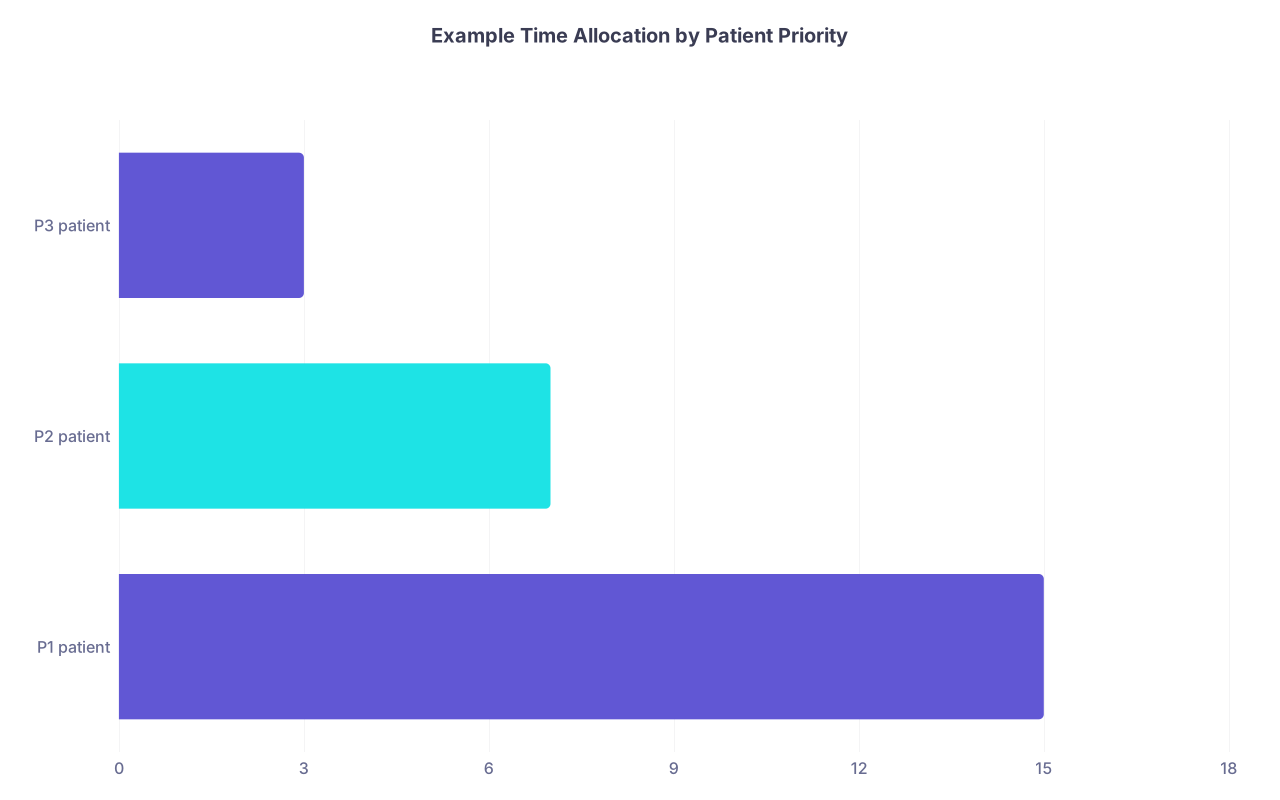
You assign time based on problem priority:
- P1-heavy patients (ICU transfers, unstable, frequent vitals): 10–15 minutes each.
- P2-heavy but stable: 5–7 minutes.
- P3-dominant, low-acuity: 2–3 minutes (quick chart check, focused exam).
You must know before you even start:
- Which 2–3 patients are P1-heavy (today’s fires).
- Which 4–5 are P2-heavy (need actual plan work).
- Which are relative “maintenance” patients.
This is where the triage scale from section 3 becomes not just organizational, but a scheduling tool.
| Category | Value |
|---|---|
| P1 patient | 15 |
| P2 patient | 7 |
| P3 patient | 3 |
Note-writing on multimorbid patients
Your notes should not be a second H&P every day. For complex patients, focus on:
- Problem-based A/P organized by your three buckets.
- Focused update on what changed in the last 24 hours.
- Explicit plans with “if/then” clauses where possible.
Example segment for a multimorbid patient:
1. Septic shock from pneumonia (P1)
Now off pressors x 6 hours; MAP >65 on low-dose norepi overnight, weaned off this morning. Lactate normalized. Still tachypneic but oxygen requirement stable on HFNC 50%/40 L.
- Continue cefepime/azithro day 3.
- Repeat lactate at noon.
- If MAP <65 for >30 min, restart norepi per ICU protocol.
- Follow up blood culture sensitivities; narrow antibiotics if possible tomorrow.
You do not rewrite the entire sepsis criteria. You show movement and a plan.
Complex chronic issues (“history of CAD, HTN, HLD, BPH, GERD”) get 1–2 lines max unless they are actively influencing today.
6. Disposition: The Most Neglected “Problem” in Multimorbid Patients
Multimorbid patients often stay longer not because of medical complexity, but because disposition planning began on “discharge day” instead of on admission.
You fix this by treating disposition as a P2 problem from day 1.
The 3-step disposition checklist
For each complex patient, you mentally walk through three questions every day:
Destination: Where do I suspect they are actually going?
- Home without services
- Home with home health
- SNF / rehab
- LTACH
- Hospice / comfort
Barriers: What is concretely blocking that?
- Medical: still needs IV meds, unstable O2, too weak to transfer safely.
- Functional: cannot ambulate, cannot transfer, cannot manage ADLs.
- Social: no caregiver, unsafe home, insurance blocks, housing issues.
- Administrative: pending insurance auth, no SNF bed, waiting on family meeting.
Next action: What can be advanced today?
- Order PT/OT if not already.
- Schedule family meeting.
- Clarify goals of care with patient.
- Notify case management of probable destination early.
Your list entry should not say “Dispo: TBD.” It should look like:
Dispo: Likely SNF. Barriers: needs PT/OT eval; lives alone; 3 prior falls in 6 months. CM aware; family prefers within 10 miles of home.
You bring this to rounds. Aggressively. Because on complex patients, if you do not drive dispo, it will happen to you instead.

| Step | Description |
|---|---|
| Step 1 | Admit multimorbid patient |
| Step 2 | Estimate likely destination |
| Step 3 | Identify barriers |
| Step 4 | Medical issues |
| Step 5 | Functional issues |
| Step 6 | Social or admin issues |
| Step 7 | Daily medical plan |
| Step 8 | PT OT consult |
| Step 9 | Case management plus family |
| Step 10 | Reassess dispo daily |
| Step 11 | Discharge |
7. Handoffs and Sign-out: Making Multimorbidity Safe for Night Float
Where this all collapses is at sign-out. Multimorbid patients get handed off as:
“He’s got a lot going on, read my note, but main thing is he’s just sick, call me if anything happens.”
Absolutely useless.
An effective sign-out for a complex patient is distilled around three elements:
- Active problems that can break tonight.
- Clear “if/then” algorithms for those problems.
- Explicit “do not do X” boundaries.
The “3 risk, 3 action” structure
For each high-risk multimorbid patient you are signing out, limit yourself to:
- Up to 3 biggest risks overnight.
- For each, what to do first, and when to escalate.
Example:
Mr. K, HD#4, septic shock improving, DNR-CCA
- Risk 1: Hypotension – off pressors since noon; MAP 65–70. If MAP <60, give 500 mL LR bolus x1. If still <60, call MICU fellow; do not restart pressor without discussing.
- Risk 2: Worsening respiratory status – currently on HFNC 50%/40 L. If increased work of breathing or SpO2 <88% despite max HFNC, call MICU and family for goals-of-care discussion; he is DNR-CCA but accepts non-invasive support.
- Risk 3: AF with RVR – rate now 90–110 on metoprolol. If HR >130 sustained for >30 min and SBP >100, give metoprolol 5 mg IV q5min up to 15 mg and page me; if SBP <100, call MICU.
That is how you make complexity survivable for night float.
You will notice this mimics your own internal framework: primary problems, acutely unstable issues, and concrete disposition/goals-of-care boundaries.
8. Tools and Templates: Making the System Fast, Not Fancy
You do not need exotic apps. You need speed and consistency.
That said, there are tools that make this easier:
- EHR custom patient lists: Many systems (Epic, Cerner) let you create custom columns. Use them for:
- Code status
- Primary problem
- Predicted dispo (Home, SNF, LTACH, Hospice)
- Smart phrases / templates: Build a skeleton A/P with:
- “Primary problem:” line
- Sections for “Acute/Active,” “Chronic/Background,” “Disposition/Systems”
- Problem-based headings
- Index cards / pocket notebooks: For interns drowning digitally, a 3x5 card per complex patient with:
- Front: ID, primary problem, today’s 3 goals.
- Back: key trends and consult plans.

If you rotate between hospitals with different EHRs, this becomes even more important. Your mental structure must be portable; the software is incidental.
9. A Concrete Example: Walking Through a Realistic Multimorbid Case
Let me show you how this all fits for a patient every medicine resident has seen.
Patient: 79F, HD#3
PMH: HFrEF (EF 30%), CKD3, T2DM, COPD, prior stroke with residual weakness, venous stasis ulcers, mild dementia, depression.
Admission: Shortness of breath, weight gain, LE edema.
Step 1: Primary problem and buckets
Primary problem:
Acute decompensated HFrEF with cardiorenal syndrome in a frail elderly patient with COPD and prior stroke.
Acute/Active:
- Volume overload with hypoxic respiratory failure.
- AKI on CKD.
- Mild delirium.
Chronic/Background:
- HFrEF, baseline NYHA III.
- COPD on home O2 2 L at night.
- T2DM on insulin.
- Prior stroke with residual R-sided weakness.
- Venous stasis ulcers.
- Mild dementia.
Disposition/Systems:
- Lives alone, daughter visits twice weekly.
- Baseline uses walker, multiple recent falls.
- PT/OT pending for dispo to SNF vs home with 24/7 support.
Step 2: Priority tagging
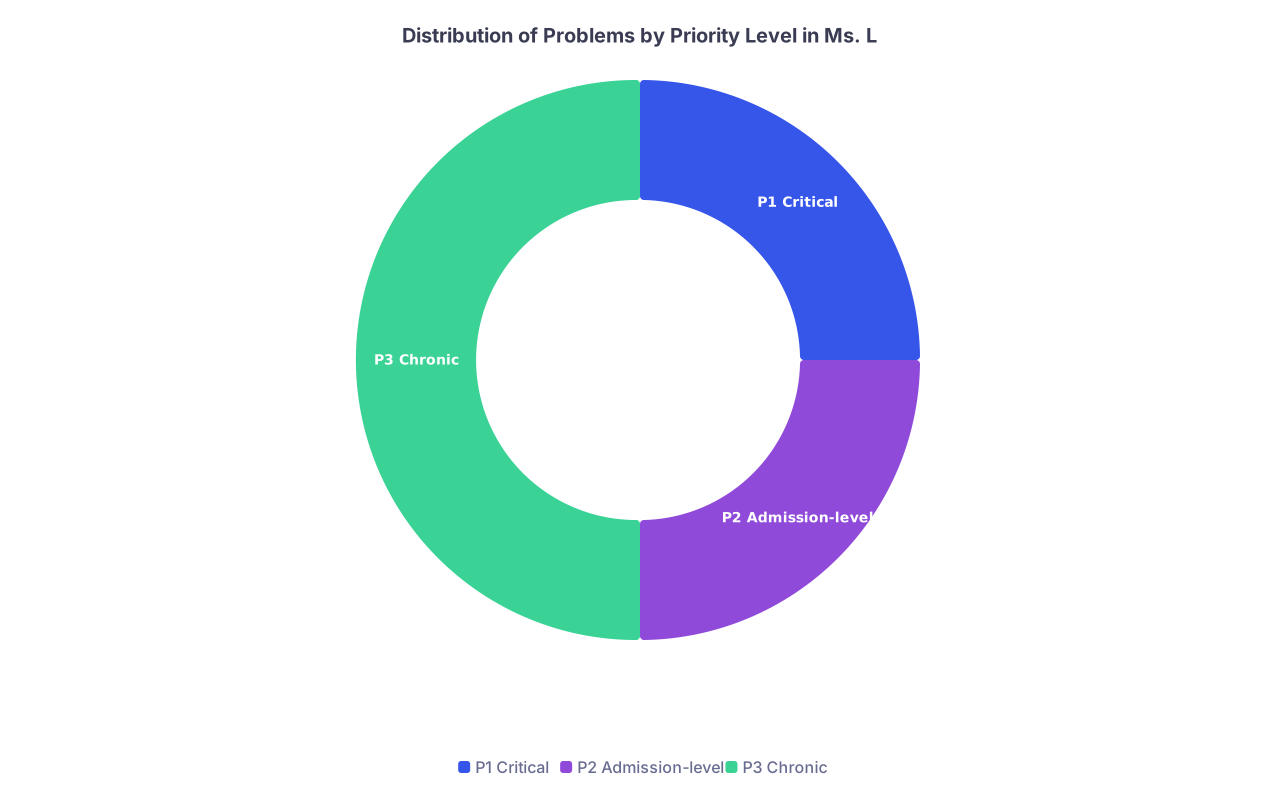
- Volume overload / respiratory failure – P1.
- AKI on CKD – P1.
- Delirium – P2 (will affect LOS and dispo).
- HFrEF baseline – P3.
- COPD baseline – P3.
- T2DM control – P2 (if sugars are 300s).
- Prior stroke, venous stasis ulcers, mild dementia – P3.
Step 3: Construct the cockpit entry
Ms. L, 79F, HD#3, DNR-CCA
Primary: Acute decompensated HFrEF with cardiorenal syndrome.
Today: 1) Achieve net -1.5 L while not pushing Cr >2.5. 2) Start dispo planning (likely SNF). 3) Reduce delirium risk factors.
Acute: (1) Volume overload – improved; net -1.0 L yesterday; still orthopneic, 2+ edema, small pleural effusions on CXR. (2) AKI on CKD – Cr 2.3 from baseline 1.6, stable vs yesterday. (3) Delirium – waxing/waning; oriented x1–2, mainly overnight confusion.
Key meds: IV Lasix 80 mg BID, metoprolol 50 BID, aspirin, statin, insulin glargine 12 units qHS with SSI.
Consultants: Cards – agree with aggressive diuresis; no advanced therapies. Nephro – ok with Cr up to 2.5 if improving volume.
Dispo: Likely SNF. Barriers: lives alone, multiple falls, needs PT/OT eval, daughter overwhelmed.
Step 4: Note and sign-out that match the system
In your A/P, you mirror this structure. In your sign-out, you highlight:
- Risk 1: Decompensated HF with AKI – if SBP <90 or MAP <65, call me; no bolus before assessing volume status.
- Risk 2: Delirium – high fall risk, bed alarm on, sitter in place.
You see the pattern. Same framing, different output (note, sign-out, round presentation).
| Category | Value |
|---|---|
| P1 Critical | 2 |
| P2 Admission-level | 2 |
| P3 Chronic | 4 |
10. The Mindset Shift: From “Complicated” to “Structured”
Once you start organizing patients this way, you will notice two things:
- Your subjective sense of “how sick” a patient is becomes clearer. Not just “a lot of stuff going on,” but “two P1 issues, several P2s, dispo is the real rate-limiter.”
- Your attendings and consultants start taking your presentations more seriously, because they are hearing reasoned structure, not raw data vomit.
One more point: this is not about being a documentation machine. This is about cognitive offloading. You build a system so that when you are post-call, hungry, and covering 18 patients, your past self did the thinking in an organized way.
That is how good residents survive busy ward months without burning out or missing dangerous trends.

Key Takeaways
- Anchor every multimorbid patient to one primary problem and three buckets: Acute, Chronic, Disposition. Then ruthlessly triage each problem P1–P4.
- Build a repeatable cockpit for each patient: a 7-line structure that includes today’s goals, active problem status, key trends, consultant recs, and explicit dispo plan.
- Use this structure to drive pre-round time allocation, safer sign-outs, and earlier disposition planning. The complexity will not go away, but your cognitive load will drop dramatically.