
The way most residents “pre-round” on ICU patients is dangerously inefficient.
They wander room to room, click randomly in the chart, copy yesterday’s note, add today’s labs, then show up to rounds with a wall of data and no story. The attending asks one pointed question about vent synchrony or pressor weaning, and the whole presentation falls apart.
You need a system. A template. Not a cute one-pager for a calm floor service. A high-yield pre-rounding template built for complex, crashing ICU patients.
Let me break this down specifically.
The Core Principle: Organize by Systems, Not by EMR Tabs
The EMR is designed for billing and medico-legal CYA, not for ICU-level clinical reasoning.
If you let the EMR dictate how you think, your pre-round is doomed. You will miss obvious things because they are buried in the wrong tab.
Your template must be:
- Written or printable (paper, iPad, whatever), independent of EMR layout
- Structured by organ system, not by data source
- Prioritized: current problems and active titratable drips first, trivia last
You are not trying to capture everything. You are building a fast, repeatable way to answer the questions your ICU attendings actually care about at 7 a.m.
Step 1: Define the “Absolute Must-Knows” for Every ICU Patient
Before we get cute with sections and subheadings, you need to hardwire a small set of non-negotiable data points that you will know cold on every ICU patient, no matter how complex.
I call this the “30-second board question” set. If they wake you up at 3 a.m. and ask about your intubated septic shock patient, these are the facts you must have.
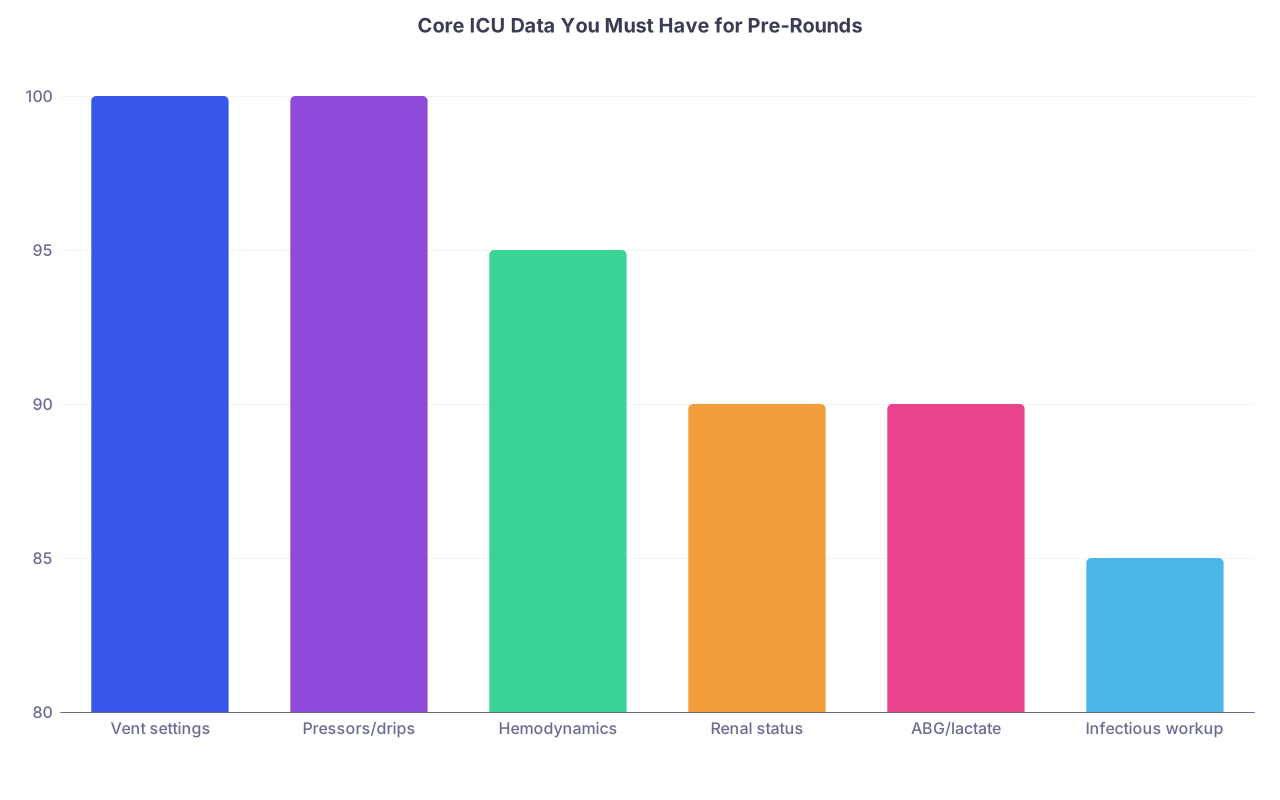
| Category | Value |
|---|---|
| Vent settings | 100 |
| Pressors/drips | 100 |
| Hemodynamics | 95 |
| Renal status | 90 |
| ABG/lactate | 90 |
| Infectious workup | 85 |
For every ICU patient on your list, you should pre-round to answer, without clicking:
Why is this patient in the ICU today?
Not the admission diagnosis from last week. The active ICU-level issue: “Refractory hypoxemic respiratory failure on high PEEP,” not “COVID pneumonia.”Airway & Ventilation
- Airway status: Intubated? Trach? NIV? High-flow? Room air?
- Mode, FiO₂, PEEP, set rate, tidal volume or pressure target
- Most recent ABG: pH / PaCO₂ / PaO₂ / HCO₃ / lactate
- Trend in FiO₂ and PEEP over last 24–48 hours (up, stable, weaning)
- Any ventilator events overnight: desats, dysynchrony, high peak pressures, auto-PEEP
Circulation & Drips
- Pressors: which, doses, trend (up/down), MAP goals
- Other drips: sedatives, analgesics, insulin, antiarrhythmics, inotropes
- Fluid status: yesterday’s net, cumulative net, current maintenance/bolus strategy
- Heart rate/rhythm pattern overnight (NSR, AF with RVR, ectopy issues)
Renal & Electrolytes
- UOP last 24h and last shift
- Creatinine trend (up, stable, down)
- On CRRT or intermittent HD? Settings and last run
- K⁺, Na⁺, Mg²⁺, Phos, Ca²⁺ – what was repleted, what still needs attention
Infection & Antibiotics
- Source (or suspected source) of infection
- Current antimicrobials + day of therapy
- Culture results pending and final
- Fevers overnight, WBC trend
Neurologic & Sedation
- Mental status or sedation level (RASS, CAM-ICU, GCS)
- Sedation/analgesia medications and recent changes
- Any neuro events: seizures, agitation, stroke workup, ICP issues if neuro ICU-ish
If you build your template so that you fill these out first, pre-rounding stops being an aimless EMR safari and becomes a targeted data extraction.
Step 2: The Skeleton of a High-Yield ICU Pre-Rounding Sheet
You want one page per patient. Max two. If your sheet is four pages of checkboxes, you will stop using it by day three of nights.
Here is a structure that actually holds up with 15+ complex ICU patients.
Top Banner: Snapshot and “Why ICU?”
This sits at the top of the page. No frills.
- Patient ID: Name, age, primary service, hospital day, ICU day
- Code Status: Full / DNR / DNI / CMO
- Isolation: Contact / Droplet / Airborne
- Why ICU Today (1 line): “Septic shock on high-dose norepi and vasopressin.”
- Today’s Main Goal (1–2 bullets):
- “Decrease FiO₂ if able, trial PEEP down”
- “Wean norepi if MAP >65, evaluate volume status”
If your attending asks “Why is this patient in the ICU and what is the plan for today?” and you cannot answer in two sentences, you do not understand the case.
Section 1: Overnight Events and Nursing Pain Points
This is where the real medicine lives. Not in the lab tab.
- Major events: desats, hypotension requiring boluses, arrhythmias, code blues, rapid responses, urgent procedures
- Vent events: high peak pressures, vent dyssynchrony, awakening/agitation, failed SBT
- Lines/tubes: new central line, art line, chest tube, EVD, drains placed or removed
- Nursing issues: uncontrolled pain, repeated bolus needs, agitation/restraints issues, line problems, tube feeds repeatedly held, glucose out of range
Have one free-text area for this. Use short phrases; you are cueing your brain, not writing a note.
Section 2: Airway, Breathing, Ventilators
For any respiratory support beyond simple nasal cannula, this needs structured detail.
For ventilated patients, I like a compact grid:
| Item | Example Entry |
|---|---|
| Mode | VC, AC/PC, PRVC, etc. |
| FiO₂ / PEEP | 60% / 10 |
| Set Rate / Spont Rate | 24 / 10 |
| Vt or Pressure | 6 mL/kg IBW or 16 cm H₂O |
| Peak / Plateau | 32 / 25 |
| ABG (last) | 7.32 / 52 / 68 / 24 / 2.1 |
Add:
- Trend: FiO₂ and PEEP compared to yesterday (↑, ↓, ↔)
- SpO₂ range overnight
- Any SBT attempt: pass/fail and why (tachypnea, desat, agitation, RSBI high)
- Imaging: CXR changes last 24h (better/worse congestion, new infiltrate, ptx)
For high-flow, BiPAP, or NIV:
- Device and settings
- Tolerance (kept on, repeatedly pulled off, facial breakdown)
- Escalations overnight (HFNC→BiPAP→intubation)
This section is where attendings will drill into ventilator strategy; if you have the mode, settings, and ABG ready, you look like you know what you are doing. Because you do.
Section 3: Circulation, Hemodynamics, and Drips
This is where many junior residents get lost. They list vitals but not the direction of travel.
Divide it like this:
Vitals trend (12–24 hours, not every reading):
- HR range
- BP / MAP range
- Tmax
- Rhythm summary: NSR, AF, PVCs frequent, runs of VT
Pressors and Inotropes:
- Drug, current dose, highest dose in past 24h
- Direction: “norepi 0.16 → 0.10 overnight,” “vaso stable at 0.03”
- MAP goal and whether we are meeting it
Other drips:
- Sedation (propofol, dex, midazolam)
- Analgesia (fentanyl, hydromorphone)
- Insulin infusion
- Antiarrhythmics (amio)
- Heparin drip (with last anti-Xa or PTT)
Fluid balance:
- Intake, output, and net over last 24h
- Cumulative net if relevant (post-ARDS week, severe HF)
- Fluid strategy: “aim net –1 to –2 L,” “euvolemic,” “gently positive for AKI”
You are trying to pre-answer: “Are they hemodynamically more stable, less stable, or the same as yesterday, and what did we do to them?”
Section 4: Renal, Electrolytes, and Output
Do not bury this under “labs” somewhere. For ICU patients, this is its own section.
Core elements:
- Creatinine: today vs yesterday vs baseline
- BUN: trend, especially on CRRT or severe catabolism
- UOP last 24h AND last 6–8h
- AKI stage if applicable
- On RRT?
- Type: IHD vs CRRT vs SLED
- Timing: last run / today planned
- Ultrafiltration goals achieved or failed
Electrolytes:
- Na, K, Mg, Phos, Ca today with arrows for trend
- Any major shifts or corrections: hypernatremia correction rate, repleted K multiple times, etc.
If you want it tight on paper, one small grid works very well.
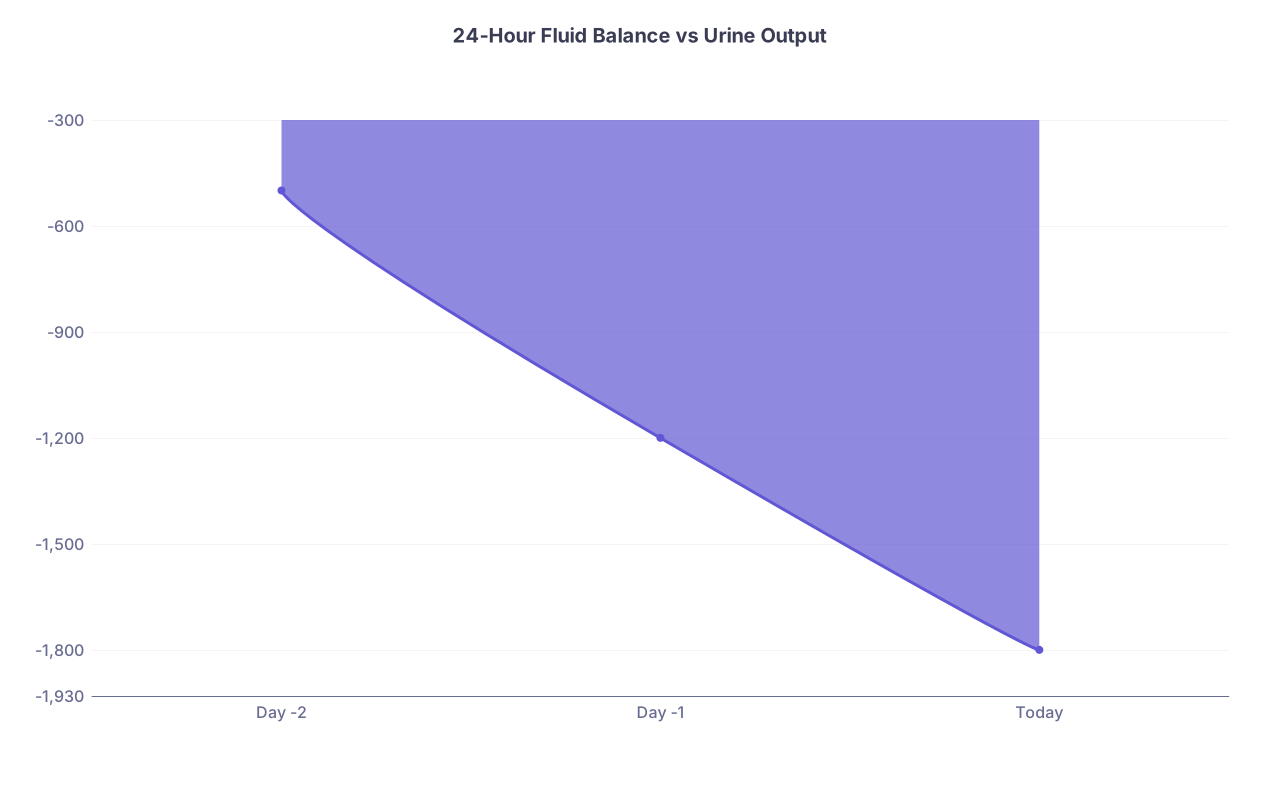
| Category | Value |
|---|---|
| Day -2 | -500 |
| Day -1 | -1200 |
| Today | -1800 |
Even a mental visual of fluid trend helps your plan: diurese harder, back off, or call nephrology about CRRT changes.
Section 5: Infection, Inflammation, and Antibiotics
This is where residents often drown in details. Do not list every random culture; organize by source.
Known / suspected sources:
- Pulmonary: VAP, aspiration, COVID, ARDS with infection component
- Intra-abdominal: peritonitis, pancreatitis, cholangitis
- Line-related
- Urinary
- Skin/soft tissue, nec fasc, etc.
- CNS infection
Antimicrobials:
- Drugs, doses, start date, “Day X of Y”
- Any de-escalation plans: “Consider narrowing vanc if MRSA PCR negative and cultures no growth at 48h.”
Fevers and inflammatory markers:
- Tmax last 24h
- WBC trend (with one or two previous days)
- CRP/procalcitonin trend if your unit uses them
Microbiology:
- Positive cultures, with organism and susceptibilities
- Negative cultures reaching meaningful timepoints
- Pending: highlight what you actually expect to change management
This setup lets you say, clearly: “We have a likely pulmonary source, on vanc/zosyn day 3, cultures negative at 48 hours, afebrile last 24 hours, WBC down from 18 to 12.2.”
That is what your attending wants to hear.
Section 6: Neurologic Status, Sedation, and Pain
Even non-neuro ICU patients live or die by how you manage their brain and comfort.
Key items:
Mental status at baseline vs today
- Intubated/sedated: RASS range, CAM-ICU if done
- Non-intubated: alert, oriented, delirious, lethargic, agitated
Sedation/analgesia:
- Drips (prop, dex, midaz) with doses and changes overnight
- Opioid regimen: drip vs PRN, total usage
- Scheduled adjuncts: gabapentin, acetaminophen, ketamine, etc.
Neuro pathology:
- Stroke: NIHSS, repeat imaging
- Seizure: AEDs, levels
- ICP if relevant: monitor values, EVD drainage, targets
A single line stating “RASS –2 to 0, CAM-ICU positive, on dex 0.7 and fentanyl 75 mcg/hr, attempting daily wake-ups” tells the team far more than a paragraph of fluff.
Section 7: GI, Nutrition, and Endocrine
This is where many ICU notes list every medication and forget the actual clinical questions.
For GI/Nutrition:
- NPO vs diet vs tube feeds
- Tube feed formula, goal rate, actual rate achieved, interruptions (OR, procedures, high residuals, vomiting)
- Bowel function: last BM, bowel regimen, ileus, NG output if relevant
- GI prophylaxis: PPI/H2 and whether still indicated
For Endocrine:
- Glucose trend last 24h
- Insulin regimen: infusion vs basal/bolus vs sliding scale
- Outliers: any >250 or <70, treatment given
- If DKA/HHS: anion gap closure, osm, fluid and insulin adjustments
You want to be able to say: “On goal tube feeds at 55 mL/hr, no residual issues, last BM yesterday with senna. Glucose 140–210 on insulin drip 1–3 units/hr.”
Not glamorous. But this is exactly what your ICU dietitian and attending track mentally.
Section 8: Heme, Coagulation, and Lines
This section is where procedure-heavy ICUs make decisions.
Track:
- Hemoglobin: today + trend (downtrending? stable?)
- Platelets: trend and thresholds
- Transfusions in last 24h: pRBCs, platelets, FFP, cryo
- Anticoagulation:
- Drug: heparin drip, LMWH, DOAC, aspirin, P2Y12
- Indication: AF, DVT/PE, mechanical valve, ECMO, etc.
- Last INR/PTT/anti-Xa where relevant
Lines and devices:
- Each central line: location, day of placement
- A-line: yes/no, site
- Foley, rectal tube, drains, chest tubes, IABP, ECMO cannulas
- Which devices might be removable today if stable
I have seen too many cases where no one realized a femoral line had been in for 10+ days because it was never clearly tracked.
Section 9: Skin, Mobility, and Disposition
Even hard-core intensivists care about these “soft” issues, because they predict outcomes.
Skin:
- Pressure injuries: location, stage
- Flaps/grafts/wounds requiring wound care following
- Prone positioning issues if in ARDS
Mobility:
- PT/OT involvement
- Level: bed-rest only vs dangling vs up to chair vs ambulating with assistance
- Barriers: hemodynamic instability, sedation, isolation devices
Disposition:
- Current status: too unstable, actively weaning, almost ready for step-down
- Barriers to transfer: high pressor requirement, unstable vent settings, pending procedures
- Estimated trajectory: “ICU for at least 48 more hours” is useful, even if rough
How to Actually Use This Template at 5 a.m.
Designing a nice-looking sheet is the easy part.
Using it, efficiently, on a real ICU service when you are post-call-tired and backed up on discharges is where people fall apart.
Here is the workflow that works.
Step A: Pre-Chart Before You Touch the Patient
You do not need to see the patient to know their vent settings and norepi dose at 4 a.m. The monitor and EMR tell you that.
Before walking into a single room:
- Print or open your blank template for each patient.
- Go through:
- Overnight events (review flowsheets, nursing notes, tele strips)
- Vitals extremes and trends
- Drips and rates
- Labs (prioritize ABG, CBC, BMP, LFTs, coag)
- Imaging results
- Fill in every section you can from the computer first.
This should take 3–5 minutes per complex patient once you are comfortable. Faster for stable ones.

| Step | Description |
|---|---|
| Step 1 | Start Pre Rounds |
| Step 2 | Print or open templates |
| Step 3 | Chart review - vitals, labs, drips |
| Step 4 | Fill core sections on template |
| Step 5 | Bedside check - exam, vent, tubes |
| Step 6 | Update key changes and plan ideas |
| Step 7 | Prioritize issues for presentation |
Bedside time should then be targeted: verifying mental status, auscultation, edema, surgical sites, drains, lines, and anything that might change your plan.
Step B: Bedside Pass = Focused Exam + Sanity Check
When you go in the room, your goal is not to discover the FiO₂. You already have it written.
Your goal:
- Confirm: “Does the patient look better, worse, or the same?”
- Verify: vent synchrony, tube position, line sites, edema, wounds, neuro status
- Ask nursing briefly: “Anything worrying you in the last few hours?”
- Scan drips visually; verify what is on the pole matches the EMR
Then add only exam findings that matter:
- Pulm: crackles vs clear, wheezes, asymmetry, work of breathing
- Cardiac: new murmur, JVP estimate if you are good at it
- Abdomen: distended, tender, bowel sounds
- Extremities: edema, mottling, pulses, cap refill
- Neuro: follow commands, move all extremities, focal deficits
You are updating your pre-charted plan with real-world confirmation.
Making It Rapid: Abbreviations, Symbols, and Shortcuts
If you do not compress your writing, your template becomes a narrative and you will abandon it.
Use tight shorthand that you can read later:
- “N” / “Y” for presence/absence (foley N, CT chest Y)
- ↑, ↓, ↔ for trends (Cr 1.2→1.4 ↑, FiO₂ 80→60 ↓)
- “+” signs for gradations (+edema, ++secretions)
- Checkboxes next to common items: VTE ppx, GI ppx, SBT done?, daily sedation holiday?

Do not try to write perfect sentences. This is your working scratchpad, not your final note.
Turning Template Data into a Crisp ICU Presentation
A beautiful template is useless if your oral presentation still sounds like “the EMR, read out loud.”
Your pre-rounding sheet should feed a structured, problem-based presentation. The order I recommend:
- One-line ID and why ICU today
- Very brief interval events: “Overnight had desaturation to 82% requiring FiO₂ increase to 70% and PEEP to 12; norepi briefly up to 0.18, now 0.12.”
- System-by-system updates, but only where something changed or needs a decision:
- Respiratory: vent settings, ABG, trend, and today’s goal (wean, hold, escalate)
- Hemodynamics: pressors, MAPs, fluid status, and whether shock is improving
- Renal: UOP, Cr trend, diuresis vs oliguric AKI vs RRT
- Infectious: new fevers, culture results, antibio course
- Neuro/Sedation: mental status, sedation strategy
- Other: GI/nutrition, heme, lines, skin/mobility
End each system with an implied or explicit action item:
- “Plan to attempt SBT this afternoon if FiO₂ <50% and PEEP ≤8.”
- “Continue to down-titrate norepi; consider additional diuresis if BP stable.”
- “Evaluate for de-escalation of vanc if cultures remain negative at 72 hours.”
The template exists to let you say those sentences without stumbling.
Adapting the Template Across ICU Types
Not all ICUs are created equal. A neuro ICU does not care as much about FiO₂ weaning as they do about ICP and sodium targets. A CTICU obsesses over cardiac output and graft patency.
You do not reinvent the template from scratch; you add a specialty block.
Example: Neuro ICU Add-On Section
- ICP values and waveform issues
- CPP targets and current CPP
- External ventricular drain (EVD): level, drainage, output
- Sodium goals (e.g., hypernatremia for ICP control)
- Seizure control: AED levels, EEG findings
Example: Surgical/Trauma ICU Add-On
- Post-op day, procedure name
- Drain outputs: JP, chest tubes (amount, quality, air leak)
- Suture/staple/wound status
- DVT prophylaxis decisions around surgeries
- Mobilization orders and restrictions (weight-bearing, spine precautions)
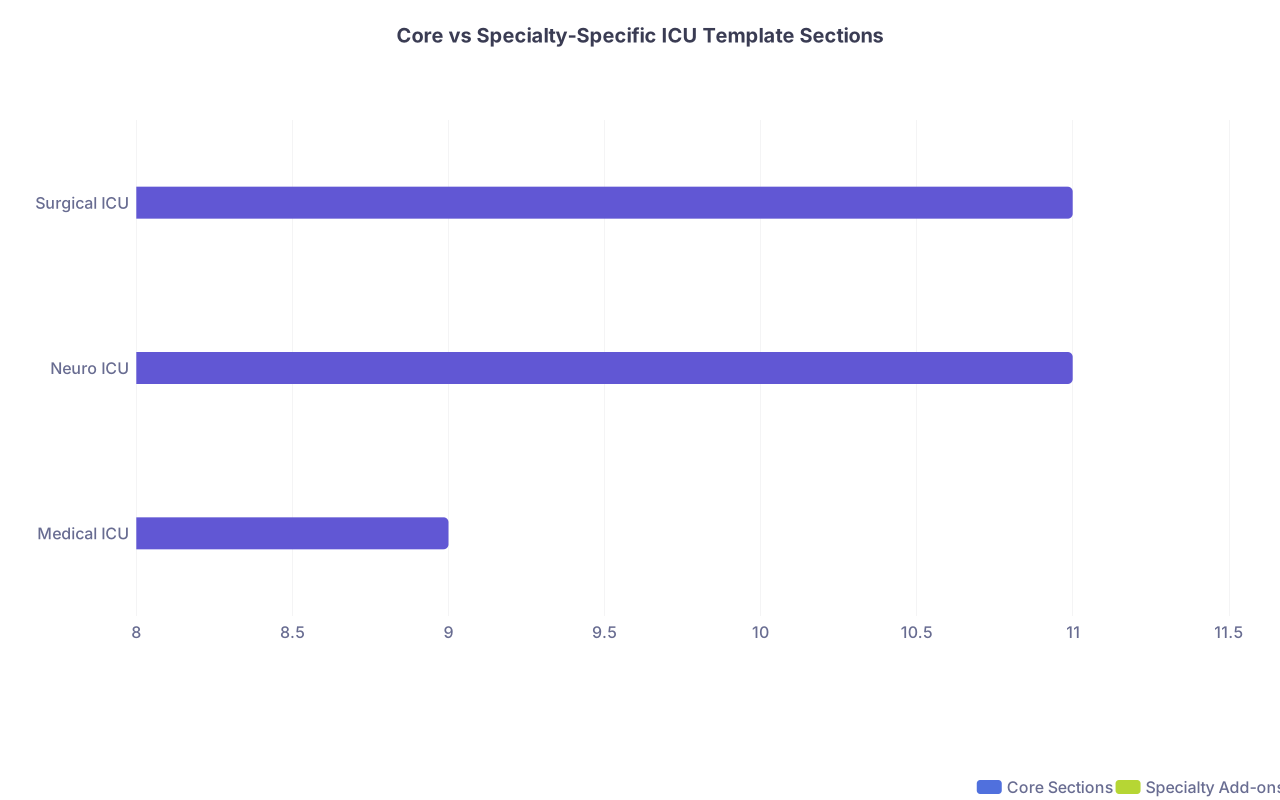
| Category | Core Sections | Specialty Add-ons |
|---|---|---|
| Medical ICU | 8 | 1 |
| Neuro ICU | 8 | 3 |
| Surgical ICU | 8 | 3 |
The core 7–8 sections stay the same. You just swap in a small specialty box at the bottom of the page.
Common Mistakes Residents Make with Pre-Rounding Templates
Let me be blunt about what I see over and over.
Templates that are basically checklists for billing.
“ROS: 10-point review negative” boxes and full medication lists clog the page. None of that helps you make ICU decisions.Over-reliance on yesterday’s note.
Copy-forward syndrome is real. You trust yesterday’s assessment more than your own template and end up perpetuating wrong vent settings or outdated culture plans.Writing too small, too cramped, too dense.
If you cannot read it at 7:30 a.m. when you are presenting, it might as well be blank.No prioritization.
Presenting the potassium level before the fact that the patient is on three pressors at escalating doses. Completely backwards.Ignoring nursing cues.
Your template has no area for “nursing concerns,” so you never ask. You miss the fact that the patient was restless all night and pulling at lines because the RASS target is wrong.
Design your template to guard against these tendencies. Not to impress your PD.
Practical Implementation: How to Build and Iterate Your Own
You do not need a perfect, artistic sheet on day one. You need something functional that you can iterate.
Start like this:
- Draft a one-page skeleton in Word/Notion/OneNote with the sections we just outlined.
- Print 10–15 copies and use them for a single call cycle.
- After each day, mark where you ran out of space, what you never used, and what you kept writing in the margins.
- Adjust:
- Expand high-use sections (vents, drips)
- Shrink low-yield ones (med list, detailed ROS)
- Add tiny checkboxes for universal ICU tasks: DVT ppx, GI ppx, SBT, sedation holiday.

Your third version will be dramatically better than your first. By the fifth, you will barely think about it; your hand will automatically go section by section as you glance through the chart.
Time Management: Surviving 12–18 ICU Patients
Here is the math no one spells out.
Let us say you have 14 ICU patients. You want to be fully ready by 7:30. You can be in the unit by 5:30. That is 120 minutes.
Budget:
- 3 minutes pre-chart × 14 patients = 42 minutes
- 3 minutes bedside × 14 patients = 42 minutes
- 36 minutes buffer for admits, procedures, interruptions
That is tight but realistic. Without a template, you will blow 10+ minutes on the first couple of sickest patients and be behind for the rest.
With a template, you move faster because every chart review is a fill-in-the-blanks exercise rather than a free-form scroll.

A Quick Example: Walking Through One Patient
Let me run you through a single case so you see how this template feels.
Patient: 64-year-old with septic shock from pneumonia, intubated.
Top banner:
- “64M, day 3 ICU, full code, septic shock from multilobar PNA. ICU for refractory shock and hypoxemic respiratory failure. Today: attempt small norepi wean, evaluate for SBT if FiO₂/PEEP improve.”
Overnight events:
- “Desat to 80% at 02:00 → FiO₂ 60→80, PEEP 8→10. Norepi up 0.12→0.18. No arrhythmias.”
Vent section:
- Mode: VC
- FiO₂/PEEP: 80/10 (was 60/8)
- Vt: 400 (6 mL/kg IBW)
- ABG: 7.30 / 50 / 60 / 24 / lactate 2.5 (prev 3.1)
- Trend: FiO₂↑, PEEP↑, still on high settings.
Hemodynamics:
- HR 90–120, NSR
- MAP 58–72, goal ≥65
- Drips: norepi 0.18 (0.10–0.18), vaso 0.03
- Net +1.5 L last 24h, cumulative +4 L
Renal:
- Cr 1.2→1.6 (baseline 1.0)
- UOP 0.3 mL/kg/hr last 12h
Infection:
- T 37.8, Tmax 38.1
- WBC 18→16
- On vanc/zosyn day 3
- Sputum: GNRs, cultures pending
- Blood cultures NGTD 48h
Neuro/Sed:
- Intubated, RASS –2 to –3
- On propofol 30, fentanyl 75, no paralytics
Nutrition:
- TF at goal 45 mL/hr, no residuals, last BM 2d ago
Heme:
- Hgb 9.2 (from 9.5), plts 210
- On heparin 5000 SC BID
Lines:
- R IJ triple lumen day 3, L radial A-line day 3, Foley, OG tube
Now your presentation is automatic and focused. The template did the thinking ahead of time.
The Bottom Line
A high-yield pre-rounding template for ICU is not stationary. It is a survival tool that shapes how you think.
Three key points:
- Build your template around ICU decisions, not EMR sections. Lead with airway, hemodynamics, renal status, infection, and sedation – everything else is secondary.
- Use the template as a workflow, not just a piece of paper: pre-chart to fill it, then bedside to confirm, then present from it. That is how you stay coherent with 15 complex patients.
- Ruthlessly iterate and compress. If a section never changes your management or your presentation, shrink it or kill it. Your time and attention in the ICU are finite; your template should reflect that reality.