
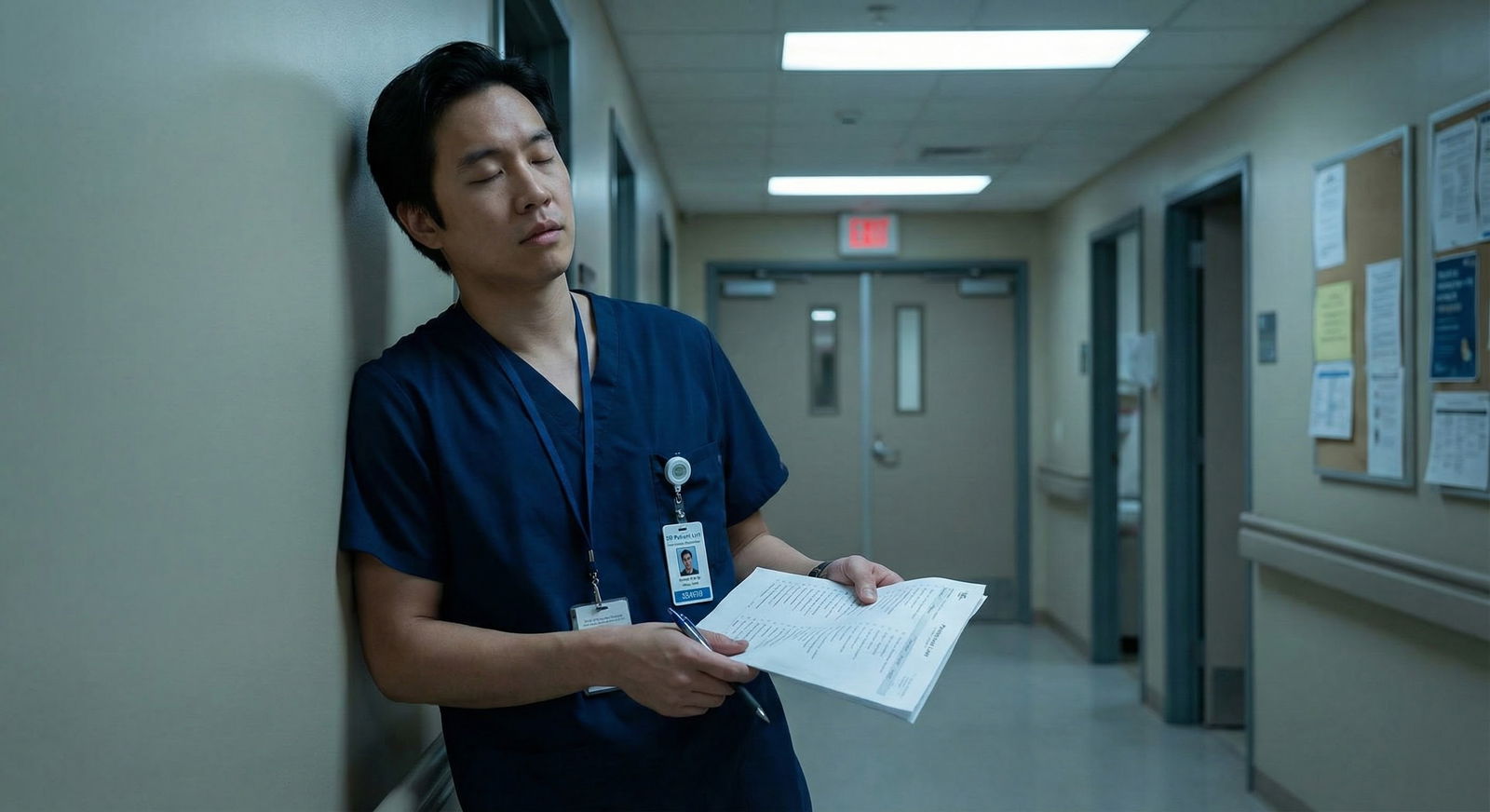
Your pager screams CODE BLUE at 6:47 AM. You were two patients deep into pre-rounds, barely awake, coffee still scalding. Now it's 8:30, the code is over, your attending is texting asking where you are, and you have exactly zero notes in the chart for the patients you saw before chaos erupted.
I've been there. Every resident has. Here's how you dig out.
The Immediate Reality Check: Stop Panic, Start Triage
That pit in your stomach? The one screaming you're about to get hammered for missing notes? Normal. Being pulled into a code blue is one of the most disruptive things that can happen to your morning workflow, and the panic is real.
But here's the thing: missing notes is common. It's fixable. What's not fixable is pretending it didn't happen or, worse, fabricating documentation to cover your tracks. The Golden Rule right now: do not fake the charting. Accuracy is non-negotiable. Speed is the priority, but not at the expense of truth.
You didn't chart what you didn't assess. Don't invent it. Don't backdate. Don't guess. You'll document what you actually saw and did, and you'll flag what you missed.
The Code Blue Triage Protocol: A Step-by-Step Flow
Before you even think about the computer, take stock. Here's the sequence:
Check the patient you were rounding on. The code is over, but what about the patient whose room you abandoned 90 minutes ago? Were they stable? Are they still stable? A quick call or walk-by ensures you're not walking into a second emergency.
The 5-Minute Rule. Spend no more than 5 minutes reconstructing the timeline of the code itself. What time did you arrive? What did you do? Was it your patient or someone else's? Jot it on a scrap of paper or in a phone note. You need a skeleton, not a novel.
Communication First. Before you open the EHR, text or page your senior or attending: "Was in a code blue. Running behind on notes. Will catch up in 15 minutes." That's it. No long apology. Manage expectations before they come looking for you.
The mistake I see most often: residents who try to chart the code note, their pre-round notes, and the next patient all simultaneously. You can't. You'll do all three badly. Sequence it. Code note first (it's fresh), then your most acute patient, then the rest.
If the code patient isn't yours, find the resident who ran it and ask if they need help with the note. If it is yours, document your role clearly, what you saw, what you did, when you arrived. Time-stamp everything.
The 'Minimum Viable Chart' Framework
When you're 90 minutes behind, you don't write a textbook note. You write a Minimum Viable Chart, the smallest documentation that is legally defensible and clinically useful.
The Must-Haves:
- Vitals (you can pull these from the monitor or flowsheet)
- Current mental status / exam focused on the chief complaint
- Your assessment in one or two sentences
- The plan: what's happening today
The Skip-For-Nows:
- Detailed HPI. You can add this later.
- Social history. Not relevant to today's acute plan.
- Review of systems. Nobody reads this anyway, and you know it.
- Family history. Unless it's a genetics consult, skip it.
Delegate the data entry. If you have a scribe, they pull labs and vitals. If you have an intern, they gather the numbers. You focus on the narrative, the assessment and plan, because that's the part that requires your brain.
Here's what a Minimum Viable Chart actually looks like in practice:
62M admitted for CHF exacerbation. Day 2. Vitals: T 37.1, HR 88, BP 134/78, RR 18, SpO2 94% on 2L NC. Alert, oriented, no acute distress. Lungs with bibasilar crackles unchanged. Plan: Continue diuresis with furosemide 40mg IV BID, daily weights, check BNP. Target net negative 1L. Discussed plan with patient.
That's 60 seconds of typing. It's honest, it's complete enough, and you can flesh out the HPI during your catch-up block later.
The Honest Handoff: Managing the Attending
Your attending texted. Or worse, they're standing at the nurses' station looking at their watch. Time for the honest handoff.
Transparency is key. Walk up and say it plainly: "I got pulled into a code blue at 6:47. I'm behind on notes. I need 10 minutes to catch up before we start formal rounds."
Don't over-explain. Don't apologize three times. Don't promise you'll "have it done in five minutes" when you know it'll take fifteen.
The why matters. You were prioritizing patient safety. A code blue is literally life or death. Charting is important, but nobody dies because a progress note was late. Your attending knows this. If they don't, that's a different problem.
The ask. Request 10-15 minutes of protected time. Most attendings will grant it without argument. The ones who won't? Ask them which patient they'd like you to skip assessing properly so you can write notes faster. That usually ends the conversation.

I had an attending once who responded to "I was in a code" with "So are your notes done?" That attending was a jerk, and I still asked for the 15 minutes. I got them. The system doesn't run on notes alone, it runs on patient care, and your attending knows that even if they pretend otherwise in the moment.
Leveraging the Team: Delegation Strategies
You have a team. Use them.
The Intern's Role. Ask your intern to pull labs, vitals, and imaging results for the patients you need to chart. They can organize this into a quick verbal summary or drop it in a shared note. While they're hunting numbers, you're writing assessments.
The Scribe's Role. If you're lucky enough to have one, dictate the assessment and plan verbally while they type. Speak in complete sentences. "Assessment: 62-year-old with CHF exacerbation, day two, responding to diuresis. Plan: continue furosemide, check morning BNP, target net negative one liter." Done.
The Nurse's Role. Before you chart, ask the bedside nurse: "Any changes since I saw the patient this morning?" This gives you the update without hunting through the chart. They'll tell you the urine output, the new symptom, the family that's been hovering. That's your update.

Delegation isn't laziness. It's efficiency. You're still responsible for the note, but you don't have to be the one clicking through 14 flowsheets to find the potassium.
Recovery Mode: Getting Back on Track
The notes are in. The attending is appeased. Now recover properly.
The Do-Over Strategy. Block 15 minutes later in the day, after morning rounds, before noon conference, to go back and flesh out the notes you skeleton'd. Add the HPI. Fill in the social history. Make the note look like something you'd be proud to show in M&M. Schedule it like an appointment. Don't wait until the end of the shift when you're too tired to think.
Fuel up. Skipping lunch to catch up on charting is a trap. Hypoglycemia makes you stupid. Stupid residents make mistakes. Eat the sandwich. Chart after.
Mental reset. One chaotic morning doesn't define your residency. Codes happen. Workflow gets disrupted. You adapted, you communicated, you documented honestly. That's the job. Let it go and move on to the next patient.
Key Takeaways
- Don't fake the charting. Accuracy beats speed every time. Backdating or fabricating is a career-ender.
- Use the Minimum Viable Chart method. Vitals, mental status, assessment, plan. Skip the fluff and fill it in later.
- Communicate your delay immediately. A 10-second text to your attending prevents a 10-minute lecture later.
- Delegate data gathering. Interns, scribes, and nurses can feed you information while you write.
- Schedule a catch-up block. Don't try to fix everything in the moment. Block time later to complete what you skipped.