
It is 8:45 PM on a Tuesday. You just took sign-out for 60 patients across three teams. Your cross-cover pager has already gone off twice during the handoff. One nurse is asking about pain control on a fresh post-op. Another is worried about a borderline blood pressure in a cirrhotic on the floor. You scroll the list and realize you barely remember which team Ms. Alvarez with the GI bleed belongs to.
This is where residents either drown… or get systematic.
Let me be blunt: on big services, cross-cover is not about “being good at multitasking.” It is about having a tight, repeatable structure that prevents you from missing the one subtle, lethal problem hiding inside 20 nuisance pages. The residents who survive nights on large services do not have better brains. They have better systems.
I am going to walk through those systems.
1. What Makes Large-Service Cross-Cover So Dangerous?
On small services, cross-cover is mostly nuisance management. On large services, you are running a low-resource triage center. The danger is not that you cannot answer every page. The danger is that you answer them in the wrong order or lose track of the important threads.
Typical setup:
Medicine resident covering 40–80 patients across 2–4 teams.
Surgery resident covering 40–60, plus consults.
Sometimes a night float intern plus a senior. Sometimes just you.
The problems:
- Volume: 30–80 pages in a night is common. Peaks at shift start, med pass, and around 3–5 AM.
- Fragmentation: Each page is a tiny slice of a patient story you did not witness.
- Latent landmines: A “mild” O2 bump or “soft” blood pressure that is actually sepsis or hemorrhage in disguise.
- Cognitive overload: You think you will remember the borderline patient from 10:15 PM. By 2 AM, you will not.
So the question becomes: how do you impose structure on chaos, consistently, when you are sleep-deprived and stretched thin?
You build systems for:
- Intake (how you receive and log information)
- Prioritization (who you deal with first, second, third)
- Execution (how you approach common cross-cover problems)
- Tracking (how you avoid losing threads)
- Output (how you hand off in the morning)
We will hit each of these in a very specific way.
2. Core Principles for Structuring Cross-Cover
If you remember nothing else, keep these three principles.
Principle 1: Default to a Written (or Typed) Tracking System
If you are trying to track a 60-patient cross-cover night in your head or in a mess of sticky notes, you are already behind.
You need one “single source of truth” that you can glance at and know:
- Who paged you
- What the issue is
- What you did
- What still needs follow-up
- What must be mentioned at sign-out
This can be:
- A printed census with your own notations
- A dedicated “Night Issues” column in the EHR list
- A personal spreadsheet / Notepad document / OneNote
- A structured note on your phone or a small notebook (if allowed and HIPAA-compliant)
But it must be one place. Not ten.
Principle 2: Triage is a Skill, Not a Vibe
Most juniors say they triage by “what feels urgent.” That is how you miss the subtle septic patient because you were busy chasing PRN Ativan. You need an explicit mental triage framework.
A simple version:
- Airway/breathing/circulation concern
- Mental status changes
- Chest pain / new neuro deficits
- Significant vitals changes (BP, HR, RR, O2)
- Active bleeding
- Pain / GI issues / nursing concerns
- Orders/clerical things (missing meds, diet orders, etc.)
Everything you hear gets mentally dumped into a bucket. You then order your actions by bucket priority, not by page arrival time or whoever sounds most annoyed.
Principle 3: Every Page Has Two Parts
- The immediate problem: What do I need to do right now?
- The trajectory problem: Do I need to circle back? Watch more closely? Notify day team?
Most residents handle the first, forget the second. Structured cross-cover systems force you to record and plan follow-ups so “mild hypotension” does not quietly progress to ICU transfer at 5:30 AM.
3. Building a Concrete Cross-Cover Log System
Let me walk you through a specific log setup. This is where most people either overcomplicate or under-build.
You want something that takes seconds per entry. If it needs perfect typing or long-form prose, it will fail at 3 AM.
| Column | Purpose |
|---|---|
| Time | When page came or issue noted |
| Patient ID/Bed | Quick locator (MRN last 4 or bed no.) |
| Team/Service | A, B, C team or service name |
| Issue | Brief summary (“SBP 80”, “CP”, “N/V”) |
| Action Taken | What you did (orders, exam, calls) |
| Follow-up Needed | “Recheck 1hr”, “Labs 0300”, “None” |
You can add one more column: “AM Sign-out Item (Y/N)”.
That is your backbone. Every single contact gets an entry.
Example entries:
- 21:05 | 8E-12 | Med A | “SBP 82/50 on pressors weaning” | “Went to bedside; bolus 500 cc; repeat BP 15 min; called senior” | “Yes – likely ICU transfer”
- 22:40 | 7W-03 | Surg Blue | “No PRN for pain; 8/10 pain” | “Reviewed orders; wrote PRN oxycodone; discussed with nurse” | “No”
- 01:30 | 9E-09 | Med C | “New Tmax 38.9; borderline tachycardic” | “Examined; ordered lactate, BCx, UA, CXR; 500 cc bolus” | “Re-eval 03:00, consider escalation”
You do not need paragraphs. You need reminders.
4. Structuring Handoff to Enable Good Cross-Cover
Your night structure starts before the first page: during sign-out.
Good cross-cover systems start with telling the day teams how to prepare cases for safe sign-out. You will eventually be the one giving that sign-out, so you might as well enforce this culture early.
For large services, I like a three-bucket system for each patient:
- Stable: “No expected issues. Routine cross-cover.”
- Watch: “Possible issues; here is what to watch / what to do first.”
- High-risk: “This patient can crash. Here are contingency plans.”
High-risk patients get explicit “if-then” statements:
- “If SBP < 90 or MAP < 65, please give 500 cc LR and recheck. If still low, call ICU fellow and me.”
- “If mental status worsens, STAT CT head and call neurosurgery.”
- “If increased O2 requirement above 4 L, switch to non-rebreather and call RRT.”
Your job at night is infinitely easier when day teams give you a prebuilt decision tree. When they do not, you build a quick mental version during sign-out for the 3–6 scariest patients.
5. Real-Time Triage: A Structured Call Response Framework
Now, you are cross-covering. The phone rings. Nurse sounds panicked. What do you do, systematically?
Use a tight script. It should feel almost canned.
Step 1: Quick Identify
“Who is the patient? Room and name?”
“Which service?” (if multiple)
Pull them up in the EHR while you talk. Always.
Step 2: One-Liner and Vital Concern
Ask for the one-liner issue:
“What is the main concern right now?”
Then:
“What are the most recent vitals?” (If not in nurse’s hand, you will look yourself.)
Classify into your mental buckets:
- A/B/C threat?
- Neuro threat?
- Hemodynamic?
- Bleeding?
- Pain/symptom?
- Admin/clerical?
Step 3: Decide: Phone Order vs Bedside
Do not autopilot to bedside for everything or you will be running all night and still missing sick people.
Go in person if:
- Any change in mental status
- Any respiratory distress or sustained O2 increase
- Any chest pain, acute neuro deficit
- Any significant hemodynamic change (SBP < 90, HR > 130, RR > 30)
- Any “something is off” from senior nurse (this one matters)
Phone/remote handling is reasonable for:
- Pain control issues with stable vitals
- Sleep meds / nausea / constipation
- Clarification of existing orders
- Minor lab abnormalities flagged without clinical change
But even for “minor” things, you still log the interaction.
Step 4: Apply a Standard Problem Algorithm
For common cross-cover problems, you should have a mental algorithm, not reinvent the wheel each time. This is where structure saves enormous time. A few examples.
Example: New Fever
Script:
- Confirm temperature method, vitals, O2.
- Review history: source known? lines? immunosuppressed? neutropenic? post-op day?
- Check last labs, cultures, recent imaging.
- Decide on minimal workup set: usually blood cultures, urine, CXR, lactate if concerning.
- Decide on fluids: bolus if hypotensive or borderline perfusion.
- Decide on antibiotics: start if high suspicion or already-indicated, or defer to day team if truly minimal concern.
Document your thought process in a quick note if your institution expects that. But at least record in your cross-cover log.
Example: Mild Hypotension
- Check vitals trend and MAP.
- Ask about symptoms: dizziness, chest pain, dyspnea, lightheadedness.
- Look at I/O, diuretics, recent meds (opiates, antihypertensives, sedation).
- Determine if fluid-responsive trial is reasonable: 250–500 cc bolus.
- Set a concrete recheck time (e.g., 15–30 minutes) and log that follow-up.
- Escalate early if pressors, advanced heart failure, complex shock patient.
You see the pattern: for your top 8–10 cross-cover problems, you should have your own consistent mini-algorithm. That is structure.
6. Managing Multiple Simultaneous Pages Without Losing Control
The most chaos you will feel is about 30–90 minutes after sign-out when pages cluster. This is where structured batching makes the difference.
Use a running queue.
Let me show you a simple but effective approach.
You receive 4 pages in 5 minutes:
- Nurse 1: “SOB, O2 requirement up from 2 L to 5 L, now 89%.”
- Nurse 2: “No PRN for 9/10 pain.”
- Nurse 3: “HR 135, SBP 92, post-op day 1.”
- Nurse 4: “Patient has not had bowel movement in 3 days.”
You do:
Rapid identify and bucket each call as you receive it.
Write very brief queue:
- “1) 5N-12 O2 2→5 L 89% – go now”
- “2) 4E-09 HR 135 SBP 92 POD1 – second, in person”
- “3) 6W-02 pain 9/10; write phone orders after #2”
- “4) 7W-05 constipation – lowest priority”
Tell each nurse honestly what you are doing.
- “I am heading now to a respiratory distress patient; you are next; expect me within ~20–30 minutes for your post-op patient.”
- “I can write the PRN orders in the next 10 minutes after I handle these two more urgent issues.”
This does three things:
- Sets expectations (nurses stop repaging as often).
- Protects your cognitive load by making the queue explicit.
- Reduces moral distress because you know you are handling things in a rational order, not just who yells loudest.
7. Using the EHR and Tools to Your Advantage (Without Drowning in Clicks)
A lot of residents either underuse or overuse the EHR at night.
The goal is targeted usage:
- Have a dedicated cross-cover list that shows: name, bed, service, code status, isolation, last vitals, and an “Issues” column you can quickly type into. Many systems allow custom columns or personal lists. Use them.
- Use filters or color-coding if available: high-risk patients highlighted.
- Use quick text/SmartPhrases for common notes: “Night cross-cover note for fever” etc. Saves time and makes your documentation uniform.
But do not let the EHR replace your own cross-cover log. They serve different purposes:
- EHR notes: legal record and clinical documentation for the chart.
- Cross-cover log: your real-time operations board.
8. Structured Communication with Nursing and Other Staff
You are not the only human in this system. If nursing is guessing your priorities, you will get haphazard pages and frustrated calls.
A few structured habits:
At the beginning of shift, briefly check in with the charge nurse (on high-volume floors).
“I am covering Med A/B/C tonight. If you are worried someone is genuinely sick, call me directly and say so. For nonurgent issues, pages are fine, and I will batch them.”When you respond to a concerning page and find something worrisome, explicitly share a plan and recheck time with the bedside nurse:
“I am giving 500 cc now. Let us recheck BP in 20 minutes. If still < 90, call me. I will also circle back around 1:00 AM.”Use consistent language to flag higher risk even if not crashing yet:
“I am a little worried about where this is going. Please keep a close eye and page me sooner than later if anything feels off.”
This builds a shared mental model. That is structure at the team level.
9. Structuring Your Own Night: Time Blocks and Rounds
Cross-cover does not mean you live purely reactive. You can build proactive blocks into the night.
A simple framework for a 7 PM–7 AM shift:
- 19:00–20:00 – Sign-out / getting organized; mark high-risk patients on list.
- 20:00–22:00 – Peak page time; mostly reactive, but try to see at least 1–2 high-risk patients in person early.
- 22:30–00:00 – Intentional “rounds” on the sickest 3–5 patients, even if not paged. Quick in-person assessments. This prevents 3 AM surprises.
- 00:00–03:00 – Batched tasks, labs follow-up, new consults.
- 03:00–05:00 – Reassess anyone with earlier hypotension/fever/resp issues.
- 05:00–06:30 – Tie up loose ends, finalize log, prep day handoff, write any crucial sign-out notes.
You will deviate from this. Constantly. But the skeleton matters. It reminds you to step back from pure firefighting and ask: “Who has the highest chance of crashing that nobody is paging me about?”
10. Morning Handoff: Closing the Loop in a Structured Way
Scattered cross-cover work with no closure breeds errors. Morning sign-out is where structure pays off.
Your cross-cover log becomes your script.
Review:
- Any patient with: RRT, transfer to higher level of care, major vitals change, significant new diagnosis/workup (e.g., started sepsis workup), new oxygen requirement, or meaningful new meds (pressors, antiarrhythmics, high-dose opioids, etc.).
- Any patient you are “worried about but stable right now.”
During sign-out to each team, you do:
- “Three quick overnight issues:
- Bed 812: Fever to 38.9, cultures sent, started cefepime due to neutropenia; lactate 1.8, vitals stable.
- Bed 709: SBP low 80s, improved to 100s after 500 cc; trend at 3 AM was stable. Might still be a little dry.
- Bed 903: O2 increased from 2 to 5 L; CXR with possible edema; gave 40 IV Lasix, now back on 3 L with sats 94–95%.”
You do not narrate everything. You highlight clinically meaningful events and your degree of concern. If you have 60 patients, most had nothing meaningful overnight. Focus on the ~10–20% with actual overnight changes.
11. Common Pitfalls and How Structure Fixes Them
A few patterns I have seen over and over.
Pitfall 1: The “I’ll Remember” Lie
New interns swear they will remember that one borderline BP they meant to recheck. Four more pages later, it is gone. Until the nurse calls about the RRT.
Solution: Absolutely everything goes in the log with a follow-up time. Even if you think it is trivial.
Pitfall 2: Handoff Amnesia
You work your tail off stabilizing a septic patient overnight. Morning sign-out: “Um, I think there was a fever or something?” Day team underestimates severity. Work is duplicated or missed.
Solution: Use the AM Sign-out column. Star or highlight 100% of “must-mention” events while they happen.
Pitfall 3: Over-escalation or Under-escalation
New residents either call RRT for everything or wait until the patient is profoundly unstable.
Structure helps you calibrate. If:
- Multiple vital signs are deranged, and you are giving bolus after bolus → time to call RRT / ICU early.
- You are uncertain but worried → loop in your senior and use the hospital’s escalation chain.
Have your own personal thresholds written somewhere early in the year. Adjust as you learn.
12. Specialty-Specific Nuances on Large Services
Cross-cover is not identical across specialties. A few pointed specifics.
Medicine
Biggest risks: sepsis, GI bleeds, decompensated heart failure, delirium, DKA/HHS.
Key structure moves:
- Have templates in your head for sepsis, CHF, and AMS.
- Pre-identify sick ICU-borderline patients at sign-out and check them twice overnight even if quiet.
- Track new oxygen requirements obsessively.
Surgery
Biggest risks: post-op bleeding, anastomotic leaks, PE, ileus/obstruction, pain management.
Structural tricks:
- For POD 0–2, make a list of “red flag” vitals or exam findings per patient and quickly run them at bedside.
- Have a clear algorithm for “increasing pain out of proportion” and “tachycardia post-op” hardwired.
- Use your log to track “watch abd exam” patients.
OB/GYN, Neuro, others
The specifics vary, but the meta-principles are identical: high-risk patients get explicit plans, and you record any change in status plus what must be followed.
13. Training Yourself: How to Actually Implement This
You will not wake up tomorrow and magically have a perfect cross-cover system. So build it in layers.
Week 1–2 of trying this:
- Start with a very simple log: time, patient, issue, action.
- Add the “follow-up” column once logging itself becomes natural.
- After a few nights, refine: which columns are you never using? Which do you wish you had?
Print a blank template for your log at the start of a shift or open a standard file in your EHR or personal notes. Do not freestyle every night. Reuse the same structure so your brain recognizes the pattern.
Visual Summary: Where Your Night Actually Goes
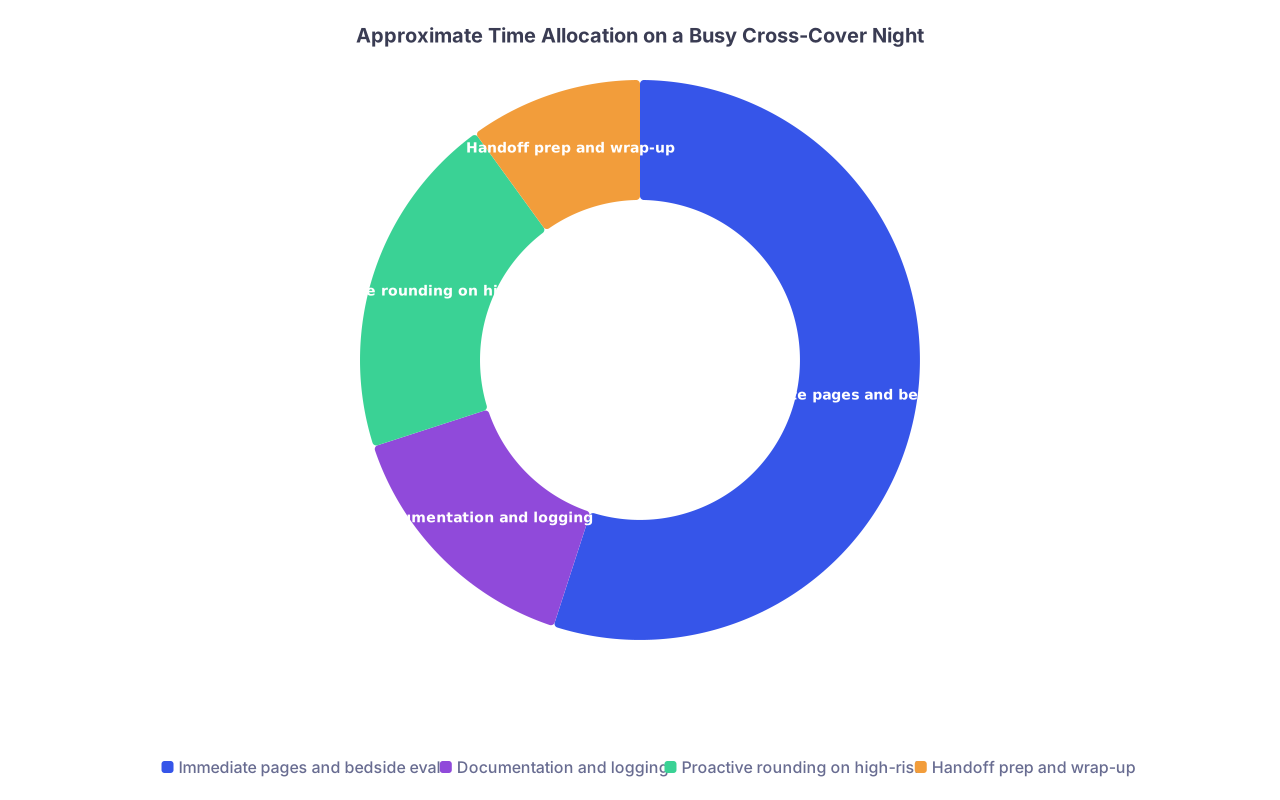
| Category | Value |
|---|---|
| Immediate pages and bedside eval | 55 |
| Documentation and logging | 15 |
| Proactive rounding on high-risk | 20 |
| Handoff prep and wrap-up | 10 |
Most residents think they are “on pages” 100% of the time. In reality, the ones who function well carve out that 20–30% for structured prep, log maintenance, and proactive checks.
A Simple Cross-Cover Workflow Map

| Step | Description |
|---|---|
| Step 1 | Receive Sign-out |
| Step 2 | Identify High-risk Patients |
| Step 3 | Set Up Cross-cover Log |
| Step 4 | Respond to First Pages |
| Step 5 | Bedside Evaluation |
| Step 6 | Phone Orders |
| Step 7 | Document and Update Log |
| Step 8 | Reassess Queue |
| Step 9 | Proactive Check on High-risk |
| Step 10 | Track Follow-ups |
| Step 11 | Prepare Morning Handoff |
| Step 12 | Urgent? |
This is, in effect, your night: repeat the D→E→F/G→H→I loop, with intentional interruptions for J and K.
One More Practical Detail: Physical Setup
Seems minor. It is not.
Set up your workstation before the chaos:
- One screen: EHR patient list and chart.
- Second screen (or paper): cross-cover log open and visible.
- Pager, phone, pen, and your printed census arranged the same way every night.

If every item you need is in the same place, your brain has fewer micro-decisions to make. That matters at 3 AM.
Quick Comparison: Ad Hoc vs Structured Cross-Cover
| Aspect | Ad Hoc Resident | Structured Resident |
|---|---|---|
| Tracking | Relies on memory, scattered notes | Uses a single consistent log |
| Triage | Reacts to whoever pages loudest | Uses explicit urgency categories |
| Follow-up | Forgets borderline cases | Writes recheck times and honors them |
| High-risk patients | Only sees when paged | Proactively reassesses overnight |
| Morning handoff | Vague recollections, missing events | Concise, specific overnight update |
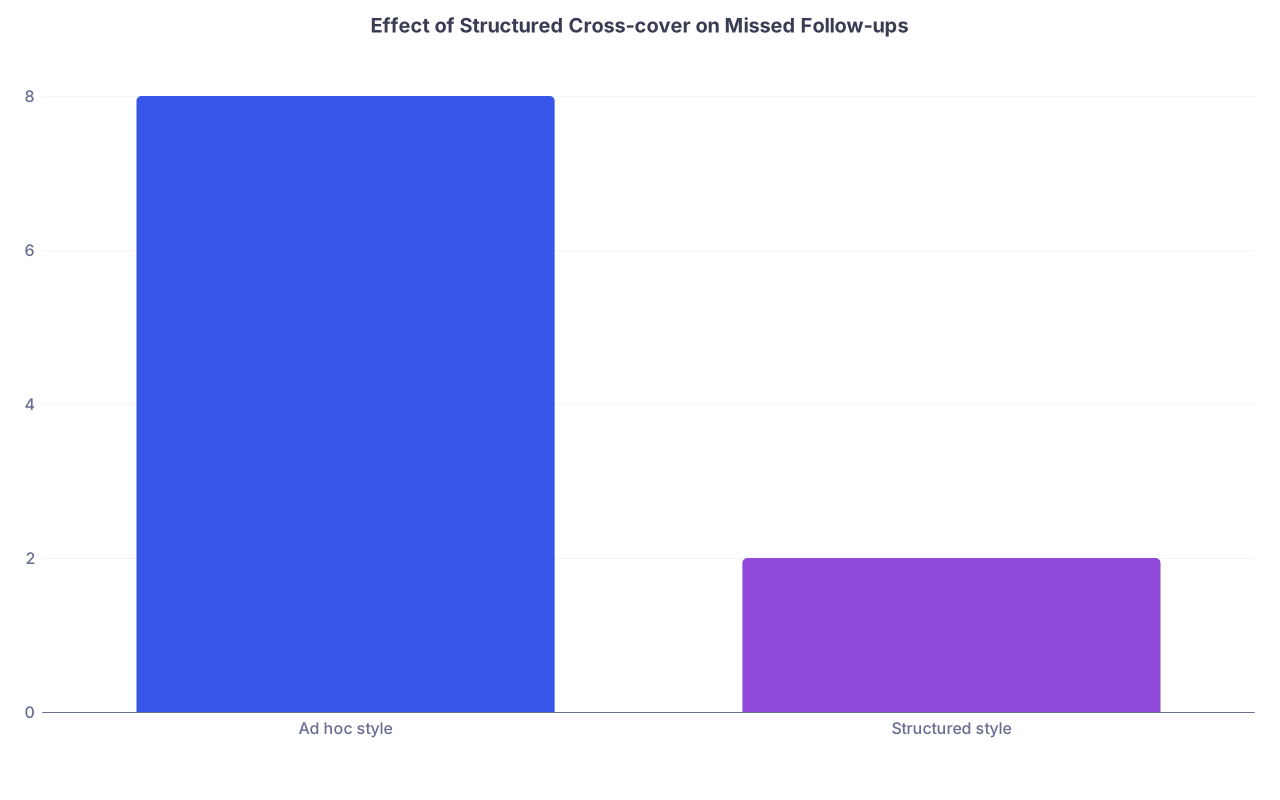
| Category | Value |
|---|---|
| Ad hoc style | 8 |
| Structured style | 2 |
(Think of those as approximate number of missed planned follow-ups per busy month. I have seen this magnitude of difference in real teams.)
FAQs
1. Is a formal cross-cover log really necessary if my EHR has a “night events” section?
Yes. EHR notes are slow, clunky, and optimized for billing and compliance, not real-time task management. You are not going to open a new note for every “HR 120, improved with pain control” episode. The log is your operational dashboard, not your legal record. Use both, for different reasons.
2. How do I avoid spending so much time logging that I fall behind on patient care?
Your entries should be brutally short. Five to ten seconds. If you are typing prose, you are doing it wrong. Example: “22:15, 7E-04, fever 38.8, BCx/UA/CXR, 500 cc, recheck 01:00.” Anything more detailed than that belongs in the chart, not in your log.
3. What if my senior does not use any structured approach and just “wings it”?
You structure your own world anyway. You do not need permission to keep a log or to triage with a mental framework. In fact, I have seen juniors quietly stabilize services while chaotic seniors bounce around. Over time, if your outcomes are better and your handoffs are clean, people notice and sometimes even adopt your system.
4. How do I decide when to call an RRT versus managing as routine cross-cover?
Have pre-set thresholds, and err slightly toward earlier escalation. Consider RRT when: there is a sustained change in vitals despite initial interventions, any unclear but serious decompensation (e.g., rapidly increasing O2 needs), or you feel out of your depth. If you are asking yourself “am I missing something big here?” twice, that is usually your answer: call.
5. What should I absolutely always tell the day team about in the morning?
Rapid responses, ICU transfers, initiation of pressors, new arrhythmias, new O2 requirements above baseline, new sepsis workup and antibiotics, significant hypotension episodes, any mental status change, and any patient you are uneasy about despite stable vitals. If you had to visit the room twice overnight, the day team should hear about it.
6. How can I practice these skills before I am thrown onto a huge cross-cover service?
Start small. On lighter rotations, create a mini log for the 10–20 patients you are covering and rehearse: write down issues, actions, and follow-ups. Ask seniors, “For this fever/hypotension episode, what would your standard algorithm be?” Write those down. Treat even low-volume nights as training reps, so by the time you hit a 70-patient med night, the structure is already muscle memory.
Key points to walk away with:
- Large-service cross-cover is survivable if you stop freelancing and build a simple, repeatable structure: a log, a triage framework, and proactive checks on high-risk patients.
- Every contact gets recorded, prioritized, and—if needed—assigned a follow-up time. Then you honor those follow-ups. That alone prevents a frightening amount of harm.
- Your job at night is not to be omniscient. It is to be systematically reliable in a chaotic environment. The structure is what makes that possible.