Monday morning. 10:00 AM Eastern. Your phone buzzes with the email you've been dreading and secretly hoping for at the same time: "You did not match to a position."
Your stomach drops. You open ERAS and the screen confirms it. No program. No city. No July 1st start date. Just a week of SOAP ahead of you, and the cold realization that you're an IMG with zero US clinical experience trying to break into a system that mostly prefers its own.
(See also: Mastering the SOAP Process for Unmatched Candidates for more.)
I've watched this exact scenario play out for dozens of applicants. Some panicked. Some froze. Some went on to match in SOAP and have thriving practices today. The difference between those groups wasn't luck. It was strategy, speed, and a refusal to treat SOAP like a consolation prize.
(See also: Navigating Visa Sponsorship Realities in SOAP if applicable.)
Let me walk you through what actually works when you're starting from behind.
This article is for educational purposes only. It is not financial advice, not legal advice, and not tax advice. Figures vary by individual circumstances, so consult a qualified professional before acting.
The Reality Check: Why SOAP Is Your Best Shot Right Now
Here's what nobody tells you on Match Day: SOAP isn't where careers go to die. It's where program directors fill categorical gaps with candidates they didn't initially consider. And that description fits you perfectly.
Programs participating in SOAP are often looking past the traditional narrative. They've already filtered through thousands of applicants. Now they need someone who can start in 17 days, pass their in-service exams, and not fall apart under pressure. Your Step 2 CK score, your clinical volume back home, your ability to handle 80-hour weeks with limited resources, these matter more than whether your letters of recommendation came from a US attending who met you twice.
That's not hopeful thinking. That's the actual selection logic happening inside program director offices during Match Week.
The emotional weight of this moment is real. You've spent years building toward a US residency, and now you're being asked to compete in a compressed, high-stakes sprint. Don't let grief slow you down. Acknowledge the disappointment for ten minutes if you need to, then get to work. SOAP moves fast. By Wednesday morning, the available positions are often cut in half.
You're not competing on narrative polish. You're competing on data, adaptability, and who can submit the sharpest application packet in the shortest window. Understand that, and you've already gained an edge over applicants still mentally stuck on Monday morning.
Step One: Audit Your File Before the Clock Starts Ticking
You've got roughly 72 hours from when SOAP opens to land an interview, maybe less. Every minute counts.
First thing: open ERAS and verify your profile is complete and visible to SOAP participants. I've seen applicants lose entire days because their photograph was corrupted or their contact information defaulted to an old email. Check everything. Twice.
Your Step 2 CK score is your golden ticket for IMG candidates without US experience. Put it front and center on your CV, mention it in your personal statement opening line, repeat it in your interview pitch. For IMGs competing against US graduates with home rotations and US letters, this score is the closest thing you have to a level playing field. A 240+ tells program directors you can handle the cognitive load. A 250+ gets you in the door even with the gap.
Now the hard part: addressing the "no US CEU" elephant in the room.
Don't hide from it. Don't apologize for it either. Frame your international training as a strength. That six-month surgery rotation in a 2,000-bed public hospital where you managed 40 patients daily with one attending supervising three interns? That's diagnostic independence most US students never develop. Your observership at a US clinic last summer? Even if it was brief, mention it. Your research year? Highlight publications.
Prepare a one-page "Elevator Pitch" document you can paste into cover notes and email responses. It should explain your background in two paragraphs, address the absence of US letters directly, and emphasize resilience, cultural adaptability, and clinical volume. Memorize it. You'll use it constantly.
Strategy Two: Targeting the Right Programs When You Have No US Letters
This is where most IMG applicants blow their SOAP. They apply broadly to prestigious programs that have already rejected them once and wonder why they get zero interview offers.
Stop that.
You need to be ruthless about program selection. Not every specialty or institution is realistic for your profile during SOAP.
Internal Medicine, Family Medicine, Pathology, and Psychiatry are your best bets. These specialties actively recruit IMGs, have higher SOAP participation, and value the diverse clinical exposure you bring. Surgery programs are tougher unless you have strong research ties to US institutions. Dermatology, Orthopedics, and other competitive specialties? Forget about them during SOAP. The applicant pool is too deep.
Use FREIDA and program websites to filter for IMG-friendly signals. Look for keywords like "diverse training environment," "serving underserved populations," "global health track," or "holistic review." These are code words for programs that won't immediately bin your application because your LORs are from a Karachi or Cairo attending.
Prioritize community hospitals and newer academic centers. Your Ivy League dreams can wait. Community programs in places like Brooklyn, the Bronx, Detroit, the Rio Grande Valley, or rural Pennsylvania often have lower applicant volume and higher SOAP participation. They're also more likely to evaluate you on merit than pedigree.
Cross-reference every program against NRMP's SOAP data from previous years. Programs that filled via SOAP in 2023 and 2024 are likely to participate again. Programs that historically fill in the Main Match rarely surface quality positions during SOAP.
Apply to 25-30 programs. Yes, it sounds like a lot. SOAP gives you a limited number of applications per specialty, so use them all. List programs, research them in batches of five, and submit applications in waves rather than dumping them all at once. Programs in different time zones update their review queues at different intervals.
Step Three: The Art of the Application Packet (Less is More)
SOAP limits your documents. Use that constraint as a forcing function.
You can typically submit one Personal Statement and select which LORs to forward. Don't waste a slot on a generic letter from a home country attending who barely knows you and wrote in stiff academic English. Program directors can smell those from a mile away.
Instead, prioritize your strongest LOR, even if it's from overseas. A detailed letter from a department chair who describes your clinical judgment, your procedural volume, and specific patient cases you managed? That's worth more than a lukewarm US letter from someone who observed you for two weeks.
Build a CV that translates your international experience into US-readable language. "House Officer in Department of Surgery" becomes "Surgical Resident with 2,000+ hours of direct patient care across pre-operative, operative, and post-operative settings." "Medical Officer in Emergency Department" becomes "Emergency Medicine Physician managing 60+ patients per shift in a high-volume tertiary care center." Same work. Better framing.
Your Personal Statement needs a complete rewrite for SOAP. Forget the five-paragraph essay you drafted in September. SOAP Personal Statements are short, direct, and answer three questions: Why this specialty? Why are you ready despite the gap? What will you bring to this program in 17 days?
Customize every cover note you send through the ERAS portal. Programs offer optional fields for additional information. Use them. One sentence about why you fit their specific mission, referencing their location, patient population, or training philosophy, beats generic flattery every time.
Technical stuff that catches people every year: PDF everything, name files correctly (Lastname_DocumentType), and keep file sizes under 5MB. Peak SOAP hours crash the ERAS portal. Submit during off-peak windows when possible. Early morning or late evening Eastern time tends to be slightly less congested.
Step Four: Communication Strategy During the Chaos
SOAP communication is its own discipline. Miss an email by 30 minutes and the position is gone.
Check your SOAP email every 30 minutes. Notifications on. Forward to your phone. Treat every program message like a text from a potential employer who might fire you for being slow.
When you receive an interview invitation, respond within one hour. Faster if possible. Programs are interviewing dozens of candidates and tracking responsiveness as a soft signal for reliability. A delayed response doesn't just lose you that interview, it tells the program you're disorganized during the most stressful week of the year.
Virtual interview prep starts now, not Sunday night. Test your camera, your microphone, your internet connection. Have a clean professional background. Iron your white coat. Know your SOAP elevator pitch cold because you'll deliver it in some form on every single interview.
The question you'll get every time: "How do you address your lack of US clinical experience?"
Don't dodge it. Don't apologize. Don't get defensive. Turn the weakness into a strength with a script like this:
"My training in [Country] gave me unique exposure to resource-limited settings where I developed strong diagnostic independence and procedural confidence early in my career. I've managed patient volumes that would typically be distributed across multiple team members in US settings, which means I can integrate into a residency program with a strong foundation in clinical reasoning and patient ownership. I'm committed to adapting my training to the US healthcare system, and I chose your program specifically because [insert program-specific reason]."
That answer reframes the gap as preparation. It's not spin. It's the truth, just organized.
Final Prep: Mental Resilience and Decision Making
Rejection during SOAP is logistical, not personal. Programs have quotas, interview slots, and ranking algorithms that have nothing to do with your worth as a future physician. If you get ten rejections in a row, it's because your Step score is below their cutoff or your specialty doesn't match their gap, not because you failed.
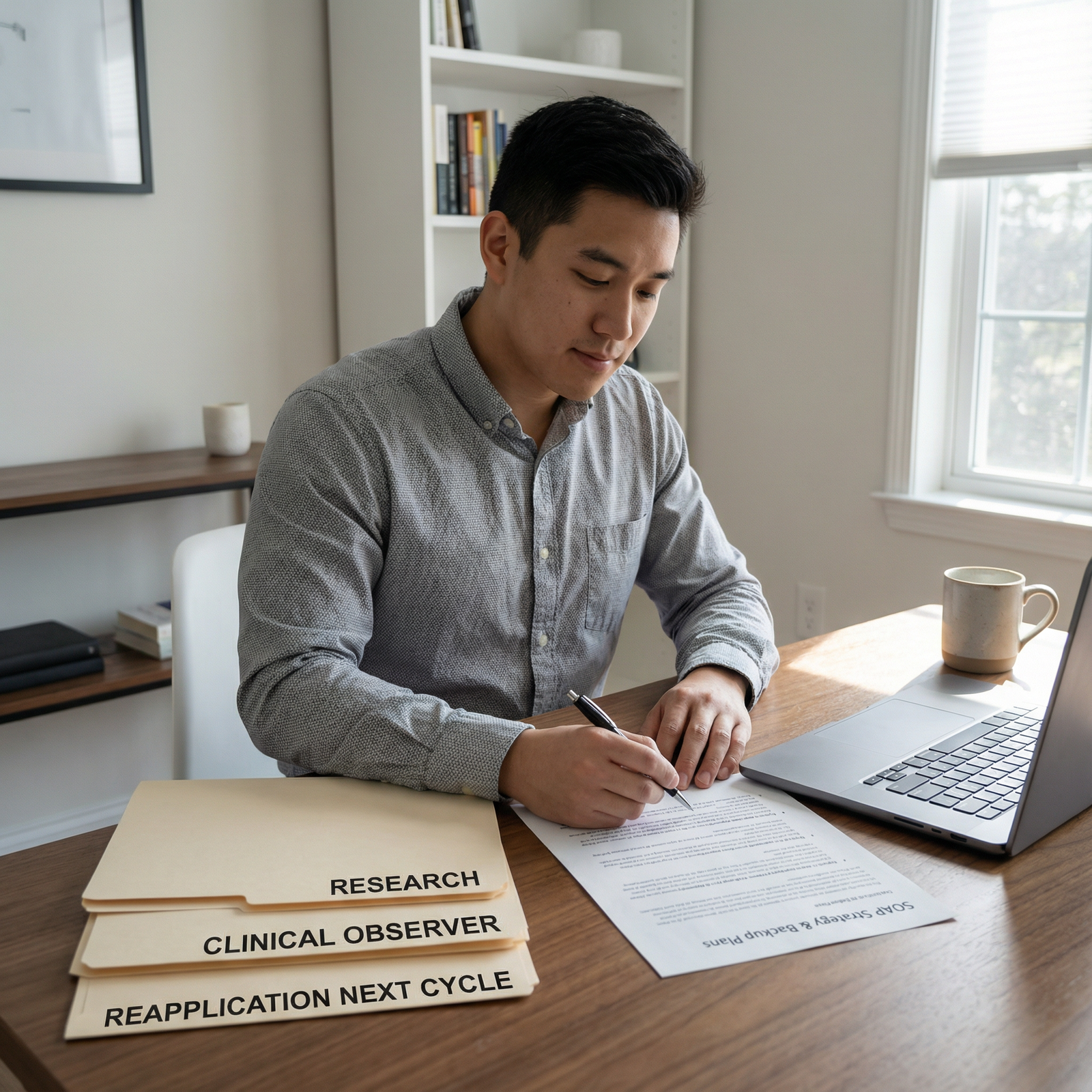
Build a fallback plan now. If SOAP doesn't work, what happens next? US Clinical Experience becomes your next immediate move. Research positions, observerships, externships, anything that adds a US line to your CV. Many successful attending physicians went through this exact detour. The marathon doesn't end because you missed one mile marker.
Take care of your body. SOAP week is a 72-hour cognitive sprint. Sleep six hours minimum every night. Eat real food. Step outside for ten minutes between application waves. Burnout doesn't help you match. A clear head does.
And here's the harder truth: if you receive multiple SOAP offers, choose the program that will actually train you well, not the one with the fanciest name or the highest city salary. A community IM program in a supportive environment beats a malignant university program every single time. You're building a career, not collecting a logo.

Your Action Steps Starting Right Now
Stop reading. Start doing.
Today: Verify your ERAS profile. Print or screenshot your Step 2 CK score report. Draft your SOAP elevator pitch.
Tomorrow: Build your program list of 25-30 IMG-friendly targets. Rewrite your Personal Statement. Customize cover notes for the first ten programs.
Day Three: Submit applications in waves. Test your interview setup. Script your responses to the seven most common SOAP interview questions.
Throughout: Check email every 30 minutes. Sleep. Eat. Hydrate. Repeat.
SOAP isn't a back door. It's a different door with the same destination on the other side. The physicians who matched through it didn't have better luck than you. They had a clearer strategy and moved faster. That's the only edge you need.