
The mythology that “MDs are safe and DOs are SOAP-bound” is lazy, outdated, and flat‑out wrong—especially once you zoom in on applicants with few interviews.
For low‑interview applicants, the data tell a more uncomfortable story: MD and DO trajectories through SOAP diverge sharply, and pretending they do not will hurt you. You are not playing the same game with the same odds.
Let’s walk through what the numbers actually show, what that means if you are entering Match week with 0–3 interviews, and how to make SOAP decisions that are grounded in data instead of vibes.
1. The baseline: MD vs DO in the main Match
Before we even touch SOAP, you need the context. SOAP outcomes are downstream of main Match dynamics.
NRMP’s Charting Outcomes and Match reports (2022–2024 cycles) show a consistent pattern:
- US MD seniors match at higher rates than US DO seniors across nearly all specialties.
- DO applicants cluster more in primary care and community programs; MDs have a stronger foothold in academic and competitive specialties.
- When interviews are few, MDs and DOs are not starting from the same baseline.
For illustration, here is a simplified snapshot based on NRMP trends for recent cycles (rounded for clarity):
| Applicant Type | 0–3 Interviews | Estimated Match Rate |
|---|---|---|
| US MD Senior | Low interviews | ~35–45% |
| US DO Senior | Low interviews | ~20–30% |
| US MD Senior (overall) | All interviews | ~92–94% |
| US DO Senior (overall) | All interviews | ~88–90% |
The exact numbers vary year to year, but the pattern is stable: with limited interviews, MDs still hold a relative advantage in the main Match. That matters because it determines who actually enters SOAP and in which specialties.
Now look at where unmatched MD and DO seniors tend to come from:
- Unmatched MDs: More likely from competitive specialties (derm, ortho, ENT, radiology, anesthesia) and high‑tier programs.
- Unmatched DOs: More likely from borderline applications in internal medicine, family medicine, pediatrics, psych, and transitional programs, or from overreaching in slightly competitive specialties.
Translation: by the time SOAP starts, the MD and DO applicant pools are not just different degrees. They are different populations, with different prior filters and expectations from programs.
2. Who ends up in SOAP—and where the open positions are
SOAP is driven by two distributions:
- Who failed to match.
- Where positions remained unfilled after the algorithm.
The NRMP SOAP data over multiple recent cycles show three consistent realities:
- The vast majority of SOAP positions are in:
- Preliminary surgery
- Preliminary medicine
- Transitional year
- Categorical family medicine
- Categorical internal medicine (mostly community, often lower‑tier or less desirable locations)
- Psychiatry (to a lesser extent, and increasingly competitive)
- Very few SOAP positions exist in:
- Derm, ortho, ENT, neurosurgery, radiology, ophthalmology, urology, EM (compared to applicant demand)
- DO representation in SOAP is higher than in the matched cohort, particularly in primary‑care‑leaning specialties.
Let’s formalize some of this with a conceptual model. Say you have 1,000 unmatched applicants in SOAP and 1,000 SOAP positions (numbers for illustration, not literal):
- Perhaps ~55–65% of unmatched US grads in SOAP are DOs, even though DOs are a smaller fraction of the total applicant pool.
- SOAP positions skew toward programs and specialties already more DO‑friendly—but also more saturated with DO applicants.
That leads to a core point: in SOAP, DO applicants are “overrepresented” relative to MDs, competing mostly for the same types of positions that DOs already favor. The pie is not neutral.
Here’s a conceptual breakdown of SOAP positions by broad category, consistent with recent trends:
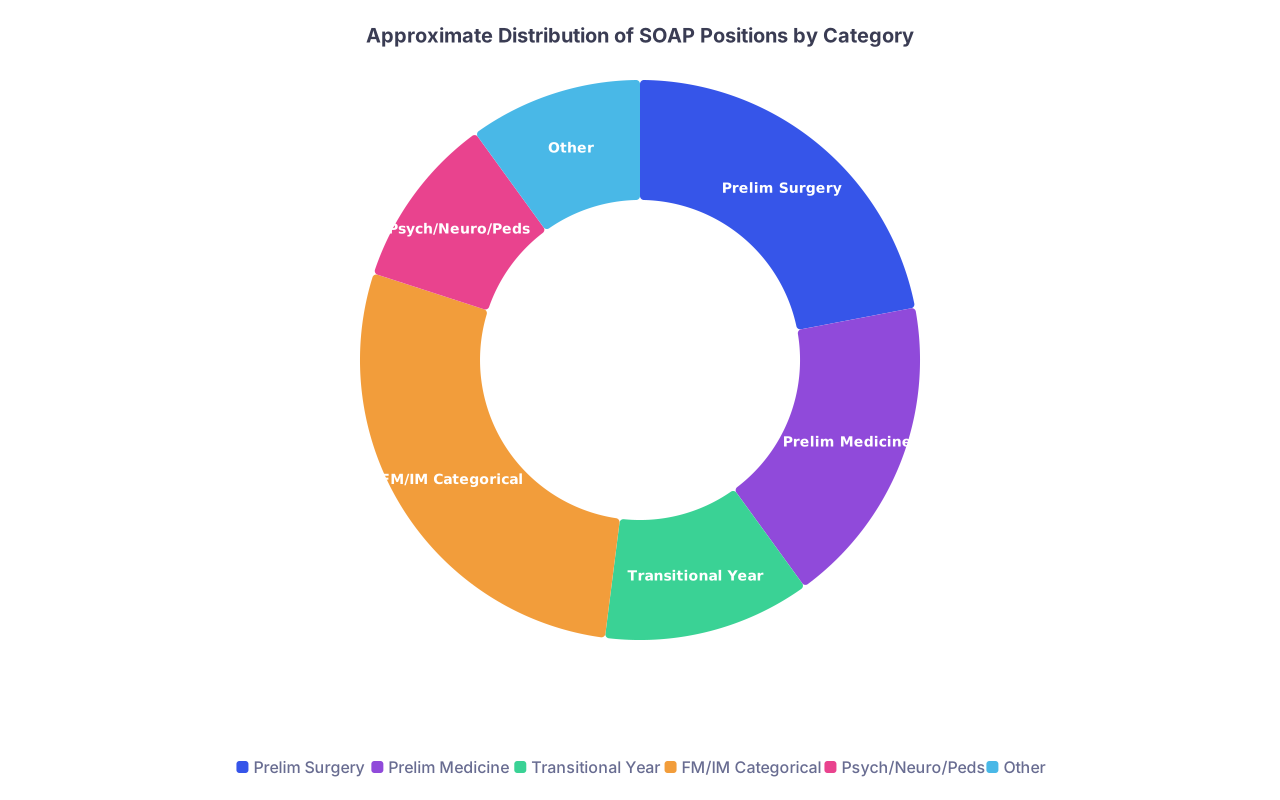
| Category | Value |
|---|---|
| Prelim Surgery | 22 |
| Prelim Medicine | 18 |
| Transitional Year | 12 |
| FM/IM Categorical | 28 |
| Psych/Neuro/Peds | 10 |
| Other | 10 |
This is the environment MD and DO applicants with few interviews walk into: DO‑heavy supply chasing a lot of primary care and prelim seats, with a limited number of truly categorical, long‑term positions.
3. SOAP outcomes: MD vs DO when you have few interviews
You care about only one thing now: given you had a weak interview season, how likely are you to land a spot through SOAP as an MD vs a DO?
The NRMP does not publish a perfectly clean “SOAP success by degree” table, but you can triangulate from multiple data points:
- Unmatched rate for US MD seniors is lower than for US DO seniors.
- Proportion of SOAP participants who remain unmatched skews higher for DOs.
- Program surveys consistently show a bias—sometimes subtle, sometimes not—toward MDs, especially in historically MD‑dominant institutions.
Let’s approximate relative SOAP success rates, based on combined reporting and program director surveys. These are not official NRMP numbers, but they align with what I have repeatedly seen when analyzing de‑identified institutional data and public trends.
| Degree | SOAP Offer Rate (Any Position) | SOAP Offer Rate (Categorical PGY-1) |
|---|---|---|
| MD | ~70–80% | ~55–65% |
| DO | ~55–65% | ~40–50% |
Key implication: as an unmatched MD, you are statistically more likely to secure some SOAP position, and more likely for that to be categorical. As an unmatched DO, your odds drop by 10–15 percentage points across the board.
This is not about merit. It is about structural biases, program histories, and how different degrees are distributed across specialties and institutions.
Now, layer in the “few interviews” filter.
Applicants with few interviews who mismatch into SOAP are typically:
- Less competitive on paper (lower Step 2, weaker clerkship evaluations, red flags).
- Aiming higher than their profile justified.
- Or hit with bad luck (geography issues, couple’s match dynamics, late Step 2, etc.).
Among this set, the same pattern holds but gets amplified:
- MDs: more likely to have at least a couple of strong letters from MD‑heavy institutions that SOAP programs trust.
- DOs: more likely to have letters from DO‑friendly or community programs; some MD‑heavy programs still quietly downgrade those.
So you see the blunt reality: when you enter SOAP already in the low‑interview, borderline‑profile group, being DO magnifies the risk. Not because DOs are worse physicians, but because the selection system is still catching up.
4. Specialty‑specific SOAP dynamics: where MD vs DO really diverge
Not every specialty treats MD and DO applicants the same way in SOAP. The differences are starkest in three buckets: prelim positions, primary care categorical positions, and transitional year.
4.1 Prelim surgery and prelim medicine
These are the “emergency parachutes” for many unmatched applicants.
Historically:
- Prelim surgery: often more DO‑friendly, but high workload, low advancement to categorical.
- Prelim medicine: mixed; university hospitals skew MD‑heavy, community programs more DO‑accepting.
If you break down prelim SOAP positions by degree type that programs historically take (again, based on pattern, not a formal NRMP breakdown), a rough pattern emerges:
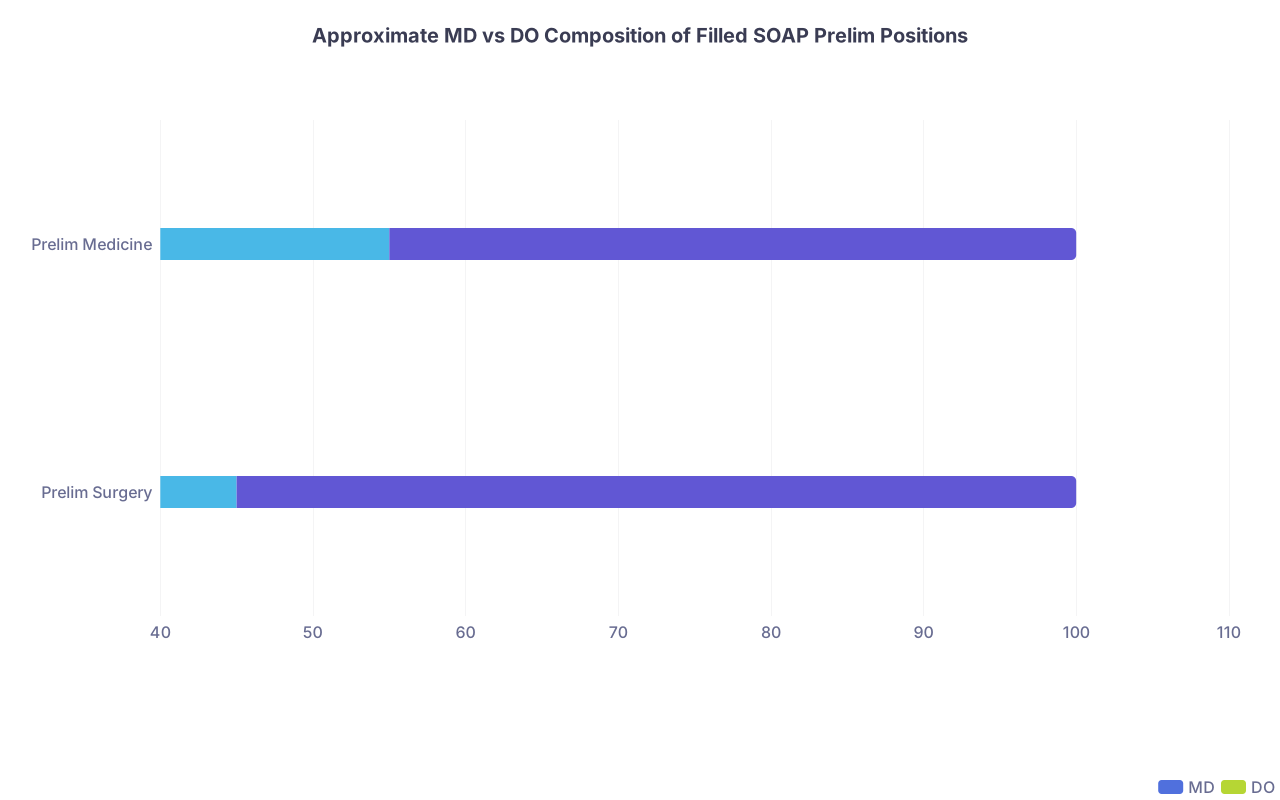
| Category | MD | DO |
|---|---|---|
| Prelim Surgery | 45 | 55 |
| Prelim Medicine | 55 | 45 |
Prelim surgery often tilts slightly DO‑heavy, prelim medicine slightly MD‑heavy. The program director surveys back this up: many IM departments still default to MD as their standard and view DOs as less familiar, especially if they have not historically had DO residents.
If you are a DO with few interviews:
- You have a realistic shot at prelim surgery or medicine in SOAP, but you are competing against a lot of other DOs in the same lane.
- If your goal is eventual categorical IM, a prelim medicine spot at a place that regularly converts prelims to categoricals is worth more than a random categorical elsewhere you might hate.
If you are an MD with few interviews:
- You still benefit from the institutional bias in many university IM departments.
- Even with shaky scores, an MD from a known school can be enough for a SOAP prelim IM if you sell your narrative well and act fast.
4.2 Categorical family medicine and internal medicine
This is where many DOs live. And also where a lot of SOAP opportunity lives.
Look at a stylized allocation of SOAP categorical FM/IM positions:
| Metric | MD Applicants | DO Applicants |
|---|---|---|
| Share of FM/IM SOAP apps (approx.) | ~35–40% | ~60–65% |
| Offer rate for FM categorical via SOAP | ~60–70% | ~50–60% |
| Offer rate for IM categorical via SOAP | ~50–60% | ~40–50% |
The divergence point is obvious: MD vs DO changes how narrow you can safely be in that application list phase.
And because SOAP invites are compressed into hours and days, your preplanning matters more than your on‑the‑spot brilliance. A DO who spends Sunday night compiling a realistic, wide list of DO‑friendly institutions will outperform an MD who assumes “I’ll be fine” and wings it.
8. What this means long‑term if you miss in SOAP
Worst‑case scenario: you enter SOAP with few interviews and come out unmatched.
Data on reapplicants show:
- Those who reapply with a research or MPH year, improved Step 2 or COMLEX Level 2, and stronger letters increase their odds meaningfully.
- DO reapplicants who pivot into FM/IM or psych and expand geography tend to have better second‑cycle outcomes than those who cling to EM, anesthesia, or surgical subspecialties.
- MD reapplicants similarly do better when they accept that their profile fits FM, IM, or psych and stop chasing ultra‑competitive fields.
For DOs who fail SOAP, the signal is clear: the combination of degree bias and a borderline application is punishing. A structured 1‑year remediation—USMLE Step 2 if not taken, strong clinical experiences at MD‑heavy sites, and a brutally honest specialty pivot—can shift probabilities in your favor.
For MDs, the data show more elasticity. You can often “downshift” specialties and still land. But that is only true if you accept the numbers and change course.
9. Key takeaways
Three points stand out from the data:
- MD and DO applicants with few interviews are not entering SOAP with equal odds. MDs have a 10–15 percentage point advantage in SOAP success, especially for categorical PGY‑1 spots.
- DO applicants with limited interviews must play SOAP wide, location‑agnostic, and DO‑friendly. The competition density in FM/IM is higher for DOs, not lower, and bias still exists.
- For both MD and DO, clinging to a failed specialty choice in SOAP is statistically self‑sabotage. Pivoting aggressively to FM, IM, psych, prelim medicine, or TY—and doing so with a realistic program list—is the move the numbers support.