
The biggest lie about the SOAP is that “any interest is good interest.” It is not. Programs absolutely separate desperate from selective applicants, and that split often decides who gets ranked high enough to actually match.
Let me walk you into the room where those decisions get made.
What Program Committees Actually See During SOAP
Program directors and coordinators are not scrolling ERAS peacefully with coffee. During SOAP, they are triaging chaos. Hundreds of applications per hour. Angry emails. Phone calls from deans. Faculty popping their heads in asking, “So…did we fill that spot yet?”
Here’s what they really see on your file when they pull you up during SOAP:
- Your full application (same ERAS, no secret SOAP version).
- Your application history: which programs you applied to originally.
- Your communications: emails, messages via ERAS, phone calls documented by the coordinator.
- Time stamps on SOAP applications.
- Sometimes: notes from faculty who know you or your school.
And they’re asking three questions, in this order:
- Is this person safe? (Professionalism, exam history, red flags.)
- Is this person desperate? (Spray-and-pray, obvious non-fit, incoherent choices.)
- Is this person selective and strategic? (Pattern that makes sense, targeted interest, sane backup behavior.)
Safe and selective? You climb the rank list.
Safe and obviously desperate? You may still match—but you drop.
And if you’re unsafe and desperate? You’re only getting ranked if they’re truly in panic mode.
How “Desperate” vs “Selective” Actually Looks on the Screen
Let me spell out how your behavior reads from the other side. Because committees don’t use your words; they use your pattern.
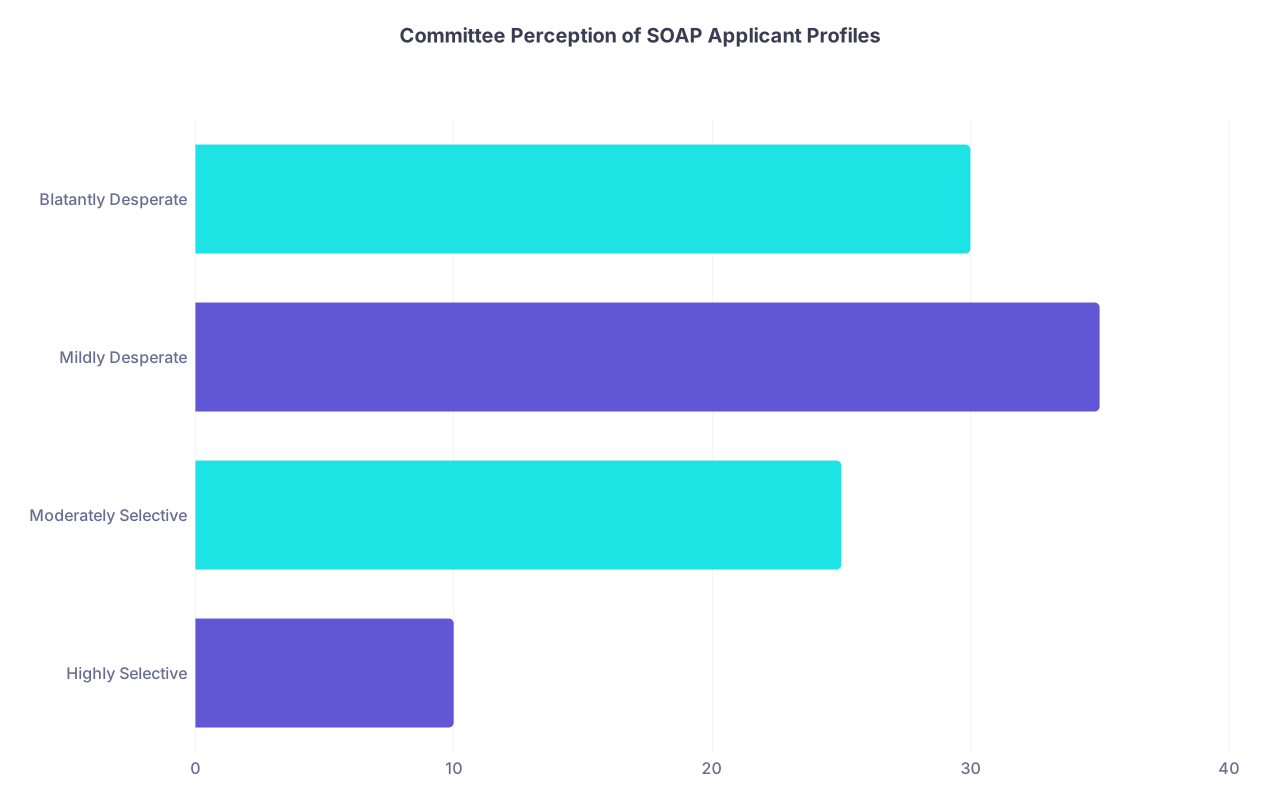
| Category | Value |
|---|---|
| Highly Selective | 10 |
| Moderately Selective | 25 |
| Mildly Desperate | 35 |
| Blatantly Desperate | 30 |
Those are rough proportions from a typical mid-tier IM program I’ve sat with. Maybe 10% look truly selective in SOAP.
The “Selective” SOAP Applicant Pattern
A selective SOAP applicant has:
- A core specialty narrative that stays coherent through SOAP.
- Backup choices that are reasonable, not schizophrenic.
- Targeted programs that align with geography, school history, or personal story.
- Communications that match the pattern: specific, not generic spam.
Example I’ve actually seen:
- Original applications: 50 categorical IM, 20 prelim IM, all in Midwest and South, mostly community or low–mid tier academics.
- SOAP behavior: Applies only to IM and prelim medicine in three states where they have ties; sends 5–10 tailored messages explaining their interest; dean calls 1–2 realistic programs to advocate.
- Result: Multiple SOAP interviews, ranked highly because they “look committed and grounded.”
Committees label these people—literally—with phrases like: “Focused. Strong regional interest. Reasonable backup.” That’s code for: safe to rank high.
The “Desperate” SOAP Applicant Pattern
Here’s what desperation looks like when the committee scrolls:
- Original apps: 40 EM, 30 Anesthesia, 20 Ortho.
- SOAP apps: 40 FM, 40 IM, 40 Psych, 20 Peds, 15 Path, a couple of PM&R.
- Messages: A generic “Your program is my top choice” blasted to multiple specialties.
- No coherent story in the PS, no updates, nothing that explains the whiplash.
People in the room will literally say things like:
“They didn’t even touch IM before today. This is just panic.”
Or:
“This person has applied to everything that moves.”
That “everything that moves” phrase is common. And once it’s said, your stock drops. You might still be ranked, but you slide behind the applicants with a believable trajectory.
How Committees Rank You During SOAP: The Real Algorithm
There’s no published SOAP algorithm. There is, however, the pattern I’ve watched play out over and over.

| Step | Description |
|---|---|
| Step 1 | Review Applicant |
| Step 2 | Low priority or skip |
| Step 3 | Rank in top tier |
| Step 4 | Rank mid list |
| Step 5 | Rank low if needed |
| Step 6 | Any red flags |
| Step 7 | Specialty fit |
| Step 8 | Desperate pattern |
What they’re really balancing:
- Risk – professionalism issues, failure patterns, attitude concerns from LORs or MSPE.
- Fit – for SOAP, that just means: can this person credibly function in this specialty and our program.
- Desperation Level – are they just grabbing anything, or do they seem to actually want us in a semi-plausible way.
Risk kills you first. Desperation decides how far down the list you slide.
Programs terrified of going unfilled will sometimes rank desperate applicants higher than they admit. But even in those moments, they still distinguish “organized desperation” from flailing.
Tactic #1: Build a Coherent SOAP Story Before You Panic
By SOAP week, most applicants are already in survival mode. The few who do well were planning their SOAP months before.
No, that’s not dramatic. I’ve heard PDs say, talking about borderline students: “If they don’t match, they’ll need a SOAP plan B toward IM or FM. Has anyone talked to them about that?”
So here’s how to look selective even when you’re not in the specialty you originally wanted.
Decide your SOAP identity 1–2 tiers down from your target
If you went for:
- EM → SOAP identity might be IM, FM, or prelim medicine.
- Ortho → SOAP identity might be prelim surgery or prelim medicine.
- Derm → IM, FM, or a research year.
- Anesthesia → IM, FM, prelim medicine.
You cannot credibly be “all in” on six different fields in 48 hours. Committees see right through that.
So you pick a SOAP identity and retro-fit your narrative:
- Adjust your personal statement to emphasize the SOAP specialty skills: continuity of care for FM, diagnostic reasoning for IM, procedural comfort for prelim surgery.
- Ask your dean’s office to prepare a short advocacy blurb consistent with that identity.
- Prepare talking points for calls and emails that support the same message.
People in the room do comment: “Their PS and dean’s letter addendum line up with this plan—this isn’t totally random.” That helps.
Tactic #2: Control the “Application Pattern” Signal
The committee can see what you applied to originally. They will use it against you—or in your favor.
| Original Apps vs SOAP Choices | Committee Interpretation |
|---|---|
| Same specialty, similar tier | Committed, realistic |
| Same specialty, lower tier | Grounded, appropriately backing down |
| Neighboring specialties only | Flexible but coherent |
| Every specialty under the sun | Desperate, identity crisis |
| Massive jump with no ties | Opportunistic, risky fit |
The trick isn’t to hide desperation—you can’t. The trick is to shape it.
How to look “selective” with your SOAP list
You have a limited number of applications per SOAP round. Use that constraint in your favor.
You want your SOAP application pattern to look like:
- Geographic clustering that makes sense (home region, med school region, family ties).
- Specialty grouping that is tight (IM + prelim medicine; FM only; prelim surgery only).
- Vertical realism (you slide down in program competitiveness, but not sideways into nonsense specialties you never touched before).
What looks bad in the room:
- Applying to an IM program in Maine, a psych program in Texas, a pathology program in California, and a FM program in Florida—with no explanation.
- Applying to prelim surgery and prelim medicine and prelim anything without any signal of why you could handle those roles.
The coordinator will pull up your list and someone will say: “Do they actually want this state? This specialty? Or just any job?” You want that to be an easy question: “Yes, this cluster makes sense.”
Tactic #3: Messaging Without Looking Pathetic
SOAP emails and calls matter. But not the way students think.
The mass “Dear Program Director, I am very interested in your program” emails are useless. Committees know you spammed them. They roll their eyes and move on.
What does get noticed:
- A concise, targeted message that clearly connects you to the program or region.
- A dean’s office or advisor call that doesn’t oversell, just vouches for your reliability.
- You not harassing them every 12 hours.
Here’s what a faculty member literally said once when a coordinator pulled up an inbox:
“Anyone who’s emailed three times in a day goes to the bottom. I don’t want that energy as an intern.”
You think you’re being persistent. They think you’re going to page them every hour.
What a selective SOAP message actually looks like
One email per program. Two if you truly have a specific connection or update. Short, focused, not begging.
Something like:
Dr. X,
I applied to your program in SOAP because I’m specifically trying to stay in [region] and pursue a career in [IM/FM/etc] focused on [brief interest]. I’ve worked with several graduates from your program through [home institution/away rotation connection], and they speak highly of the teaching culture.
I’d be grateful for any consideration for an interview.
Best,
[Name, AAMC ID]
That reads as selective, even if they know you’ve applied to 30 programs. Because you’re giving them a story they can repeat: “they want to be in our region, they know our graduates, they want our specialty.”
The worst SOAP message?
- Overly emotional (“I am begging you for a chance to achieve my dream”).
- Inconsistent (“EM has always been my passion” emailed to an FM program).
- Aggressive (“I have not heard back yet and I want to reiterate my interest”).
Those get screenshotted and mocked internally more than you’d like to believe.
Tactic #4: How They Rank “Desperate but Competent” Applicants
Now the uncomfortable truth: being labeled desperate does not automatically kill you. In SOAP, everyone is desperate on some level. Programs know this.
The question in the room is: are you desperate and still functional?
Here’s what committees typically do with the “good but clearly scrambling” group:
- If you have solid exams, decent LORs, and no red flags, you can still land mid-to-upper on the rank list—even if your pattern is scattered.
- If you have marginal exams or a failure, but you look organized and selective, you may beat out a higher scorer who looks like chaos.
I’ve seen a PD literally say:
“Yes, they applied broadly in SOAP, but at least their stuff is clean and their story makes sense. I’ll take stressed and structured over high score and erratic.”
What kills you is the combo of erratic behavior plus other concerns:
- USMLE/COMLEX failures with a massive scatter-gun SOAP list.
- Vague or concerning professionalism hints in the MSPE plus unhinged messaging.
- No coherent explanation for shifts in specialty choice.
Programs are asking: “If this is how they behave under pressure, what will they be like on call?”
If your desperation leaks as disorganization or emotional volatility, you slide toward the bottom—or off the list.
Tactic #5: Using Your Dean’s Office Without Letting Them Tank You
Here’s the part students rarely understand: program committees know which schools send realistic calls and which schools pressure them with fantasy.
When your dean’s office calls:
- A trusted, grounded dean who only advocates for realistic candidates? Their phone call matters.
- A dean who calls every PD in the country for everyone? Noise. People put those calls on speaker and half-listen.
You want to coordinate with your dean strategically:
- Give them a short list of truly plausible programs.
- Give them a consistent narrative: “I’m now fully committed to IM in the Midwest,” not “they’d take anything anywhere.”
- Ask them to emphasize reliability, work ethic, and being low-drama. Committees are screening for meltdown risk.
I’ve sat in rooms where the PD says: “Our colleague at [your med school] says this student is solid and would be grateful for the spot.” That alone has launched someone up the list.
But when the dean oversells (“top of the class,” “outstanding clinician”) and the application doesn’t match, trust erodes in seconds.
Tactic #6: Red Flag Management in SOAP (Yes, They Still Care)
SOAP is not a magical amnesty period. They still care about your failures, professionalism issues, and gaps. They just move faster.
Your goal is to be “safe enough” and “predictable enough.”
Common red flags during SOAP ranking discussions:
- “Why did they fail Step 1 and Step 2? Any explanation?”
- “They switched specialties three times—EM, then anesthesia, now IM. Is this someone who’s going to bail?”
- “This MSPE has subtle language about professionalism. Huge risk when we’re filling in a rush.”
If you have red flags:
- Use your SOAP PS and any allowed communication to briefly, clearly address stability now.
- Less emotion, more structure: what changed, how you improved, why you’re stable going forward.
- Avoid overly long explanations. Nobody has time. They want one clean paragraph they can mentally file as: “addressed and improving.”
Tactic #7: Pre-SOAP Moves That Make You Look Selective Later
The most successful “selective” SOAP candidates started the work before they knew they needed SOAP. Here’s what they did differently in the months before Match:
They:
- Had a realistic backup specialty identified with their advisor.
- Did at least some rotation, research, or meaningful exposure in that backup field.
- Mentioned that backup in their dean’s meetings so there was already a documented pattern if things went south.
- Didn’t apply only to hyper-competitive tiers in their dream specialty; they built in some “possible SOAP homes.”
Then, when SOAP hit, their pivot didn’t look like chaos. It looked like plan B.
I’ve heard PDs compare two candidates in SOAP and say:
“This one always had IM as a second interest—we saw it in their application. The other one looks like they woke up today and picked IM out of a hat.”
Guess who they rank first.
Tactic #8: Emotional Control – The Unspoken Ranking Factor
Here’s the brutal behind-the-scenes truth: committees are not just ranking competence. They’re ranking perceived drama.
On SOAP week, everyone’s stress is at the ceiling. The last thing programs want is to import more volatility. So they subconsciously favor applicants who look emotionally contained under pressure.
Patterns that signal drama to committees:
- Hyper-frequent emails.
- Long, highly emotional personal statements or messages.
- Overly intense language in communications (“my entire life depends on…”).
- Any hint that you or your family are threatening legal action or escalation.
Patterns that signal emotional stability:
- Calm, straightforward communications.
- Brief, solution-focused explanations of setbacks.
- Coordinated messaging with your dean, not behind-the-scenes parallel chaos.
- Accepting reality (e.g., pivoting reasonably) instead of clinging to a dead specialty in denial.
I’ve watched PDs say: “She’s had a rough path, but her messages were calm and mature. I trust that.” That single observation has moved someone up ten spots.
FAQ (Exactly 3 Questions)
1. If I applied only to a competitive specialty originally, will programs in other specialties automatically see me as desperate in SOAP?
They will see you as a pivot, yes—but that’s not automatically negative. If your pivot is coherent (for example, EM → IM, or ortho → prelim surgery) and your SOAP materials and messaging acknowledge that shift in a grounded way, you look like someone adapting to reality, not flailing. The worst thing you can do is pretend you always wanted their specialty when your ERAS history clearly shows otherwise. Name the pivot briefly, explain why it fits, and act like an adult making a hard but rational choice.
2. Should I apply as broadly as possible in SOAP to maximize my chances, or limit myself to maintain a “selective” image?
If you’re at high risk of going unmatched again, you do need to apply broadly—but strategically. That means broad within a coherent lane (e.g., IM + prelim medicine + FM in a few realistic regions), not broad across all specialties and all geographies with no narrative. Committees expect breadth in SOAP. What hurts you is incoherent breadth. Think in clusters: one or two specialties, a few focused regions. That still gives you a wide net without broadcasting “I have no idea who I am.”
3. How much do SOAP emails and calls actually change my rank position?
They rarely drag you from “never” to “top pick,” but they can move you meaningfully within a narrow band. A strong, specific email or a well-timed dean’s call might take you from the lower half of the rank list into the upper half, or from “on the fence” to “include.” That’s huge in SOAP where lists are short and margins are thin. What they will not do is reverse a serious red flag or erase a completely scattered pattern. Think of communication as a tie-breaker and amplifier, not a substitute for a coherent application.
Key points to walk away with:
Committees absolutely separate desperate from selective applicants, and they’re doing it by pattern, not by your self-description. Your job in SOAP is to narrow your identity, cluster your choices, and communicate like a stressed but functional colleague—not a drowning applicant. If your behavior under pressure looks organized, mature, and consistent, you rise on the list, even in the chaos.