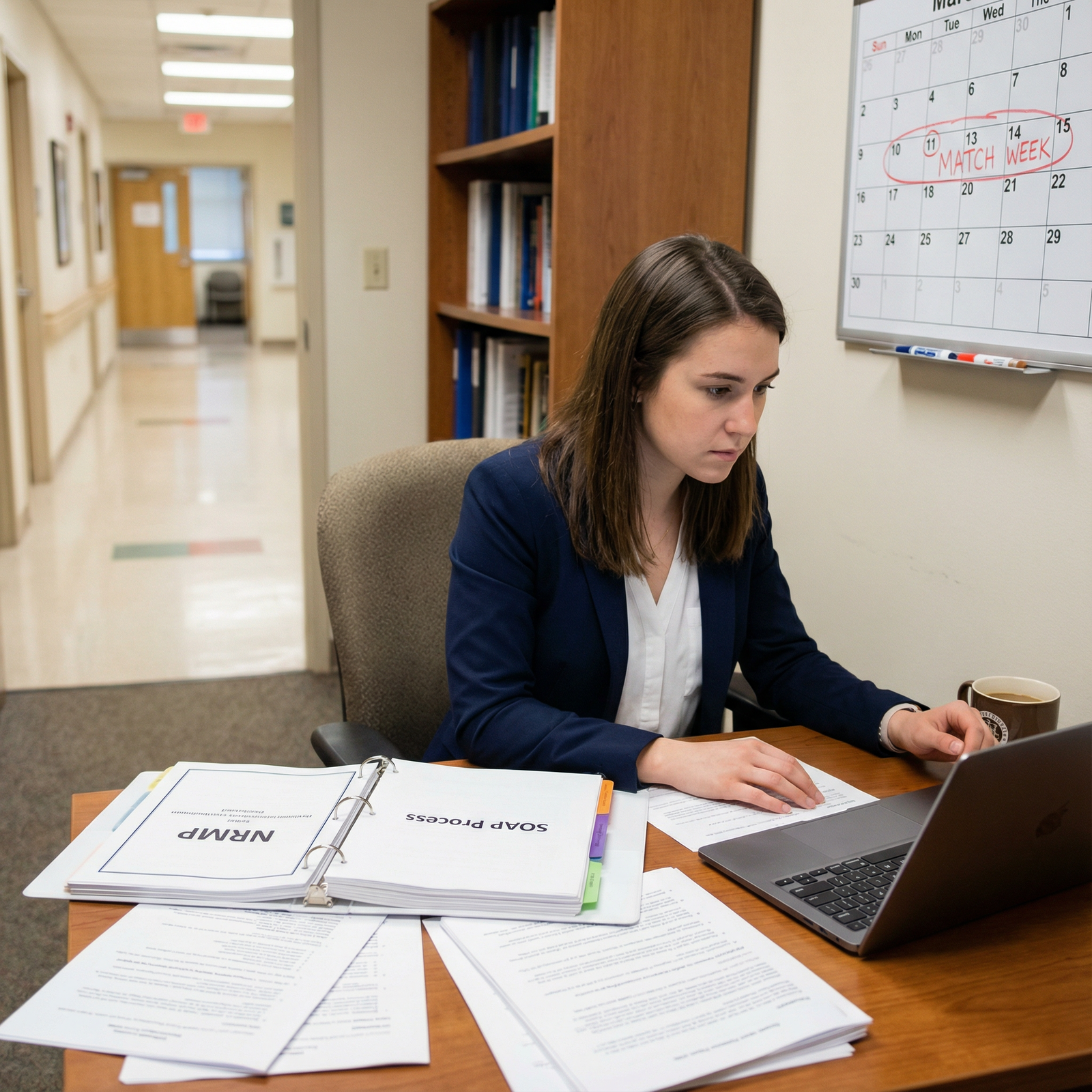
The way you update your CV and ERAS during SOAP can quietly sabotage you faster than a bad interview.
Most unmatched applicants think SOAP is about scrambling for any open spot. The smart ones know: it is about telling a tight, coherent story in an insanely compressed timeline. Your CV and ERAS updates either support that story—or blow it up.
Let me be blunt: programs are looking for reasons to move quickly, not to “give you the benefit of the doubt.” Sloppy updates, panicked additions, and incoherent narratives are easy reasons to pass.
You’re in a high‑risk moment. Here’s how not to make it worse.
1. Treating Your CV as a Dumping Ground Instead of a Narrative Tool
Your biggest mistake? Thinking “more is better.”
I’ve watched applicants add every single volunteer hour, half‑finished project, and minor committee they ever touched into their SOAP CV in a frantic attempt to “look stronger.” Programs see the opposite: lack of focus, lack of judgment, and a desperate last‑minute scramble.
Your CV during SOAP has one job: reinforce a clear, believable story about why you belong in the type of program you’re applying to now.
The mistake pattern looks like this:
- Original ERAS: Mostly Internal Medicine focused
- SOAP applications: Family Medicine, Psych, IM prelim, even Path
- CV update: adds a random radiology observership, a 2‑week ortho shadowing, and some generic “leadership” without context
That’s how you look unfocused and opportunistic.
The safer move:
- Prioritize experiences that align with SOAP specialties you’re actually targeting
- Remove (or de‑emphasize) clutter that confuses your trajectory
- Update descriptions to highlight skills/program‑friendly attributes, not just tasks
Do not turn your CV into a data dump. It’s a narrative document, even in SOAP.
, Inconsistent dates, Typos/unprofessional tone](https://cdn.residencyadvisor.com/images/articles_svg/chart-common-cv-problems-noticed-by-programs-in-soap-1553.svg "Common CV Problems Noticed by Programs in SOAP")
| Category | Value |
|---|---|
| Too cluttered | 80 |
| No clear specialty signal | 70 |
| [Last-minute additions look fake](https://residencyadvisor.com/resources/soap-limited-interviews/last-minute-soap-panic-moves-that-quietly-sabotage-your-chances) | 55 |
| Inconsistent dates | 45 |
| Typos/unprofessional tone | 40 |
The trap: thinking “SOAP is desperate, so none of this matters.” It matters more. Programs skim faster, judge harder, and have less patience.
2. Making Last‑Minute ERAS Edits That Break Your Story
Another serious self‑inflicted wound: changing your ERAS profile or experiences in ways that contradict what you sent before Match week.
Programs do look at prior applications if they saw you first round. PDs, APDs, and coordinators talk. They notice when your “story” suddenly changes overnight.
Examples I’ve actually seen:
- Applicant originally branded themselves as “future cardiologist, passionate about tertiary care.” SOAP version suddenly claims “committed to rural primary care and long‑term community relationships” because they’re applying FM.
- A personal statement for Psych that mentions “my long‑standing commitment to Internal Medicine and critical care” because someone copy‑pasted the wrong paragraph then rushed.
- Research project dates quietly extended into the future to “show ongoing productivity” when the PI would absolutely disagree.
This is how you lose trust. Fast.
Programs are not expecting your SOAP applications to be identical to your original ones. But they are expecting them to be compatible with the same person—same values, same core trajectory, adapted to a slightly different direction.
- Sudden, dramatic specialty “passion” shifts without any backing experiences
- Different versions of the same experience with changed scope, numbers, or outcomes
- Word‑for‑word personal statement reuse across totally different specialties
- Inconsistent graduation or exam dates between documents and ERAS
If you must pivot your narrative:
- Focus on transferable skills, not magical new passions
- Anchor your “new” interest in something already visible in your prior app
- Don’t rewrite your whole identity overnight; adjust, don’t reinvent
SOAP is allowed to show flexibility. It’s not a license to completely rewrite your backstory.
3. Ignoring How Your CV and ERAS Look to a Time‑Strapped Program
Programs reviewing during SOAP are not reading your CV like a novel. They’re scanning under pressure.
If your updates make it harder to quickly understand who you are, you lose.
Common self‑sabotaging choices:
- Giant paragraphs in experience descriptions
- No clear section ordering (research buried above clinical)
- Redundant items (listing the same role three different ways)
- Cute section titles or overly casual language
During SOAP, your docs need to be skimmable. That means:
- Short, focused bullet points (2–4 per experience)
- Emphasis on what you did and what skills you brought, not flowery stories
- Clean alignment of ERAS entries and CV sections
- Clearly labeled, conventional sections: Education, Exams, Clinical Experience, Research, Volunteer, Work, Honors
Think like the program: Are they going to understand your strengths in 15–30 seconds of scanning? If not, you’ve already made it too hard.

A frequent rookie error: stuffing every bullet with “passion,” “dedication,” “lifelong dream,” and other filler. It reads like noise. Programs are looking for competence, reliability, and fit—not melodrama.
Start stripping:
- Delete bullets that repeat the same idea for different experiences
- Remove activities older than 5–7 years that add no value to your current story
- Cut generic tasks (e.g., “took vitals,” “assisted with patient care”) unless you can frame something distinctive
SOAP is not the time to impress with volume. It’s the time to impress with clarity.
4. Letting Gaps, Failures, and Red Flags Go Unaddressed—or Poorly Addressed
If you’re in SOAP, there’s usually something in your file that programs are side‑eyeing: low scores, failed attempt, gap, leaves, multiple attempts at Match, weak letters, etc.
The dangerous move: pretending these do not exist and hoping a program just “misses it.”
They don’t. They zoom in on it.
What undermines your SOAP narrative:
- ERAS updates that quietly shift dates to “compress” gaps
- Leaving a clear multi‑month hole with zero explanation
- Contradicting what your dean’s letter or MSPE already documented
- Vague, defensive descriptions when you do address an issue
You’re safer when you:
- Keep dates honest and consistent across CV, ERAS, MSPE, and transcripts
- Add a brief, neutral explanation to activities that might otherwise look like a mysterious void
- Show what you did with that time in a way that demonstrates growth or responsibility (clinical observership, structured study, family responsibility, health treatment with recovery)
Don’t write a five‑paragraph essay in your CV about a Step failure. But also don’t pretend it didn’t happen.
What looks bad:
- “Took time off for personal reasons” repeated three times for different time blocks
- Using vague “independent research” to cover six‑month periods with no output, no mentor, no structure
What looks mature:
- A single‑sentence explanation that acknowledges reality without over‑sharing
- Followed by evidence of stability and consistent effort afterward
Programs don’t require perfection. They do require that your story doesn’t smell like you’re hiding something.
5. Misaligning Your “SOAP Narrative” With Your Actual File
You’ll hear a lot of talk about “crafting your SOAP narrative.” The mistake is thinking your narrative lives only in one place—like a new personal statement or email.
Your narrative is:
- Your original ERAS content
- Your updated ERAS fields
- Your CV
- Any new letters (if allowed/used)
- What your dean’s letter/MSPE already said
- What you say in interviews
They all need to sound like they belong to the same person.
Here’s where people screw this up:
- Telling programs they’re “fully committed to Psychiatry” while their CV and ERAS still scream surgical subspecialty
- Claiming a “strong interest in underserved communities” when they have zero community or primary care experience listed
- Presenting themselves as “calm and resilient” while their application history shows 3 LOAs, incomplete rotations, and no explanation
Is that fixable mid‑SOAP? Partially. But only if you’re strategic.
You can’t fabricate past involvement, but you can:
- Re‑frame existing experiences more clearly around skills relevant to the SOAP specialty
- Pull forward things you downplayed before (e.g., a behavioral health rotation now gets more space in your CV if you’re applying Psych)
- Make sure your chronological story (what you did, when) tracks with the way you talk about your trajectory
Your narrative should answer these silent program questions:
- “Can this person function safely in our program?”
- “Does this person’s background plausibly match our specialty?”
- “Are they likely to stick with us and not try to jump ship first chance they get?”
If your CV and ERAS updates leave any of those answers in doubt, you just undercut yourself.
| Aspect | Aligned Narrative Example | Misaligned Narrative Example |
|---|---|---|
| Specialty Interest | IM rotations, QI project, continuity clinic | Mostly surgery electives, now claiming Psych |
| Location Preference | Multiple experiences in region, family nearby | No ties, suddenly “lifelong dream” to be there |
| Career Goals | Primary care work + FM apps | ICU research + “passion for outpatient lifestyle” |
6. Over‑Editing vs. Under‑Editing: Both Can Hurt You
Two opposite but equally dangerous SOAP instincts:
- “I need to completely rewrite everything.”
- “I shouldn’t change anything; it’s too risky.”
Both are wrong when taken to extremes.
Over‑Editing: The Reinvention Trap
You decide SOAP is your chance to erase all previous missteps. So you:
- Reorder major experiences
- Inflate roles (“coordinated” becomes “led,” “assisted” becomes “managed”)
- Add new “interests” that never appeared before
- Change your tone drastically (suddenly ultra‑formal or weirdly dramatic)
Programs who saw your original app will notice. Even programs seeing you for the first time will feel the inconsistency if your MSPE and CV don’t sound like they describe the same person.
This kind of reinvention screams: “I’ll say anything to get a spot.”
Under‑Editing: The “Frozen Application” Mistake
On the other hand, some applicants are so scared of making errors they do nothing:
- Don’t correct obvious typos in ERAS
- Don’t update passed Step 2 CK scores
- Don’t add new clinical experiences from the months after original submission
- Don’t tighten descriptions that were originally written for a different specialty
This makes you look disengaged. Like you’re not actively trying to improve or adapt, even when given a second chance.
The right middle ground:
- Update exam scores, recent rotations, ongoing roles—accurately
- Adjust descriptions to highlight SOAP‑relevant skills, but don’t change core facts
- Trim and clarify; don’t rewrite the entire structure of your history
If a change would surprise your dean, your PI, or your past self reading your original app, pause. You’re probably pushing too far.
7. Wasting Your Limited Time on the Wrong Edits
SOAP is brutally timed. You don’t get days to workshop every sentence. Yet I’ve seen people burn an entire night rewriting one personal statement paragraph while leaving major ERAS and CV issues untouched.
Think in triage.

| Step | Description |
|---|---|
| Step 1 | Start SOAP Week |
| Step 2 | Update ERAS core data |
| Step 3 | Clarify with brief, honest notes |
| Step 4 | Retarget descriptions to new specialty |
| Step 5 | Polish CV formatting and clarity |
| Step 6 | Spot check for consistency across all documents |
| Step 7 | Any new exam scores or rotations? |
| Step 8 | Major red flags or gaps? |
| Step 9 | Specialty pivot? |
High‑yield updates first:
- New exam results (especially if they fix a prior weakness)
- New U.S. clinical experience or sub‑internships
- Clarifying any time gaps since your original submission
- Cleaning up obvious inconsistencies between CV and ERAS
Medium‑yield:
- Re‑ordering experiences to better highlight relevant ones
- Sharpening a few key descriptions to emphasize responsibility and reliability
- Updating contact info, geographic preferences, etc.
Low‑yield (but where people oddly spend most time):
- Rewriting every single entry from scratch
- Over‑polishing language that was already fine
- Obsessing over minor stylistic differences that no PD cares about
The big waste: agonizing over word choice (“motivated” vs “driven”) while leaving your failed Step or 8‑month gap completely unexplained.
Don’t do surgery on adjectives while ignoring fractures in your timeline.
8. Letting Desperation Show—In Ways Programs Instantly Recognize
There’s a certain “SOAP smell” to some applications. You do not want it.
Signs you’re rewriting from a place of panic, not judgment:
- Suddenly adding “interest in every specialty” to your CV or ERAS profile
- Writing absurdly generic “career goals” that could fit any program on Earth
- Inserting emotional language that doesn’t fit (“This is my only dream,” “I will never stop fighting for this,” etc.)
- Overstating future plans (“I plan to become world‑renowned expert in…” in a SOAP application? No.)
Programs are not heartless. But they are very allergic to desperation that comes with poor boundaries and unrealistic expectations.
Instead of overselling:
- Show emotional stability in how you talk about setbacks
- Demonstrate steady work, not grand promises
- Let your actions (updated clinical work, improved scores, consistent effort) speak more loudly than your adjectives
SOAP is high emotion for you. It must not read that way to them.

If your updated CV and ERAS sound like a plea instead of a professional presentation, you’re undercutting your own case.
9. Forgetting That People Talk—and Compare Versions
This part people underestimate.
During SOAP:
- Coordinators forward PDFs
- PDs check old ERAS submissions
- Faculty compare what you said in an email vs what’s in ERAS
- Some programs have already interviewed you once and still have notes
When your CV says you did 10 posters, your ERAS says 6, and your letter writer mentioned “2 abstracts,” they may not know which is right—but they now know something doesn’t add up.
Common inconsistency traps:
- Changing research output counts without real new products
- Updating roles from “shadowing” to “observer” to “clinical trainee” between cycles
- Quietly omitting an old experience you previously emphasized heavily
- Geographic story shifting (you used to want East Coast only, now claiming lifelong dream to be Midwest FM)
Will every discrepancy kill your chances? No. But they accumulate. And in SOAP, where small reasons to say no are all a program needs, that’s risky.
Before you hit submit:
- Pull your original ERAS (if you can) and compare key numbers: research, leadership, work experiences, dates
- Make sure big pieces didn’t shrink, grow, or magically move
- If you genuinely must fix a past error, fine—just don’t compound it by over‑correcting
You’re not just updating in a vacuum. You’re updating inside a system with memory.
10. Not Getting a Sanity Check Before Locking Changes
One of the most avoidable mistakes: making all your updates in isolation at 2 a.m., then locking them in without a single other set of eyes.
During SOAP, you’re exhausted, anxious, and emotionally invested. That’s the worst headspace to be your own editor.
You don’t need ten reviewers. You need one reasonable, detail‑oriented person who:
- Knows your general story
- Can skim for obvious contradictions or misalignments
- Will tell you if the tone slipped into panic or over‑sell
Red flags a good reviewer can catch quickly:
- A bullet that sounds like bragging instead of confident
- An unexplained 4‑month period between rotations
- Two different graduation dates in two different documents
- A personal statement line that does not match your actual experience list at all
If you truly have no one, at least:
- Print your CV and ERAS PDF (or export to PDF) and read them from start to finish in one sitting
- Circle anything that would confuse you if you knew nothing about yourself
- Fix those first
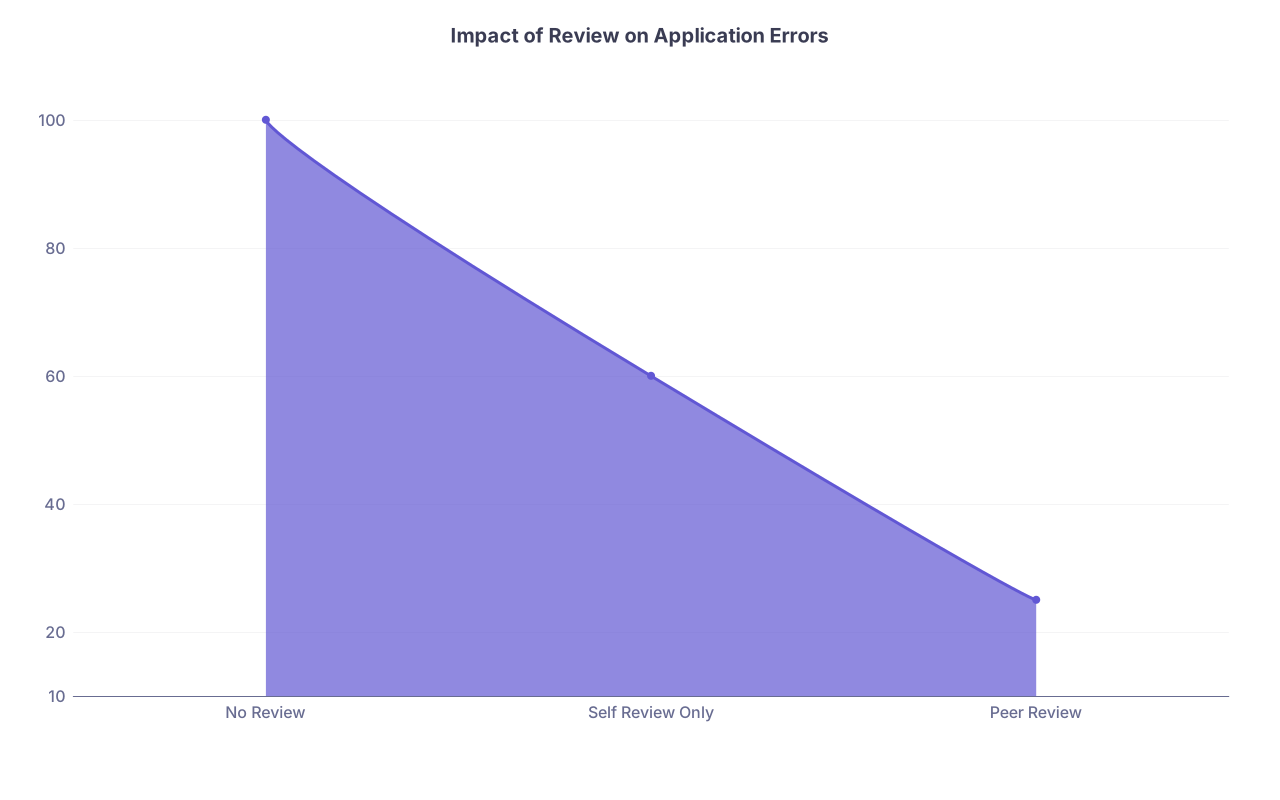
| Category | Value |
|---|---|
| No Review | 100 |
| Self Review Only | 60 |
| Peer Review | 25 |
I’ve seen applicants go from “this will raise questions” to “clean and consistent” with literally 30 minutes of outside review. And I’ve seen others tank themselves because they didn’t want to “bother” anyone.
You’re not bothering people. You’re fighting for your career.
Final Takeaways
Keep this tight in your head:
- Your CV and ERAS updates must tell one coherent, honest, specialty‑plausible story—not a panicked reinvention.
- Clarity, consistency, and alignment beat volume, drama, and last‑minute padding every single time.
- Every edit during SOAP should either fix a weakness, highlight real strength, or reduce confusion. If it does none of those, do not waste time on it.