
Crafting Specialty-Switch Explanations for SOAP When Your Season Underwhelmed
Most SOAP applicants destroy their chances with one move: vague, defensive explanations for why they are suddenly switching specialties after a weak season. Programs are not confused by the switch. They are repelled by the story you tell about it.
Let me break this down very specifically, because this is where people either salvage a career or dig the hole deeper.
You are in SOAP. Your main specialty did not work out. Maybe you had 0–3 interviews. Maybe you ranked and still did not match. Now you are staring at a SOAP list full of prelim spots, categorical IM, FM, psych, peds, maybe transitional year, and a few things you never seriously considered.
The bad instinct: write a generic “I have always loved [new specialty]” paragraph and pretend the last 12 months did not happen.
Programs can see your ERAS. They see your chosen specialty, your letters, your experiences. They know this was not your original plan. The question in their heads is not “Why this specialty?” It is:
- Can this person function safely on July 1?
- Are they going to reapply and leave?
- Are they blaming everyone else for a poor season?
- Will they be miserable here?
Your explanation must answer those questions clearly and calmly, without sounding desperate or dishonest.
Let us go step by step.
Step 1: Understand what SOAP programs actually worry about
If you do not understand their fears, you will write the wrong essay and bomb the phone call.
Programs taking SOAP candidates are usually juggling three things:
Service needs
They need interns who can carry a census, write notes, call consults, not implode on call. SOAP is not just a charity match. It is staffing.Risk management
They know SOAP spots are often filled by:- Reapplicants
- People switching out of more competitive fields
- Applicants with red flags (low scores, gaps, professionalism issues) Their job is to pick the ones who will not create new problems.
Retention and morale
They do not want someone who will be bitter, disengaged, or gone in a year without a plan that makes sense. Residents like that drag teams down fast.
So your specialty-switch explanation needs to show three things explicitly:
- You can handle the work now.
- You have a realistic, coherent plan.
- You can actually see yourself satisfied in this path, not just “using” them.
You do that with structure and specifics, not word salad.
Step 2: Be honest about what “underwhelmed season” really means
You cannot write a good explanation if you are lying to yourself about why you are here.
Underwhelmed season usually falls into a few patterns:
- Overreached on specialty (e.g., 229 Step 1, 238 Step 2, average portfolio, applied to 40 derm programs and 0–1 backup)
- Poor application strategy (late ERAS, very narrow geography, weak letters, poor personal statement)
- Real red flags (fails, misconduct note, long leave, multiple attempts, COMLEX-only in competitive field)
- Strong file but brutally competitive cycle (happens in ortho, ENT, plastics, anesthesia, etc.)
Your internal “why” will color your explanation. If you still think the process was unfair and everyone else is clueless, it shows in your tone.
Do this on paper before you write a single SOAP line:
List the main reasons your season underperformed:
- Scores / class rank
- Number and type of applications
- Letters
- Timing
- Specialty competitiveness
Identify what is actually fair to mention:
- You can’t say: “Derm rejected me because the system is biased.”
- You can say: “Dermatology is extremely competitive, and my metrics placed me at the lower end for interviews despite genuine interest and focused preparation.”
You are not writing a confessional. You are writing a professional narrative. Own your reality without self-immolation.
Step 3: Choose a rational target for SOAP
This is where people go off the rails. Grabbing at any open spot is how you end up with explanations that sound incoherent.
You need to pick targets that you can plausibly justify from your existing record.
| Original Plan | Plausible SOAP Targets | Harder to Justify in SOAP |
|---|---|---|
| Ortho | IM prelim, TY, gen surg prelim | Path, psych categorical |
| Derm | IM categorical, FM, TY | Gen surg categorical |
| Radiology | TY, IM prelim, IM categorical | EM categorical |
| EM | IM, FM, TY | Path, radiology |
| Neurosurgery | Gen surg prelim, TY | Peds, OB/GYN categorical |
You are trying to create a story that sounds like this:
“I pursued X for reasons A and B. I did not match due to C. In reassessing, I see that my skills and experiences align concretely with Y, and I believe I can build a meaningful career here because of D and E.”
If your original specialty and SOAP target have zero overlap in skills, patient population, or experiences, you need to make the bridge very explicit.
Step 4: Build the core structure of your explanation
You will reuse the same spine for:
- SOAP-specific personal statement
- Email to PD / coordinator
- Quick elevator answer on phone calls
Keep the structure tight: 4 parts.
Brief acknowledgment of original plan
One or two sentences. No drama.Concise reason the season underwhelmed
Focused, fact-based, not whiny.Clear, specific rationale for the new specialty
Tied directly to real experiences from your application and life.Reassurance about commitment and performance
Address concern about reapplying / leaving, and whether you can function clinically.
Let me show you how each part should look.
Step 5: Write Part 1 – Acknowledge the original specialty without overexplaining
Wrong versions I see constantly:
- “I originally applied to orthopedic surgery, but after deep reflection I realized my true passion lies in internal medicine.” (Nobody believes the “true passion” pivot that magically appears in SOAP week.)
- “I was forced to reconsider my career path due to the extremely competitive nature of my desired specialty.” (Victim tone.)
You want something like this:
“I applied this cycle in orthopedic surgery, drawn by the opportunity to restore function and work closely with patients over time. I completed away rotations in musculoskeletal care and enjoyed the operative environment and team-based culture.”
Short. Neutral. It shows you had a plan, and there were coherent reasons.
If you applied in a hyper-competitive field:
“I pursued dermatology this cycle after building a strong foundation in chronic disease management and outpatient care. I valued the diagnostic reasoning, continuity, and procedural aspects of the field.”
Again, calm. No excuses yet.
Step 6: Write Part 2 – Explain the underwhelmed season without sounding bitter
You must walk a narrow line: acknowledge reality without projecting anger or fragility.
Bad patterns:
- Blaming: “Unfortunately, I did not receive interviews commensurate with my qualifications due to the increasingly competitive landscape and bias against DO applicants.”
- Oversharing: “I failed Step 1 twice and that prevented me from matching.” (Programs can see the fail; you do not need to center it in your pitch.)
Better approach:
- Name the facts.
- Put them in context.
- Move on.
Example for competitive specialty, borderline numbers:
“Despite strong clinical evaluations and positive feedback on rotations, my application was not competitive for orthopedic surgery this year. My Step scores and research output placed me below the typical range for interviews in this specialty, and I received limited opportunities to be seen by programs.”
Example for late / flawed strategy:
“I submitted a focused list of applications and limited my geographic range significantly for personal reasons. In retrospect, this strategy narrowed my opportunities. I received few interviews and ultimately did not match.”
If you have a failure/red flag:
“An early Step 1 failure constrained my competitiveness in orthopedic surgery despite subsequent improvement and a passing Step 2 score. Programs in this field place heavy emphasis on testing metrics, and I had fewer interview offers than needed to match.”
Notice what I am doing:
- I am not hiding the reality.
- I am not writing a pity essay.
- I am clearly implying: “This explains why ortho did not work, not why I am a bad doctor.”
Then stop. Do not spiral into a paragraph about how unfair everything felt.
Step 7: Write Part 3 – Construct a believable rationale for the new specialty
This is the centerpiece. This is where most SOAP explanations collapse.
You cannot say: “Now I realized I am passionate about [new specialty].” Too sudden. Too rehearsed.
You need to:
- Pull specific experiences from your history that directly touch the SOAP specialty.
- Show you have thought concretely about the day-to-day reality of that field.
- Avoid implying this is just a “parking spot.”
Let us do examples by scenario.
Example: Ortho → Internal Medicine prelim / categorical
Weak:
“I now realize that I am more interested in the holistic care provided in internal medicine.”
Better:
“Throughout medical school, my strongest clinical rotations were on inpatient internal medicine services. I enjoyed managing undifferentiated presentations, coordinating with consultants, and following patients through complex hospital courses. Even while focused on orthopedics, I found myself drawn to the broader medical issues impacting surgical outcomes—optimizing diabetes control, managing anticoagulation, and addressing heart failure.
As I reassessed my options during this cycle, it became clear that the aspects of care I value most—diagnostic reasoning, longitudinal relationships, and multidisciplinary coordination—are central to internal medicine. I can see myself building a long-term career in hospital medicine or a subspecialty fellowship after strong IM training.”
Specific. Grounded in real tasks. Relatable to the PD reading it.
Example: Derm → Family Medicine
Weak:
“I discovered a passion for primary care late in my fourth year.”
Better:
“My interest in dermatology grew out of an early commitment to outpatient medicine and chronic disease management. I enjoy counseling patients, building trust over repeated visits, and addressing quality-of-life concerns that unfold over months and years. On my family medicine rotations, I appreciated how skin disease, metabolic conditions, mental health, and social determinants often intersect in a single visit.
As this match cycle unfolded, I took a hard look at what parts of clinical work consistently energize me. Those have always been: longitudinal relationships, patient education, and comprehensive care in the outpatient setting. Family medicine offers all of these, with the added breadth to care for entire families and communities.”
Again: you are not pretending derm never happened. You are connecting the core motivations to a broader field.
Step 8: Write Part 4 – Address commitment, future plans, and reapplication
Programs assume SOAP specialty-switchers will bolt at the first chance to reapply. You have to manage that head-on.
You have three honest positions you can take:
- “I intend to build a permanent career in this new specialty.”
- “I am open to a long-term career here, and if my goals evolve, I will handle that professionally.”
- “I plan to complete a prelim year and reapply to my original field.” (For prelim spots only.)
What you cannot do: imply you will use a categorical IM or FM spot as a 1-year stepping stone. That is the fastest path to the rejection pile.
Sample language for categorical spots:
“I am approaching SOAP with a clear, long-term mindset. While my original application focused on orthopedics, I am not using internal medicine as a placeholder year. I can see myself fully invested in an IM career, whether as a hospitalist or through fellowship in fields like cardiology or pulmonology. If fortunate to join your program, my intention is to complete full training and contribute meaningfully to the residency community.”
For prelim / TY spots where reapplication is expected:
“I am applying to preliminary and transitional positions with the intention of using this year to strengthen my clinical foundation and reapply in [original field]. That said, I understand the responsibility that comes with an intern position. My focus during the year will be to deliver reliable, high-quality patient care, function as a fully engaged team member, and represent your program well. I am transparent about my long-term goals but fully committed to the work of the intern year.”
The key: clarity and respect. PDs hate being misled more than they hate reapplicants.
Step 9: Thread this explanation through all your SOAP touchpoints
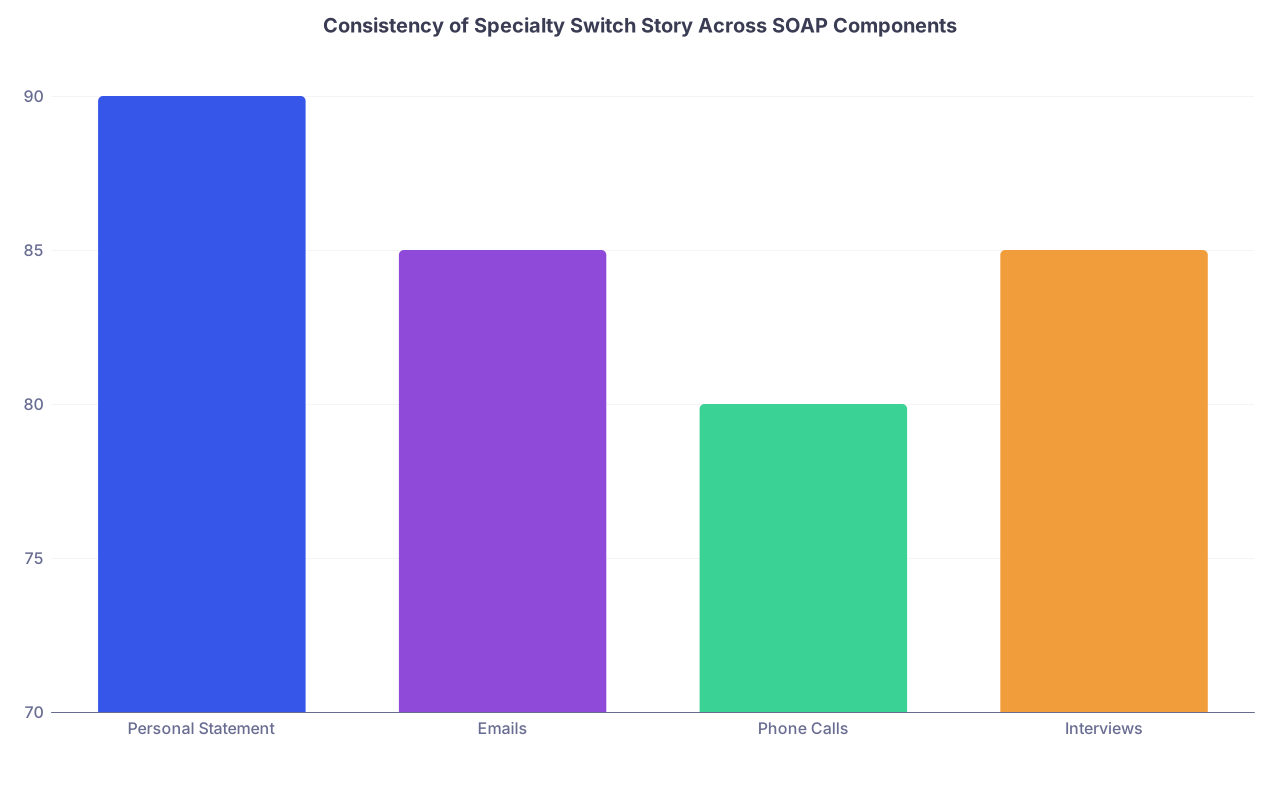
This is not just about one paragraph in a SOAP PS. You need message discipline.
You will use the same narrative spine in:
- SOAP personal statement
- The short “why this specialty/program?” text boxes some programs use
- Emails to PDs
- Phone calls with coordinators / PDs / faculty
- Any last-minute Zoom / phone interviews
Here’s the mental model: one story, multiple formats.
| Category | Value |
|---|---|
| Personal Statement | 90 |
| Emails | 85 |
| Phone Calls | 80 |
| Interviews | 85 |
You are aiming for ~80–90% consistency. Details can shift. Core message should not.
Write out a 3–4 sentence version you can say out loud in 20–30 seconds. Practice it.
Something like:
“I applied this year in orthopedic surgery because I enjoy procedural work and team-based care in the hospital. My scores and application were not competitive enough in that field, and I had a limited interview season that did not result in a match. Looking back at my rotations, the services where I consistently thrived were internal medicine—managing complex medical issues, coordinating care, and following patients through their hospital course. I am applying through SOAP with a genuine interest in building a long-term career in internal medicine and contributing fully as an intern.”
That’s what you say when someone on the phone asks, “So tell me about your application this year.”
Step 10: Calibrate tone – confident, not delusional; humble, not self-abasing
This part separates adults from applicants still emotionally stuck on Monday at 11 AM.
You need to strike a few tonal notes:
- Responsibility: you understand your season, you are not blaming the world.
- Stability: you are not falling apart, even if this week is awful.
- Respect: you are not treating SOAP programs as consolation prizes.
Things that sound bad to PDs:
- “I deserve an opportunity to prove myself.” (Entitled.)
- “I was shocked I did not get more interviews.” (Out of touch.)
- “I will do anything, any specialty, anywhere.” (Desperate, and obviously false.)
Better tone:
- “This outcome forced me to reassess my assumptions and think more broadly about where I can contribute as a physician.”
- “I recognize that my initial strategy was narrow and did not align well with the competitiveness of the field.”
- “I would be grateful for the opportunity to train in a program that values strong clinical work and team-based care.”
You are not selling perfection. You are selling resilience and clarity.
Step 11: Common landmines in specialty-switch explanations
Let me call out specific mistakes I have seen tank otherwise decent SOAP chances.
Pretending you always wanted the SOAP specialty
Programs can read dates on your application. They see 3 ortho letters, 2 ortho aways, ortho research, and a last-minute IM PS. Do not insult them.Over-disclosing psych / personal crises in detail
Saying “personal circumstances impacted my original cycle” is fine. A paragraph about your breakup, depression, and family fight? No.Highlighting you will reapply from a categorical spot
Categorical PDs do not want to be your “backup plan” credential farm.Being cryptic about red flags
If you have a clear, visible issue (Step fail, leave of absence), and you say nothing anywhere, it looks evasive. Address it briefly and maturely, then move on.Copy-pasting generic “why this specialty” text from classmates
PDs can smell template language. They read hundreds of these. They remember the real ones.
Step 12: Concrete language templates you can adapt
You should not copy these verbatim, but use them as scaffolding.
Template – Ortho/Neurosurg → IM prelim / TY
“I pursued [orthopedic surgery / neurosurgery] this cycle because I am motivated by procedural work and the chance to help patients regain function. My away rotations confirmed that I enjoy the operating room and team-based culture.
However, my application was not competitive in that field this year. My board scores and research profile placed me below the usual thresholds for interviews, and I had a limited season that did not result in a match.
As I have reflected during this process, I recognize that the parts of medicine I value most—managing complex hospitalized patients, coordinating with consultants, and following clinical response to treatment—are central to strong internal medicine training. My best clinical evaluations came from IM services, where I was consistently commended for reliability, clear communication, and ownership of my patients.
I am applying for a preliminary [or transitional] year with the intention of delivering dependable, high-quality inpatient care, strengthening my clinical foundation, and contributing fully to the residency team.”
Template – Derm/Rads → FM / IM categorical
“I applied this year in [dermatology / diagnostic radiology], drawn initially by the diagnostic reasoning and opportunity for focused expertise. My metrics and research were not competitive enough to secure sufficient interviews in this field, and I did not match.
Stepping back, I have looked closely at where I have felt most effective as a clinician. On my [family medicine / internal medicine] rotations, I consistently enjoyed forming relationships with patients, managing chronic conditions, and working within a multidisciplinary team. I value the breadth of problems seen in primary care and the chance to follow patients over time as their lives and health evolve.
These experiences have led me to pursue a categorical position in [family medicine / internal medicine] through SOAP. I can see myself building a long-term career in this field, either in outpatient practice or potentially through fellowship, and I am prepared to commit fully to residency training in this specialty.”
Template – EM → IM / FM
“I focused my initial application on emergency medicine because I enjoy acute care, rapid decision making, and working with diverse patient populations. Despite solid clinical evaluations, I had a limited interview season and did not match.
During third and fourth year, I found that I also thrived in inpatient [internal medicine] and outpatient [family medicine] settings. I appreciated having more time to build rapport, follow diagnostic workups, and see the impact of treatment decisions over days and weeks rather than hours.
Through this process I have realized that what matters most to me is caring for medically complex patients, collaborating with a team, and having the option for continuity. [Internal medicine / Family medicine] provides that framework, and I am committed to pursuing full training in this specialty.”
Step 13: Match your explanation to timeline and process reality
SOAP is compressed. You do not have weeks to craft a literary masterpiece. You have hours.
Use a simple workflow.
Do not spend 6 hours rewriting adjectives. Spend 60 minutes getting the story straight, then paste that into all your formats with minor tuning.
Step 14: Do a sanity check with someone who will tell you the truth
If you have access to:
- A home PD (even in another specialty)
- A faculty mentor
- A dean/student affairs person who actually reads SOAP stuff
- A resident who has sat on rank meetings
Run your 4-part explanation past them. Ask one question:
“Does this sound honest, coherent, and professional, or does it read as spin?”
If they say “you still sound like you’re angry at ortho” or “this makes it look like you’re using FM for a year,” listen.
You do not need ten editors. You need one person who has seen how PDs think.
Step 15: Keep your emotional processing separate from your professional narrative
SOAP week is brutal. You are grieving an identity you spent years building. That is real.
But you cannot dump that grief straight into your explanation.
Journal somewhere else. Talk to friends. Vent off ERAS.
What you deliver to programs has to sound like someone who can show up on July 1, accept a list of 8–10 patients, and not collapse when something goes wrong at 3 AM.
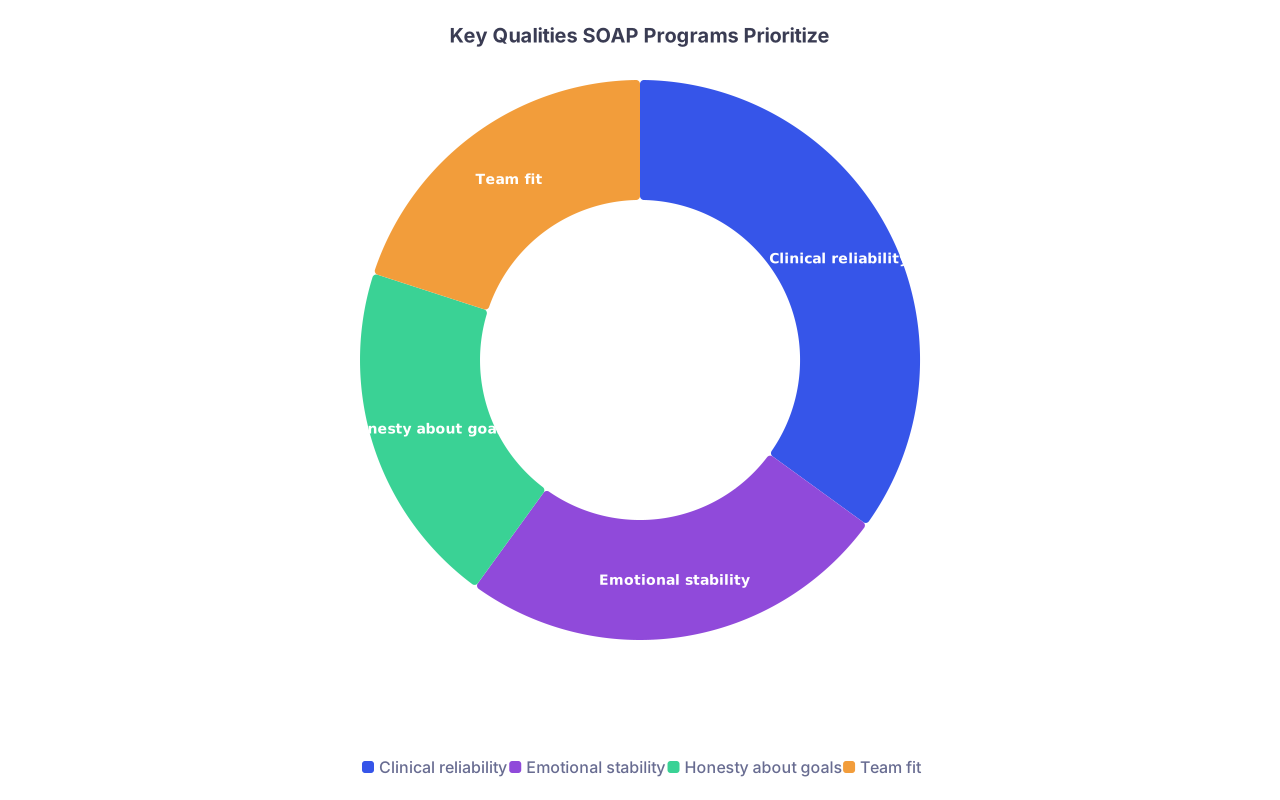
Programs are not asking you to be happy this week. They are asking you to be stable, teachable, and realistic.
| Category | Value |
|---|---|
| Clinical reliability | 35 |
| Emotional stability | 25 |
| Honesty about goals | 20 |
| Team fit | 20 |
That is what your specialty-switch explanation should project.

Two final points to carry into your SOAP calls and emails
You are not required to justify your entire life story. You are required to give a clear, credible account of:
- Why your original season underperformed.
- Why this new specialty makes sense with your skills and experiences.
- How committed and functional you will be if they choose you.
The goal is not to erase the underwhelmed season. The goal is to convince one PD that you understand yourself better today than you did six months ago—and that, despite the detour, you are exactly the kind of intern they want on their list at 11:59 PM on Thursday.

Key takeaways:
- Build a 4-part explanation: original plan, why the season underwhelmed, specific rationale for the new specialty, and explicit statement of commitment.
- Be concrete and believable—tie your SOAP specialty to actual rotations, feedback, and tasks you have done, not sudden “new passions.”
- Keep your tone grounded: accountable without self-destruction, honest about goals without treating SOAP programs as disposable stepping stones.