
The myth that “a decent Step score guarantees a match” is statistically false – and the data around limited interviews and SOAP makes that painfully clear.
If you are sitting with one or two interview invitations and eyeing the possibility of the SOAP, you are not unlucky. You are in a well‑documented risk group. The NRMP data spells it out in black and white.
Let’s walk through what the numbers actually show – and what that means for you if you are heading toward SOAP with limited interviews.
1. What Step Scores Actually Buy You (And What They Do Not)
Step scores used to feel like the currency of the realm. Step 1 is now pass/fail, but Step 2 CK has largely absorbed the old Step 1 role. The problem is that too many applicants still misread what a “good” score guarantees.
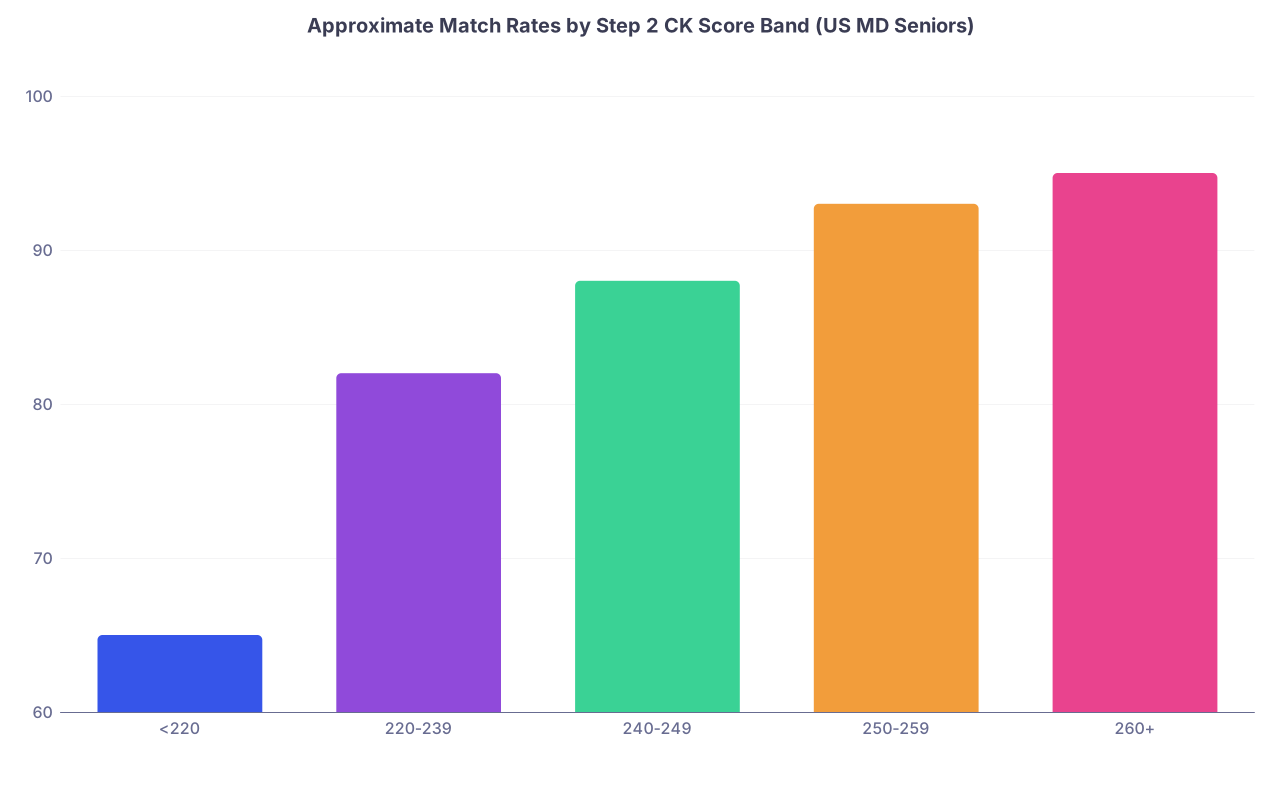
Match rates by Step 2 CK score band
Broadly, higher Step 2 CK scores correlate strongly with higher match rates. No surprise. But the slope is not infinite, and the risk never drops to zero.
| Category | Value |
|---|---|
| <220 | 65 |
| 220-239 | 82 |
| 240-249 | 88 |
| 250-259 | 93 |
| 260+ | 95 |
These are rounded, composite approximations drawn from multiple recent NRMP Charting Outcomes reports. The exact numbers vary by year and specialty, but the trend is stable:
- Below ~220: You are in a high‑risk band for many core specialties.
- 220–239: You are competitive for less competitive programs and specialties, but far from “safe.”
- 240–249: You are in the “solid but not elite” zone. This is where many unmatched surprises actually live.
- 250+: You are in the top strata. But still not invulnerable if other pieces of the application are weak.
Here is the uncomfortable reality I have seen again and again: students with 240–250+ who get only 2–3 interviews, then land in SOAP, are not unicorns. They are overrepresented among those who overestimated what their score would fix.
A high Step 2 CK score does three main things:
- Gets your application past initial screens (cutoffs).
- Helps you secure a baseline number of interviews if your list is sensible.
- Buys you flexibility to recover from weaknesses like average grades or modest research.
What it does not do:
- Compensate for applying too narrowly.
- Override red flags (fails, professionalism issues, big education gaps).
- Guarantee program love if your interview performance, letters, or fit are weak.
From a numbers perspective, treating a 250+ as “I can apply only to top‑tier, coastal, academic programs” is essentially a self‑imposed probability cut. You are lopping off dozens of programs that would statistically reduce your risk of needing SOAP.
2. Limited Interviews: The Hard Probability Wall
You can have a strong Step 2 CK score and still be in danger if your interview count is low. The NRMP Program Director Survey and Charting Outcomes data make that crystal clear.
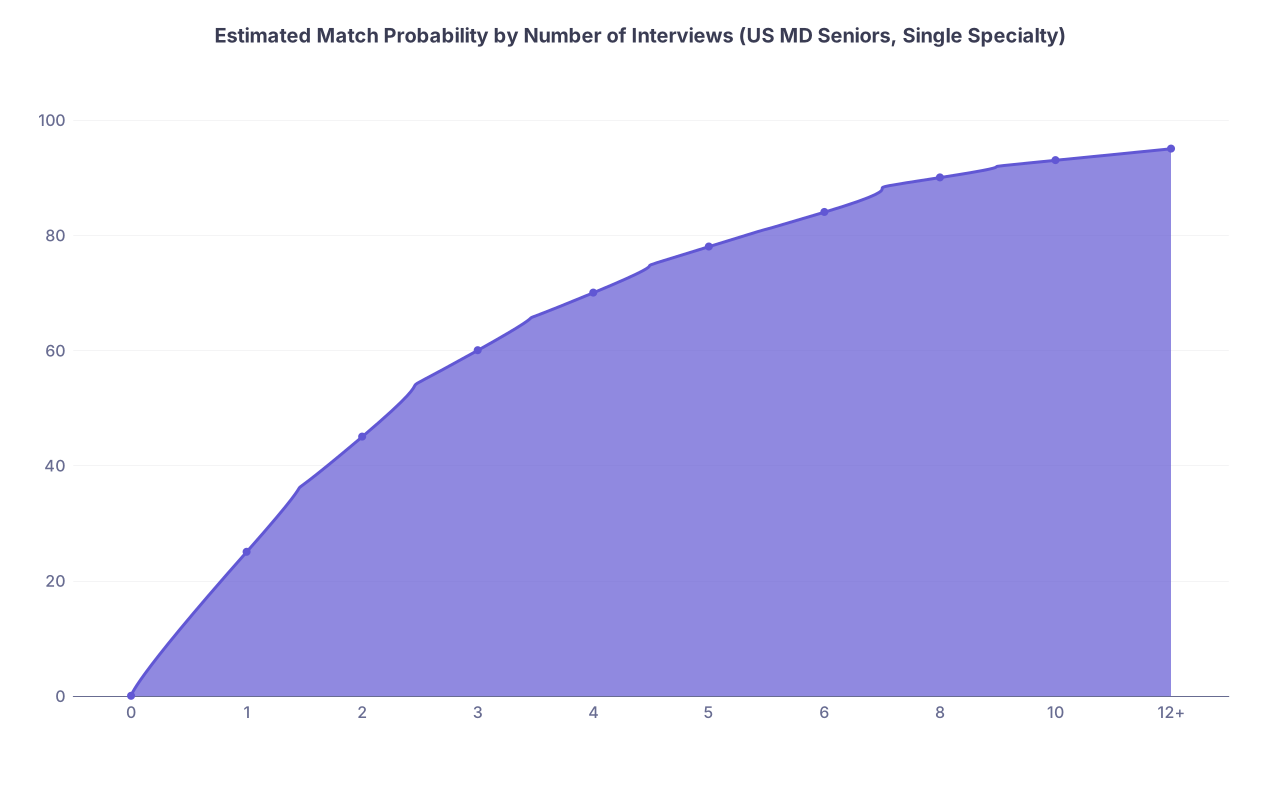
The data show a steep, nearly exponential increase in match probability as the number of contiguous ranks (which usually tracks closely with number of interviews) rises. The curve flattens after a point, but the early part is brutal.
Here is a simplified depiction for U.S. MD seniors applying to a single specialty:
| Category | Value |
|---|---|
| 0 | 0 |
| 1 | 25 |
| 2 | 45 |
| 3 | 60 |
| 4 | 70 |
| 5 | 78 |
| 6 | 84 |
| 8 | 90 |
| 10 | 93 |
| 12+ | 95 |
Again, these are approximate blended values, but they mirror NRMP’s own curves:
- 1–2 interviews: You are in coin‑flip territory or worse.
- 3–4: Still high risk. Many unmatched applicants live here.
- 5–7: Risk drops substantially, but not to zero.
- 10+: You are statistically in a very strong position unless you have a major red flag or miss entire interview days.
If you hold:
- Step 2 CK 245,
- Not a red‑flag applicant,
- 2 interviews total in your preferred specialty,
the data do not care that your friends say “you’ll be fine.” Your numerical risk profile looks more like an under‑prepared applicant than a “good” one.
Why limited interviews usually means SOAP risk
From what I have seen in thousands of case discussions:
- Applicants with 0–2 interviews in their only applied specialty are very likely to end up in SOAP.
- Those with 3–4 interviews are on the bubble, highly dependent on interview performance and how efficiently they rank.
- Those with ≥8 in one specialty rarely SOAP unless they have a red flag or dual‑applied poorly and split interviews.
This is why advisors harp on getting interview numbers rather than obsessing over “tier” of programs. The match algorithm cannot rank prestige. It ranks positions.
3. Who Actually Ends Up in SOAP – And Why
The Supplemental Offer and Acceptance Program (SOAP) is not random. The pool has a predictable composition once you look at the data trends.
High‑level SOAP pool composition
Each year, thousands of applicants go unmatched and become SOAP‑eligible. A very rough breakdown based on NRMP and anecdotal institutional data looks like this:
| Group | Share of SOAP Pool |
|---|---|
| US MD seniors | 10–15% |
| US DO seniors | 20–25% |
| International grads (US/non) | 50–60% |
| Prior year grads/Repeaters | 10–15% |
Within those groups, several patterns repeatedly show up among those with limited interviews:
- Applied to a single, relatively competitive specialty (e.g., EM, Ob/Gyn, Ortho) with no meaningful backup.
- Geographic restriction (only coasts, only one state, only big cities).
- Over‑weighted Step scores in their self‑assessment. Ignored weaknesses in clinical grades, LORs, or professionalism narrative.
- Late application or incomplete ERAS for weeks.
Step scores in the SOAP pool are more heterogeneous than most people think. You will see:
- Plenty of applicants with Step 2 CK < 220 (predictable risk).
- A large cluster 220–240.
- A non‑trivial group in the 240–250+ range who simply did not get enough interviews or mis‑strategized.
So if you are thinking, “I’ll never be in SOAP; my Step 2 is 252,” you are not reading the data correctly.
4. How Step Scores and Limited Interviews Play Out Inside SOAP
SOAP is its own market. Different rules. Different dynamics. And your Step 2 CK score behaves differently here than it did in the main match.
What fills in SOAP?
SOAP tends to be dominated by a small number of specialties and program types:
- Internal Medicine (especially community and smaller academic affiliates)
- Family Medicine
- Pediatrics
- Psychiatry
- Preliminary/transitional year spots
- Some categorical surgery or less common specialties, but in small numbers
The fill patterns from year to year show that:
- Top‑tier academic programs rarely have multiple SOAP positions, and when they do, they often fill quickly and preferentially with higher‑scoring applicants or those with clear connections.
- A large proportion of SOAP positions are at community or less competitive programs that already screened out your application once, or never saw it because you did not apply there.
Inside SOAP, your Step score a) helps you rise to the top of filters at programs scrambling to fill, and b) partially offsets the weaker impression created by limited main‑match interviews. But there is a ceiling.
If you have a 255 Step 2 CK and no interviews because you only applied to 30 elite programs in a competitive specialty, SOAP does not magically offer you similar programs. It offers unfilled positions, skewed heavily toward primary care at community sites. The data are ruthless about this.
Score thresholds vs SOAP success
Programs in SOAP are tired, rushed, and defensive. They want to avoid:
- Visa complications (for some).
- Known red flags.
- Very low Step scores that might predict failure on in‑training or boards.
From talking with PDs and coordinators, informal SOAP filters often look like:
- US grads: Step 2 CK cutoffs in the low 220s or “pass on first attempt.”
- IMGs: Higher cutoffs (e.g., 230+) at many programs, sometimes higher in competitive states.
- Red‑flag applicants: Screened much more subjectively. A 250 with a professionalism issue is often riskier to them than a 230 with a clean record.
So if you are a US MD/DO senior with a Step 2 CK ≥ 235–240 and no major red flags, your numerical profile in SOAP is usually quite strong relative to the total pool – even if you had limited interviews. That is one of the few advantages you carry into that week.
5. Strategy: If You Have Limited Interviews, What Do the Numbers Tell You To Do?
Let me be direct. If you have:
- 0–2 interviews in your only specialty,
- or 3–4 in a moderately competitive specialty with no realistic backup,
you must start acting as if SOAP is likely, not as if it is a remote worst‑case.
First: quantify your actual risk
Do a cold, data‑driven assessment:
Compare to the probability curve:
- 1–2 in a competitive field: high risk.
- 3–4: significant risk, but some chance.
- 5–7: fair odds if interviews went well and rank list is sensible.
Adjust for red flags: failed Step attempt, professionalism write‑up, major gap. Those shift your curve to the right (need more interviews to reach same probability).
If you end up with ≤4 interviews total and any red flag, the data say you are far from safe, regardless of Step 2 CK.
Second: shape your SOAP target list in advance
The worst SOAP outcomes I have seen came from people who tried to improvise during SOAP week. They chased prestige or clung to their original specialty long past the point when the numbers told them to pivot.
You should have a pre‑built structure like this:
| Tier | Type of Program | Specialty Focus |
|---|---|---|
| A | Community IM and FM in multiple states | Primary care categorical |
| B | Pediatrics, Psychiatry | Mix of community/academic |
| C | Preliminary medicine/surgery, TY | Geographic flexibility |
Then, adjust your expectations:
- High Step (e.g., ≥245): You can be more selective within SOAP, but you still need a wide geographic net.
- Mid Step (230–240): Broaden even more; include smaller or rural programs.
- Lower Step (<225): You likely need to prioritize volume and flexibility over preference.
Your goal is not elegance. It is maximizing the expected number of offers. That is a math problem, not an ego problem.
6. How the Numbers Shape Real SOAP Decisions
This is where theory meets what I have seen in real SOAP weeks.
Scenario 1: Strong Step, very few interviews
Profile:
- US MD senior, Step 2 CK 252,
- 2 interviews in EM,
- No IM/FM backup,
- No red flags.
Risk profile:
- For EM with 2 interviews, probabilities hover in the 30–40% range at best.
- There is no second specialty to dilute risk.
Likely path:
- If unmatched, SOAP options will be dominated by IM/FM prelims or categorical, possibly some peds or psych.
Data‑aligned preparation:
- Rank the EM programs you interviewed at in a straightforward order.
- Pre‑build a SOAP list heavy on IM/FM categorical positions across many states.
- Accept that your Step 2 CK will help you stand out to many of those programs, but will not conjure EM spots that do not exist.
Scenario 2: Average Step, moderate interviews but red flag
Profile:
- US DO senior, Step 2 CK 232,
- 4 IM interviews, 2 FM interviews,
- One failed Step 1 attempt.
Risk profile:
- 6 total interviews sounds decent, but the failure reduces effective probability.
- Match odds may be closer to the 3–4 interview curve.
Likely path:
- If unmatched, SOAP may still yield IM/FM categorical spots, but some programs will pass based on the Step 1 failure.
Data‑aligned preparation:
- Push for as many programs on your SOAP list as possible that have historically accepted DOs and prior failures.
- Use your personal statement and SOAP communications to directly address and neutralize the failure, because the numerical hit is already “priced in.”
Scenario 3: High Step, many interviews, unmatched
Profile:
- IMG, Step 2 CK 255,
- 10 IM interviews (mix of community and academic),
- Unmatched.
Risk profile:
- Statistically surprising but not impossible. Probably a ranking strategy problem, interview performance issues, or visa constraints.
In SOAP:
- High Step will be a clear asset. Many IM programs with unfilled spots will elevate this application quickly.
- But visa status, year of graduation, and clinical currency may matter more than an extra 10 points on Step 2.
Data‑aligned response:
- Apply to essentially every SOAP IM opening that fits your visa and graduation year constraints.
- Do not waste time trying to re‑engineer the narrative of “why I did not match” – SOAP programs do not have the bandwidth for long stories. They run filters and skim.
7. Concrete Moves Before, During, and After SOAP
This is where you turn the data into action.
Before SOAP (once you see interview numbers are low)
- Expand your applications if the window is still open. Especially to:
- Community programs.
- Less saturated geographic regions.
- Seek brutally honest feedback on your interview performance and application:
- Are your LORs generic or damning by faint praise?
- Did you tank early interviews?
- Start building your SOAP target spreadsheet now:
- Columns: Program name, specialty, location, visa policy, historic DO/IMG friendliness, your personal priority tier.
During SOAP
You will not have time to be precious:
Treat your Step 2 CK score as a filter tool:
- If your score is above typical cutoffs, you can afford to skip the very lowest‑tier or chronically troubled programs, but only slightly.
- If your score is at or below average, you should maximize volume and not overfilter.
When programs call or interview briefly:
- Do not recite test scores; they already have them.
- Use your time to highlight reliability, fit for their location, and commitment to completing the program.
Watch fill patterns across Rounds:
- After Round 1, if you see that your specialty is disappearing, you need to shift aggressively to prelim/TY or another core specialty.
- The numbers of remaining spots are public. If there are 10 categorical IM positions left nationwide and thousands of SOAP‑eligible candidates, you do not wait and hope.
After SOAP (if you still do not match)
This outcome is hard, but the math is simple:
- Your future match probability is not dictated by raising a 245 to a 255.
- It is dictated by fixing the reasons you ended up with few interviews or weak interest in the first place.
That usually means:
- Broadening specialty and geography next cycle.
- Improving clinical evaluations and letters.
- Getting fresh US clinical experience (for IMGs and prior grads).
- Addressing any professionalism or communication issues that may have sunk interviews.
I have seen applicants with mid‑230s Step 2 match easily on a re‑app after fixing strategy and interview skills, while prior 250+ re‑apps failed again because they refused to change their target list or self‑presentation. The scores did not save them. The structure did.
8. The Real Takeaways From the Numbers
Strip away the noise and anecdotes, and the data on Step scores, interview counts, and SOAP say three blunt things:
Step 2 CK is a gatekeeper, not a guarantee.
A strong score makes it easier to get enough interviews and to stand out in SOAP, but it cannot compensate for narrow applications, poor interview performance, or red flags.Interview quantity is one of the strongest predictors of match.
Applicants with ≤2–3 interviews in a single specialty live in a high‑risk zone, regardless of score. If that is you, treat SOAP as a near‑term reality and plan accordingly.SOAP is a separate market with its own probabilities.
Your job in SOAP is not to “salvage prestige.” It is to use your numerical advantages (Step scores, US grad status, clean record) to maximize the chance of any reasonable offer from the pool that exists, not the pool you wish existed.
If you can keep those three points fixed in your mind, your decisions – before, during, and after SOAP – will be much closer to what the numbers actually support.