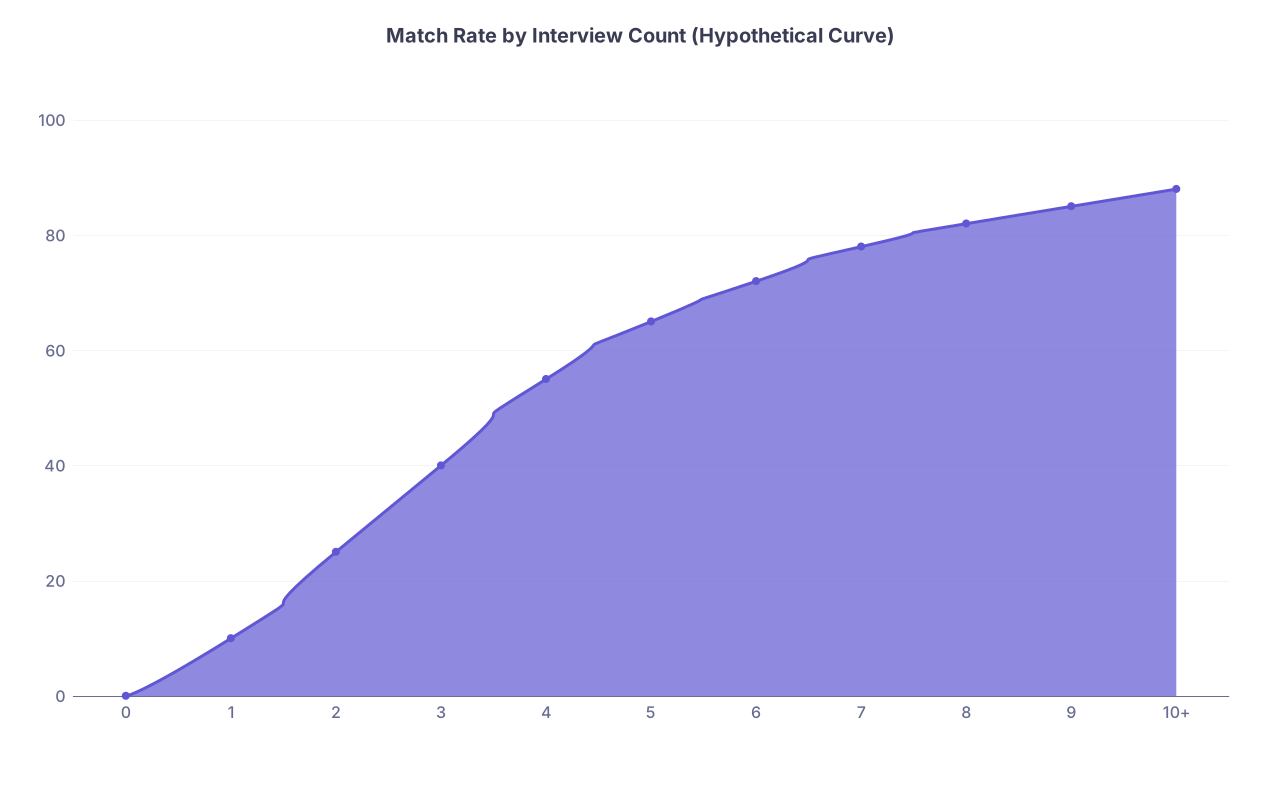
| Category | Value |
|---|---|
| 0 | 0 |
| 1 | 10 |
| 2 | 25 |
| 3 | 40 |
| 4 | 55 |
| 5 | 65 |
| 6 | 72 |
| 7 | 78 |
| 8 | 82 |
| 9 | 85 |
| 10+ | 88 |
The mythology around “just needing one interview” to match is wrong. The data shows a brutally simple pattern: match probability is a curve, not a cliff, and if you are going into SOAP with limited interviews, you are working against the slope of that curve.
I am going to treat you like an adult and give you numbers, not platitudes.
1. What the Data Actually Shows About Interviews and Match Rates
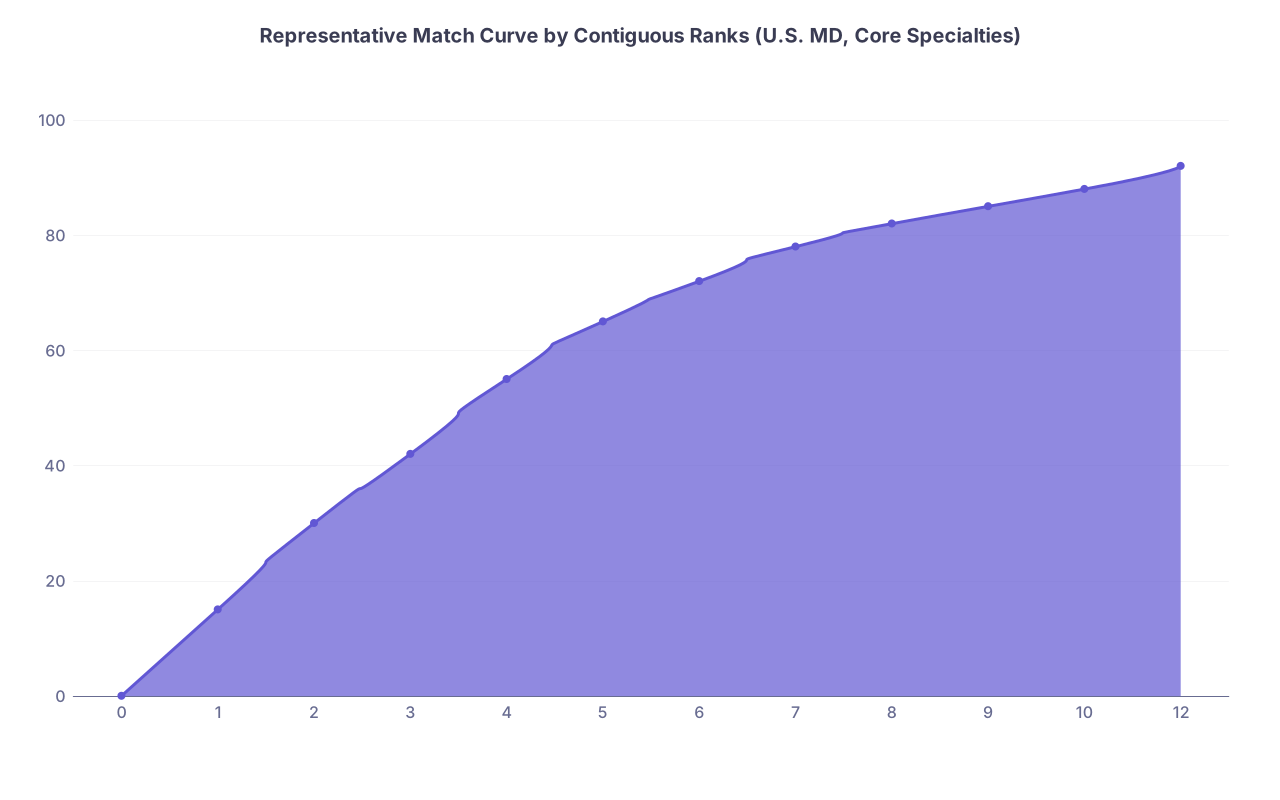
Start with the core relationship: number of contiguous ranks (a direct proxy for interview count) vs probability of matching. NRMP has published this for years. The curves are consistent.
For U.S. MD seniors in most core specialties, the match probability:
- Rises from near 0% with 0 ranks
- Crosses ~50% somewhere around 4–5 ranks
- Approaches ~80–90% once you hit 10–12 ranks
Programs interviewed → ranks on your list → probability of matching. That is the chain.
Let me anchor this with approximate ranges from NRMP’s Charting Outcomes and the main Match data. These are rounded, but they capture the shape very well:
| Contiguous Ranks (≈ Interviews) | Match Probability |
|---|---|
| 0 | ~0% |
| 1 | 10–20% |
| 3 | 35–45% |
| 5 | 60–70% |
| 8 | 75–85% |
| 10+ | 85–92% |
Those are the “healthy” curves. You are not in that group if you are reading an article about SOAP with limited interviews.
For U.S. DO seniors and U.S. IMGs, the same shape appears, but shifted downward:
- DO: Need more interviews for the same probability; some specialties show >10 ranks just to hit ~75–80%.
- U.S. IMG: Steeper penalty. You might be sitting at ~40–50% even with 8–10 ranks in competitive fields.
- Non‑U.S. IMG: The curve is lower again; “enough” interviews is a bigger number.
And then there are the high‑competition specialties—Derm, Ortho, Plastics, ENT, Neurosurgery, integrated Vascular, etc. Those behave more like a step‑function: either you have 10–15+ interviews and a decent shot, or you have few and your probability collapses.
To visualize the general pattern, consider a smoothed approximation (again, representative, not exact):
| Category | Value |
|---|---|
| 0 | 0 |
| 1 | 15 |
| 2 | 30 |
| 3 | 42 |
| 4 | 55 |
| 5 | 65 |
| 6 | 72 |
| 7 | 78 |
| 8 | 82 |
| 9 | 85 |
| 10 | 88 |
| 12 | 92 |
The inflection points matter:
- 0–2 interviews: Extremely high risk of not matching.
- 3–5 interviews: Coin‑flip territory.
- 6–8 interviews: Odds now favor matching, but not guaranteed.
- 9–12+: Reasonable safety, assuming not some ultra‑competitive niche.
If you have limited interviews, you are somewhere in the left half of that curve. That changes how you should behave before, during, and after Match Week.
2. Defining “Limited Interviews”: Where the Risk Actually Spikes
People say “I only got a few interviews” and mean anything from 2 to 12. That is useless. The risk profile depends heavily on the exact number and the specialty.
Let’s quantify “limited” more brutally.
<ai-table title="Risk Bands by Interview Count (Most Core Specialties)"
| Interview Count | Risk Category | Rough Match Probability |
|---|---|---|
| 0 | Catastrophic | 0% (no list, no match) |
| 1–2 | Critical | ~10–30% |
| 3–4 | Very high risk | ~30–55% |
| 5–7 | Moderate risk | ~55–75% |
| 8–10 | Manageable risk | ~75–85% |
| 11+ | Lower risk (not zero) | ~85–92% |
This is for U.S. MD seniors in non‑ultra‑competitive specialties. Move every band down 10–20 percentage points for:
- U.S. DO in competitive areas
- U.S. IMGs in any moderately competitive field
- Non‑U.S. IMGs nearly across the board
Now overlay specialty competitiveness. Roughly:
<ai-table title="Interview Thresholds by Specialty Tier (U.S. MD Senior)"
| Specialty Tier | Examples | Interviews for ~80%+ Odds |
|---|---|---|
| Ultra‑competitive | Derm, Ortho, Plastics, ENT | 12–15+ |
| Competitive but not top tier | EM, Anesthesia, Gen Surg, OB/GYN | 10–12 |
| Mid‑range / core | IM, Peds, Psych, FM | ~8–10 |
| Less competitive | Some FM, Path in certain regions | 6–8 |
So if you tell me, “I have 4 interviews in categorical IM and 1 in prelim surgery,” I hear: very high risk, somewhere around 40–60% chance of not matching in your chosen field.
If you say, “I have 2 FM interviews as a non‑U.S. IMG,” I hear: critical risk—SOAP planning is mandatory, not optional.
3. Match Week Mechanics: Why Limited Interviews Make SOAP Central
Match Week is a binary event from the NRMP server’s viewpoint. You either have a position or you do not. The underlying process is just the algorithm playing out on those probability curves.
Here is the simplified flow:

| Step | Description |
|---|---|
| Step 1 | Submit Rank List |
| Step 2 | Match Algorithm |
| Step 3 | Receive Program Info |
| Step 4 | Unmatched or Partially Matched |
| Step 5 | Access Unfilled List |
| Step 6 | Post Match Scramble Only |
| Step 7 | Submit SOAP Applications |
| Step 8 | SOAP Offers Rounds |
| Step 9 | Accept Offer |
| Step 10 | Matched via SOAP |
| Step 11 | Matched? |
| Step 12 | SOAP Eligible? |
The key point: limited interviews do not “doom” you, but they drastically increase the chance that you land in node E (unmatched or partially matched) and must rely on SOAP.
And SOAP is not a soft landing. It is a constrained, compressed market with much worse odds per application than the main Match. You cannot apply everywhere, you cannot spam endlessly, and programs are under pressure to fill quickly.
The data pattern each year:
- Unmatched applicants > unfilled PGY‑1 positions. There is a gap.
- A large fraction of unfilled slots cluster in a few areas: FM, IM (often community or lower‑reputation programs), Peds in some years, Prelim medicine/surgery, Transitional Year, and certain geographically undesirable or newly accredited programs.
- Competitive specialties have very few SOAP spots. Many have zero.
So, if you are entering Match Week with 0–4 interviews in a moderately or highly competitive field, your probability of being in SOAP is non‑trivial. Planning around that reality beats hoping the curve magically shifts.
4. Quantifying Risk Bands: 0–5 Interviews and What They Really Mean
Let me break the most painful part down numerically—0 to 5 interviews—because that is where the anxiety is highest and the optimism is usually most disconnected from reality.
0 Interviews
Probability of matching in the main algorithm: 0%. No rank list, no match.
This cohort either did not receive any interviews, cancelled them all, or applied so catastrophically mismatched that nothing materialized.
Strategy is 100% SOAP + post‑Match scramble + reapplication planning. If you are in this bucket and still think “something might happen,” you are ignoring basic math.
1–2 Interviews
Think of this as lottery ticket territory, not “decent shot.”
Typical match probabilities (for U.S. MD, core specialties) at 1–2 ranks:
- 1 rank: ~10–20%
- 2 ranks: ~25–35%
This is under assumptions of average competitiveness and no red flags. If you have a rocky record (remediations, Step failures, etc.), the effective probability is worse.
Two hidden problems:
- Rank list illusion: Applicants routinely overestimate how high they are on a program’s list based on polite interview feedback.
- Correlation issue: If you are a weaker applicant, your two interviews are often at more competitive or less interested programs than you think.
If you are at 1–2 interviews, you should act as if you are very likely to be in SOAP. Not “maybe.” Very likely.
3–4 Interviews
This is the danger zone people misinterpret as “probably fine.”
Rough approximations for U.S. MD, core specialties:
- 3 ranks: ~35–45%
- 4 ranks: ~45–55%
That means: even with 4 programs, a coin flip is generous. For DO, IMG, or competitive specialties, you are below 50% in many scenarios.
What I have actually seen:
- Strong applicant, 3 interviews at solid IM programs → matched at #2.
- Average applicant, 4 interviews in Gen Surg → unmatched.
- DO student, 3 FM interviews, borderline board scores → SOAP FM categorical.
The curve is not merciful here. It is just math.
Behavioral mistake in this band: people under‑prepare for SOAP because “surely I will match at one of these.” Then Monday’s email hits, and they lose 12–24 critical hours to shock and disorganization while their peers are already in the SOAP portal.
5 Interviews
You finally cross into territory where the odds are slightly favorable, but it is not “safe.”
For many U.S. MD applicants in core specialties:
- 5 ranks → ~60–70% match probability
Better than a coin flip. Still means 30–40% of people with five programs do not match in that cycle. That is not rare.
For DO, IMG, or competitive specialties, five interviews is still high risk.
So with five, your behavior needs to be split‑brain:
- Prepare as if SOAP is likely.
- Hope as if the main Match still bails you out.
This cognitive dissonance is uncomfortable. Do it anyway.
5. SOAP Strategy When You Come In With Limited Interviews
SOAP is not a second Match. It is a constrained allocation problem under time pressure and information asymmetry. If you want to use it effectively, you need to think like a data person, not like an optimist.
Understand the supply side
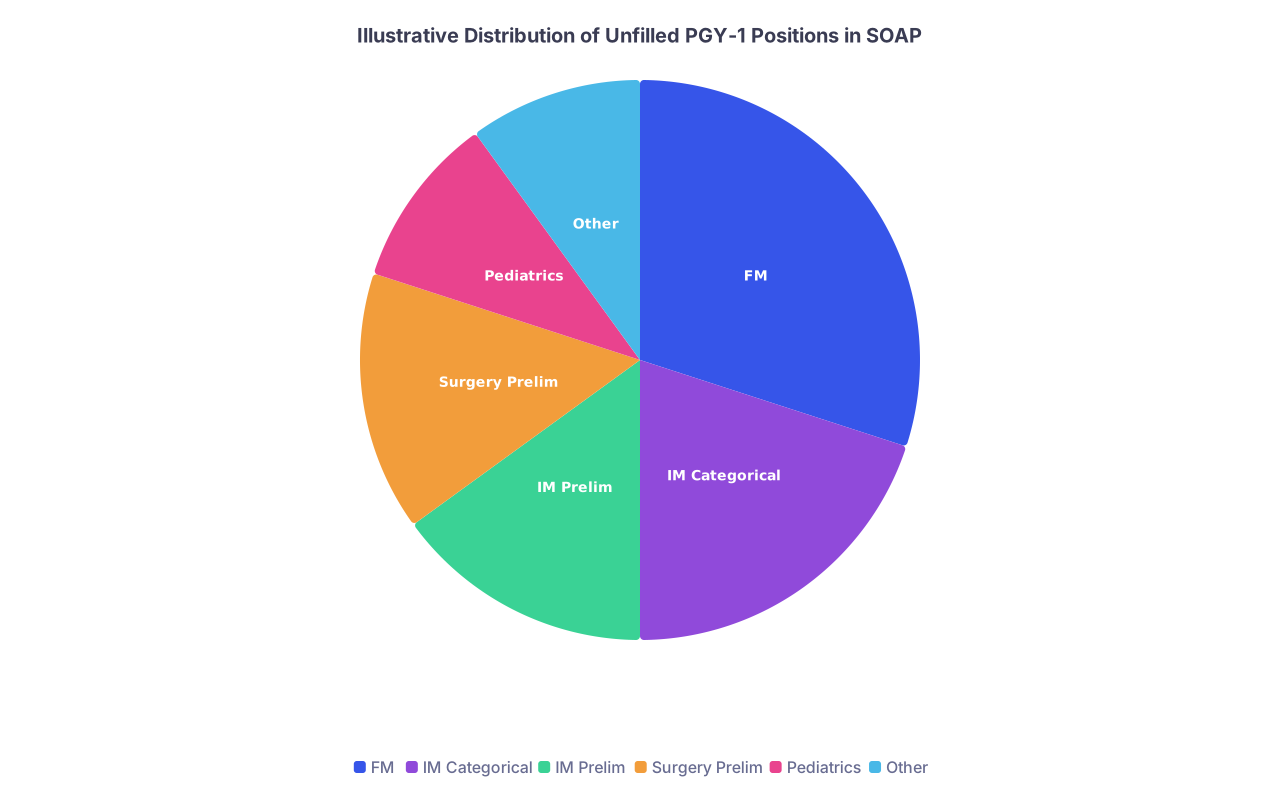
Each year the unfilled position breakdown looks broadly similar:
| Category | Value |
|---|---|
| FM | 30 |
| IM Categorical | 20 |
| IM Prelim | 15 |
| Surgery Prelim | 15 |
| Pediatrics | 10 |
| Other | 10 |
The actual percentages vary by year, but the story holds:
- Family Medicine + Internal Medicine (categorical + prelim) dominate.
- Surgery categorical, Derm, Ortho, etc., barely appear or do not appear at all.
- Many SOAP positions are at community, rural, or less competitive programs.
If you came into Match Week with few interviews in a competitive specialty, expecting SOAP to rescue you into that same specialty is fantasy. Most of your real options will be:
- Switching to a less competitive specialty (often FM, IM, Psych, occasionally Neuro, Path, etc.)
- Taking a prelim or transitional year and re‑applying with stronger credentials.
Constrain your target set intelligently
You are limited by SOAP rules: maximum number of applications per round, limited rounds, strict communication boundaries.
Your job is to:
- Identify which specialties and locations you are truly willing to accept.
- Prioritize programs where your probability of being ranked is actually >0, given your metrics and background.
- Avoid wasting slots on “dream” SOAP applications in fields that essentially never fill through SOAP.
A very crude heuristic:
- If your Step/COMLEX scores and academic record are below the mean for a specialty even in community programs, do not sink SOAP slots into that specialty unless it has a historically large SOAP footprint (e.g., FM in some regions).
- If you are an IMG, especially non‑U.S., double‑down on specialties and locations that have a prior track record of taking IMGs, even if it means geographic compromise.
You have days, not months. That means pre‑work before Match Week:
- Build a ranked preference: Specialty A > Specialty B > Prelim route > Research year > Non‑clinical.
- Decide your “line in the sand”: Would you actually move to rural Midwest FM? If no, do not pretend you would in SOAP.
Estimate your own “SOAP profile”
Use your existing application as data. Where did you get your limited interviews?
- All at community programs in less desirable locations → In SOAP, similar programs are your realistic targets, possibly in even more remote regions.
- Mix of academic + community but only few total → Your profile might be borderline for academic but acceptable for many community programs. SOAP applications should skew that way.
- Only preliminary offers in the main season → Main‑Match programs may see you as a prelim‑level candidate; your SOAP strategy might hinge on prelims + long‑term plan.
SOAP is a short optimization problem under resource constraints. Treat it that way.
6. Planning Scenarios by Interview Count
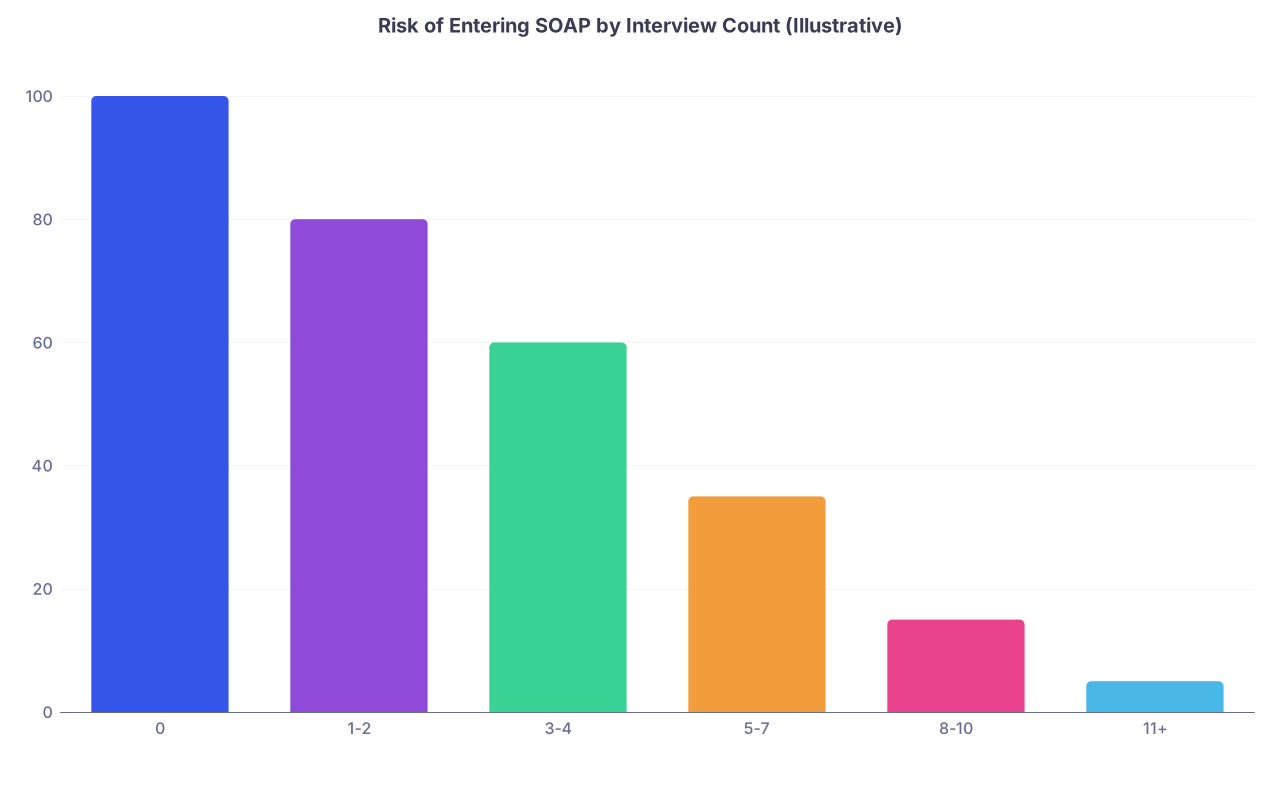
Let me map this onto concrete plans for different interview counts so you can see what rational behavior looks like.
| Category | Value |
|---|---|
| 0 | 100 |
| 1-2 | 80 |
| 3-4 | 60 |
| 5-7 | 35 |
| 8-10 | 15 |
| 11+ | 5 |
The values are “percent of applicants in this band likely to be in SOAP or unmatched” in many specialties. The exact numbers differ, but the pattern is accurate.
Scenario A: 0–2 Interviews
Assume: extremely high likelihood of being in SOAP.
Your priorities before Match Week:
- Meet with your dean / advisor and explicitly map out SOAP and reapplication strategies.
- Identify 2–3 fallback specialties you are genuinely willing to enter.
- Prepare documents: updated CV, personal statements customized for fallback specialties, letters you can quickly re‑use.
- Clarify visa or licensing constraints if you are an IMG or on a J‑1/H‑1B track.
On Monday of Match Week, if you are unmatched:
- Move immediately to SOAP preparation. Do not spend half a day spiraling.
- When the unfilled list opens, you and your advisor should already know: which specialties, which states, which hospital types you are targeting.
Scenario B: 3–4 Interviews
Assume: 40–60% chance of not matching in your chosen specialty.
Preparation should be nearly as aggressive as in 0–2, just with the psychological acknowledgment that you might not need SOAP.
What I would do:
- Build a full SOAP plan anyway.
- Pre‑write alternate personal statements for FM, IM, Psych, or a prelim year, depending on your comfort level.
- Identify acceptable “Plan B” paths:
- Categorical in another specialty via SOAP
- Prelim medicine/surgery with structured plan to strengthen your profile
- Dedicated research or MPH year if your ultimate target is highly competitive
The worst mistake in this band is treating SOAP as an afterthought and waking up on Monday afternoon, unmatched, with nothing ready.
Scenario C: 5–7 Interviews
Assume: you are more likely than not to match, but not by a wide margin.
I would assign a mental probability like this for a U.S. MD in a core field with 6 interviews: 70% match, 30% SOAP/unmatched. For DO/IMG or competitive specialties, reverse those numbers.
Behavior:
- Do the SOAP prep, but you do not need to go as deep into alternate career scenarios unless you are in a high‑competition specialty.
- Have at least one fallback specialty statement drafted and your CV and ERAS profile clean and updated.
- Be brutally honest about your competitiveness. If your metrics are weak, treat your “effective” interview count as one band lower.
Scenario D: 8+ Interviews
If you have 8–10+ interviews in a non‑ultra‑competitive field and are a U.S. senior, your probability of matching is high, though not absolute.
You still do minimal SOAP prep:
- Confirm that your documents are accurate and easily adaptable.
- Have a short list of fallback specialties or prelim options in case the extremely unlikely happens.
Most people in this band will not need SOAP, but every year you see someone with ~8 interviews go unmatched because of idiosyncratic rank behavior, narrow geographic preferences, or red flags.
7. The Hard Truth: When Limited Interviews Signal a Bigger Mismatch
The number of interviews is not just a stochastic outcome. It is feedback.
If you applied broadly and appropriately and still got 0–3 interviews, that data is telling you something:
- Your board scores or clinical performance are substantially below the typical range for your chosen specialty.
- Your application strategy (locations, program types) was misaligned with your competitiveness.
- You have red flags (failed Step/COMLEX, professionalism issues, major leaves of absence) that many programs will avoid.
- Your specialty choice is out of sync with your objective profile.
SOAP can save you from a gap year, but it does not erase that mismatch. It just gives you a different optimization problem: maximize probability of any residency position vs maximize probability in your dream specialty.
If you end up unmatched after SOAP, the quantitative question for the next cycle is:
“What changes the slope of my curve the most?”
Usually that is not “send more applications.” It is:
- Better Step 2/Level 2 (if still pending or low).
- Stronger letters from a targeted away or research year.
- Specialty pivot to something better aligned with your record.
People hate hearing this because it feels like giving up. It is not. It is responding to data.
8. Three Numbers You Should Keep in Your Head
I will end with the only three numbers that matter in this context:
Your interview count → implied match probability.
Use the bands above. Be honest, especially if you are DO, IMG, or targeting a competitive field.The proportion of unfilled positions by specialty in SOAP.
FM and IM dominate. If your dream field never appears on the SOAP unfilled list in meaningful numbers, it will not magically be your safety net.Your personal risk tolerance.
Whether you aim for categorical in a different field via SOAP, or accept a prelim and re‑apply, or take a research year—that is a risk-return decision. But make it with numbers in front of you, not vibes.
Limited interviews do not guarantee disaster. They just move you left on the match‑probability curve. If you recognize that early, prepare aggressively for SOAP, and are willing to adjust your target based on what the data shows, you convert a chaotic week into a calculated move.