
Most applicants with 0–2 interviews are not “unlucky.” The numbers say they are structurally disadvantaged—and that some specialties give them a lifeline in SOAP while others shut the door.
Let me walk through what the data actually show, not the folklore you hear on Reddit.
1. The Hard Math of Limited Interviews
Limited interviews usually mean 0–2 interviews by the NRMP rank deadline. At that point, your probability of matching in the main Match is poor.
NRMP’s “Charting Outcomes” and partner analyses have been consistent for years:
- Applicants with 0 interviews have essentially a 0% main Match rate.
- Applicants with 1 interview: often in the 20–30% match probability range.
- Applicants with 2–3 interviews: roughly 40–60%, depending on specialty and applicant type.
By the time SOAP starts, you are in a cohort that is heavily enriched for three groups:
- Low-interview applicants in competitive specialties who never had a real shot.
- Reasonable candidates who overreached or applied too narrowly.
- Red-flag applicants (exam failures, professionalism issues, or late exam completion).
SOAP does not “reset” the odds. It redistributes the remaining probability mass. The specialty mix of unfilled positions dictates where limited-interview applicants still have leverage.
2. Where Positions Actually Go Unfilled
The first constraint is structural: you cannot SOAP into specialties that do not leave spots.
Look at a simplified approximation of recent NRMP data (numbers vary slightly year to year, but the pattern is stable):
| Specialty | Approx. Unfilled Positions | Typical % Unfilled of Offered |
|---|---|---|
| Internal Medicine (categorical) | 300–500 | 2–4% |
| Family Medicine | 400–800 | 5–10% |
| Pediatrics | 50–120 | 1–3% |
| General Surgery (categorical) | 10–40 | <2% |
| Psychiatry | 30–80 | 1–3% |
| Emergency Medicine* | 400–800 (recent spike) | 8–18% |
*Emergency Medicine is in flux; recent cycles saw unprecedented unfilled rates.
Translate that:
- Family Medicine and Internal Medicine reliably generate the largest absolute number of unfilled categorical PGY‑1 slots.
- Pediatrics, Psychiatry, and categorical General Surgery unfill relatively few spots most years; competition in SOAP is harsh.
- Emergency Medicine used to rarely have unfilled positions; now it occasionally floods SOAP with hundreds.
Every limited-interview applicant needs to internalize this: your SOAP outcome is mostly a function of where the vacancies are, not where you would ideally like to train.
3. SOAP-Friendly vs SOAP-Hostile Specialties
Let’s talk match probability for limited-interview SOAP applicants by specialty. We do not get applicant-level SOAP data from NRMP, but program fill patterns and anecdotal numbers from program directors give a fairly clear picture.
3.1 SOAP-Friendly “Landing Zone” Specialties
These are specialties that:
- Routinely have many unfilled spots.
- Have programs willing to consider a broad range of applicants (including IMGs, low-interview, and reapplicants).
- Optimize for bodies on the schedule and board-pass probability, not prestige.
They are your statistical allies if you are entering SOAP with 0–2 interviews.
Family Medicine
Family Medicine is the classic SOAP landing zone.
The data pattern:
- Hundreds of unfilled positions most years.
- Many community programs, often in less popular geographic regions.
- High IMG and DO representation.
Typical profile of SOAP-matched FM candidates:
- Step 1: pass (often on first attempt, but some programs accept a retake).
- Step 2 CK: mid‑210s to mid‑230s for IMGs; DOs often in a similar band.
- Limited or generic primary care experience is usually sufficient.
The failure rate in SOAP for applicants who pivot aggressively to FM—apply broadly, have a pass on all exams, no catastrophic red flags—is not 0%, but it is substantially lower than in other specialties. In other words, if you are a clean-file graduate and decide “I will do FM anywhere,” the conditional probability of eventually matching through SOAP is materially higher than in most alternatives.
Internal Medicine (Categorical and Preliminary)
Internal Medicine behaves similarly, but slightly more selective at the top.
- Large absolute number of unfilled positions, but much of that pool is clustered in:
- Small community programs.
- Less popular cities or rural areas.
- Programs with high service burden and lower board pass rates.
Prelim IM spots are also common in SOAP, but they are one year and do not guarantee a PGY‑2 categorical slot. Important distinction.
Data reality:
- Categorical IM SOAP spots do fill quickly.
- Programs often run quick filters: Step failures, major professionalism notes, or late graduation may be fatal at many sites.
- But if you are a recent graduate with a passing Step 2 and some US clinical experience, your odds here are still strong compared with other specialties.
Emergency Medicine (in the current era)
The recent collapse in EM applicant interest created a temporary statistical anomaly:
- Hundreds of EM positions unfilled in some cycles.
- Many solid community EM programs ended up in SOAP.
For limited-interview candidates, this is a double-edged sword:
- On the positive side: EM programs that once took almost exclusively US MDs with strong scores now consider DOs and IMGs with moderate scores.
- On the negative side: program directors still care about clinical evaluations, communication, and real EM interest. A SOAP application that screams “I never considered EM until 10:00 a.m. Monday of SOAP” is weaker.
Nonetheless, if you have:
- Satisfactory emergency medicine exposure (elective, SLOE-like letter, or at least solid ED comments in your MSPE),
- Competitive but not stellar scores,
- And you are willing to work in less popular locations,
then your SOAP odds into EM have been materially better than historical norms.
3.2 SOAP-Neutral Specialties
Pediatrics
Pediatrics usually has a modest number of unfilled categorical spots.
These programs:
- Often fill with a mix of US MDs, DOs, and IMGs.
- Still care heavily about Step 2 CK, teamwork comments, and empathy-driven narratives.
For limited-interview applicants:
- If you had a few peds interviews but came up short, SOAP pediatrics can be viable, especially in non-coastal, non-academic centers.
- If you never demonstrated any pediatrics interest in your application (no peds rotations, no letters, no personal statement alignment), you will struggle to outcompete pediatric-focused SOAP applicants.
Outcomes here are highly stratified: pediatric-ready SOAP applicants have a decent shot; generic or late-switch applicants do not.
Psychiatry
Psychiatry demand is high, and unfilled spots are relatively few by SOAP.
You might see:
- A handful of unfilled categorical positions.
- Some prelim or transitional psychiatry-related positions (rare).
SOAP into psychiatry for a limited-interview candidate is essentially a niche phenomenon—usually tied to one of the following:
- Geography that many applicants avoid (rural, underserved, high-security forensic hospitals).
- Program with well-known high workload or lower board pass rates.
- Red-flag tolerance (programs willing to consider applicants that others avoid).
Statistically, as a limited-interview applicant, you should not plan on psychiatry as your primary SOAP lane. It is a lottery ticket.
3.3 SOAP-Hostile Specialties
Some specialties almost never offer a realistic SOAP path for low-interview applicants:
- Dermatology
- Orthopaedic Surgery
- Ophthalmology
- Radiation Oncology
- Otolaryngology
- Integrated Plastics, Vascular, CT Surgery
- Radiology (diagnostic and IR) – there are occasional SOAP seats, but they tend to be scooped by already-strong candidates who mis-aimed geographically or dual-applied.
These programs might have:
- 0–5 unfilled positions nationally.
- Deep waiting lists of stellar applicants from the main Match who over-applied or whose first choice did not rank them high enough.
For a limited-interview applicant, the numbers are brutal: you are competing for a microscopic number of spots against peers who were already above the cutoff for multiple interviews in the main cycle. In practice, very few low-interview candidates salvage a match here through SOAP.
4. How Applicant Type Changes SOAP Odds
Your baseline SOAP probability is not only about specialty. It is also about which bin you fall into:
- US MD Senior
- US DO Senior
- US Graduate (prior year)
- Non‑US IMG
- US‑IMG
NRMP does not publish SOAP-specific match rates by group, but we can infer patterns from main Match data and program behaviors.
| Applicant Type | Relative SOAP Advantage | Typical SOAP Outcome Pattern |
|---|---|---|
| US MD Senior | Highest | Often land IM/FM/Peds/EM if flexible |
| US DO Senior | High | Strong in IM/FM/EM; some Peds/Psych |
| US-IMG | Moderate | Mostly FM/IM; occasional EM/Peds |
| Non-US IMG | Variable | Heavy concentration in FM/IM only |
| Prior-Year Grad | Lower | Need strong scores / connections |
Data-backed expectations:
- US MD seniors with limited interviews who pivot aggressively to SOAP-friendly specialties generally do well. Program preference is real.
- US DO seniors occupy a similar band; osteopathic-friendly IM/FM/EM programs rely heavily on DOs to fill unfilled spots.
- IMGs, especially non‑US IMGs, are disproportionately represented in SOAP but cluster into FM and IM. Their probability of SOAP match into EM, Peds, or Psych is much lower.
- Prior-year grads face a compounding penalty. Every year away from graduation nudges your odds downward unless you are in a strong research or clinical role.
If you are an IMG with limited US clinical experience, entering SOAP with 0–2 interviews, the realistic match pathways converge almost entirely on Community IM and FM.
5. What the Numbers Say About Strategy
Now the actionable part. The data patterns above imply several strategic rules for limited-interview applicants in SOAP.
5.1 Rank List Positioning Before SOAP
The worst-performing group I see every year: applicants with few interviews and a delusional rank list.
Example pattern:
- 2 interviews: one in a mid-tier categorical IM, one prelim surgery.
- Rank list: 15 highly competitive programs where they never interviewed + their 2 actual interviews.
The math:
- A program cannot rank you if you did not interview.
- Those 13 unreachable programs on your list do not increase your match probability above 0.
- If your one realistic categorical IM program ranked you low, you are essentially done before SOAP even starts.
By contrast, applicants who:
- Interviewed at a mix of competitive and safety programs.
- Ranked all realistic programs (including community FM/IM they were lukewarm on).
- Were honest about their profile.
…enter SOAP from a better starting point. Many never reach it.
5.2 SOAP Application Breadth
SOAP is not the time for surgical precision. It is the time for statistical coverage.
NRMP allows up to 45 program applications per SOAP round (historically). The data pattern among successful SOAP applicants is simple: they use that capacity aggressively in specialties with:
- High unfilled count.
- Reasonable fit with their background.
- High historical IMG/DO intake, if relevant.
If you are a limited-interview IMG entering SOAP, and you send:
- 8 applications—5 EM and 3 Psych,
you are ignoring the denominator reality. Hundreds of unfilled FM/IM jobs exist; you are voluntarily not in their applicant pool.
Contrast with a candidate who:
- Targets 25–35 FM programs and 10–15 categorical IM programs in round 1.
- Prioritizes programs that historically take IMGs/DOs.
- Adjusts in later rounds only if no interest emerges.
That applicant is treating SOAP like a probability problem, not a dream-board.
5.3 Specialty Switching in SOAP
Does switching specialty in SOAP work? The data say: sometimes, but only when the switch aligns with the unfilled market.
The switches that statistically make sense for limited-interview applicants:
- From any non-primary care specialty → Family Medicine.
- From any non-primary care specialty → Internal Medicine (particularly if you have some IM rotations or letters).
- From EM/Anesthesia/IM → Emergency Medicine in years with high EM unfilled.
Switches that rarely work in SOAP:
- Into competitive specialties (Derm, Ortho, ENT, Rad Onc, Plastics).
- Into Psychiatry or Neurology from a file with zero demonstrated interest.
Programs in the second group are usually still choosing from a relatively rich applicant pool and have little incentive to take a cold-switch SOAP applicant with limited exposure.
6. Visualizing Where the Real SOAP Opportunity Is
Here is a crude visualization of how unfilled positions concentrate by a few broad specialty categories for limited-interview applicants:
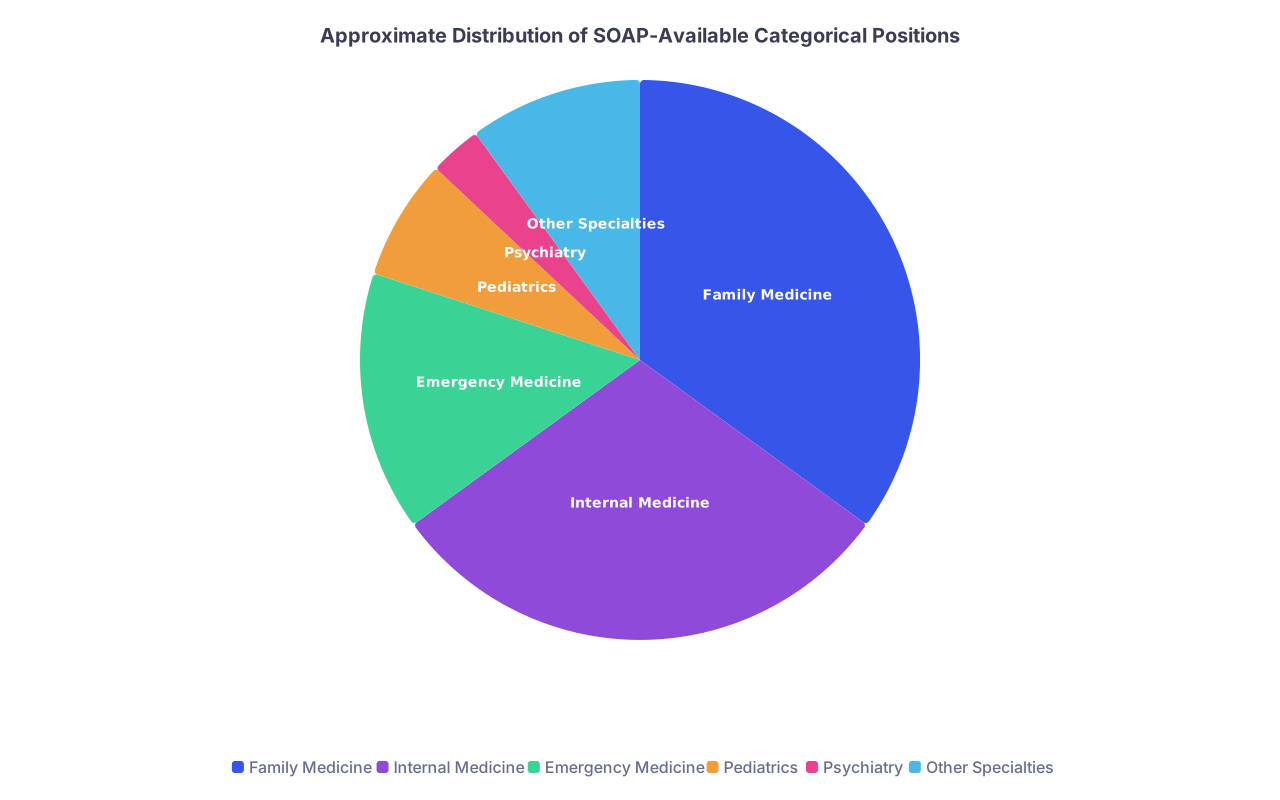
| Category | Value |
|---|---|
| Family Medicine | 35 |
| Internal Medicine | 30 |
| Emergency Medicine | 15 |
| Pediatrics | 7 |
| Psychiatry | 3 |
| Other Specialties | 10 |
Interpretation:
- Roughly two-thirds of viable SOAP categorical opportunities for struggling applicants cluster in FM + IM.
- EM has become a significant slice in some cycles.
- Peds and Psych combined form a small minority of positions.
- The rest—the glamorous specialties that dominate student conversations—account for a small fraction of realistic SOAP landings.
7. Timeline and Process: When You Actually Make These Moves
The SOAP calendar is brutal. Decisions that massively affect your probability of matching get compressed into hours.

| Step | Description |
|---|---|
| Step 1 | Unmatched Notification |
| Step 2 | Review Unfilled List |
| Step 3 | Prioritize IM/FM/EM Programs |
| Step 4 | Reassess Specialty Expectations |
| Step 5 | Revise Personal Statements |
| Step 6 | Submit Max Applications Round 1 |
| Step 7 | Field Calls and Quick Interviews |
| Step 8 | Accept Best Fit Offer |
| Step 9 | Broaden Specialty/Location Next Round |
| Step 10 | Any target specialty spots? |
| Step 11 | Any Offers by Round End? |
If you wait until Monday morning of SOAP to decide whether you accept FM or IM as outcomes, you are already behind the curve.
I have watched applicants lose hours debating whether to “hold out” for EM or Psych while FM programs are literally calling their classmates. The phone stops ringing fast.
8. What “Limited-Interview” Applicants Who Still Match Have in Common
Pull together the patterns from the data and what I have seen in real cycles.
Limited-interview applicants who still match through SOAP usually share these traits:
They abandon sunk costs quickly.
If their original specialty left 0 or 1 unfilled spot nationwide, they pivot immediately to IM/FM/EM where the numbers favor them.They apply broadly and rationally.
They saturate FM and IM programs that historically take applicants like them (US MD vs IMG, DO-friendly, etc.). Not 5 programs. More like 25–40.They present a coherent narrative—even in SOAP.
Their updated personal statements and emails show some minimal alignment with the new specialty. A one-paragraph, hastily edited note about caring “for the whole patient” beats a reused dermatology personal statement every time.They accept geographic reality.
They stop filtering programs by whether they like the city and focus on whether the program fills their main criteria: ACGME-accredited, reasonable training volume, tolerable reputation for safety and education.They keep their phone close and answer it.
Many SOAP decisions hinge on rapid response to program outreach. I have watched applicants miss calls, then lose positions to the next candidate on the list.
On the other side, limited-interview applicants who remain unmatched after SOAP:
- Over-concentrate on specialties with few unfilled spots.
- Under-apply to FM/IM despite clear structural evidence.
- Try to preserve prestige or location preferences that they no longer have leverage to demand.
9. The Bottom Line by Specialty
To close this out, condense everything into where limited-interview applicants still have meaningful match probability through SOAP.
| Specialty Group | SOAP Match Likelihood (Low-Interview Applicant) | Comment |
|---|---|---|
| Family Medicine | High | Primary landing zone |
| Internal Medicine (Categorical) | High–Moderate | Strong for clean-file applicants |
| Emergency Medicine | Moderate–High (recent cycles) | Volatile but currently favorable |
| Pediatrics | Moderate for peds-focused; low for switchers | Need prior peds interest |
| Psychiatry | Low | Few spots; high competition |
| General Surgery (categorical) | Very Low | Rare SOAP path, almost lottery-like |
| Competitive specialties (Derm, Ortho, ENT, Plastics, Rad Onc, etc.) | Near Zero | Essentially closed in SOAP |
| Transitional/Prelim IM/Surgery | Moderate | Common backup; not long-term solution |
And if you prefer seeing it as a simple ranking of actual opportunity:
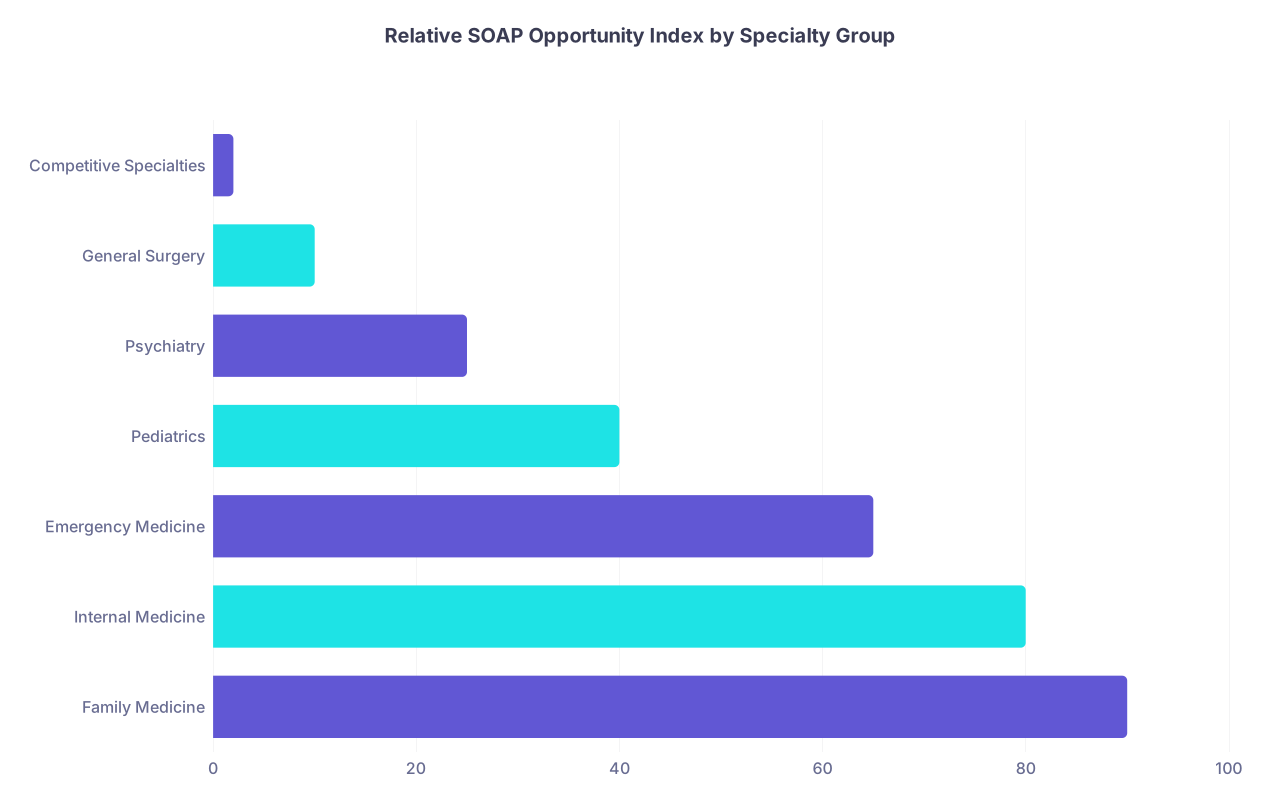
| Category | Value |
|---|---|
| Family Medicine | 90 |
| Internal Medicine | 80 |
| Emergency Medicine | 65 |
| Pediatrics | 40 |
| Psychiatry | 25 |
| General Surgery | 10 |
| Competitive Specialties | 2 |
(Values are a rough index from 0–100, not exact percentages, but they reflect the real directional differences.)
10. Three Things to Remember
First: SOAP is not a talent contest. It is a market for unfilled positions. That market is dominated by Family Medicine, Internal Medicine, and—currently—Emergency Medicine. If you are not willing to pivot there, your odds collapse.
Second: Limited interviews do not doom you, but they force you into a narrower set of rational choices. Applicants who match from this position use broad applications, realistic specialty targets, and fast decisions. They do not cling to fantasy lists.
Third: Specialty culture and unfilled numbers matter more than your personal preference at this stage. If you want any residency at all, you go where the vacancies and historical IMG/DO intake patterns support you. Everything else is secondary.