
What if you grab a SOAP spot in a program that feels wrong… and you’re stuck there forever, miserable, with a ruined career and no way out?
Yeah. That one.
Let’s talk about that fear directly, because pretending “any residency is fine” doesn’t help when your stomach is in knots and your email refresh button has permanent fingerprints.
The Dark Thought: “If I Take a Bad SOAP Spot, I’m Screwed Forever… Right?”
Short version: no, you’re not automatically screwed.
But also no, a terrible fit is not “no big deal.”
Both extremes are wrong. The truth is somewhere in the tense, messy middle.
Here’s what you’re actually up against in SOAP:
- Limited options, time pressure, and emotional exhaustion
- Programs that didn’t fill for a reason (sometimes benign, sometimes not)
- The voice in your head saying: “If I don’t grab something, I’ll never match again”
- Another voice saying: “If I grab the wrong thing, I’ll hate my life and kill my chances later”
You feel like you’re choosing between:
- Option A: unemployment, shame, and permanent “unmatched” scarlet letter
- Option B: a toxic residency where you burn out, get destroyed on evaluations, and never get a fellowship
That’s why you’re here: trying to figure out which fear is more realistic.
Let’s cut through the catastrophizing and look at actual long-term impact.
What Really Happens If You Take a “Bad Fit” SOAP Spot?
“Bad fit” means different things, so let’s separate it out. Because some “bad” is fixable. Some is tolerable. And some is nope-don’t-do-it-if-you-can-avoid-it.
Types of “Bad Fit” that Usually Don’t Kill Your Career
These feel awful when you’re stressed, but they’re usually survivable:
- Wrong geographic location (far from family, expensive city, wrong region)
- Not your dream specialty, but still within something you can live with
- Lower-tier or community program vs big-name academic center
- Less research, less prestige, weaker fellowship pipeline
- Weird call schedule, less-than-ideal facilities
Those things can absolutely affect quality of life and career opportunities, but they don’t automatically make you unemployable or doomed. People get fellowships and good jobs from “no-name” and SOAP programs all the time. Quietly. Without bragging about it on Reddit.
The more serious question is this:
Types of “Bad Fit” that Can Cause Real Damage
Here’s where my red flags go up:
- Real, ongoing toxicity: bullying, harassment, retaliation, chronic unaddressed mistreatment
- Dangerous: corners cut with patient care, unsafe staffing, “just sign this, don’t ask” culture
- Repeated stories from former residents about:
- people being pushed out unfairly
- residents not getting key cases or training
- chronic ACGME citations or probation issues
- A specialty you deeply, viscerally do not want and can’t see yourself in at all
- Programs with a long pattern of non-completion (tons of residents leaving or getting fired)
Those can hurt you: emotionally, mentally, and sometimes on paper (bad evals, incomplete training, no board eligibility).
So the question becomes: is the SOAP spot you’re looking at “uncomfortable and not ideal” or “actively hazardous”?
Because “uncomfortable and not ideal” is often worth taking.
“Actively hazardous” is the one that can haunt you.
SOAP vs No Match: Which Is Actually Worse Long-Term?
Here’s where people lie to you with fake certainty.
You’ll hear:
- “Any residency > no residency. Always.”
- Or the opposite: “Never settle, just reapply stronger.”
That’s too simplistic. Reality is more like: it depends on three things.
| Factor | SOAP Spot Likely Better | Reapplying Likely Better |
|---|---|---|
| Visa status | Usually | Rarely |
| Big red flags in program culture | Rarely | Usually |
| You’re open to that specialty | Yes | No |
| Significant application gaps | Yes | Maybe |
| You can realistically improve stats | Maybe | Yes |
| Severe mental health concerns | Depends | Depends |
When Taking a SOAP Spot Often Makes Sense
- You’re an IMG or on a visa where missing one year can snowball into never matching
- You don’t have a clear, realistic plan to significantly improve your application
- The specialty isn’t your dream, but you could see yourself reasonably okay in it
- The program doesn’t have glaring danger signs — just not prestigious, not ideal
You can:
- complete residency
- build a career
- maybe pivot later (fellowship, hospitalist, primary care, or a subspecialty adjacent move)
Does it look perfect on paper? No.
Does it let you be a functioning physician with a salary and license? Yes.
That’s not nothing.
When It Might Be Smarter to Say “No” and Reapply
Harsh truth: this is riskier. But sometimes it’s still the better risk.
It might be better to reapply if:
- The program has solid evidence of being toxic or unsafe
- The specialty is something you would actively hate and you know you’d be miserable daily
- You have a realistic plan to be significantly stronger next cycle:
- Retaking Step 2 with a major score bump potential
- Getting strong US clinical experience with letters
- Fixing a glaring red flag (failed exam, big gap, personal statement disaster)
- You have emotional and financial support to survive another year outside training
- You’re early in your career path and not coming off multiple years of no-match
What I’ve seen hurt people most isn’t failing once.
It’s stringing together 2–3 cycles of “no match, no meaningful change, just try again.”
So if you say no to a SOAP spot, you can’t just “hope things are different next time.” You need a cold, specific plan.
Will a SOAP Program Brand You as “Lesser” Forever?
You’re imagining fellowship directors pulling up your ERAS, seeing “SOAP” in bright red letters, and tossing your application aside.
That’s not how it works.
Programs don’t see “SOAP” stamped on your forehead. What they see:
- Where you trained
- How you did there (letters, evaluations, responsibilities)
- Whether your program is known to produce solid graduates
A few hard truths:
- Yes, coming from a tiny or notorious SOAP program can make some hyper-competitive fellowships harder to reach.
- But for a lot of normal adult jobs — hospitalist, primary care, general IM/FM, many non-ultra-competitive fellowships — what matters more is:
- You completed residency
- You’re board eligible/certified
- Your attendings actually liked working with you
- You aren’t a walking nightmare in culture and competence
I’ve seen cardiology fellows from mid-tier community IM programs. Psych attendings from SOAPed programs. Anesthesia residents who started in prelim medicine they didn’t want.
Is it always the straight line? No. But SOAP is not a permanent scarlet letter.
Red Flags vs “This Just Feels Bad Because I’m Panicking”
During SOAP, your internal alarm system is turned to maximum. Everything feels like a red flag.
Here’s how I’d roughly separate true danger signs from SOAP stress magnifiers.
True Red Flags (Stop and Think Hard)
- Current or recent residents warning you:
“We’ve lost multiple residents,” “Administration doesn’t back us,” “We feel unsafe” - Program on ACGME probation or recently with major citations
- Reputation locally for abuse, retaliation, or covering up errors
- Super vague, evasive answers about why they didn’t fill
- High number of residents not finishing or “leaving for personal reasons” over and over
- “We don’t really have a mentor or structure” in a specialty where that’s critical (surgery, neurosurg, etc.)
Things That Feel Awful but Are Not Automatic Dealbreakers
- Small town you don’t like or never imagined living in
- Fewer electives, less research, fewer subspecialty rotations
- Community program vs big shiny academic hospital
- Residents look tired and not thrilled on Zoom (it’s residency…)
- Program leadership seems awkward, not charismatic
Be honest: some of your “this feels terrible” is about grief. Grieving the match you thought you’d have. Grieving the person you imagined yourself as.
That grief is real. But it’s not the same as actual long-term career harm.
What If I Take a SOAP Spot and Try to Switch Later?
This is the other fantasy/backup plan running in your head: “I’ll just SOAP now, then laterals transfer later.”
Possible? Yes. Guaranteed? No.
Transfers happen. I’ve seen:
- IM → Neuro
- Prelim surgery → Anesthesia
- FM → Psych
- Internal moves from one program to another due to partner/spouse/location
But the reality:
- Transfers are rare and often driven by:
- Program closures
- Spousal relocation
- Very clear, documented bad fit or need for location change
- You’ll need:
- Good evaluations
- A PD who’s at least not blocking you
- An open spot in the specialty/year you want
So yes, it’s an option. But it shouldn’t be your only justification for taking something you absolutely know you’ll hate.
Better mindset:
“Can I live with completing this program if I never get to transfer?”
If the answer is yes, even grudgingly, that’s workable.
If it’s no, that’s a warning.
How to Decide Under SOAP Pressure Without Nuking Your Future
You’re exhausted and you have minutes or hours, not months. So you need a good enough decision, not a perfect one.
Here’s a very rough triage process:

| Step | Description |
|---|---|
| Step 1 | SOAP offer |
| Step 2 | Strong reason to reapply |
| Step 3 | Strongly consider accepting |
| Step 4 | Carefully weigh SOAP vs reapply |
| Step 5 | Specialty totally unacceptable? |
| Step 6 | Serious toxicity or danger signs? |
| Step 7 | Any realistic plan to improve app? |
| Step 8 | Support to endure another year? |
And when you’re on the fence between two SOAP options, ask yourself:
- Where am I more likely to be supported, not just used as a warm body?
- Which specialty would I hate less on a bad day?
- Which program seems more stable long-term?
- Where can I see myself functioning, even if not thriving, for 3+ years?
Not “where will I be ecstatic.” That ship may have sailed this cycle.
More like: “Where will I be least harmed, and reasonably able to build a life and career?”
That’s the level we’re at in SOAP, and it’s okay to admit that.
You’re Allowed to Want More — And Still Take a Less-Than-Perfect SOAP Spot
There’s a weird shame dynamic around SOAP.
People act like:
- If you take anything, you “gave up on yourself.”
- If you reapply, you “wasted a year” and “could have been a doctor already.”
Both sides judge each other. It’s stupid.
You’re allowed to:
- Take a SOAP spot that isn’t your dream and still want more later
- Feel disappointed and grateful at the same time
- Be proud you matched anywhere and still feel angry at how unfair the system feels
- Use a non-ideal situation as a stepping stone instead of a final destination
The worst place to stay is: paralyzed, refreshing forums, trying to find proof that one choice is 100% right and the other is 100% wrong.
You’re not going to get that. This is risk management under time pressure, not a math problem with one right answer.
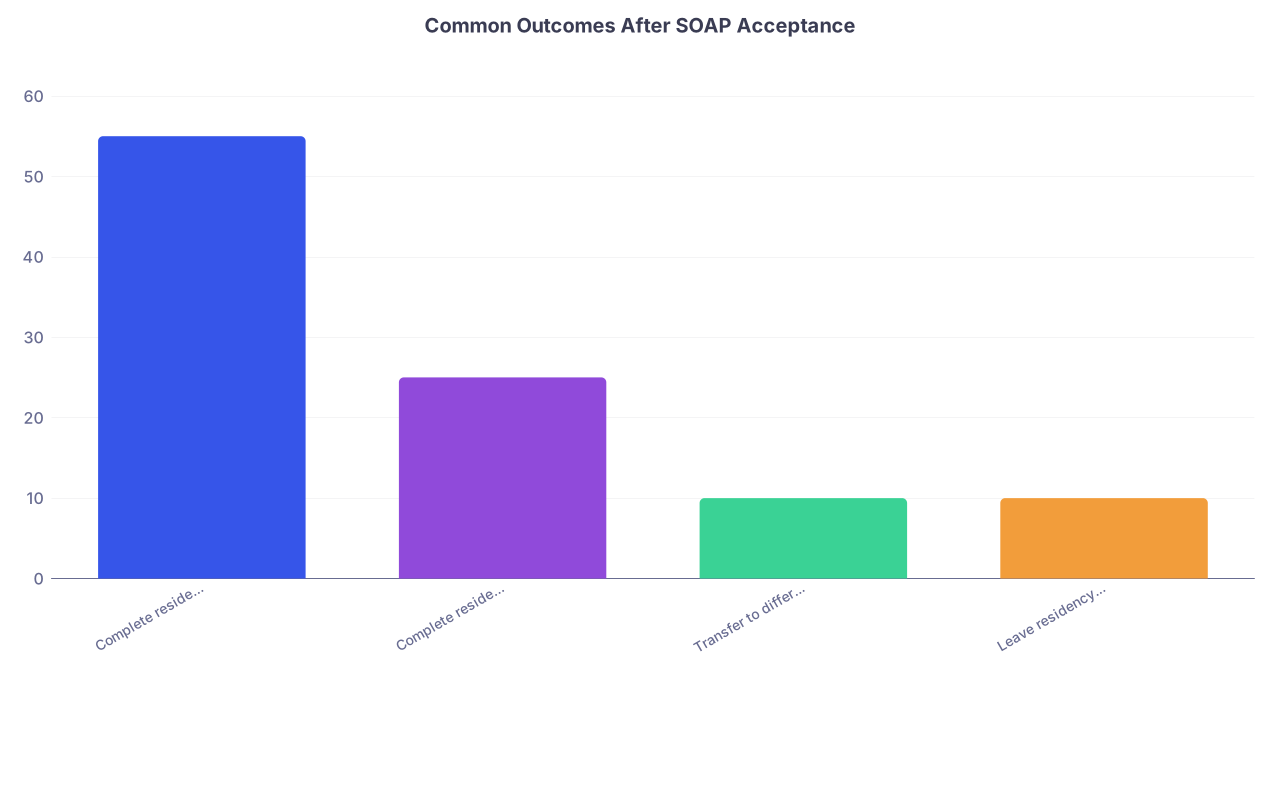
| Category | Value |
|---|---|
| Complete residency and practice | 55 |
| Complete residency then fellowship | 25 |
| Transfer to different program | 10 |
| Leave residency early | 10 |
These numbers aren’t exact for every specialty or year, but the point is:
Most people who SOAP still become practicing physicians.
Some even end up exactly where they wanted, just with a bumpier path.
You’re not automatically an outcast.
FAQ: Anxious SOAP Edition (6 Questions)
1. Will program directors or fellowship directors know I got in through SOAP?
Not explicitly. There isn’t a giant “SOAP” flag burned into your record. They’ll see:
- That your program historically fills or doesn’t fill
- That you started PGY-1 at X place, in X year
- Your performance, letters, and progression
If your program is known as “the place that never matches and always fills in SOAP,” people might infer it. But being from a less competitive program doesn’t automatically tank you. Strong letters and solid clinical performance matter a lot more than the exact mechanism by which you got in.
2. Is it better to SOAP into a less-desired specialty than to go unmatched and reapply for my dream specialty?
It depends how realistic your “dream” is. If you’re talking derm, plastics, ENT, ortho, with average or below-average stats and no major change planned for next year? I wouldn’t bet my entire future on a reapplication miracle.
If your dream is something like IM, peds, FM, psych — and you were close this time, with a clear way to improve (better Step 2, more USCE, stronger letters) — reapplying might make more sense. You need brutal honesty here, not fantasy. Ask someone who has seen a lot of cycles (PD, advisor, not just your friend who matched gas at Mayo).
3. If I take a SOAP spot and it’s horrible, can I leave and reapply later?
You can leave, but that’s not a clean reset. Future programs will ask:
- Why did you leave?
- How were your evaluations?
- Was there any professionalism or performance issue?
If the program is objectively toxic and you document things, seek support early (GME, mentors, mental health). Some residents do successfully transfer out of bad situations. But leaving without finishing and without a clear narrative can make re-matching harder, not easier. Don’t bank on “I’ll just quit if it’s bad” as your main strategy.
4. Does going through SOAP hurt my chances for fellowship later?
Not by itself. Fellowship directors care more about:
- Where you trained and for how long
- Your evaluations and letters
- Research, if relevant to that field
- Your interview and perceived fit
If your SOAP program is weak in your desired subspecialty (e.g., zero cardiology presence for someone who wants cards), yes, that can make life harder. But people have made it from community or SOAPed programs into solid fellowships by hustling hard, finding mentors, and building a clear track record.
5. How do I tell if a SOAP program is truly toxic or just not fancy?
Ask blunt questions if you can get a resident or recent grad on the phone:
- “Have any residents left the program in the last few years?”
- “Do you feel supported by leadership when there are conflicts or mistakes?”
- “What’s the weakest part of the program?”
- “If you had to choose again, would you still come here?”
Listen not just to words but tone. Long pauses. Awkward laughs. “We’ve had some… challenges” with no specifics. That’s not ironclad proof, but it’s signal. Compare that to someone who says, “It’s not perfect and it’s busy, but people are fair and I’m learning a lot.” That’s a world of difference.
6. I’m terrified of regretting my choice. How do I make peace with whatever I decide?
You’re going to have some regret no matter what. If you SOAP, you’ll wonder “what if I had waited and reapplied?” If you reapply, you’ll wonder “what if I had just taken that spot and started my life already?”
Peace comes from making a decision that:
- You can explain to yourself logically later
- Matches your actual constraints (money, visa, mental health, support)
- You made with the best info available under ridiculous time pressure
Then you commit. If you SOAP somewhere, go all in: show up early, work hard, build relationships, carve opportunities. If you reapply, treat this next year like your job — not a passive “gap year,” but an aggressive repair and rebuild year.
Open a blank document or notes app right now and write down:
- The one SOAP option you’d accept if you had to decide this second.
- The one situation where you would walk away and choose to reapply instead.
Seeing those two lines in front of you will tell you more about what you actually want — and what you can actually live with — than another three hours of doom-scrolling forums.