
The thing everyone’s too scared to say out loud is this: it is possible to go through SOAP and have zero programs rank you. And you’re not crazy for worrying about it.
I’m going to assume that’s the scenario running on repeat in your head right now: you don’t match on Monday, you scramble in SOAP, you interview for a few spots (or none), and then… nothing. No email. No “Congratulations.” Just silence.
Let’s talk about that worst-case scenario like adults. Not to terrify you—you’re already terrified—but to actually answer the real question: What if no programs rank me in SOAP? Then what?
Because there is a “then what.” Several, actually.
First: How Bad Is “No Ranking in SOAP,” Really?
Let me level with you: not matching again during SOAP feels like getting rejected twice in one week. Primary Match on Monday. SOAP results on Thursday. It’s brutal.
Emotionally, it’s a wrecking ball:
- Everyone around you is posting “I matched!”
- Faculty start using phrases like “nontraditional pathway” and “alternative options.”
- Your brain immediately jumps to: “My career is over. I’m done. I should have gone into tech.”
But in reality? Not matching in SOAP is:
- A serious setback.
- A massive blow to your confidence.
- Logistically annoying and expensive.
It is not:
- A permanent ban from medicine.
- Proof that you’re unfit to be a doctor.
- The end of all residency chances forever.
I’ve seen people not match, not SOAP, sit out a year, fix their application, and then land in good categorical spots: internal medicine, FM, psych, peds. Not unicorns—actual humans with imperfect stats and messy stories.
The most dangerous part of “no SOAP offer” isn’t the year delay. It’s the shame spiral that makes you do nothing, or cling to fantasy plans, instead of setting up a real contingency.
So let’s build that contingency like you’re assuming SOAP fails. And if you do get an offer—awesome, you just over-prepared.
What Actually Happens If You Don’t Get Ranked in SOAP
On SOAP Thursday, one of two things hits your email:
- You got an offer. You accept. You cry. Your blood pressure returns to human levels.
- You didn’t. And you start living out the scenario you’ve been dreading.
If you end SOAP with no offer, here’s what you’re looking at in the immediate aftermath:
- Your ERAS cycle is basically dead for this year.
- You’re not training July 1.
- You need something—anything—on your CV for the next 12 months so you don’t look like you disappeared.
- You have to decide: reapply? Change specialty? Change strategy? Change country?
This is where most people freeze. They feel blindsided, even though they’ve been panicking about this exact possibility for months. Panic isn’t a plan.
(See also: Terrified of SOAP: How to Cope With the Uncertainty and Still Perform for more on managing fear and performance.)
You need a plan before SOAP week. So “no rank” isn’t a cliff—just the start of Plan B.
Step One: Stabilize the Freefall (The First 2–4 Weeks)
You’re going to want to jump straight into “Okay, I’ll do research / MPH / prelim / anything.” Slow down. For a few weeks, your actual job is to not self-destruct.
Here’s what that looks like in practice:
Tell a small inner circle
Not everyone. Not the entire class GroupMe. A few people who can actually help: a dean, an advisor, a trusted attending, maybe a recently graduated resident. Let them hear the story. Let them react. Then ask, “Can we make a plan?”Get clarity on why you didn’t match
Don’t just guess. Ask faculty who have seen many cycles:- Was it scores?
- Specialty competitiveness?
- Late step scores?
- Poor letters?
- Weak or disorganized application?
- Red flags (fails, professionalism issues, big gap)?
You won’t fix what you won’t name. And yes, it’s going to sting.
Decide your reapplication intent early
Two big questions:- Am I reapplying?
- Same specialty, or a different one?
Don’t sit in limbo until August. Programs can’t help you if even you don’t know what you want to do.
Concrete Paths After a Failed SOAP (What People Actually Do)
Here’s where your brain probably oscillates between “It’s over” and “Maybe I’ll just magically match next year.” Both are lies. The truth is in the middle, and it’s specific.
1. The “Reapply Stronger” Year (Most Common, Most Boring, Most Effective)
This is the unsexy option, but it’s the one that works for a lot of MD/DOs.
You spend 1 year deliberately improving your application in ways that are actually visible to programs.
That usually means some combination of:
A research position (paid or unpaid)
Especially at an academic center in your target specialty or a nearby one (IM, FM, psych). Doesn’t have to be Harvard. Even a decently busy hospital with a few publish-hungry attendings works.Clinical work with U.S. experience and relationships
Things that count:- Hospital-based research fellow with clinic involvement
- Clinical instructor, preceptor, or junior faculty teaching role in some settings
- Scribe or clinical assistant if it gets you face time with attendings
- Postgraduate “clinical scholar” positions some hospitals run
The key is access to letter writers, not just hours.
Extra rotations / observerships / sub-I-ish experiences
Especially if you’re switching specialties or applying to less competitive ones. You need someone in that field saying, “Yes, this person can do the job.”Fixing any exam issues
- If you haven’t taken Step 3 and your scores aren’t stellar, Step 3 with a solid pass can help for some IM/FM/psych programs.
- If you have a fail, you need a clean record from here on out and a narrative about growth, not excuses.
What this year cannot be:
- A random gap with “personal time” and nothing structured.
- Just moonlighting at a random urgent care with no academic link, no letters, no advancement.
- You hiding because you feel ashamed.
Your new ERAS next year has to scream, “Look at everything I did since last Match. I didn’t just wait, I worked.”
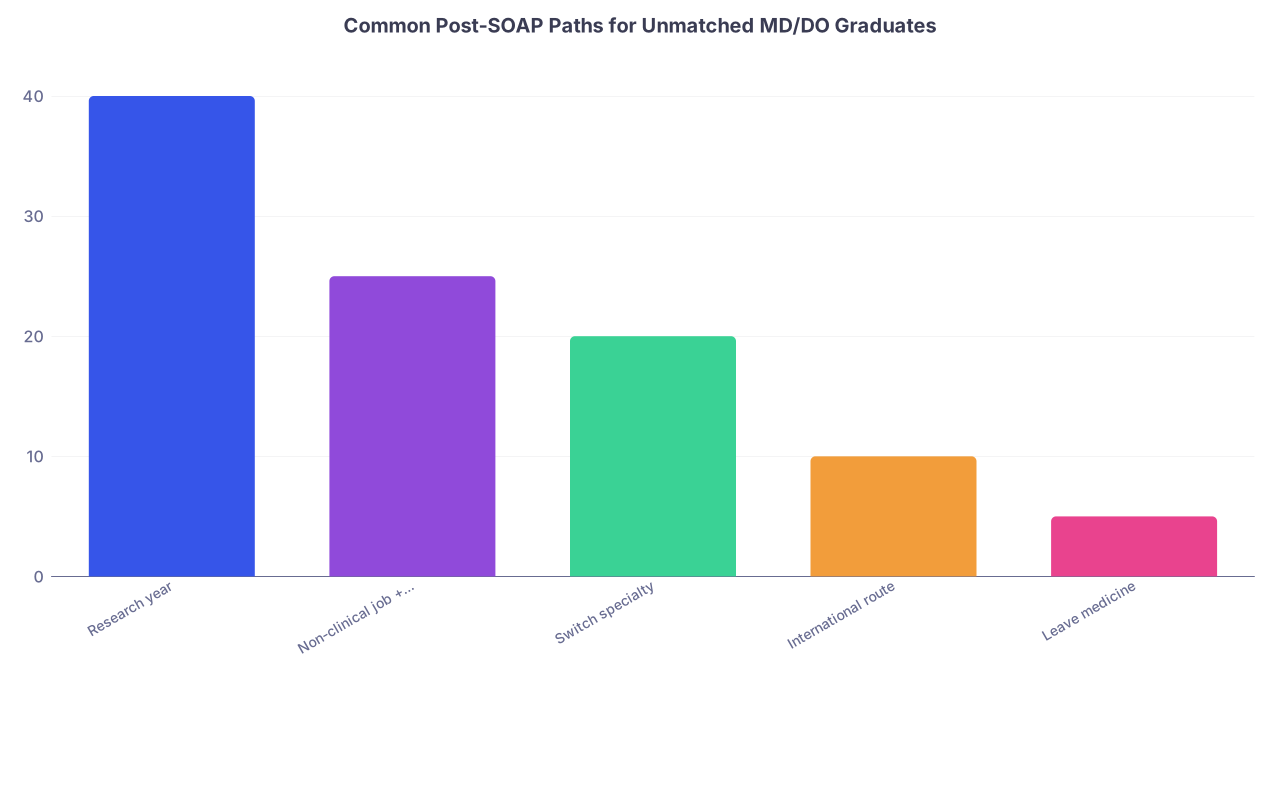
| Category | Value |
|---|---|
| Research year | 40 |
| Non-clinical job + reapply | 25 |
| Switch specialty | 20 |
| International route | 10 |
| Leave medicine | 5 |
Choosing a Specialty Strategy: Stay, Pivot, or Completely Switch
This is the part that keeps people up until 3 a.m. staring at spreadsheets.
“Do I stay loyal to my dream specialty?”
“Do I switch to something more ‘realistic’ like IM or FM?”
“Does that make me a sellout?”
Here’s the harsh truth: programs care more about realism than your dream. If you have multiple red flags and you’re glued to a hyper-competitive specialty, they’re going to assume you lack insight.
So you ask yourself a few blunt questions:
- Did I apply to a competitive specialty (derm, plastics, ortho, ENT, urology, ophtho, some EM markets, radiology, anesthesia in certain cycles) without top-of-the-pile stats, research, or institutional backing?
- Did I also apply narrowly? Few programs, no backups?
If yes, then reapplying to the same thing with only minor improvements is basically gambling. Again.
(See also: Afraid to Switch Specialties in SOAP: How Risky Is the Pivot Really? for guidance on specialty pivots.)
Many people:
- Reframe their interest and pivot to internal medicine, family medicine, psych, peds, or transitional/prelim with a long-term plan.
- Show commitment to the new field with rotations, letters, and updated personal statements that actually make sense.
You can absolutely pivot from, say, surgical specialty dreams to IM and still have a meaningful career, procedure-heavy practice, ICU time, etc. Is it the fantasy you had in MS2? Maybe not. Is it a real, respected doctor life? Yes.

| Step | Description |
|---|---|
| Step 1 | No SOAP Offer |
| Step 2 | Explore non-clinical plan |
| Step 3 | Identify weaknesses |
| Step 4 | Choose new specialty |
| Step 5 | Research or clinical year |
| Step 6 | Strengthen letters and CV |
| Step 7 | Reapply next cycle |
| Step 8 | Reapply to residency? |
| Step 9 | Same specialty? |
Can an MD/DO Work Without Residency?
This is where the panic gets very loud. “If I never match, I’ll never be a doctor. I’ll lose everything.”
Let’s be clear: to practice independently as a physician in the U.S., you need residency. That part is non-negotiable.
But in the in-between—this year, maybe next year—you can do things that are:
- Surprising to most applicants
- Actually valuable
- Not just “giving up”
Things I’ve seen unmatched MD/DO grads do:
- Full-time research coordinator or postdoc-style roles at academic hospitals
- Clinical informatics or quality improvement positions (especially if you like systems, EMRs, or policy)
- Medical education positions (simulation lab, curriculum support, anatomy TA roles for med schools)
- Industry jobs: pharma, biotech, medical communications, consulting
Are those “consolation prizes”? Sometimes they feel like it. But they can also:
- Pay your bills.
- Keep you near medicine.
- Open doors you didn’t even know existed.
- Strengthen a future application if you choose to reapply.
The worst path is pretending these options don’t exist and letting the shame keep you idle and isolated for a year.
Should You Consider Going Abroad for Residency?
This one always comes up, especially from unmatched U.S. MD/DOs who are desperate and Googling UK, Australia, Ireland, etc.
Reality check:
- Most other countries are not dying to train U.S. grads who couldn’t match at home. Their systems are also competitive, regulated, and complex.
- Moving internationally to chase a residency equivalent is not an easy button. You’re talking visas, exams (PLAB, AMC, etc.), different licensing rules, and possibly very limited paths back to the U.S. later.
That said, a tiny subset of people do:
- Move abroad
- Train successfully
- Either stay there or, rarely, come back under specific pathways
But if you’re considering this because you’re panicking in March and don’t want to face your classmates, that’s not strategy. That’s avoidance.
If you’re genuinely open to building a life and career in another country long-term? Different story. But that deserves calm, researched decision-making, not Match Week chaos.

Financial Reality of a Gap Year After SOAP Fails
People don’t talk about this enough, and it quietly fuels the panic.
No SOAP offer means:
- No resident salary starting July 1
- Loan payments looming (depending on your grace/forbearance status)
- Application costs again next year: ERAS fees, NRMP, potentially more exams, travel if in-person interviews return in your specialty
Rough breakdown (ballpark):
| Expense Category | Estimated Range (USD) |
|---|---|
| ERAS + NRMP fees | $1,000–$2,500 |
| Exam costs (Step 3 etc.) | $1,000–$1,500 |
| Interview-related costs | $200–$1,000 |
| Moving/relocation later | $1,000–$4,000 |
| Living expenses during gap year | Highly variable |
So if you’re panicking about money on top of everything else—you’re not being dramatic. It is a lot.
But again, the answer isn’t “freeze.” It’s:
- Look for paid positions (research, clinical roles, industry) instead of only unpaid observerships.
- Talk to your loan servicer early about deferment/forbearance options as a non-matched grad.
- Budget as if you know you’ll be applying again—because you probably will.
How to Emotionally Survive Being “The One Who Didn’t Match”
I’m not going to sugarcoat this. The shame is real.
Scrolling through Instagram that week feels like watching your own funeral in real time.
A few things I’ve seen make a difference:
Control the narrative
You don’t owe everyone details. A simple line works:
“I didn’t match this cycle. I’m working on strengthening my application this year and reapplying.”
Say it enough and you stop flinching when you hear yourself.Limit exposure to the comparison machine
Mute group chats. Temporarily delete apps if you have to. You’re not weak for doing this—you’re protecting what little mental bandwidth you have left.Get one or two people who can handle your worst fears
The uncensored stuff: “What if I literally never match?” “What if I wasted my 20s?”
Keeping that all in your head by yourself is how people end up in very dark places.
And if your brain goes to self-harm or “I don’t want to be here if I’m not a doctor” territory? That’s not just “normal applicant anxiety.” That’s a red flag for getting actual mental health support, urgently. Your worth is not conditional on a NRMP algorithm.
Planning Now: What You Should Set Up Before SOAP Week
If you’re reading this before SOAP and spiraling, use that anxiety for something useful.
Even if you do end up matching in SOAP, it won’t hurt to have:
A list of faculty/mentors you’d contact if you don’t match
A rough backup plan:
- “If I don’t match, I’ll aim for a research year in X specialty at Y region.”
- “If I pivot specialties, my top backup fields are A and B.”
A CV and basic cover letter ready to send to:
- Research mentors
- Program directors
- Hospital departments with open “research associate” or “clinical fellow” jobs
A money plan
Not a perfect one. Just basic “If I’m not paid as a resident, here’s how I survive the next 6–12 months.”
Planning doesn’t jinx you. It just means Future You isn’t starting from zero when you’re already emotionally wrecked.
The Ugly Truth and the Quiet Hope
Here’s where I land on all this:
- Yes, it is absolutely possible that no programs rank you in SOAP.
- Yes, it will feel like a personal indictment of you as a human.
- No, it does not actually mean your career is over unless you decide you’re done.
Plenty of MD/DOs:
- Have a failed Match + failed SOAP year
- Take a structured, intentional gap
- Come back with a stronger, more realistic application
- Match into solid, fulfilling residencies
You don’t have to pretend this doesn’t terrify you. It is terrifying.
But terror plus a plan beats terror plus denial every single time.
If nothing else sticks, remember these:
- “No SOAP offer” is a delay and a data point, not a permanent verdict.
- A gap year that’s structured and visible (research, clinical work, specialty pivot) can absolutely flip your trajectory.
- You are not the first, you are not the last, and this nightmare scenario has multiple exits—none of which you can use if you decide you’re already done.