
Your Step scores didn’t “sink” your season. They just made SOAP your new main event.
I’m going to say the thing you’re probably too scared to say out loud: you’re terrified your Step scores tanked your entire match season, and now SOAP feels like some chaotic, humiliating consolation prize where only “unwanted” applicants go to scramble for whatever’s left.
That’s not what it is.
But if you treat SOAP like an afterthought, it can become your worst-case scenario.
Let’s walk through this like someone who’s up at 2am refreshing email and mentally replaying every bad NBME score. Because that’s me too: the Worried Applicant brain that immediately assumes, “Low Step = doomed.”
It’s not doomed. It’s just different.
First: Did Your Step Scores Actually “Sink” You?
Let’s be blunt: Step scores absolutely affect interviews and Match chances. Program directors filter with them. They always have, even with pass/fail Step 1 now—Step 2 CK is the new gatekeeper.
But you’re probably over-assigning blame to the numbers and under-estimating everything else.
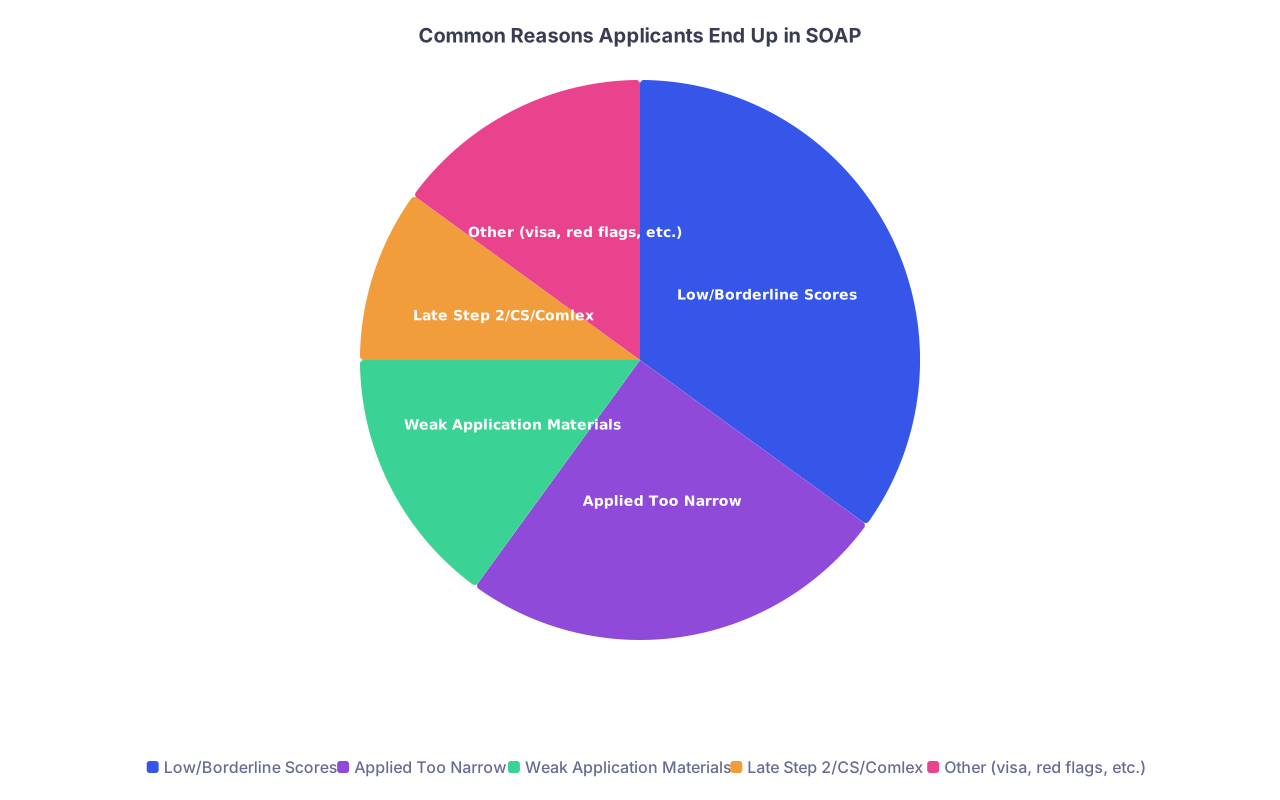
| Category | Value |
|---|---|
| Low/Borderline Scores | 35 |
| Applied Too Narrow | 25 |
| Weak Application Materials | 15 |
| Late Step 2/CS/Comlex | 10 |
| Other (visa, red flags, etc.) | 15 |
Here’s what I’ve seen over and over in real people who end up in SOAP:
- Step 1: pass or low
- Step 2 CK: borderline for their specialty or late
- Very few interviews (0–4)
- Applied to only 30–60 programs in a competitive field
- No updated Step 2/3 scores in time
- Personal statement generic, letters “fine but not great”
Sound familiar?
Your brain’s saying, “My Step scores sank my season.” But honestly, programs are ruthless about everything: fit, letters, timing, school, visa issues, research, weird gaps.
Scores hurt. But they rarely act alone.
That actually matters, because if Step alone didn’t kill you, Step alone won’t save or doom your SOAP. There are other levers you still control.
What SOAP Actually Is (And What It’s Not)
SOAP isn’t the Hunger Games where low-score people fight over one unfilled prelim medicine spot.
SOAP is a structured, brutally fast, second match that cares about:
- Are you eligible (no match + registered + passed required exams)?
- Are you realistic (willing to rank programs that fit where you stand now, not where you wished you’d be)?
- Can you pivot quickly (update documents, answer calls, sell your story)?

| Step | Description |
|---|---|
| Step 1 | Unmatched on Monday |
| Step 2 | Check SOAP Eligibility |
| Step 3 | View Unfilled Programs |
| Step 4 | Submit Up To 45 Applications |
| Step 5 | Program Review |
| Step 6 | Interviews Calls or Video |
| Step 7 | Programs Create Preference List |
| Step 8 | SOAP Rounds Offers |
| Step 9 | Accept One Position |
SOAP is not:
- A secret blacklist of “bad” applicants
- A place where no one gets a decent residency
- A career death sentence
Every year there are solid people in SOAP: couples match casualties, people who went too competitive (hello Ortho/DERM), international grads who misjudged the US market, US grads with late Step 2, or people like you who had a couple of numbers that made programs nervous.
You’re not the only one there. You’re just the one living in your own head about it.
How Much Do Step Scores Matter in SOAP?
Here’s the terrifying question spinning in your mind: “If my Step scores kept me from matching, why would SOAP programs want me now?”
Because SOAP isn’t about perfection. It’s about filling positions with people who can safely function as interns. Programs in SOAP are still selective, but the context shifts:
- In the main match, they might auto-screen at 220+ or 230+ for Step 2.
- In SOAP, some will absolutely still screen. Others widen the net. A lot.
| Context | Typical Score Cutoffs | Flexibility Level |
|---|---|---|
| Main Match | Higher, rigid filters | Low |
| Early SOAP | Still screeny | Moderate |
| Late SOAP Rounds | More flexible | Higher |
| Post-SOAP | Case-by-case | Very high |
Programs in SOAP are thinking things like:
- “We need reliable, pass-the-boards, show-up-on-time residents.”
- “This person’s Steps are low, but they passed, they’ve got good clinical comments, and they’re clearly motivated.”
- “We can’t be as picky as October. Let’s talk to them.”
Your scores don’t magically improve in SOAP. But the threshold of what’s acceptable can shift.
SOAP won’t erase a 3 fails + massive professionalism red flags situation.
But it absolutely can absorb:
- Borderline/low but passing Step 1/Step 2
- One previous failure with clear remediation and later pass
- Step scores fine for IM/FM/Peds but too low for the ultra-competitive field you aimed for
So no, your Step didn’t end your chances. It narrowed your options and probably changed which specialties and programs are realistic.
That’s painful. But it’s not the end.
Who Actually Has a Shot in SOAP With Low Step Scores?
Let me be harsh for a second, then encouraging.
SOAP is not a miracle machine. It will not:
- Turn a 4-time Step failure into a PGY-1
- Get you Derm/Plastic/Neurosurgery out of nowhere
- Override serious professionalism/disciplinary issues
Where SOAP does save people with worrying scores:
- US MD/DO with low Step 1, but passing Step 2 in a reasonable range
- IMGs with borderline scores but strong clinical and realistic specialty choices (FM, IM, Psych, Peds, some prelims/Transitional Year)
- Applicants who overreached specialty-wise (e.g., applied Radiology with 215–220 Step 2, now pivoting to IM/FM)
- People with a single exam failure but consistent upward trend and strong MS3/MS4 evals
If you’re sitting there with Step 1 pass, Step 2 CK in the 210–225 range, and you were aiming for a competitive field? SOAP can absolutely be your rescue route into a more attainable specialty.
If you’re a US MD/DO who didn’t match, your odds in SOAP are still far from hopeless, especially in primary care–leaning fields.
If you’re an IMG with lower scores, your window is narrower, but not automatically closed—especially for FM, IM, or prelim medicine spots in less popular locations.
What You Can Do Right Now To Lessen the Damage
This is the part your anxiety doesn’t want to hear, because it’s easier to spiral than to prepare. But SOAP is brutally fast. If you wait until Monday of Match Week to “see what happens,” you’re done.
Here’s where Step actually matters: your story.
Programs will wonder: “Why didn’t this person match?”
You can’t pretend your scores weren’t part of it. But you can control how you frame them.
You need a 2-part narrative ready:
What happened.
- “I struggled with standardized test timing/issues/anxiety early on, reflected in my Step scores.”
- “I initially applied broadly within a competitive specialty where my scores were below the typical range.”
Why you’re not a risk.
- Point to strong shelf exams, strong clerkships, later improvement (even modest), Step 3 if taken, or any pattern of reliability.
- Emphasize clinical competence: “Consistently above-average clinical evaluations, trusted with high responsibility on sub-I.”
You’re not writing a pity manifesto. You’re giving them a reason to think: “Okay, this person knows what went wrong and why it’s not a permanent liability.”
Strategy: Using SOAP When Your Step Scores Hurt
Here’s where you can either accidentally sabotage yourself or actually recover.
1. Be ruthless about specialty choices
This is the ego-killer. If your Step scores helped block you from your dream specialty, SOAP is not the place to double down on denial.
You have to be willing to pivot to:
- Internal Medicine (especially community programs, less popular states)
- Family Medicine
- Pediatrics
- Psychiatry (still getting more competitive, but some SOAP spots do appear)
- Transitional Year / Prelim Medicine / Prelim Surgery (if you’re planning a longer path)
If you’re sitting there with a 215 Step 2 still clinging to Radiology or Ortho in SOAP… you’re not “fighting for your dream.” You’re wasting the one emergency parachute you have.
2. Play the numbers game, not the prestige game
You get to send up to 45 applications in SOAP. This isn’t the time to treat programs like college admissions rankings.
Target:
- Programs in less popular states and smaller cities
- Community-heavy hospitals
- Places that historically have more IMGs or DOs (often means more flexibility around scores)
- Unfilled prelim spots if you’re open to a multi-step journey
Your ego will scream: “But I don’t want to live there.”
Your future self with a PGY-1 contract will scream back: “We can move later.”
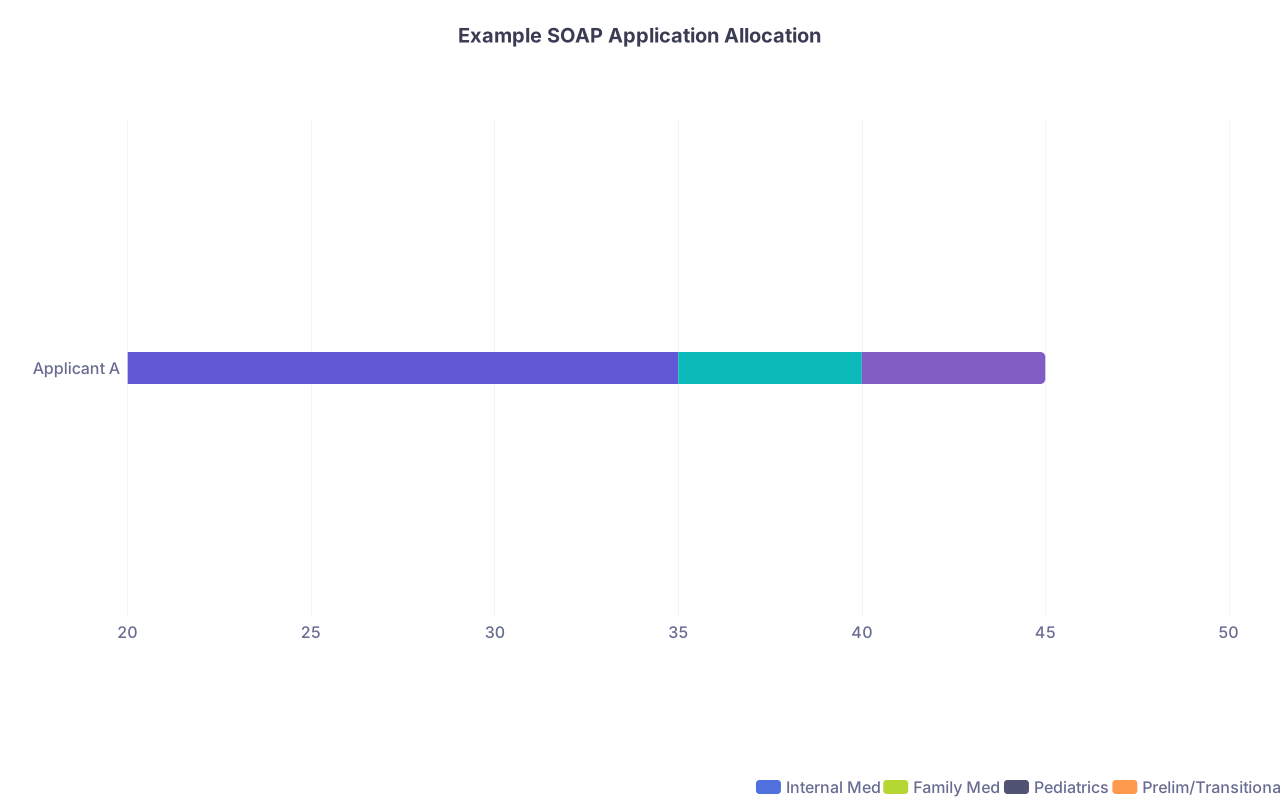
| Category | Internal Med | Family Med | Pediatrics | Prelim/Transitional |
|---|---|---|---|---|
| Applicant A | 20 | 15 | 5 | 5 |
3. Fix what you can in your documents
You can’t rewrite your entire application, but you can tighten a few things quickly:
- Personal statement: swap your specialty-targeted one for a primary-care-appropriate or prelim-appropriate version that briefly, honestly contextualizes your scores without obsessing over them.
- CV: emphasize clinical experiences, continuity clinics, leadership, reliability.
- LoRs: if you’ve got one that subtly trashes you (“solid but not stellar”), consider not using it if you have better ones.
You’re not hiding your scores. You’re making sure they’re not the only thing that stands out.
4. Prepare for intense, fast communication
SOAP interviews are weird. Phone calls out of nowhere. Short Zooms. Rapid-fire scheduling.
Programs will often ask:
- “Tell me about your application and why you think you didn’t match.”
- “What specialty did you originally apply to and why are you interested in ours now?”
- “Do you have plans if you don’t match this cycle?”
This is where your Step anxiety wants to ramble and overshare. Don’t.
You need a 2–3 sentence, calm, practiced answer that:
- Owns your lower scores
- Highlights what’s changed or what you’ve proven since
- Shows you’ve mentally committed to this specialty/program type now
Something like:
“My standardized test performance earlier in medical school wasn’t as strong as I’d hoped, which limited my initial interview offers. Since then, I passed Step 2 on the first attempt and my clinical rotations—especially internal medicine and sub-internships—have been very strong. I’ve reflected a lot on fit, and I’m now committed to pursuing a career in internal medicine, particularly in a program where I can grow clinically and serve a diverse patient population like yours.”
Not perfect, but better than choke-laughing and saying, “Yeah… my Step scores were a disaster.”
Worst-Case Thinking: What If SOAP Fails Too?
Let’s talk about the nightmare scenario that’s lurking behind all of this: you go through SOAP, still end up without a spot, and your Step scores feel like a permanent scarlet letter.
It will feel catastrophic. But you still wouldn’t be finished.
Real people have:
- Taken a research year
- Done an MPH or other degree strategically
- Worked as a hospitalist scribe, clinical coordinator, etc. while reapplying
- Retaken Step 2 or completed Step 3 to show improvement (where allowed and appropriate)
- Switched target specialties to something more realistic
Plenty of unmatched + SOAPed-out applicants match the next year. Especially if they:
- Fix their specialty target
- Broaden their geographic range
- Strengthen letters and recent clinical work
- Demonstrate any upward testing trend (even modest)
You don’t want that path. I know.
But the existence of a Plan B actually matters when you’re panicking. This isn’t your only shot at practicing medicine.
Right now, though? Your job is to not let anxiety make you underperform on the shot that’s right in front of you: SOAP.
What SOAP Can Do For You, Even With Bad (or Mediocre) Steps
Let me strip it all down.
SOAP cannot:
- Turn back the clock and give you pristine Step scores
- Magic you into an ultra-competitive field that rejected you in the main match
- Guarantee anything
SOAP can:
- Give you an honest second chance at a real residency
- Put you in front of programs that are now willing to consider slightly lower scores because they still need strong, reliable interns
- Let you pivot into a realistic, stable specialty where you can still build a career, pay your loans, and take care of patients
Your numbers didn’t “sink your season.” They shoved you into a narrower lane. SOAP is one of the few remaining roads still open inside that lane.
Don’t waste it by:
- Staying fixated on only your dream field
- Chasing prestige over actual opportunities
- Letting shame about your scores leak into every conversation
You’re allowed to be embarrassed. You’re allowed to be angry. But you’re still responsible for what you do this week.
FAQ (Exactly 4 Questions)
1. My Step 2 is under 220. Do I even have a realistic shot in SOAP?
Yes, in certain fields and settings. Internal Medicine, Family Medicine, and sometimes Pediatrics or Psychiatry programs—especially community-based programs in less popular locations—will seriously consider applicants in that range if the rest of the application shows reliability and good clinical performance. Is it harder? Yes. Impossible? No. Your realism about specialty and geography will matter more than ever.
2. Should I mention my low Step scores directly in interviews, or hope they don’t bring it up?
If they don’t mention it, you don’t lead with it. But be ready with a calm, short explanation if they ask why you think you didn’t match. You acknowledge it briefly, connect it to something you’ve already improved (clinical performance, later exams), and move quickly back to your strengths and your commitment to their specialty. Don’t launch into a 5-minute trauma dump about NBME exams.
3. Is it better to SOAP into a prelim spot with my scores, or wait and reapply next year for a categorical position?
There’s no universal right answer. If you can SOAP into a prelim spot in medicine or surgery at a program where you could realistically network into a PGY-2 or reapply more competitively, that can be better than having a completely blank year. But if the prelim is in a toxic setting with no realistic path forward, and you have solid options for a productive gap year (research, strong mentorship, test improvements), reapplying might be smarter. This is where honest advice from mentors who know you really matters.
4. How do I handle the shame of being in SOAP when my classmates matched?
There’s no nice way to say it: it hurts. It feels like public failure. But I’ve watched people go from SOAP shame to PGY-2 life where absolutely no one cares how they matched, only how they take care of patients and work with the team. Right now, set emotional boundaries—mute group chats for Match Week, tell 1–2 trusted people what’s happening, and focus on execution. You can process the feelings fully later. This week is about survival and giving yourself a shot at being a doctor, not winning the social media version of Match.
Open a blank document right now and write a 3–4 sentence explanation of why you think you didn’t match and why you’re still a safe, committed bet for a SOAP program—then practice saying it out loud until it sounds like confidence, not apology.