
The idea that SOAP rank lists are strictly “merit-based” is a comforting myth. They are not.
Some limited‑interview applicants rocket to the top of SOAP lists while others never get a call. The difference isn’t random. It’s a combination of quiet back‑channels, last‑minute risk calculations, and brutal time pressure on program directors that nobody explains to students.
Let me walk you through what really happens in those rooms.
What SOAP Actually Looks Like From the Program Side
You see SOAP as four rounds, time windows, and a panicked inbox.
We see SOAP as controlled chaos.
On Monday at noon, programs get that infamous “You have unfilled positions” email. They have only a few hours to:
- Log onto ERAS
- Filter hundreds of desperate applications
- Decide who’s getting called
- Coordinate faculty to do phone/Zoom “interviews”
- Submit a rank list that will lock them in
There’s no committee retreat. No multi-week holistic review. It’s sprint triage.
Program directors and coordinators sit around a table (or in a Zoom room) with a running spreadsheet. Names move up and down in real time as calls happen, red flags appear, or someone’s mentor frantically emails.
Here’s the part you need to understand: with that kind of time pressure, they are not searching for “the best overall applicant.” They are searching for “the least likely to burn me this July.”
Those are very different criteria.
The Brutal Truth About “Limited Interviews” in SOAP
If you went into SOAP with 0–3 interviews from the regular cycle, you already know what people whisper:
“Programs will assume something is wrong with me.”
Sometimes that’s true. Sometimes it’s not. But here’s the nuance from the PD side that students never hear.
During SOAP, when we see:
- US MD with 0–1 interviews
- US DO with 1–3 interviews
- IMG with only home country interviews or none at all
We do not all react the same way. Some of those people get sorted mentally into “no‑go,” others into “high‑yield rescue candidates.”
The ones who jump to the top of the list usually have one of three things going for them:
- A simple, easily explainable reason for low interviews
- A strong, recent validator (Step 2 improvement, late letter, late rotation)
- Someone we trust quietly vouching for them
The limited‑interview people who rise in SOAP are not always the “strongest” on paper. They’re the ones whose story reduces our perceived risk the fastest.
What Programs Really Prioritize in SOAP (That Nobody Tells You)
Let me spell out the ugly hierarchy. In SOAP, we’re not dreaming about “reshaping our program.” We’re trying not to be on fire in July.

Here’s what actually drives a suddenly high rank for a limited‑interview applicant:
1. Immediate Service Needs Trump Everything
If a program’s losing three seniors, has a vacant chief spot, or their night float is chronically understaffed, they are not looking for “interesting research potential.” They’re looking for:
- People who can carry a large patient load
- People unlikely to quit or fail Step 3
- People who will not need hand‑holding on every call night
A limited‑interview applicant who looks reliable and durable often beats a more glamorous but risky profile.
Example I’ve seen multiple times:
At a mid-tier community internal medicine program with 5 unfilled spots, the PD said straight out:
“I need workhorses who will not melt in October.”
Guess who climbed the list?
- The US MD with one interview, solid Step 2 (245+), average research, lots of work experience and a letter that literally said “hardest working student I’ve had in 10 years.”
- Over the IMG with 250+ but vague letters and no US hands‑on experience.
- Over the DO with fancy research but three Step 2 fails.
Why? The first one felt like a low‑maintenance resident. When time is short, we pick “safe” over “sexy.”
2. Clean, Boring Files Are Gold During SOAP
During the main cycle, committees love “interesting.” Nontraditional stories. Big career changes. Unique paths.
During SOAP? Interesting can read as “complicated.”
If your file is:
- No professionalism flags
- No unexplained leaves
- Nothing that requires a 10‑minute explanation call to your dean
You jump ahead of people with “mystery elements,” even if their CV is stronger.
A limited‑interview applicant who looks “boringly safe” often gets ranked higher than someone with a more impressive record but unresolved questions.
I’ve sat in SOAP rooms where a PD literally said:
“Skip anyone I have to call the dean about. I do not have time.”
So the limited‑interview US DO with:
- Mid‑220s Step 2
- Solid clinical grades, nothing flashy
- A gap year clearly explained as “family caretaker, now fully resolved, back to full‑time”
Might be ranked over a higher‑scoring US MD with an unexplained leave, professionalism notation, or murky remediation that the PD doesn’t have time to fully understand.
The Hidden Power Moves That Lift Limited‑Interview Applicants
This is the stuff advisors do not walk you through. They either don’t know or they’re afraid to say it out loud.
Strategic Dean’s Letters and Targeted Outreach
Some schools play SOAP aggressively. Others basically wash their hands of you.
At aggressive schools, by Monday morning of SOAP, the dean or student affairs office is already:
- Calling PDs where you did away rotations
- Emailing programs they know have a history of taking their grads in SOAP
- Quietly saying, “This student had limited interviews because of X, but we trust them / would re‑rank them highly.”
If a PD hears from a dean they respect that you’re safe, your limited‑interview status matters a lot less.
The applicant who jumps up the list is often the one whose dean or advisor got on the phone, not the one with the slightly better Step score.
The Late “Validator”: Step 2, Sub‑I, or Letter
Programs love fresh data. It de‑risks you.
If your limited‑interview status can be reframed as “they were late but strong,” you’re suddenly attractive.
Examples of validators I’ve seen revive thin applications in SOAP:
- Step 2 score that jumped 15–20 points over a weak Step 1
- A strong home-sub‑I with a letter arriving in January or February saying “we’d be happy to have them here”
- A remediation completed cleanly with clear progress documented
I watched one applicant go from “maybe we should skip” to “rank them first” in under ten minutes at a community FM program because:
- They had only one regular‑cycle interview
- Their Step 1 was barely passing, but Step 2: 242 (significant jump)
- Their new letter (uploaded just before SOAP) from a rotation said “top 5% of students this year”
The PD literally said: “Okay, they figured it out. I can work with that.”
The Quiet Endorsement That Outweighs Your Entire ERAS
You have no idea how much a single trusted voice can override your low interview count.
If a PD hears this from someone they trust:
“Look, they got screwed by timing/late Step 2/weak early advising. But they’re a solid human, they work hard, and they won’t cause problems.”
You can leapfrog a dozen stronger‑on‑paper applicants instantly.
Think of these behind‑the‑scenes players:
- Your home PD in the same specialty
- A rotation site PD at a place that filled but likes you
- A well‑known faculty member with personal ties to other programs
- Even a chief resident who rotates across multiple hospitals
They pick up the phone and say, “Off the record, I’d take them.”
That matters more than a line item on your CV.
Why Some Limited‑Interview Applicants Are Preferred in SOAP
This is the part nobody believes until they see it.
Sometimes, a limited‑interview applicant is actually more desirable in SOAP than the applicant with a dozen interviews and no match.
Why? Because each of those prior interviews is a silent data point.
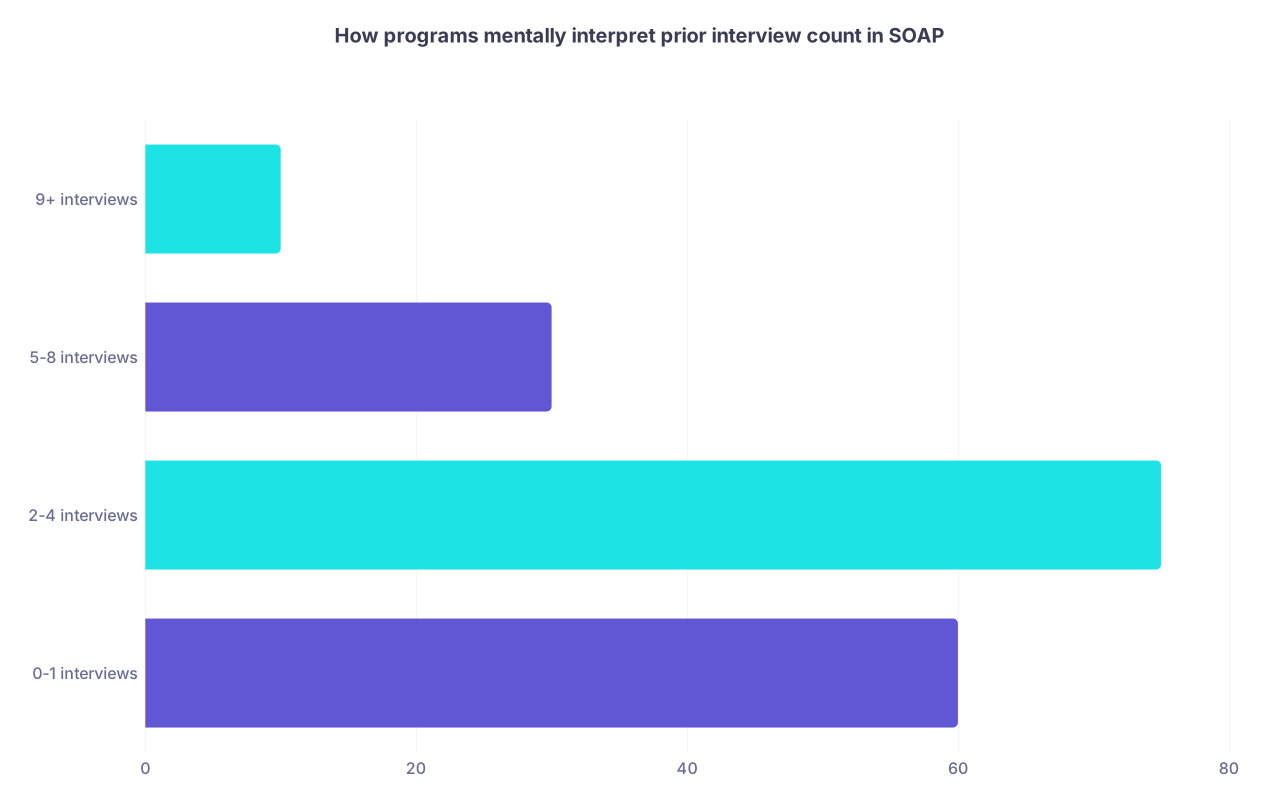
| Category | Value |
|---|---|
| 0-1 interviews | 60 |
| 2-4 interviews | 75 |
| 5-8 interviews | 30 |
| 9+ interviews | 10 |
Let me translate that chart into how PDs think:
- 0–1 interviews: “Could be early red flags. Or could be late transformation, poor initial list, or bad advising.” We’re curious but cautious.
- 2–4 interviews: “Borderline candidate; maybe market mismatch or a bit unlucky.” We’re watchful.
- 5–8 interviews, no match: “Hmm. Multiple programs met them and still didn’t rank high enough. Why?”
- 9+ interviews, no match: “Somebody saw something I can’t see in ERAS—or they interviewed poorly or have interpersonal issues.”
I’ve seen PDs literally sort SOAP Excel sheets and say, “I want the people who didn’t strike out at 12 programs.”
So the US DO with three interviews at mid‑tier community programs, none of which matched them, may look less concerning than the US MD who had 10 interviews including several academic places and still slid into SOAP.
Limited interviews can be reframed as: “The market never got a full look at this person.” That’s actually less scary to some programs than “The market saw them repeatedly and consistently passed.”
How Your Behavior During SOAP Changes Your Rank
You are not just a stack of scores and PDFs during SOAP. How you act in those 48–72 hours matters more than you think.
Programs are watching for three things:
- Stability
- Communication
- Fit for their specific environment

| Step | Description |
|---|---|
| Step 1 | Program calls applicant |
| Step 2 | Brief focused conversation |
| Step 3 | Voicemail or delayed reply |
| Step 4 | Possible lower rank |
| Step 5 | Moves up rank list |
| Step 6 | Stays low or off list |
| Step 7 | Answers promptly |
| Step 8 | Shows insight and maturity |
Answering Like a Professional, Not a Panicked Student
If when we call you:
- You sound composed
- You have a coherent explanation for your limited interviews
- You’re able to articulate what you learned and what you want
You get bumped up.
If you sound frantic, bitter, disorganized, or “checked out,” you slide down or off the list. PDs know that how you handle SOAP is a preview of how you’ll handle a bad night in the ICU.
I watched a PD move someone from #6 to #1 on a SOAP list after a 7‑minute call because:
- When asked about their low number of interviews, they said:
“I applied too narrow at first and realized too late I needed to broaden. My Step 2 was pending for a large part of the season. I’ve fixed that moving forward—my Step 2 is now 247 and I’ve taken feedback seriously on my interviewing.” - They didn’t blame schools, didn’t rant about unfairness, didn’t melt.
That kind of response screams “low drama, high maturity.” Programs eat that up.
Availability and Responsiveness
Yes, it matters.
The applicant who misses two calls, responds to emails six hours late, and seems confused about time zones? Instantly lower risk tolerance.
The one who:
- Responds quickly
- Shows up on time for a last‑minute Zoom
- Has their tech working
- Looks like they actually care about the program
They move up.
More than once I’ve heard:
“Rank them above the others who no‑showed our calls or needed three reschedules.”
The Program’s Risk Equation: Why You, With Limited Interviews, Might Win
Inside a SOAP room, your file goes through a quick mental equation. Not formal. But very real.
Roughly, it’s this:
Perceived Clinical Competence + Reliability – Risk of Headache = Rank Position
For limited‑interview applicants, what matters most is:
- Is there a simple story for the low interview count?
- Do we have any positive recent data?
- Do we have anyone vouching for them?
- Did they handle this chaotic week like someone we trust with patients at 3 a.m.?
If the answers lean “yes,” your lack of regular‑season interviews fades quickly in importance, especially at:
- Community IM, FM, Peds, Psych
- Programs with chronic staffing issues
- Programs that have had recent resident attrition and are nervous about repeating it
They will consciously choose the limited‑interview applicant who feels stable over the glossier file with a whiff of chaos.
Practical Levers You Can Actually Pull (Even Late)
You can’t completely rewrite your story before SOAP. But you can tilt the odds.

1. Control Your Narrative About Limited Interviews
Have one sentence ready that’s honest, tight, and constructive.
Examples:
- “I applied too narrowly geographically early on and expanded too late in the cycle.”
- “My Step 2 was still pending for much of the season, which limited interest until late; it’s now posted and I’m proud of that improvement.”
- “I had a family situation that restricted away rotations; that’s resolved, and I’m fully available now.”
Then follow it with evidence of growth:
- “I’ve gotten feedback on my interview style and practiced extensively.”
- “My recent evaluations reflect that I’m functioning at the level of an intern.”
Make it clear you’re not in denial, not blaming, not spiraling.
2. Get Someone to Pick Up the Phone
You’re allowed to ask. Many students never do.
Reach out to:
- Your student affairs dean
- Your home specialty advisor
- A PD or faculty member from an away rotation who liked you
Say something like:
“I know I’m in SOAP with limited interviews. If you feel you can, would you be willing to reach out to a few programs on my list where you have connections and vouch that I’m dependable and ready for residency?”
Not everyone will. But if even one does, that can shift your entire trajectory.
3. Be Hyper‑Professional in Every Interaction
Respond quickly. Check your email and phone obsessively during SOAP windows. Test your Zoom beforehand. Dress like you’re walking into a standard interview, not rolling out of bed into a panic call.
You want the PD to hang up the phone and say:
“They’re calm. They get it. They’ll show up.”
A Realistic Look at Where Limited‑Interview Applicants Can Shine in SOAP
Not every program is going to fall in love with you late. Some specialties barely participate in SOAP at all. But there are specific contexts where limited‑interview candidates actually have leverage.
| Program Type | Why You May Be Attractive |
|---|---|
| Community Internal Medicine | Need reliable workhorse residents quickly |
| Community Family Medicine | Open to nontraditional paths, late improvers |
| Psychiatry (non-elite programs) | Value maturity, life experience, and stability |
| Pediatrics (community-heavy) | Focus on team behavior and low-drama personalities |
| Transitional/Preliminary Medicine | Need bodies who can function safely on day one |
In these settings, the story you tell, the stability you project, and the allies who speak for you matter more than your interview count from October.
What You Should Take Away From This
Your limited number of regular‑season interviews is not a permanent scarlet letter in SOAP. It’s a data point that can be reframed.
From the inside, I’ve watched:
- Applicants with one interview beat out people with ten, because they felt safer, cleaner, and better validated.
- Deans and PDs quietly rescue “undermatched” students by calling a friend at another program.
- Students with shaky initial cycles turn themselves into “late bloomers” in a PD’s eyes with one strong Step 2 and a composed SOAP call.
SOAP is not fair. It’s fast, messy, and deeply human. Which is exactly why some limited‑interview applicants leap to the top of rank lists while others never move.
Your job isn’t to be perfect. It’s to make it easy for a sleep‑deprived program director, staring at a spreadsheet at 11:30 p.m., to say:
“Let’s put them first. I won’t regret this in July.”
Years from now, you won’t remember the exact rank number you were on some SOAP list. You’ll remember whether, in that chaotic week, you acted like the resident you wanted them to see.