
It is Monday of Match Week. Your email is open on one screen, NRMP on the other. “We are sorry, you did not match to any position.”
Your stomach drops. You replay the fall in your head: 30 applications, 3 interviews, nothing since December. Part of you suspected this might happen. The rest of you is stunned.
You have maybe 24–36 hours before SOAP applications lock in again.
Your ERAS was built for a different world:
- Narrow specialty focus
- Polished but slow-burn personal statement
- Letters tailored to a field you now might not pursue
Now you are staring at a list of unfilled positions and realizing: this is a different game.
Here is the blunt truth: if you treat SOAP like “resending my old app,” you will lose. Programs in SOAP read at high speed, with brutal filters. They are trying to fill service needs safely. They want clear signals, fast.
So your job now is not “tweak a few things.”
Your job is to rapidly rebuild your ERAS profile so it makes instant sense to a new set of programs, often in a new specialty, with a new message:
“I am ready to start on July 1. I am low-risk. I am coachable. I will show up and do the work.”
Let us walk through exactly how to do that in 24–48 hours.
1. Get Oriented Fast: What SOAP Is Actually Testing
SOAP is not testing your long-term potential as a future division chief. It is testing whether you are a safe, trainable, immediately usable intern.
Programs are asking three questions in about 15–45 seconds of scanning your application:
- Does this person make sense for our specialty and our program?
- Are there any red flags that will make my life miserable?
- If I call this person, can I trust they will not implode as a PGY-1?
Your ERAS has to answer those three questions right away, especially if you are switching specialties or backing into a less competitive field.
So your rapid rebuild has one goal:
Align your story, documents, and filters with the reality of SOAP positions you are actually applying to – not the fantasy of your original application.
That means:
- Ruthlessly re-targeting your narrative
- Reordering and reframing experiences
- Fixing obvious red flags in how you present yourself
- Making it dead simple for a busy PD to say “Fine, call them.”
2. Choose Your SOAP Targets Intelligently (in 2–3 Hours)
Before you touch a single sentence of your application, you need a target map. Who are you rebuilding this for?
You do not have time for hand-wringing. You need a 2–3 hour sprint to decide:
- Primary specialty target(s) for SOAP
- Geographic tiers you can realistically accept
- Program type you are willing to do (prelim vs categorical)
Use a quick, ruthless framework:
A. Decide your SOAP specialty lane
If you were:
- Applying to a very competitive specialty (Derm, Ortho, ENT, Plastics, Rad Onc, etc.) with:
- Few interviews, or
- Average/weak Step scores, or
- No strong home support
You probably need to pivot to:
- Internal Medicine
- Family Medicine
- Pediatrics
- Psychiatry
- Transitional Year / Preliminary Medicine / Preliminary Surgery (if ultimately aiming at your original field)
This is not about giving up your dream. It is about not being unemployed in July.
If you were already in a core field (IM, FM, Peds, Psych) and still did not match:
- You probably stay in that same field for SOAP, but:
- Widen geography
- Include community programs
- Add prelim/TY if appropriate
You can apply to multiple specialties in SOAP, but you must pick a primary narrative. Two is manageable (e.g., IM + TY). Three+ is chaos.
B. Clarify your geographic red lines
SOAP often means relocating to places you never considered in September.
Decide quickly:
- Regions you definitely will accept (e.g., Midwest, South, specific states)
- Regions you absolutely cannot (family, visa issues, etc.)
Be honest. If you will decline an offer from Rural Arkansas no matter what, do not waste applications there.
C. Prelim vs categorical: where do you stand?
If your original field is still realistic later (you have strong mentors, strong scores, and a realistic reapplication strategy), it might be reasonable to:
- Target Prelim Medicine or TY now
- Plan to reapply to the competitive specialty later
If your prior attempt was weak across the board (scores, letters, application, clinical performance), then chasing prelims as a “launchpad” to a super competitive field is often delusional. You may be better off committing to a categorical spot in a core field now.
Write this down. Literally.
| Priority | Specialty | Position Type | Regions |
|---|---|---|---|
| 1 | Internal Med | Categorical | Midwest, South |
| 2 | Family Med | Categorical | Anywhere but West |
| 3 | TY / Prelim Med | 1-year only | Any |
Now you know who you are rebuilding for.
3. Rebuild Your Personal Statement for SOAP (In One Focused Draft)
Your old personal statement is probably useless.
It was likely:
- Hyper-focused on your original specialty
- Abstract, story-driven, slow to get to the point
- Buzzword-heavy (leadership, passion, etc.) with little about being an intern
You need a new statement that does exactly three things:
- Explains your interest in this SOAP specialty without sounding fake
- Translates your existing experiences into value for this field
- Signals you are practical, resilient, and ready to work hard on Day 1
A. Structure that works in SOAP
Aim for 3–4 tight paragraphs, 3/4 to 1 page max.
Paragraph 1: Grounded “why this field”
- One concise story or moment that connects you to the specialty you are now applying to
- Do not use a cheesy “ever since I was a child” opener
- Anchor it to a real patient, real rotation, or real mentor
Example (for IM pivoting from Anesthesia):
On my internal medicine sub-internship, I admitted a man in his fifties with decompensated heart failure who had not seen a physician in over a decade. Over the next week, I saw the impact of careful medication titration, patient education, and longitudinal follow up through his primary team. That experience, and similar ones on my IM rotations, made it clear that my strengths align with inpatient internal medicine – managing complex problems over time and building trust with patients at vulnerable moments.
Paragraph 2: What you bring that is useful on July 1
- 3–4 concrete strengths tied to rotations, work, or life
- Emphasize reliability, communication, work ethic, and teachability
- Short, specific examples: “On night float…”, “During my sub-I…”
Paragraph 3: Address the pivot if needed (briefly, not defensively)
If you are changing specialties:
I initially applied to anesthesiology, drawn to acute physiology and procedures. Through that process, and in discussion with mentors, I realized that the aspects of medicine I value most – continuity, complex diagnostic reasoning, and team-based ward care – are central to internal medicine. I am fully committed to pursuing internal medicine training and contributing as a reliable, hardworking intern.
No multi-paragraph apology. No self-flagellation.
Paragraph 4: Close with clear, grounded goals
Short, practical, not grandiose:
As a PGY-1, my priorities are to be a dependable team member, communicate clearly, and continue improving my clinical reasoning. I am eager to train in a program where I can care for a diverse patient population, receive direct feedback, and grow into a competent, compassionate internist.
Done.
B. One statement or multiple?
If you are applying to:
- One primary field only → 1 tailored statement
- One core field + TY/prelim medicine → Either:
- One generic medicine-oriented statement, or
- Two versions with slight tweaks (if you have time)
Do not try to maintain 4–5 different statements. You will break something.
4. Reframe Your Experiences and Activities for SOAP
Programs in SOAP skim. They look at:
- Education
- USMLE/COMLEX
- Experiences (Work, Research, Volunteer)
- Publications
- Class rank / MSPE highlights
Your goal is to:
- Push clinically relevant, reliability-signaling experiences to the top
- Rewrite descriptions to speak SOAP language: teamwork, workload, responsibility
- De-emphasize things that scream “I wasn’t really interested in your field until yesterday”
A. Reorder your experiences
Within ERAS categories, you can reorder entries.
Top 3–5 experiences should be:
- Recent clinical roles (sub-Is, acting internships)
- Long-term commitments showing reliability (job, longitudinal volunteer, scribe work)
- Leadership where you actually did something hard and tangible
Move down:
- Obscure research that has nothing to do with patient care
- One-off, short-term volunteer events
- High school or early college fluff
B. Rewrite descriptions to highlight SOAP-relevant skills
You do not have time for sweeping rewrites of 30 entries. Focus on:
- Top 5–7 experiences
- Any experience that is directly related to your SOAP specialty
- Any job that shows real responsibility (EMT, nurse, MA, scribe, etc.)
You want:
- Short, specific bullets or short paragraphs
- Clear actions and outcomes
Bad:
Participated in clinical research in cardiology. Gained experience working with patients and collaborating with team members.
Better:
Completed 200+ hours as a clinical research assistant on a heart failure registry. Consented and interviewed patients on the inpatient wards, coordinated with nurses and residents, and ensured accurate data entry under time pressure.
Or for volunteer work:
Volunteered at student-run free clinic. Responsibilities included intake, vital signs, medication reconciliation, and presenting cases to supervising physicians for over 100 patient visits.
This tells a PD: this person has actually dealt with real humans, in real time, in a somewhat chaotic environment.
5. Clean Up Your Red Flags (Presentation Matters)
You cannot erase a low Step 1 score or failed rotation this week. But you can control how chaotic or coherent your profile looks.
A. Address obvious gaps briefly (if needed)
If you have:
- A leave of absence
- Failed a rotation
- Major gap in training
Use the ERAS Explanation box (if available to you) or a brief MSPE addendum via your school if they allow.
Keep it:
- 2–4 sentences
- Factual, non-emotional
- Ownership + resolution
Example:
I took a leave of absence from January to June 2023 for personal health reasons. During that time, I received appropriate treatment, fully recovered, and have since completed all remaining clinical rotations without issues. I do not anticipate any further interruptions in training.
Do not write a novel. PDs do not have time to read it.
B. Fix cosmetic chaos
You have a few hours to fix the things that quietly scream “disorganized”:
- Typos in major sections
- Inconsistent formatting in experiences
- Overly long, meandering descriptions
- Random capitalization of Medical Student, Resident, etc.
You are not aiming for literary art. You want:
- Clean, readable, not embarrassing
- No obvious copy-paste artifacts (“orthopedic surgery” in an IM app)
6. Rethink Your Letters of Recommendation, Fast
This is the part most applicants mishandle in SOAP.
If all your current letters say “This student will be a great dermatologist,” and you are applying to Family Medicine, that is a problem.
You cannot conjure new letters from thin air in 24 hours. But you can:
- Change which letters you assign to which specialty
- Ask for rapid new letters from key faculty – if your school supports it
A. Prioritize field-agnostic or core-rotation letters
For SOAP in primary care / IM / Peds / Psych, best letters are:
- Medicine sub-I or core rotation
- Other core rotations (Peds, FM, Psych, Surgery)
- Strong character letters from people who supervised you closely (clinic directors, long-term job supervisors)
Letters that are often less helpful for SOAP in general fields:
- Pure research letters (especially if no direct clinical supervision)
- Highly specialized letters from competitive specialties you are leaving
If you have a great letter from your IM sub-I that you did not use in your original competitive specialty application because it wasn’t “prestigious enough,” now is its time.
B. Ask for emergency field-appropriate letters (if there is time)
Many schools do have emergency SOAP processes. You should:
Email or call your Dean’s office / Student Affairs immediately and ask:
- “Who can help me coordinate SOAP letters right now?”
- “Can we upload a new letter in 24 hours if an attending agrees?”
Email 1–2 attendings who know you well on relevant rotations with a very tight ask:
- Subject: “SOAP – Request for expedited letter (IM)”
- Acknowledge the short notice
- Attach CV + draft PS + bullet list of what you did with them
- Ask for a brief, concrete letter focusing on your clinical performance
If they say yes, great. If no, move on. Do not beg.
7. Fix Your Program Signaling: Filters, List, and Strategy
You can rebuild the best ERAS in the world and still get nowhere if you apply like you are still in October.
SOAP is a speed and probability game. You are not trying to “protect your brand.” You are trying to get a phone call.
A. Be realistic with filter-related problems
Common killers:
- Step 1/2 below certain thresholds
- Need for visa sponsorship
- Gaps or prior failures
You cannot see every program’s internal filters in SOAP. But you can:
- Prioritize community and smaller academic programs; they are often more flexible
- Target programs that historically take IMGs if you are an IMG
- Avoid hyper-elite university programs unless your application clearly fits
B. Use your full application allotment smartly
You get a limited number of SOAP applications per round (often 45). Use them like this:
- 60–70% on your primary realistic specialty (e.g., IM categorical in community and mid-tier academic)
- 20–30% on closely related or backup options (FM, TY, prelims)
- The rest on stretch options only if they are not obviously out of reach
Do not spray 45 applications into highly competitive prelim surgery spots if your record is marginal and you have no surgical exposure. That is fantasy, not strategy.
8. Build a One-Page “Call Script” Version of Yourself
Programs that reach out during SOAP will often call with little warning. They might have your application open on a second monitor, but they are busy and tired.
You need your own internal “cheat sheet,” so you sound composed and consistent.
Make a one-page document (for yourself, not to upload):
- 3 key reasons you fit their specialty now
- 2–3 strongest clinical examples showing you work well under pressure
- 1–2 honest but brief lines addressing why you did not match originally
- 1 line on why you are open to their location / program type
- Clear, simple career goal
Example line for “why I did not match”:
I applied to anesthesiology in a very competitive year with a limited number of interviews. I underestimated how tight the match would be. I have reflected on that process and am now fully focused on internal medicine, where my strengths and experiences are a better fit.
Practice saying this out loud a few times. You do not want to improvise this under adrenaline.
9. Time-Boxed Action Plan: 24–36 Hours
You cannot do everything. You need a schedule.
Here is a sample rapid rebuild plan you can follow or adapt.
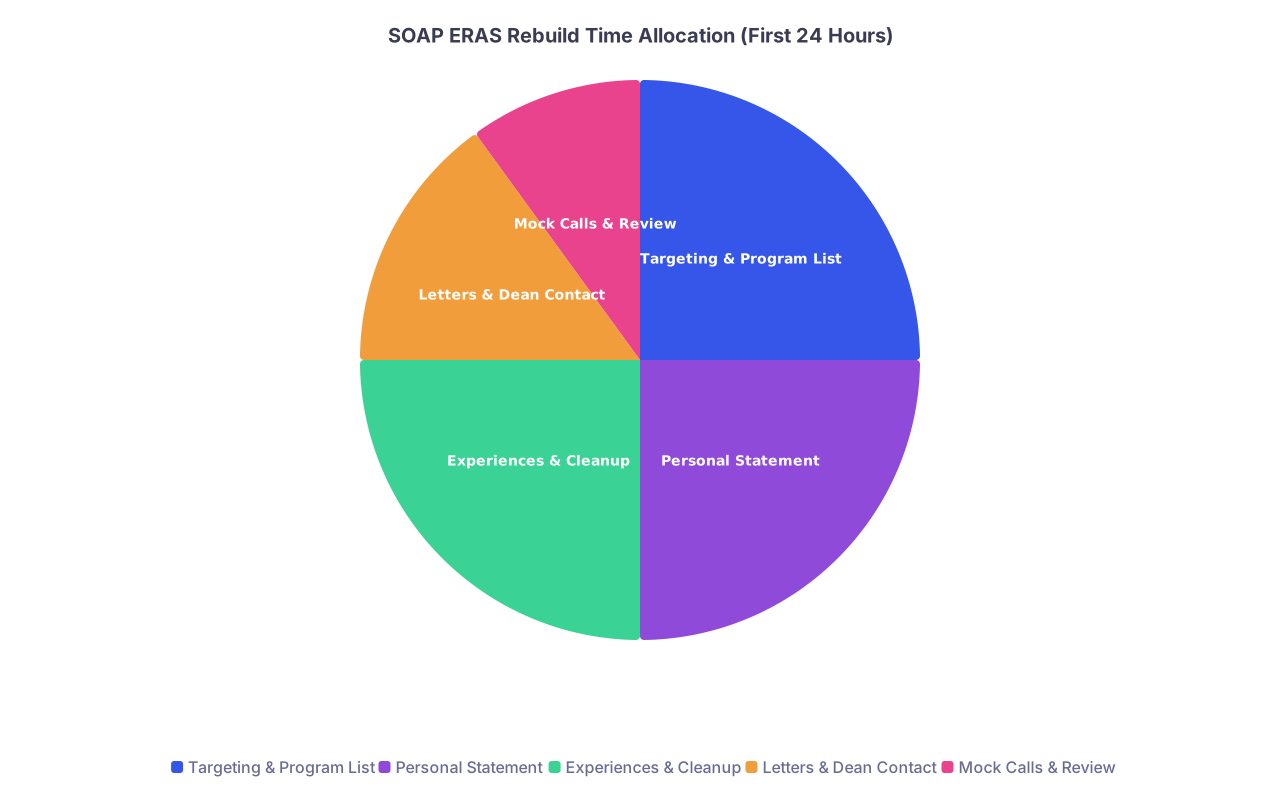
| Category | Value |
|---|---|
| Targeting & Program List | 25 |
| Personal Statement | 25 |
| Experiences & Cleanup | 25 |
| Letters & Dean Contact | 15 |
| Mock Calls & Review | 10 |
Hour 0–3: Targeting and reality check
- Meet (virtually or in person) with your Dean’s office / advisor if possible
- Decide:
- Primary SOAP specialty
- Backup specialty / TY / prelim options
- Geographic tiers
- Start sketching which programs you will target when the list opens
Hour 3–7: Personal statement rebuild
- Draft new primary specialty PS from scratch using the structure above
- Edit it once yourself
- If possible, get one trusted person to read it (friend, resident, advisor)
- Finalize and upload
Hour 7–12: Experience reordering and rewriting
- Reorder experiences so clinically strong and reliability-focused entries rise to the top
- Rewrite 5–7 key experiences to emphasize:
- Responsibility
- Clinical exposure
- Teamwork and communication
- Quick pass for typos and formatting
Hour 12–16: Letters and school coordination
- Confirm which letters are currently uploaded
- Decide letter combinations per specialty (assign in ERAS)
- Email 1–2 attendings for possible rapid letters if your school says they can upload in time
- Confirm with your Dean any MSPE updates or guidance
Hour 16–20: Program list construction
- Once SOAP unfilled list is available:
- Filter by specialty and geography
- Cross-reference with your realistic profile (IMG status, Step scores, visa)
- Build a prioritized list of programs to apply to in each round
Hour 20–24: Mock calls + tightening
- Write your one-page “call script”
- Practice 1–2 mock phone interviews with a friend or mentor
- Final quick pass on:
- Personal statement
- Experience section
- Contact information in ERAS (triple-check phone and email)
10. Mental Reset: Stop Punishing Yourself, Start Playing the Game in Front of You
You are going to be angry. At yourself. At the system. At random classmates who matched with half your work.
You can process that later.
Right now, you need a clear head for about two days. That is it.
Some blunt truths I have seen over and over:
- Highly capable students fail to match for structural and timing reasons, not because they are incompetent.
- Plenty of mediocre applicants land spots in SOAP because they are pragmatic and fast, not perfect.
- Programs are not looking for perfection in SOAP. They are looking for safe, functional interns who will show up and learn.
Your job is to present yourself as exactly that:
- Grounded
- Honest
- Trainable
- Actually interested in the work they do
That is more valuable in SOAP than another “passion for research” paragraph.
11. Concrete Next Step (Do This Now)
Open your current ERAS personal statement.
Delete any sentence in the first paragraph that:
- Mentions your original competitive specialty by name, or
- Could not plausibly apply to your SOAP specialty target.
Then, write three new sentences that:
- Name the SOAP specialty you are now targeting
- Reference a real patient or rotation tied to that field
- State clearly what part of that daily work you actually like
Do that first. It will force your brain to accept the new reality and give you the spine for the rest of your rapid rebuild.
Then, move to your experiences and start pulling your most clinically grounded work to the top.
You do not have time to be perfect. You do have time to be clear, coherent, and convincing for the programs actually looking at you during SOAP.