
The belief that “Program Directors will hold SOAP against you forever” is exaggerated, lazy, and often just wrong.
Does SOAP come with baggage? Yes. Is it a permanent scarlet letter that secretly follows you throughout your career? No. Most of the horror stories you hear are built on half-truths, survivor bias, and people repeating what they were told as MS2s without ever talking to an actual PD.
Let’s strip this down to what actually happens, what’s on record, and what PDs really do with that information.
What SOAP Actually Signals (And What It Does Not)
SOAP isn’t a morality test. It’s a logistics mechanism.
It means one thing with 100% certainty:
On the third Monday in March, you did not have a categorical Match.
That’s it.
But people load that single data point with all sorts of assumptions:
- “You must be a terrible applicant.”
- “You must have big professionalism problems.”
- “You’ll be radioactive when you apply again or try to switch specialties.”
None of those are inherently true.
Here’s what SOAP may correlate with, depending on context:
- Applying too few programs or too competitively (classic: 10 derm programs with a 230 and no backup)
- Late Step 2 CK score (or poor score released too late to adjust strategy)
- Visa issues, couples match complexity, geographic constraints
- Late specialty change with weak home support
- Under-ranked, overconfident rank list
Sometimes it does flag true performance or professionalism issues, but those are usually independently obvious in the file: failed Step attempts, marginal clerkship comments, remediation notes, leaves of absence.
SOAP is rarely the first red flag. It’s the outcome of the whole pattern.
So when PDs see “prior SOAP participant” or simply piece it together from your trajectory?
They’re asking: was this a one-time systems/strategy failure, or was this a competency problem?
Very different questions from “Do I hate this person on principle?”
What PDs Actually See and Remember
There’s a myth that there’s some big red banner in ERAS that says “SOAP CANDIDATE – PROCEED WITH CAUTION.”
There isn’t.
ERAS does not tag you forever as “SOAP.” PDs infer it in a few ways:
- You did prelim-only or transitional year in a year that you were clearly trying to Match categorical.
- There’s a gap year that lines up uncomfortably well with a prior Match failure.
- You volunteered the information in your PS, CV, or interview (which you usually should—strategically).
The NRMP documents do record SOAP participation at the system level, but PDs are not logging into some secret “SOAP offenders” registry every time they read an application.
What PDs do remember is this: former SOAP residents who performed well vs. those who didn’t.
And here’s the uncomfortable truth for the doom-and-gloom crowd: a solid chunk of SOAPed residents do just fine. Many outgrow whatever issues led them there. Some are among the most grateful, hardworking residents in the class because they know how close they were to sitting at home unmatched.
So no, you are not branded in some national blacklist.
You’re just another applicant whose path sends a signal. PDs then interpret that signal in context.
The Data: What Actually Happens to SOAPers Long-Term
Everybody loves to make claims; almost nobody bothers to look at the reports.
NRMP and AAMC data over the past several cycles show some consistent patterns:
Unmatched rates are highest in the most competitive specialties and among US-IMGs and non-US-IMGs.
Translation: SOAP isn’t a personal moral failing; it’s often a market mismatch combined with applicant pool dynamics.A significant portion of previously unmatched applicants do match in subsequent cycles.
Many of those use a prelim year, transitional year, or research year as a bridge. Are they penalized forever? No. They get into programs that looked at those years as proof of function, not just proof of failure.Program directors care far more about performance in current training than about how you entered it.
NRMP’s Program Director Survey consistently shows the heavy hitters for ranking decisions:- Letters of recommendation from known faculty
- Performance in residency (for transfers) or MS3/MS4 (for first-time applicants)
- Step 2 CK score, prior Step failures
SOAP isn’t even a named variable. It’s baked into the story, not a separate metric.
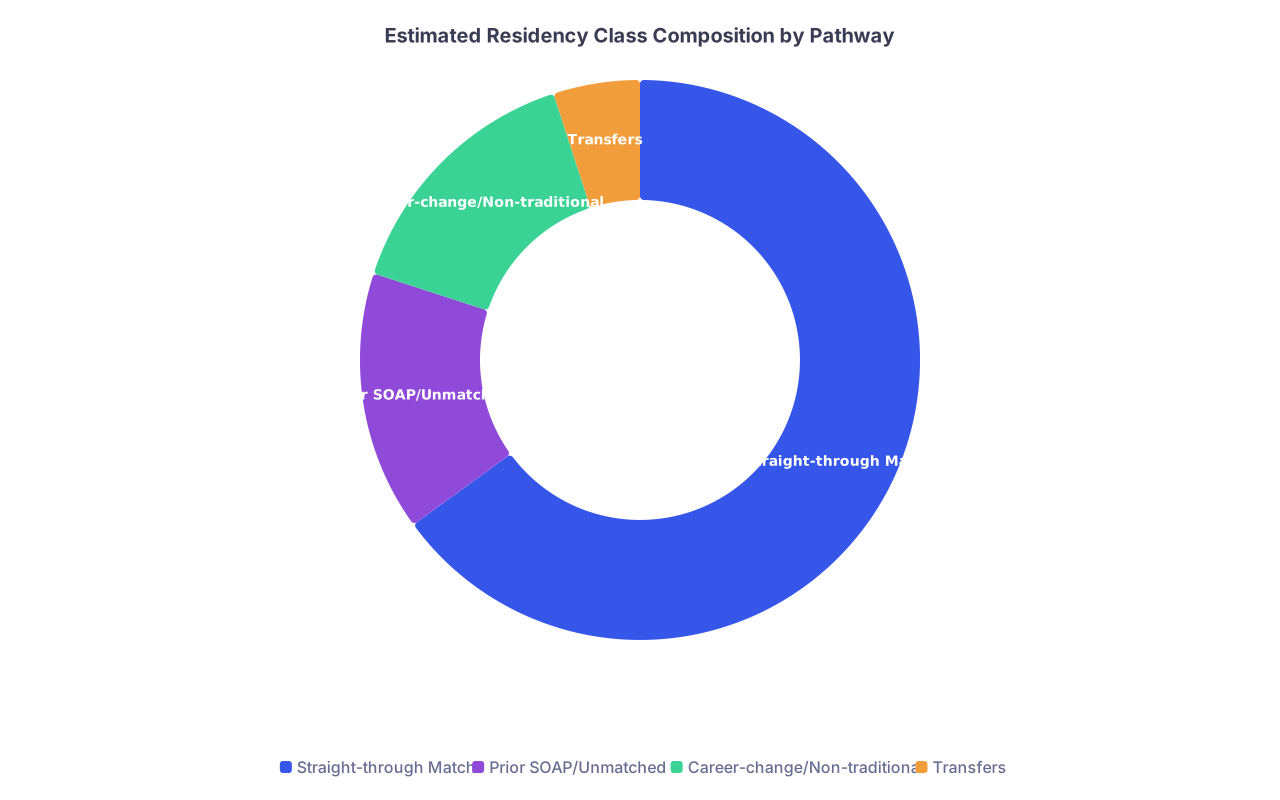
Let’s quantify one thing: how many residents in any given class have had some kind of “non-traditional” path? SOAP, prior unmatched cycle, prelim year, research gap, leave of absence, career change.
Way more than people admit.
| Category | Value |
|---|---|
| Straight-through Match | 65 |
| Prior SOAP/Unmatched | 15 |
| Career-change/Non-traditional | 15 |
| Transfers | 5 |
These aren’t exact national numbers, but they align with what many PDs will quietly tell you: 20–30% of a class is “non-linear” in some way. SOAP is just one variant.
If SOAP was career death, that band wouldn’t exist. Yet it very obviously does.
When SOAP Does Hurt You Later
Now for the part people tend to experience first-hand and then overgeneralize.
There are absolutely situations where SOAP creates a real, lasting handicap. Not because of stigma, but because of what SOAP represented in that specific case.
Here are the main scenarios where PDs genuinely hold it against you:
Unexplained, repeated failure.
If you SOAP once and clearly learn nothing—apply again with the same unrealistic strategy, same weak application, same vague story—PDs just see poor judgment. They don’t need “SOAP” as an extra reason.SOAP into a prelim you coast through.
If you’ve got midcycle evals that say “bare minimum effort, not dependable,” and faculty quietly warn the PD you’re not a good teammate? That’s what kills your prospects, not the SOAP entry. PDs talk. Bad reputations move faster than SOAP labels.You spin or hide the truth.
Trying to dodge direct questions about your prior Match, minimizing obvious red flags, or lying about whether you applied before—that’s the kiss of death. Honesty with insight is salvageable. Evasion is not.You used SOAP to jump into a field you clearly didn’t understand or care about.
SOAPing into FM, hating every second, trash-talking the specialty, then trying to reapply anesthesia? Yes, some PDs will hold that against you. Not because of SOAP. Because you burned a spot and disrespected the field.
So let’s be precise: SOAP itself is rarely the problem. SOAP plus denial, poor insight, or bad behavior absolutely is.
When SOAP Matters Less Than You Think
I’ve sat with PDs flipping through stacks of applications. Here are some actual quotes:
- “This guy SOAPed last year but look at these prelim letters. I don’t care that he SOAPed; I care that his current PD says he functions at a PGY-2 level already.”
- “She didn’t match EM the first time, but she killed it on her FM internship and her Step 2 CK climbed 15 points. I’ll take that trajectory.”
The common theme: trajectory and trust.
A few scenarios where SOAP mostly fades into the background:
You performed strongly in your SOAP position.
Rock-solid evals. Chief residents who say, “we’d keep her if we had a spot.” Step 2/3 passed cleanly. That combination is far stronger than the initial ding of not matching.Your specialty switch is logical and honest.
Example: you SOAPed into internal medicine after failing to match neurology, discovered you actually like complex medical management, and now you’re doubling down on IM with strong letters. PDs buy that.Your initial failure is clearly explained by strategy, not competence.
Classic: under-advised student from a newer school applies IR, DR, and no backup. Strong file, but plays the game poorly. PDs who read context and talk to mentors can distinguish.You’re an IMG with clear systemic obstacles.
Many PDs are realistic about visa issues, school reputation, funding constraints. If you SOAPed once and then secured a solid prelim spot and proved yourself, they recognize that the deck was stacked differently for you.
Here’s how PDs often mentally sort prior SOAPers:
| Category | PD Reaction |
|---|---|
| SOAP + poor performance + denial | Hard pass |
| SOAP + average performance + vague story | Low priority, maybe backup |
| SOAP + strong performance + clear insight | Serious consideration, context matters |
| SOAP due to pure overreach/strategy | Neutral once trajectory is good |
Notice what’s doing the real work there: performance and insight, not the word “SOAP.”
Should You Disclose SOAP in Future Applications?
Short answer: yes, but on your terms, with a narrative that shows growth.
The worst move is pretending it never happened and hoping they do not notice. Many will at least suspect it from your timeline. Once they suspect you’re hiding something, every other part of your application gets read with suspicion.
You want control? You explain it briefly and directly.
Something like:
- One to two sentences on what happened (facts, not drama).
- One to three sentences on what you did in the interim (prelim year, research, Step scores, self-reflection).
- One to three sentences on what changed in your approach and why you’re a stronger candidate now.
Not a confession. Not a pity party. A progress note on your own career.
PDs are not allergic to failure. They are allergic to people who cannot learn from it.
Switching Specialties After SOAP: Is That “Held Against You”?
This is where a lot of paranoia comes from.
Someone SOAPs into FM, then applies to anesthesiology. Or SOAPs into a prelim medicine year and later applies to neurology. Will PDs hold that first SOAP outcome against them?
Sometimes yes, sometimes no. It depends on:
- How your current PD and faculty describe you.
- Whether your story shows maturity or just chasing prestige.
- Whether your initial attempt seems like delusion or reasonable risk.
If your file looks like this:
- Failed to match in derm.
- SOAP into prelim medicine.
- Did excellent work, no drama.
- Realizes they actually like hospital-based medicine, not clinic.
- Applies IM or neuro with strong letters and no attitude…
Most PDs are not sitting there muttering, “But SOAP though.”
If, instead, it looks like:
- Failed to match plastics with a wildly unrealistic list.
- SOAP into general surgery.
- Underperforms, complains constantly, openly belittles gen surg.
- Now wants to bail to radiology or anesthesia “because lifestyle.”
Yes, some PDs will absolutely remember and will absolutely hold that against you. And they should.
Again: the issue isn’t SOAP. It’s judgment and professionalism.
The Bigger Truth: Everyone Overstates The Stigma
Why does the “SOAP stigma” myth persist so strongly?
A few reasons:
- People who did great after SOAP don’t broadcast it.
- People who got burned once love clean, simple villains—“SOAP ruined my career”—instead of analyzing their own decisions.
- MS3/MS4 rumor mills thrive on fear because it keeps everyone clinging to traditional advice.
The reality is more boring and more hopeful:
- SOAP is a setback and a signal.
- It can absolutely be overcome with performance, transparency, and a coherent trajectory.
- It only becomes a permanent mark if you never address why you were there in the first place.
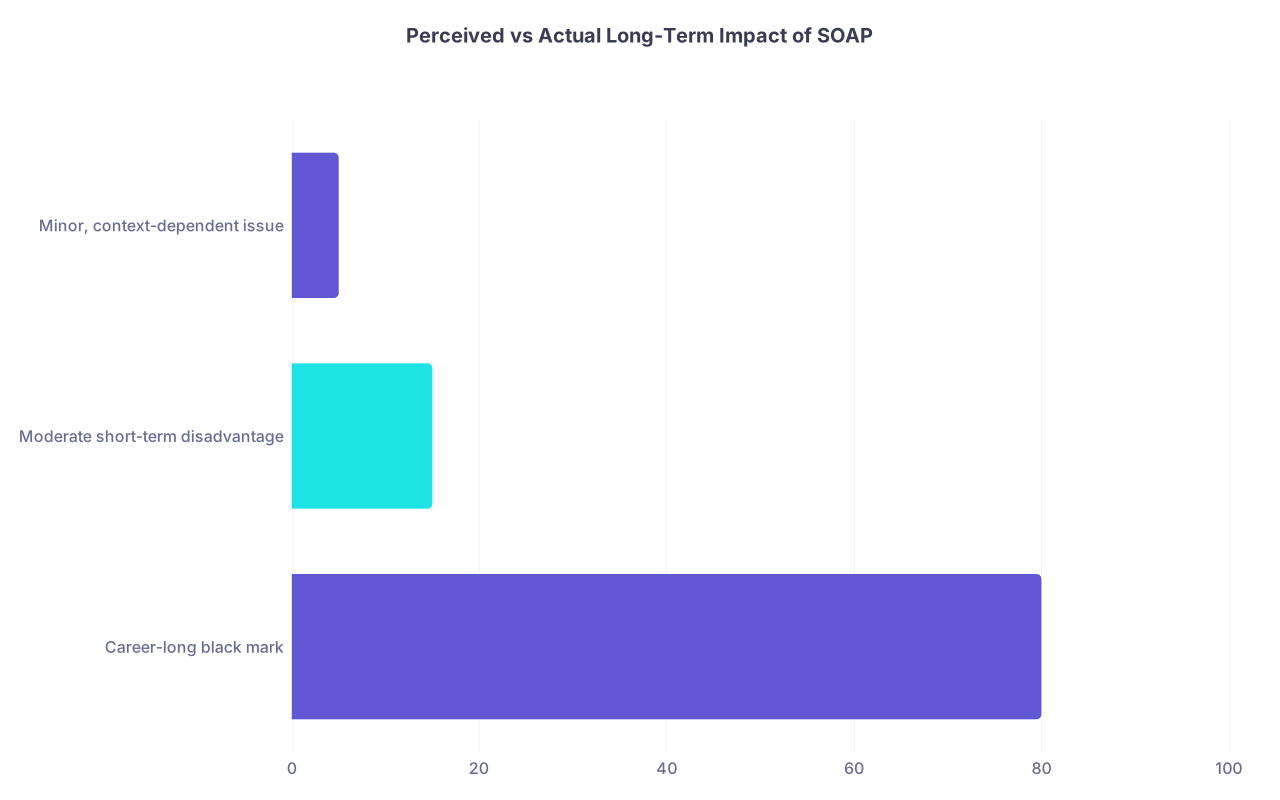
Here’s how your real “SOAP risk” compares with what people think you’re up against:
| Category | Value |
|---|---|
| Career-long black mark | 80 |
| Moderate short-term disadvantage | 15 |
| Minor, context-dependent issue | 5 |
The perceived impact is flipped from reality. In practice, for most who course-correct, SOAP becomes background noise within a few years.
If You’re Heading Toward SOAP Now: What Actually Matters
You cannot time-travel and undo this year’s Match. You can control what story you’ll be able to tell next year.
Focus on three things:
Where you land, not just that you land.
A prelim or SOAP spot with solid teaching, clear expectations, and PDs who will actually vouch for you matters far more than the program’s brand name. You are collecting future letters and a track record, not Instagram content.How you perform in the role you get.
Show up early. Read. Own your patients. Be the resident attendings trust. Everyone knows you landed there via SOAP. What they want to know is whether you belong there now.How clearly you can explain your path one year from now.
“I overreached, learned from it, worked hard, and here is objective evidence that I can function at the level you need” is a very defensible story. And it’s one PDs hear—and accept—every single cycle.
To put it bluntly: if you’re still obsessing about whether “PDs will hold SOAP against me” a year from now, instead of working on becoming undeniable where you are, you’re focusing on the wrong variable.
A Quick Reality Check on Timelines
Here’s how this usually plays out for someone who SOAPs then succeeds:

| Step | Description |
|---|---|
| Step 1 | SOAP year |
| Step 2 | Secure prelim or categorical spot |
| Step 3 | Strong clinical performance |
| Step 4 | Supportive PD and strong letters |
| Step 5 | Reapply or transfer strategically |
| Step 6 | Match into target or related specialty |
| Step 7 | SOAP becomes footnote |
Notice what’s missing?
Any step called “Beg PDs not to hate SOAP.”
Because that’s not the game being played.
The Bottom Line
Three key truths, no sugar-coating:
- SOAP itself is not a permanent career stain; what you do after SOAP is what PDs actually judge.
- PDs do not sit around blackballing “SOAPers”—they filter for performance, honesty, and judgment, not just past outcomes.
- If you treat SOAP as a data point, not a death sentence, and build a clear, upward trajectory from it, the stigma shrinks faster than you think.