
The biggest lie about SOAP is that it’s “a second chance.” It isn’t. It’s controlled risk management, and programs are obsessively asking one question: Is this person safe to rank?
Let me tell you what that actually means behind closed doors.
Program directors and selection committees are not hunting for the “best” applicant in SOAP. They’re hunting for the least likely to implode. To quit. To fail exams. To melt down on nights. To end up in the PD’s office every week as a problem.
You walk into SOAP thinking, “How do I sell my strengths?” They’re sitting in their offices thinking, “How do I avoid a disaster?”
If you don’t understand that shift, your SOAP strategy will be completely wrong.
What “Safe to Rank” Really Means in SOAP
When I’ve watched PDs review SOAP lists, the conversation changes tone compared with regular Match. During main recruitment, they talk about “potential,” “fit,” “research,” “leadership.” During SOAP, the language shifts:
- “Are they going to pass Step 3?”
- “Are they going to show up?”
- “Any professionalism flags?”
- “Do I trust this applicant not to blow up my life?”
“Safe to rank” in SOAP usually boils down to four questions:
- Will this resident show up, work hard, and not vanish?
- Will this resident pass required exams on time?
- Is this resident emotionally stable enough to function under pressure?
- Is there any hidden landmine (disciplinary action, lawsuit, pattern of chaos)?
If you look dangerous on any of those fronts, you’re done. It doesn’t matter how great your letters are.
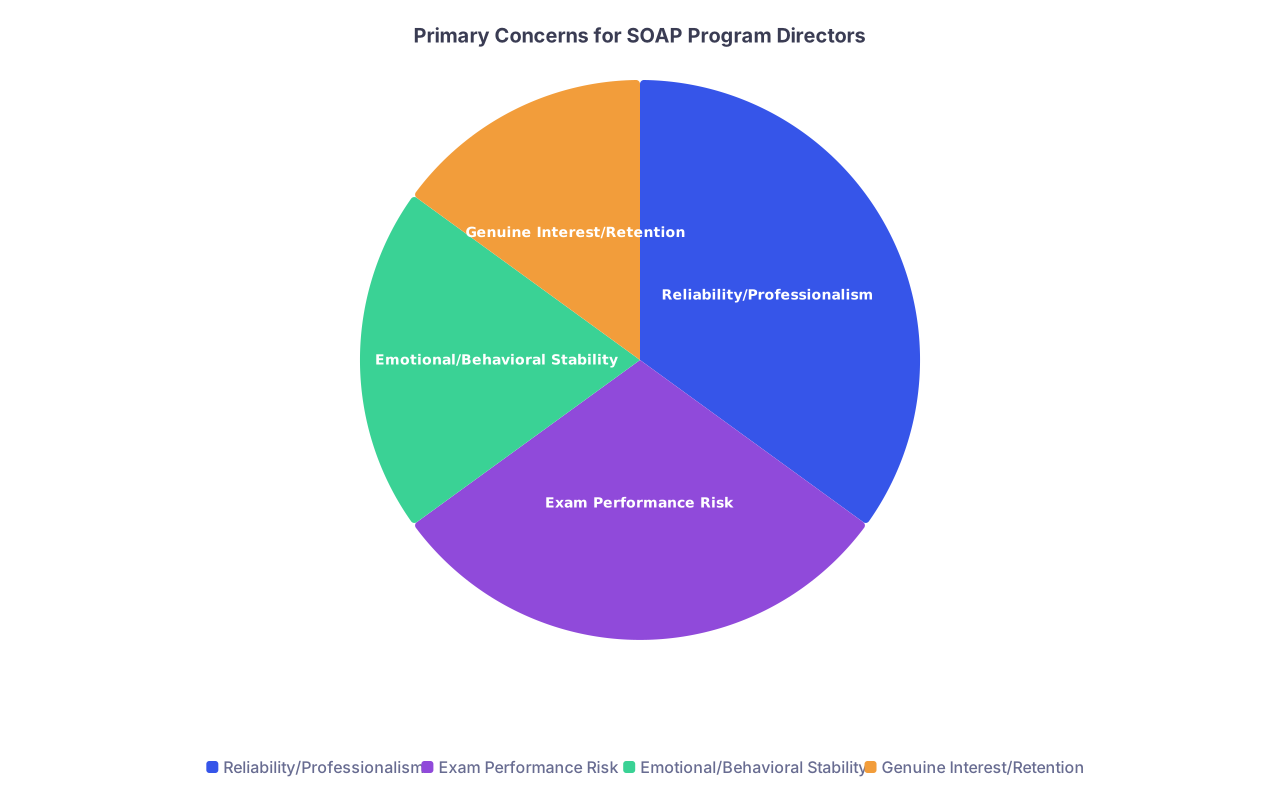
| Category | Value |
|---|---|
| Reliability/Professionalism | 35 |
| Exam Performance Risk | 30 |
| Emotional/Behavioral Stability | 20 |
| Genuine Interest/Retention | 15 |
Notice what’s missing from that list: research output, shelf scores, class rank, publications. Those are nice-to-have bonuses in SOAP. They’re not what makes you “safe to rank.”
The Unspoken Filters: How Programs Quietly Sort SOAP Applicants
Nobody will ever publish this, but here’s what actually happens in SOAP week in a lot of programs.
The “trash pile” happens fast
On Monday/Tuesday of SOAP, you’ve got a tired PD, maybe an APD, a coordinator, sometimes a chief resident. Hundreds of applications flood in within hours.
I’ve watched this in real time:
Laptop open. Filters on. Rapid scanning. Within the first 60–90 minutes, half to two-thirds of applicants are essentially dead on arrival.
- Unexplained gaps in training or education
- USMLE/COMLEX failures without a clear narrative and progression
- Multiple short stints at different programs (smells like “problem resident”)
- Disciplinary issues vaguely referenced with no real explanation
- Personal statements that sound generic, copy-pasted, or clearly mass-sent
- Application suggesting they actually want a different specialty
You know that line PDs love? “We’re looking at the whole applicant.” During SOAP, the “whole applicant” time window is about 30 seconds on first pass.
If you make that first cut, then they start asking: “Safe or risky?”
The Core Dimensions of “Safe” in SOAP
There are a few patterns PDs consistently look for when they decide you’re safe to rank in SOAP. These are rarely written down, but they come up in every committee room.
1. Stability: No Drama, No Chaos
This is number one. Programs have been burned before by residents who implode mid-year. It only takes one nightmare story to hard-wire a PD’s brain.
You look “stable” when:
- Your education/professional path is relatively linear
- Any interruptions (LOA, repeat year, illness) are clearly explained and resolved
- You have people vouching for your reliability in strong, concrete terms
- You’ve stuck with things: same med school, same job over time, consistent activities
You look unstable when:
- You’ve moved programs, schools, or jobs constantly without clear reasons
- Your personal statement and ERAS entries scream “chaotic energy”
- Your narrative is vague: “personal reasons,” “family issues,” “health issues” with no clarity
- Your references are oddly generic or faint praise
I’ve seen PDs literally say, “I don’t want to be the next line on this person’s CV.”
If your path has bumps, you must preemptively control the narrative. A clean, concise explanation that ends with: “Problem solved. Performance strong since then.” That’s the signal of safety.
2. Exams: No Future Headaches
Programs loathe remediation paperwork. Nothing makes them more anxious than a resident likely to fail Step 3 or in-training exams.
You look safe on exams if:
- You passed Step 2/COMLEX Level 2 on first try, even if scores are average
- You’ve had a failure, but subsequent scores show a clear upward trend
- You can calmly and specifically explain what changed in your study habits
You look risky if:
- Multiple exam failures, especially Step 2 or Level 2
- No Step 2 score yet, plus a marginal Step 1/pass
- Long unexplained delay taking Step 2 or Step 3
- You get defensive or vague when asked about exam performance
The best SOAP candidates with exam blemishes say something like:
“I failed Step 1. I was disorganized, thought I could wing it. I changed to a structured study schedule, did X question banks, worked with Y mentor, and scored Z on Step 2. Since then I’ve passed every standardized exam on the first attempt.”
That’s what a PD hears as: problem identified, corrected, unlikely to recur. Safe.
The Personal Statement and Emails: What You Don’t Realize They’re Reading For
Your SOAP personal statement is not about selling your dream. It’s about lowering perceived risk.
Most of the “generic” SOAP statements I see are garbage from a PD’s standpoint. Way too aspirational. Not enough reassurance.
Here’s what PDs are scanning for subconsciously:
- Do you sound grounded or grandiose?
- Do you show commitment to their field, not just to “getting any spot”?
- Do you acknowledge past problems with insight and humility, if applicable?
- Do you convey that you’re ready to work, not ready to be “rescued”?
If your statement reads like a pity party or a redemption movie pitch, you’re in trouble. The more you beg, the more desperate you sound, the more they worry about hidden issues.
Same thing with your outreach emails. Programs don’t have time for long narratives. But they do read quick signals.
What helps:
- Brief, targeted messages that prove you understand their program
- A sentence or two explicitly addressing why you’re ready to be a reliable PGY-1 or PGY-2 now
- A clear statement of commitment to the specialty (or to primary care if FM/IM)
What hurts:
- Mass emails with obvious copy-paste
- Overly emotional, “this is my last chance” tone
- Arguing about why the Match was unfair to you
Interview Behavior: How Committees Decide in 10 Minutes If You’re Safe
SOAP interviews are shorter, more rushed, more utilitarian. But PDs and chiefs are hyper-attuned during them. They’re not interviewing for sparkle; they’re screening for landmines.
There are five things that absolutely matter in that 15–20 minute SOAP interview.
1. Emotional Reliability
They’re watching: Are you steady? Can you talk about disappointment and failure without unraveling?
What feels safe:
- You acknowledge the setback without dramatics
- You don’t blame everyone else
- You can clearly articulate what you learned and how you changed
- Your affect is even, not numb and not wildly intense
What raises red flags:
- Tears that you can’t quickly regain control from
- Rambling, unfocused answers
- Obvious bitterness about your med school, prior programs, or the Match
- Over-sharing personal trauma without boundaries
I’ve been in meetings where a PD says, “I’m not sure they’d hold up on night float,” and that’s it. You’re off the rank list.
2. Professionalism Reflexes
SOAP is where PDs test your default operating mode.
They notice:
- Did you show up on time for a same-day Zoom invite?
- Is your background chaotic—people walking through, noise, clutter?
- Are you dressed like someone starting a professional job next week?
- Do you answer questions directly or dodge and ramble?
They assume this: however you behave under SOAP pressure is how you’ll behave on service. If you’re scattered when desperate, that’s a bad sign.
3. Coachability and Insight
One of the easiest ways to be “safe” is to come off as coachable.
Safe signals:
- “I realized I needed structure and mentoring, so I did X, Y, Z.”
- “My faculty said I tend to over-explain, so I’ve been working on concise clinical communication.”
- “In feedback I heard __ and here’s how I changed my approach.”
Unsafe signals:
- “I didn’t get much feedback.”
- “I don’t really know why I failed that exam.”
- “My school/program didn’t support me.” (Even if true, it sounds like blame.)
PDs want someone they can fix if needed—not someone who doesn’t recognize problems.
The Quiet Preference for “Known Quantities”
Here’s a brutal SOAP truth that applicants never get told: programs strongly prefer people they’ve already seen, or who are attached to an institution they trust.
There’s a clear hierarchy.
| Rank | Applicant Type |
|---|---|
| 1 | Former rotator / student at program |
| 2 | Home institution student |
| 3 | Same-state / same-system applicant |
| 4 | Applicant with strong internal referral |
| 5 | Totally unknown external applicant |
Why? Because familiarity lowers perceived risk.
If they’ve seen you on service and you were normal, not a problem, showed up on time, didn’t freak out on call—that’s gold in SOAP. You may not have been top of the list for regular Match, but in SOAP you’re suddenly extremely attractive.
You cannot change this hierarchy during SOAP week. But you can play to it:
- Lean on anyone at the institution you know (residents, faculty, alumni) to quietly vouch for you
- Mention any prior rotations, collaborations, or regional ties succinctly in your communications
- Emphasize you’re likely to stay, not transfer, if they pick you up
Red Flags That Quietly Kill You in SOAP
Let me spell this out clearly. There are certain patterns that make a PD’s hair stand on end in SOAP, even if they’d hesitate to say it out loud.
These are the big ones:
- Multiple prior residencies without a crystal-clear, documented reason and strong support letters
- Unexplained gaps in medical training or employment
- Any sniff of professionalism concerns: no-shows, dishonesty, combative behavior
- A personal statement that fixates on your own suffering more than your readiness to work
- Non-committal talk about the specialty, especially for primary care fields
You might think, “But SOAP is for people with issues, right?” Yes. But PDs still stratify risk—someone with “one controlled problem” looks better than “a pattern of chaos.”
If you have a prior termination from residency, or a serious professionalism event, you are not automatically dead. But your explanation has to be extremely tight, consistent across your application, and backed by at least one person in authority who will say, “They learned. I’d take them now.”
How to Make Yourself Look “Safe” Even If You’re Not Perfect
No one in SOAP is perfect. PDs know that. They’re not hunting for spotless. They’re hunting for predictable.
Here’s the honest playbook.
1. Own your story cleanly and concisely
Two or three sentences. No rambling.
“I failed Step 1 because I underestimated the exam and tried to balance too many outside responsibilities. I restructured my schedule, sought guidance, and scored X on Step 2. I’ve passed every clinical exam and in-service since using this system.”
That reads as mature. Finished. Solved.
2. Shift from “I need” to “I can”
Too many SOAP applicants talk like supplicants.
Bad: “I just need a chance. I need support. I need a program that will believe in me.”
Better: “I can bring consistent work ethic, reliability, and a commitment to improving every month. I’ve shown that in [concrete example].”
They want someone who contributes, not someone they have to rescue.
3. Emphasize continuity and commitment
If you’re applying to FM, IM, Psych, Peds—anything primary care—make it clear you’re not treating their specialty as your consolation prize.
Make it obvious you’re not going to bail and re-apply to Derm next year.
Specific is safer:
“I’ve oriented my electives, projects, and mentors around internal medicine. My long-term plan is to practice as a hospitalist in this region.”
That line alone can move you from “flight risk” to “safe to rank.”
SOAP vs Main Match: What Changes in What They Care About
The value system shifts during SOAP, and if you don’t adapt, you get left out.
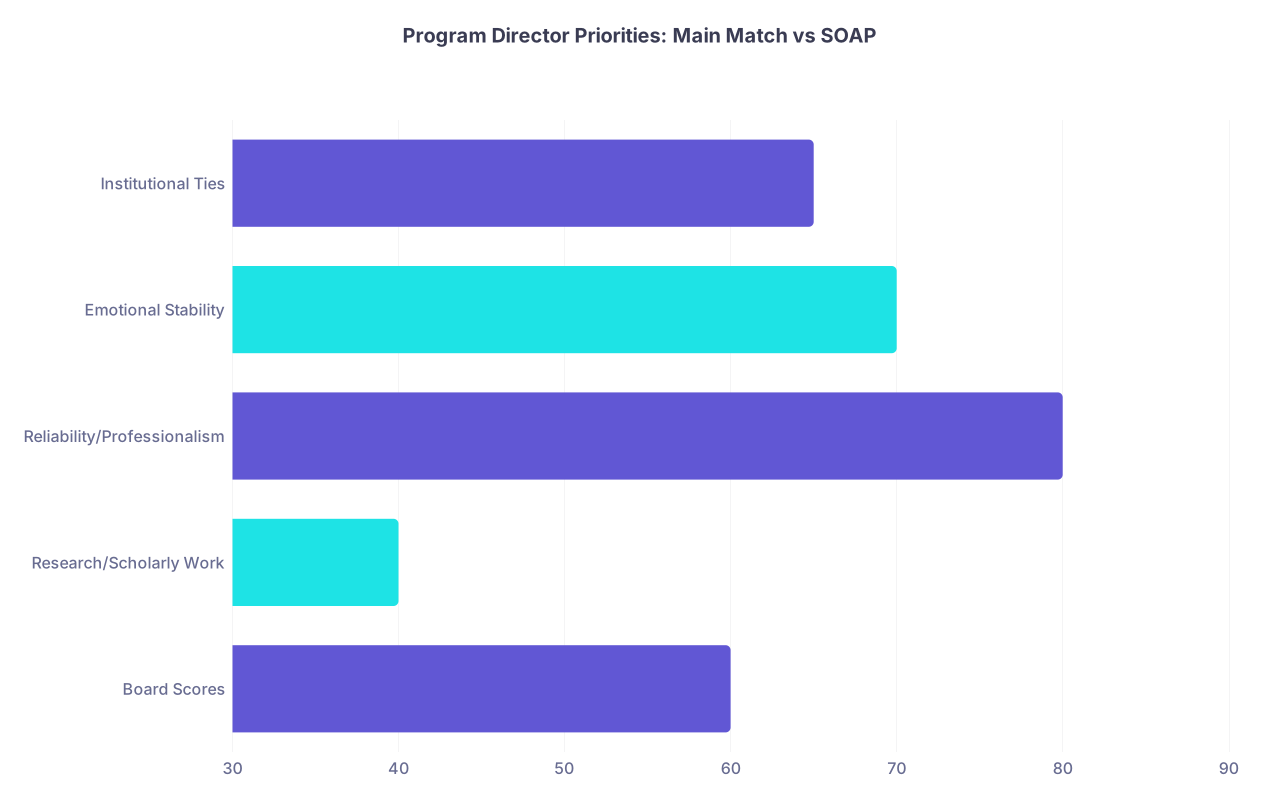
| Category | Value |
|---|---|
| Board Scores | 60 |
| Research/Scholarly Work | 40 |
| Reliability/Professionalism | 80 |
| Emotional Stability | 70 |
| Institutional Ties | 65 |
Let me decode that.
During the main Match, PDs obsess a bit more over numbers and CV sparkle. In SOAP, none of that matters if you look like a potential time bomb.
A calm, average-scoring, solidly reliable applicant with a straightforward life story will outrank a brilliant, high-scoring, but erratic-sounding one in SOAP almost every single time.
Putting It All Together During SOAP Week
You don’t have infinite moves. SOAP is compressed, chaotic, relentless. But there are a few practical levers that directly affect whether you look “safe to rank.”
Tighten your narrative everywhere
Your ERAS entries, personal statement, and interview answers should all tell the same short story:
- Here’s the bump I hit (if any)
- Here’s exactly what I changed
- Here’s the pattern of stability since
- Here’s why I’m a good fit and likely to stay and succeed here
If those four pieces are clear, you’re already ahead of half the pool.
Show up like a resident, not a desperate applicant
During SOAP:
- Answer emails quickly and professionally
- Be over-prepared for any interview: read their website that morning
- Keep your tech, background, dress, and schedule locked down
You’re auditioning for “Can I trust this person to be here at 5:45 AM post-call and still function?”
Use people, not just paper
If you have any human connection to places you’re applying—resident from your med school there, prior attending, a faculty friend of a friend—this is the time to reach out and ask for a quiet vouch.
I’ve seen PDs move someone from “maybe” to “rank” after one trusted text from a colleague: “I know this student. Solid. Will work hard. No drama.”
A Simple Mental Model for SOAP
Think of it this way: in SOAP, programs are not picking future stars. They’re picking colleagues they can survive next year with.
If you can make every part of your application quietly communicate:
- I show up.
- I pass my exams.
- I do the work without drama.
- I know who I am and where I fit.
Then you’re not flashy. You’re not spectacular. You’re something far more valuable in SOAP.
You’re safe to rank.