
You are here
It’s the second week of March. You’re refreshing your email like it owes you money. You had 2 interviews. Maybe 1. The NRMP email pops up: “We are sorry to inform you…” and you already know what it says before you click.
You did not match.
Your dean says, “We’ll navigate SOAP.” Your classmates say, “You’ll be fine—everyone finds something in SOAP.” And you’re sitting there thinking: If I only got 1–2 interviews the first time, what are program directors actually saying about me right now? What’s happening in those rooms I’m not in?
Let me tell you what really happens behind those doors.
Because I’ve sat in those meetings. I’ve heard the actual phrases:
“Only one interview? Why?”
“Is this someone we’re rescuing, or did the market already tell us something?”
“Good applicant, but why did no one else want them?”
You need to understand that conversation. Once you see how they think, you can stop guessing and start playing the game with your eyes open—especially in SOAP.
How PDs really interpret 1–2 interviews
Here’s the part nobody tells you: program directors absolutely look at your interview count as a “market signal.”
They are not supposed to. But they do.
On ERAS, when we open your application in SOAP (or in the main season, for that matter), we see your past interviews in your personal statement, in your email trails, in your timeline, and in what your dean hints at. We also infer it from your application profile. And people talk. PDs email each other. Coordinators gossip. “Did you see this person? Did you interview them?” That informal intelligence colors how 1–2 interview applicants are perceived.
Roughly, there are three mental buckets we put low-interview applicants into:
Under-recognized / under-applied applicant
Good on paper, but something about geography, strategy, or late Step 2 made them invisible.High-risk / high-noise applicant
Something in the file screams “problem”: failed exam, professionalism flag, SOAP last year, big gap, non-standard pathway.Reality-checked applicant
Borderline stats, average letters, generic PS, no hooks. The market basically decided they’re “fine but not compelling.”
No PD will say it that bluntly on a recorded webinar. But behind closed doors, that’s exactly how the conversation goes.
Inside the PD room: the actual thought process
Let’s walk through a real SOAP-style meeting. Picture it: Monday of SOAP week. Applications just dropped. Program director, associate PD, chief resident, maybe a coordinator sitting with coffee that’s already gone cold.
We pull up a list of 300+ applicants for 3–5 unfilled positions. Somebody says, “We need to move fast.”
We start scanning. When your name comes up and it’s obvious you only had 1–2 interviews, the questions are instinctive:
- “Why so few?”
- “Is this a late bloomer or a damaged file?”
- “Is there a geography reason? A visa issue? Red flag?”
Then the file review starts.
The “story” check
PDs look for whether your low interview count actually makes sense.
If your Step 2 is 203, you’re from a newer DO school, and you applied to Derm—your 1 interview makes perfect sense. That’s “market reality,” not a mystery. That doesn’t kill you in SOAP because at least the story is coherent.
If you’re sitting at 240+ Step 2, solid US MD, some research, and still only got 1 or 2 invitations? People in that room start digging. Hard.
Typical lines you’d hear:
- “What am I missing?”
- “Was there a late score release?”
- “Any gaps or failures?”
- “What did the MSPE say?”
Because when your application looks better than your interview count, we assume there’s either:
- Some hidden red flag that other programs spotted.
- Or a strategic disaster in how you applied.
I’ve seen PDs call friends in other programs: “Hey, did you guys interview [Name, AAMC ID]? Anything I should know?” Those calls happen more than you think—especially when we’re trying to avoid bringing in a time bomb during SOAP.
The red-flag sweep
If you have only 1–2 interviews, every tiny negative thing suddenly weighs heavier:
- A single exam failure suddenly feels like a trend.
- One lukewarm phrase in a letter (“did everything that was asked of them”) sounds damning.
- A gap year with “personal reasons” becomes suspect.
- A vague professionalism comment in the MSPE jumps to the top of the conversation.
Inside voice of the room:
“Okay, this is why nobody picked them up.”
or
“This might be why they didn’t get more interviews.”
It’s not fair, but when we’re speed-sorting 300 SOAP applications, short interview history + soft spots in your file = quick downgrade.
The program risk calculation
Here’s the brutal truth: In SOAP, PDs are not just asking “Is this a good future colleague?” They’re also asking:
“Can this person quietly function on nights in July without blowing up the residency?”
Low-interview applicants are seen—rightly or wrongly—as a higher-risk group. That doesn’t mean “bad doctor.” It means: maybe less vetted, less market-validated. PDs overcompensate by scrutinizing you harder.
The conversation in the room looks like:
- “We are desperate, but we’re not suicidal.”
- “I’d rather run short than take someone with obvious professionalism issues.”
- “If we can’t trust them at the front desk at 3 a.m., it’s not worth it.”
So if your file shows any sign you might need a lot of extra support, your 1–2 interviews become another argument against you.
How they sort you in SOAP when you only had 1–2 interviews
SOAP is fast, chaotic, and more algorithmic than anyone admits.
Let me walk you through a very realistic flow for how low-interview applicants get handled.

| Step | Description |
|---|---|
| Step 1 | SOAP Applications Drop |
| Step 2 | Initial Score Filter |
| Step 3 | Auto Screen Out |
| Step 4 | Red Flag Scan |
| Step 5 | Deprioritize List |
| Step 6 | Interview History Check |
| Step 7 | Deeper File Review |
| Step 8 | Standard Priority |
| Step 9 | Selective Call or High Rank |
| Step 10 | Meets Minimums |
| Step 11 | Red Flags Present |
| Step 12 | 1-2 Interviews Only |
| Step 13 | Coherent Story and Strong Fit |
Step 1: Hard filters first
Before anyone looks at your “story,” there are crude filters:
- Step 2 threshold (you fail this, you’re out)
- Visa status (some programs simply cannot sponsor)
- Prior SOAP / prior non-match (some automatically deprioritize repeat unmatched)
If you have 1–2 interviews and you’re already barely squeaking past these minimums, you’re usually in the “maybe later” pile. Which often means never.
Step 2: Interview count as a tiebreaker
When we’re staring at 40 almost-identical applicants for 2 SOAP interview spots, interview history becomes a tiebreaker.
The unconscious (sometimes very conscious) logic:
- “This person had 10 interviews and didn’t match. That worries me.”
- “This one had 1 interview. Maybe they just under-applied, might be a hidden gem?”
Yes, ironically, having too many interviews and still not matching rings its own alarm bells. PDs wonder, “What happened in those interviews?”
So your 1–2 interviews aren’t automatically fatal. They just force the PD to make a decision: hidden gem vs. already-screened-out risk. That decision hangs on how clean and coherent your file looks.
The three main “narratives” PDs write about you
Behind closed doors, PDs are always trying to compress your chaos into a one-line narrative they can remember and defend at the committee table.
For low-interview applicants, I keep seeing the same three storylines.
1. The overlooked local workhorse
This is the only category where 1–2 interviews can secretly help you.
Typical scenario:
- You’re from a lower-ranked or newer med school.
- You applied mostly in one region.
- You rotated at a mid-tier community or university-affiliated program.
- They liked you, but they only had 1–2 spots and prioritized their own school’s students. You didn’t interview widely elsewhere.
When you pop up in SOAP for a nearby similar program, the conversation can sound like:
- “Stats are fine, nothing flashy, but solid.”
- “Probably under-applied or got squeezed by geography.”
- “We need someone who will show up and work; this is exactly that.”
These applicants get framed as: “Under-recognized, could have matched with a slightly wider net.” They can jump high on the SOAP list if the PD trusts their school and letters.
2. The avoid-for-a-reason candidate
This one stings, but you need to hear it.
If you had 1–2 interviews and any of the following…
- Failed Step 1 and repeated a course
- Professionalism notation in MSPE
- Very vague dean’s letter with careful wording
- Old graduate (5+ years since graduation, especially for IMGs)
- Prior non-match or prior SOAP
…PDs will very often assume the rest of the market already did the vetting for them.
You get comments like:
- “There’s a reason they only had one interview.”
- “Probably not worth the risk given what else we have.”
You’re not automatically out. But you’re no longer being evaluated from scratch. You’re fighting the accumulated judgment of an entire application cycle.
3. The mismatch / mis-strategy applicant
These are the ones who aimed too high, too narrowly, or too strangely.
Think:
- Applied categorical surgery with mid-220s, no research, no home program.
- Geographic demands like: “Only West Coast, only big cities, only academic centers.”
- Applied super late, Step 2 came in October, half the interview season gone.
In SOAP, the narrative becomes:
- “They’re actually fine for FM/IM/Peds, but the original application strategy was insane.”
- “Probably would’ve matched if they’d been realistic earlier.”
For these applicants, PDs will consciously “re-slot” them into a more realistic specialty. If you’re now applying in SOAP to a less competitive field, your 1–2 original interviews get partially forgiven, because they were in the wrong battlefield to begin with.
What PDs actually say in rank meetings about you
Let me give you a sample of the exact phrases I’ve heard in rank or SOAP meetings about applicants with 1–2 interviews.
On the positive side:
- “Only had two interviews, but their Step 2 was late. I think the timing killed them, not the quality.”
- “This is a solid DO from a school we trust; they just applied too regionally.”
- “Letters are strong, everyone calls them a hard worker. I don’t care that they only got one interview—this is someone who’ll show up.”
On the negative side:
- “The whole country looked at this file and said no. There’s our answer.”
- “Multiple attempts on exams and only one interview? We’re asking for trouble.”
- “If they couldn’t land more interviews with this board score, something went very wrong in person.”
And the neutral-skeptical:
- “I want to know why they only had one interview. If we can’t answer that, I’m not ranking them high.”
- “Fine on paper. Completely generic. No wonder they didn’t get more bites.”
The difference between the first group and the last two is whether there’s a plausible, non-scary explanation that everyone at the table can repeat in one sentence.
You want to give them that sentence.
How you can change that story in SOAP (even with 1–2 interviews)
You can’t rewrite the past season. But you can absolutely influence what PDs think when they see your name pop up in SOAP.
Clarify the “why so few interviews” before they decide for you
Your job is to preempt their suspicion with a clean, believable explanation. Not an excuse. A narrative.
Acceptable narratives PDs will buy:
- “Step 2 taken late; fewer programs considered complete at the time they were sending most interview offers.”
- “Applied very regionally due to family obligations; limited the number of programs I approached.”
- “Originally applied to a more competitive specialty, have refocused on [new specialty] with mentorship from [specific faculty].”
You do this through:
- A brief, tight SOAP-specific personal statement that explicitly addresses the shift.
- Your dean’s support letter or advisor call to the PD, if you can get it.
- Emails from mentors at programs you rotated at, vouching for you.
What does not work: vague nonsense like “due to unforeseen circumstances I had fewer interviews than expected.” PDs translate that as: “Hidden disaster.”
Clean up every single thing that looks like a red flag
With only 1–2 interviews, you do not have the luxury of “hoping they don’t notice.”
You need to show you understand and have moved beyond your weaknesses. That changes your risk profile.
If you failed an exam:
- Own it plainly in your PS: “I failed Step 1 in [year] due to [concise, non-dramatic reason]. Since then, I passed Step 2 on the first attempt with [score], and on rotations I’ve consistently performed at [honors/high pass].”
- Have a letter that explicitly speaks to your reliability and growth since then.
If you applied too competitively:
- Say it: “I initially applied to [specialty] based on limited early exposure. Through rotations and mentorship, I’ve realized my goals and strengths are better aligned with [new specialty]. My best performance evaluations have been in [related rotations].”
You are giving the PD a line they can use in the meeting:
“Yes, they only had 1–2 interviews, but they were in a different specialty. Look at their evaluations in this field.”
How PDs compare you to others in SOAP
You’re not being judged in a vacuum. You’re being weighed against other desperate people.
Here’s how you stack up against typical SOAP competitors from a PD’s vantage point:
| Applicant Type | How PDs Usually View Them |
|---|---|
| 1–2 interviews, coherent story, clean file | Under-recognized, safe to consider |
| 1–2 interviews + prior failures/red flags | High-risk, low priority |
| 8–12 interviews, no match | Interview/performance concern |
| Re-applicant, improved Step 2 and letters | Depends: can be redemption or chronic risk |
| Strong IMG with solid scores, no US interviews | Systems/geography barrier, not necessarily bad |
Sometimes your 1–2 interviews actually look better than the 8–12-interview applicant who somehow didn’t match. We’ve all met that resident who “interviews great” on paper but blows up once they start. PDs are wary of that.
The low-interview applicant with a tight, honest narrative often feels safer than the shiny talker with mysterious non-matches everywhere.
What PDs remember after all the files blur together
By late SOAP week, most PDs are exhausted, slightly cynical, and only remember a handful of applicants distinctly.
Here’s what sticks in their heads when you only had 1–2 interviews:
Did your story make sense?
If a PD can explain you in 15 seconds without sounding crazy—“Late Step 2, under-applied, strong worker”—you have a shot.Did anyone credible vouch for you?
A trusted faculty phone call, a known program letter, or a dean they respect can override the “only 1–2 interviews” skepticism instantly.Do you feel safe at 3 a.m. on call?
If there’s any lingering worry about reliability, professionalism, or needing too much hand-holding, you drop.
That’s what “behind closed doors” really means. Not mysterious algorithms. Just tired humans trying to reduce risk while filling shifts.
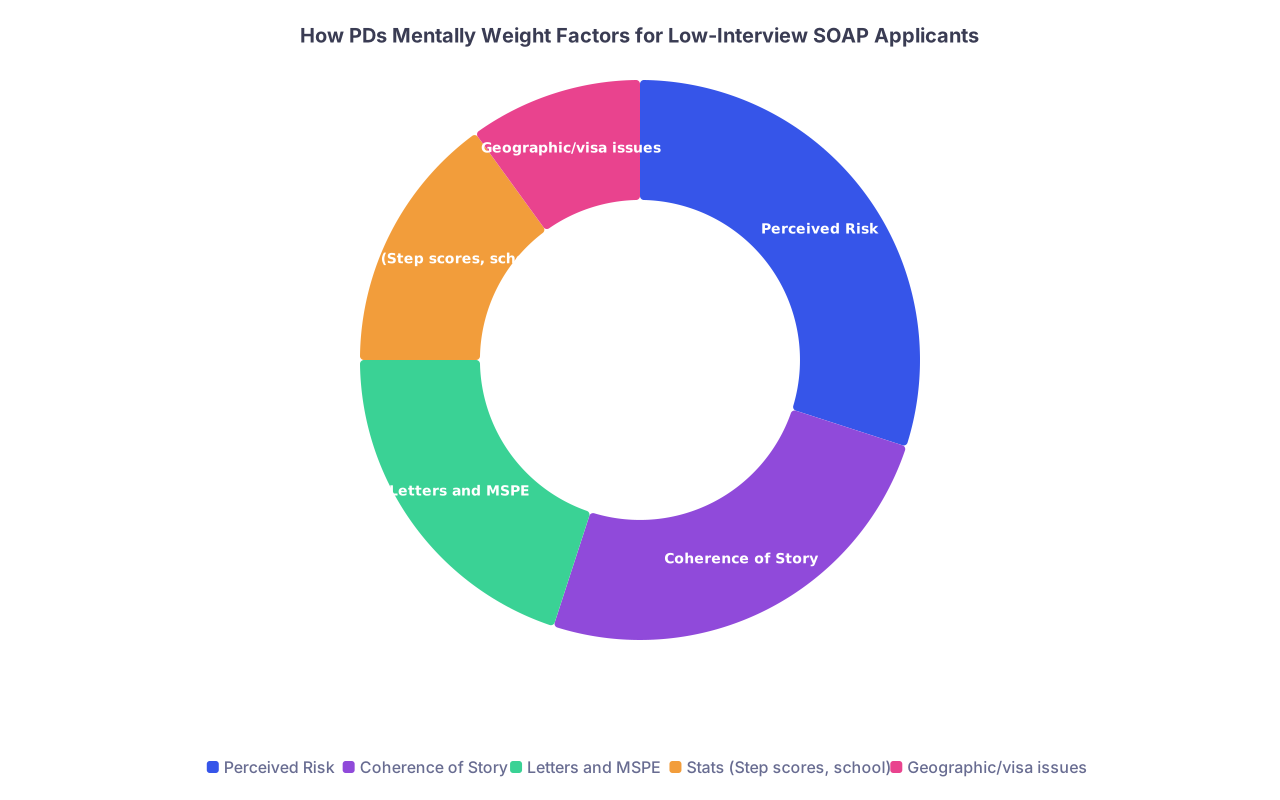
| Category | Value |
|---|---|
| Perceived Risk | 30 |
| Coherence of Story | 25 |
| Letters and MSPE | 20 |
| Stats (Step scores, school) | 15 |
| Geographic/visa issues | 10 |
If you’re reading this before you SOAP
If you still have time before SOAP, use it to sharpen your narrative and line up advocates.
Two moves matter most:
Get one person with actual weight to call or email for you.
Not a random attending from a two-week elective. Someone who either runs a service, is known in the region, or is directly in your target specialty.Rewrite your personal statement as a targeted explanation, not a life story.
Two-thirds of it should quietly answer: “Why only 1–2 interviews and why now this specialty?” without sounding defensive or melodramatic.
You are not trying to impress. You’re trying to disarm suspicion.

If you already went through SOAP and still didn’t match
Then the conversation about you in next year’s cycle will be even harsher unless you change the terms.
Inside the PD room, you’re now:
- “Did not match twice.”
- “Is this a chronic problem or a fixable one?”
You will need:
- A year of structured clinical work (prelim spot, research with heavy clinical involvement, or a well-documented gap-year plan)
- Clear improvement: better Step 2 CK if not taken, stronger letters, more specialty-specific experience
- A totally different and more realistic target list
But that’s another essay.

The quiet truth you weren’t told
Here’s the part no dean’s session will say out loud:
PDs are not neutral arbiters reading every file from scratch. They’re human, reading your 1–2 interviews as a loud signal and then deciding whether to believe it—or to override it.
How they decide that comes down to three things:
- Whether your low interview count has a clean, believable explanation that doesn’t scream “walking disaster.”
- Whether someone they trust is willing to say, “I’ve worked with this person. They’ll be fine.”
- Whether your file looks like you’ll quietly handle the work, not create fires.
If you only remember three points from all this, make them these:
- PDs absolutely talk about “why only 1–2 interviews,” and they will invent a story if you don’t give them one.
- A coherent narrative plus strong, specific advocacy can flip you from “avoid-for-a-reason” to “overlooked workhorse,” even in SOAP.
- Every line in your file either increases or decreases perceived risk. In SOAP, with 1–2 interviews, your only real job is to cut the perceived risk down as much as humanly possible.