
Only 54–60% of unmatched applicants who enter SOAP actually secure a PGY‑1 position that year. Yet 100% of the advice you hear the week before Match says the same thing: “Take any SOAP offer. Any residency is better than none.”
That sounds safe and responsible. It is also sometimes wrong. And occasionally disastrous.
Let me be blunt: there are real scenarios where rejecting a SOAP offer is the smarter long‑term move. Not common. But real. The problem is most people talk about SOAP like it’s a moral test of “gratitude” rather than a career decision with real data and trade‑offs.
Let’s bust this one properly.
What SOAP Actually Looks Like (When You’re in the Fire)
SOAP is not some calm, rational marketplace. It is a four‑round, time‑boxed frenzy where:
- You’re sending applications in bulk.
- Programs are speed‑screening dozens to hundreds of unmatched applicants.
- Interviews are often 10–20 minutes, sometimes less.
- Pressure from classmates, advisors, and family hits max volume.
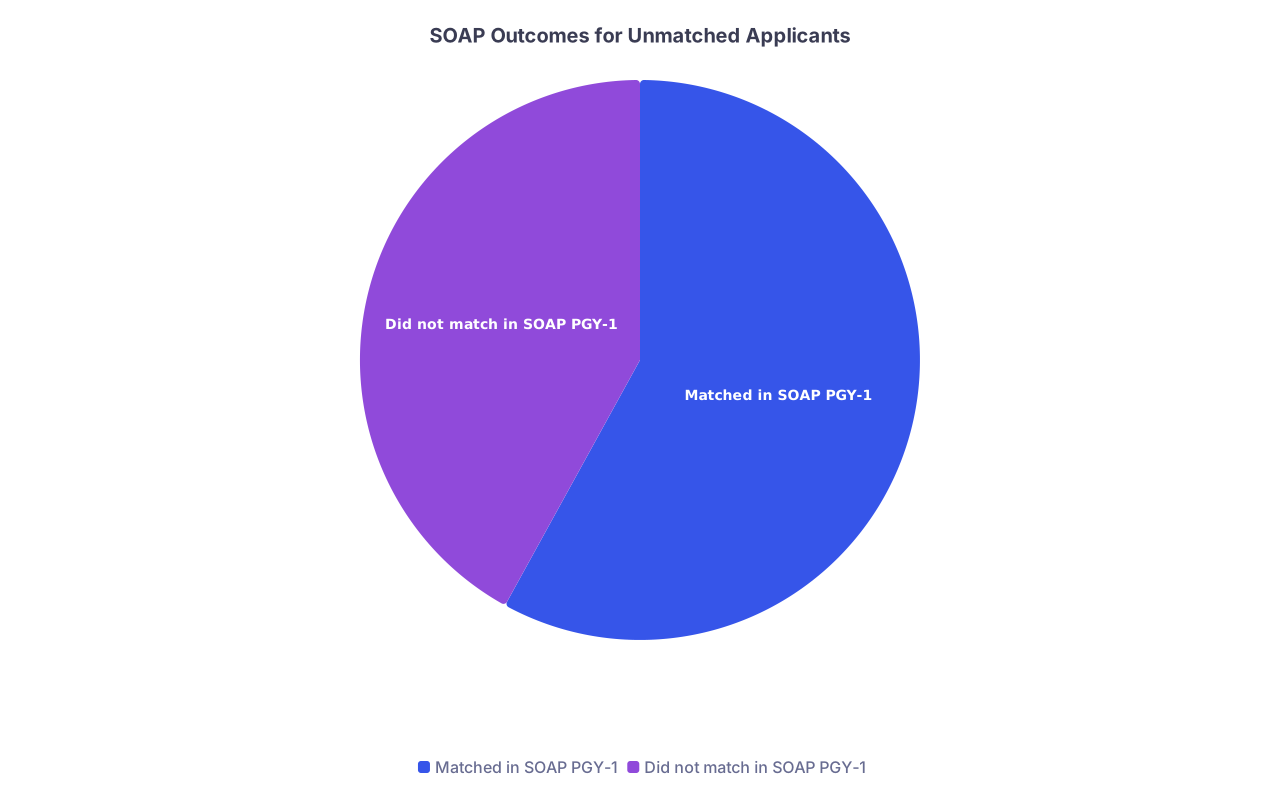
| Category | Value |
|---|---|
| Matched in SOAP PGY-1 | 58 |
| Did not match in SOAP PGY-1 | 42 |
Rough national picture in recent pre‑pandemic cycles (numbers vary slightly year to year, but the pattern holds):
- Around 6–8% of US MD seniors, 10–15% of DO seniors, and a much higher percentage of IMGs go unmatched after the main Match.
- Of all unmatched applicants who enter SOAP, a bit more than half land a PGY‑1 position.
- A decent chunk of categorical positions in SOAP are in lower‑filling specialties (FM, IM, peds, psych), community programs, or geographically isolated regions.
- A nontrivial number of SOAP spots are prelim or transitional year only.
That last detail matters. Accepting “any offer” sometimes means locking yourself into a path that actually makes it harder to get where you want to go.
The Myth: “Any Residency Is Better Than No Residency”
I’ve heard this said by:
- Well‑meaning deans.
- Relatives who think residency is like “getting any job."
- Even residents who lucked out on SOAP and assume everyone else’s situation is identical.
The underlying assumptions are:
- Training quality is roughly similar everywhere.
- Once you’re “in the system,” moving to what you really want is straightforward.
- A gap year is career suicide, and unmatched = permanent label.
All three are partially false.
Training environments vary wildly. Some programs are solid, supportive, and give you real doors for the future. Others are barely functioning, have chronic ACGME citations, endless turnover, and zero track record of helping grads get fellowships or transfers.
Transfers are possible, but not guaranteed. And they’re much easier from some programs than from others.
Gap years are risky if you handle them badly. They’re not inherently toxic if you handle them well and your application is still fundamentally competitive.
Let me show you where “take anything” clearly fails.
When Saying “No” to SOAP Actually Makes Sense
Notice the phrasing: “makes sense.” Not “feels nice.” Not “lets you dream forever.” I’m talking rational, defensible decisions based on your profile, risk tolerance, and actual program quality.
Here are the big buckets where declining a SOAP offer is reasonable.
1. The Program Has Serious Quality or Accreditation Red Flags
There are SOAP programs that are basically one inspection away from serious trouble. You won’t see that on ERAS banners, but there are ways to sniff it out fast:
- Recent or ongoing ACGME citations.
- Sudden large losses of faculty or program leadership.
- High resident attrition (especially PGY‑1/PGY‑2 leaving mid‑year).
- Chronic under‑filling even before SOAP, year after year.
- Residents openly warning you off in calls or messages.
If, during your whirlwind SOAP interview or quick resident outreach, you hear things like:
- “We’ve had a lot of residents leave recently.”
- “We’re on ACGME warning but working on it.”
- “We’re still trying to replace multiple attendings who left.”
- “We don’t have a stable PD right now.”
That’s not just “suboptimal.” That’s a serious career risk. You can get stuck in a program that:
- Loses accreditation (now you’re scrambling mid‑stream).
- Gives poor training plus a toxic environment, burning you out.
- Becomes a dead end academically and geographically.
Taking that kind of spot “just to have something” can easily be worse than waiting a year, strengthening your file, and aiming for a stable program with a track record of actually graduating residents.
2. The Spot Is a True Dead‑End Relative to Your Goals
I’m not talking about prestige fantasies here. I’m talking structural dead ends.
Common culprits:
- A prelim year in a field where:
- You have no viable bridge plan.
- There are almost no linked PGY‑2+ spots, and the program has no track record of getting prelims into categorical positions.
- A specialty you unequivocally hate and would likely leave.
- A niche program that almost never places grads into fellowships or competitive roles you care about.
Example I’ve seen multiple times:
You wanted categorical general surgery. You go unmatched. SOAP offers you a prelim surgery spot at a place that:
- Has no guarantee of conversion.
- Historically converts 0–1 prelims a year, if that.
- Is located in an area with extremely few open PGY‑2+ categorical spots.
You feel pressure: “It’s surgery, take it!” But realistically, you may be signing up for:
- One brutal year.
- No secured PGY‑2 position.
- Limited ability to meaningfully improve your application (you’re busy surviving 100‑hour weeks).
- Then re‑entering the Match competing against fresh grads with research and letters, while you’re exhausted and geographically stuck.
For some people, the better play is:
- Take an extra year.
- Do research, a strong prelim in a more flexible specialty, or targeted clinical work.
- Rebuild and reapply with a coherent story and stronger metrics.
That’s not cowardice. That’s strategy.
3. Your Application Is Actually Competitive Enough to Improve with One Strong Year
This is the part almost nobody explains clearly.
Not all unmatched applicants are the same. There are:
- Near‑miss candidates: solid stats, strong letters, a few interviews, maybe overreached on ranking or had geographic constraints.
- Structurally weak applicants: multiple fails, very low Step scores, professionalism concerns, or no US clinical experience (for IMGs).
The “accept anything” mantra makes sense for the second group much more than the first.
If you’re a near‑miss candidate, the data supports a different approach. Historically, applicants who:
- Went unmatched once.
- Spent a focused year doing:
- A well‑chosen research fellowship,
- A strong prelim in IM or surgery at a reputable hospital,
- High‑quality US clinical experience (for IMGs),
- Then reapplied with improved Step 2/Level 2, stronger letters, and a realistic rank list…
…often matched solidly the second time. Not universally. But enough that it’s a real pattern, especially in IM, FM, peds, psych, and transitional‑year‑friendly fields.
If you’re sitting on:
- Step 1 (when scored) around 225–235 USMD / 220–230 DO,
- Step 2/Level 2 in a similar or higher range,
- No exam failures,
- Reasonable clinical grades,
- 5–10 interviews that just did not convert…
…locking yourself into a low‑quality SOAP categorical in a specialty you dislike, or a random prelim with no exit strategy, is not automatically “better” than one coherent year of strengthening and reapplying.
4. The Offer Forces a Life Situation You Genuinely Cannot Sustain
This one is messy and individual. But real.
Some SOAP offers come from:
- Rural areas with almost no support system.
- High‑COL cities with low resident pay and no affordable housing.
- Places where you’re the only person of your background and the program clearly does not know how to support you.
If you’ve got:
- Major caregiving responsibilities,
- Health needs that require specific care,
- A partner/kids with constraints you actually cannot ignore,
then “any residency or you’re ungrateful” is just lazy, context‑blind advice.
You do not get bonus points in life for torching your family or your physical health to “not waste” a SOAP slot. If you know with high confidence you cannot realistically function in that setting for 3+ years, taking the offer just kicks the explosion down the road.
When You Probably Should Take the SOAP Offer
Now the other side. Because for many of you, the myth is mostly right: you should accept.
There are plenty of scenarios where “any reasonable SOAP offer” really is the rational choice.
Here are the big ones.
1. Significant Exam or Academic Issues
If your file includes:
- Multiple Step/Level failures,
- Very low Step 2/Level 2 (or no score yet and no plan),
- Remediated clerkships or professionalism flags,
- Very few or no interviews in the main cycle,
your chances of turning this around in one year are lower. Not zero. Lower.
In these cases, residency committees are not mainly asking “Why no match?” They’re asking “Can this person pass boards and handle clinical work safely?” Time alone seldom changes that impression unless you do something extremely specific and strong (e.g., additional degree, extended clinical proof, retaken exams with big jumps).
If you get a SOAP offer in a tolerable specialty at a reasonably stable program, you should think very hard before declining. For many in this group, that offer may be your only realistic path into US GME.
2. You’re an IMG Without Strong US Anchors
Data is brutally clear here: IMGs without US clinical experience, US letters, or a strong Step 2 have a very hard time matching and rematching.
For IMGs, a SOAP PGY‑1 in FM, IM, peds, or psych at a legitimate, non‑toxic program can be a golden ticket. It gives you:
- US training experience,
- US faculty advocates,
- A path to Step 3 during residency,
- A real chance to prove yourself in‑system.
Turning that down because you think you can “aim higher next year” is often magical thinking, unless your file is already stellar and you made an obvious strategic error (like only applying to one city where your partner lives).
3. You’re Flexible on Specialty and Geography, and the Program Is Solid Enough
If you’re not married to a single specialty, and you get:
- A categorical offer in FM, IM, peds, psych, or even pathology,
- At a reasonably stable community or university‑affiliated program,
- Without glaring red flags from residents,
then “take it” is generally good advice.
You can build a great career from non‑fancy programs. Academic medicine, leadership roles, fellowships—people get there from ordinary residencies all the time. They just do the work, get good letters, and stay out of trouble.
Don’t throw that kind of opportunity away because the zip code is not your first choice or the name doesn’t impress your old college roommate.
Quick Reality Check: What Actually Changes If You Wait?
Let’s put this in a simple comparison.
| Factor | Accept SOAP Offer Now | Decline & Reapply Next Year |
|---|---|---|
| Income | Start earning PGY-1 salary | No resident salary for 1 year |
| Clinical skill | Develop rapidly in real care | Depends on finding clinical/research |
| Application “story” | Clear path, no gap to explain | Must justify gap and show progress |
| Specialty flexibility | Often narrowed by choice | Potentially more flexibility later |
| Risk of no future match | Usually lower | Can be significantly higher |
| Burnout/fit risk | Depends on program quality | Depends on year structure and stress |
If your plan for a “rebuild year” is vague—“do some research,” “maybe shadow,” “study a bit”—you’re probably better off taking a SOAP spot.
If your plan is precise—“one‑year funded research in X with Dr. Y, strong chance of first‑author paper, weekly clinic days, dedicated Step 2 or Step 3 plan”—and your profile is already near‑competitive, then declining a truly bad SOAP option might be rational.
How to Decide in 24–48 Hours Without Losing Your Mind
SOAP gives you almost no time, which is why people panic and default to “yes” on everything. You need a simple decision framework ready before chaos hits.
Here’s a streamlined version.

| Step | Description |
|---|---|
| Step 1 | Receive SOAP Offer |
| Step 2 | Consider decline and structured reapply plan |
| Step 3 | Strongly consider accepting |
| Step 4 | Accept offer |
| Step 5 | Any major red flags? |
| Step 6 | Near-miss or strong file? |
| Step 7 | Can you tolerate specialty and location? |
| Step 8 | Realistic reapply path? |
“Major red flags” means things like accreditation warning, mass resident exodus, or a program clearly on life support. Not just “small town” or “not academic enough.”
“Near‑miss or strong file” means:
- Adequate scores with no failures,
- Reasonable interviews this cycle,
- Clear explanation for why you missed.
“Realistic reapply path” means:
- Specific opportunities lined up (research, prelim, structured work),
- Advisors who believe your chances will genuinely improve,
- Willingness and ability to take the financial and emotional hit of another cycle.
If you cannot define those clearly, you’re fooling yourself.
One More Uncomfortable Truth: Pride Is a Terrible Career Advisor
I’ve sat in rooms where unmatched students said things like:
- “I’m better than FM.”
- “That program isn’t prestigious enough.”
- “I’d rather wait and match derm or ortho.”
Some of these people matched something later. Many did not. The harsh part: programs remember patterns. Multiple unmatched cycles with no serious intervening work look bad. Vanity plays terribly on paper.
There’s a line between:
- Rationally declining a toxic or dead‑end situation,
- And turning down good, stable training because your ego wants a fancier badge.
You have to know which side you’re on. And be brutally honest about it.
The Bottom Line
A few key truths that cut through the noise:
- “Take any SOAP offer” is not a law of physics. It’s a crude heuristic that’s right for many people but absolutely wrong for some.
- Saying no can make sense when the program is genuinely unstable, structurally dead‑end for your goals, or your record is strong enough that a clearly planned reapply year is likely to improve your outcome.
- For applicants with serious exam/academic issues or weak overall profiles, a reasonable SOAP spot is often your best—and maybe only—real path into US residency.
You’re not choosing between “gratitude” and “entitlement.” You’re choosing between different risk profiles for the next 5–40 years of your life. Treat it like that.