
It is one week before rank list lock. Your ERAS portal is quiet. Your email is quieter. You have 4 interviews total. Maybe 3. Maybe 1. And the thought sitting in the back of your mind that you have tried to ignore is now front and center:
“If I do not match, am I actually ready for SOAP?”
At this point you should stop pretending that “it will probably be fine” is a plan. You can hope for the Match and still prepare ruthlessly for SOAP. Those two things are not mutually exclusive. The people who ride out SOAP successfully with limited interviews almost always did the unglamorous preparation in this exact week.
Here is how to use the final 7 days before rank list lock, day by day, to be SOAP-ready without blowing up your sanity.
Overview Timeline: Your Week Before Rank Lock
Let me lay out the week first, then we will drill down.
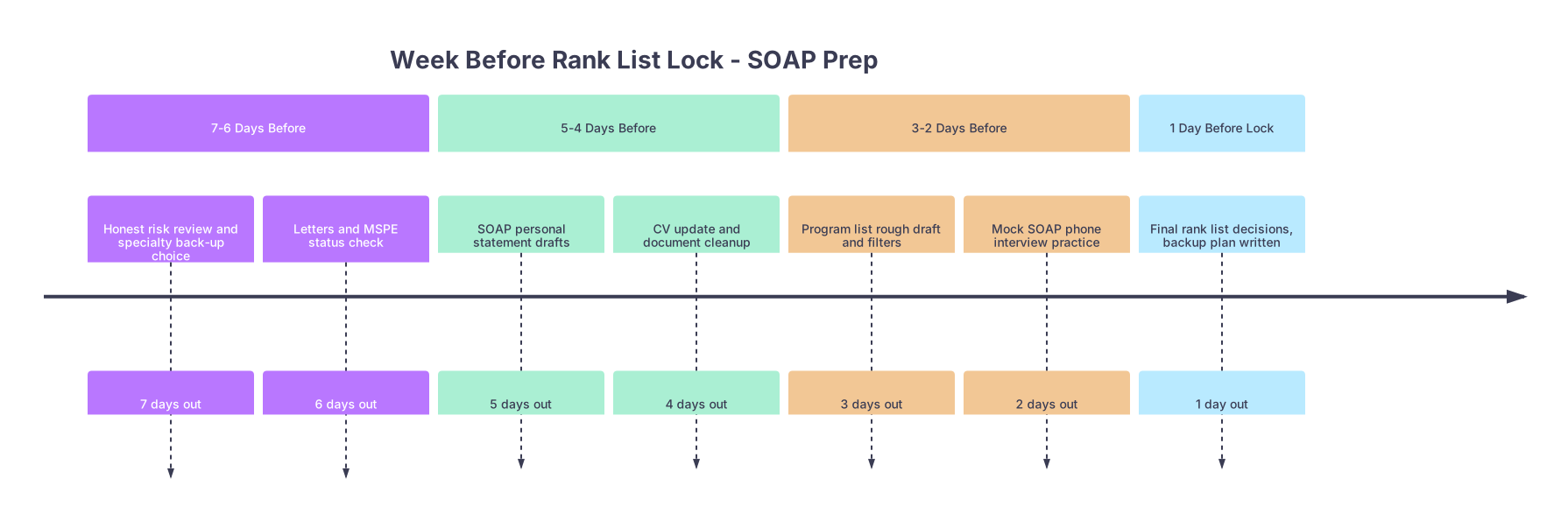
| Period | Event |
|---|---|
| 7-6 Days Before - Honest risk review and specialty back-up choice | 7 days out |
| 7-6 Days Before - Letters and MSPE status check | 6 days out |
| 5-4 Days Before - SOAP personal statement drafts | 5 days out |
| 5-4 Days Before - CV update and document cleanup | 4 days out |
| 3-2 Days Before - Program list rough draft and filters | 3 days out |
| 3-2 Days Before - Mock SOAP phone interview practice | 2 days out |
| 1 Day Before Lock - Final rank list decisions, backup plan written | 1 day out |
At every point, your rule is simple: if you would be embarrassed to hand your SOAP materials to a PD tomorrow morning, they are not ready.
7 Days Before Lock: Reality Check and Strategy Choice
You are one week out. Time to decide how seriously you are going to take the possibility of SOAP.
At this point you should:
Do a cold, unsentimental risk assessment
- Count interviews. Under 8–10 in a competitive specialty? You are at real risk. Under 5 anywhere? You should be SOAP prepping like you expect to use it.
- Factor in:
- Any failures (Step/COMLEX, clerkships)
- Red flags (LOA, professionalism, late graduation)
- Specialty competitiveness (EM 2020 is not EM 2024, etc.)
- Ask a blunt advisor (not the always-positive dean) for an honest take. Someone who actually sees match lists: your home PD, APD, or a trusted faculty in your specialty.
Choose your SOAP strategy track Pick one primary path and one backup:
- Track A: Same specialty, broader programs
- You will target prelims/TY or lower-demand programs in your specialty.
- Track B: Neighboring specialty pivot
- IM ↔ FM; Gen Surg → Prelim → later categorical; OB/GYN → prelim surgery/IM; etc.
- Track C: “Any residency” stability
- You prioritize any ACGME-accredited position where you can legally and sanely work as a physician next year.
Do not overcomplicate it. For most low-interview applicants, it is IM + FM + prelim/TY as the main SOAP basket.
- Track A: Same specialty, broader programs
Clarify your non‑negotiables If you SOAP, what will you absolutely not accept?
- Geographic: Are there states you will not move to under any circumstances?
- Accreditation: Would you take a new program with no graduates yet?
- Shift type / niche: Hard no on malignant prelim-only surgical ICU with zero support?
Write these down. When SOAP opens, your judgment will be impaired by stress and adrenaline. Decide some rules now.
End-of-day 7 checklist
- Honest risk conversation completed with at least one advisor.
- Primary SOAP track chosen (same specialty vs pivot vs any residency).
- Hard no’s written down in a note you can look at later.
6 Days Before Lock: Documents and Letters Audit
Today is about infrastructure. If you SOAP and your documents are a mess, you start behind.
At this point you should:
Audit what ERAS/NRMP already has
- Confirm:
- USMLE/COMLEX scores uploaded and correctly reported.
- MSPE present and not “pending” without reason.
- All existing LoRs are uploaded and correctly labeled.
- Check that you can still assign letters to new applications quickly.
- Confirm:
Decide on SOAP-specific letters You are not writing new letters during SOAP. That is a fantasy. You are deciding how to use what you have.
- Identify:
- 1–2 strong generalist letters (IM/FM/surgery attendings who actually know you).
- Any “to specialty X” letter that might look strange if you pivot hard. Example: A letter titled “Emergency Medicine Letter of Recommendation” in an FM SOAP app. Not ideal, but not fatal if content is strong.
- Make a SOAP letter plan:
- For IM/FM SOAP → prioritize medicine-heavy or primary care–friendly letters.
- For prelim/TY → mix of core rotations, someone who can say you are safe and reliable on the wards.
- Identify:
Talk to your school about SOAP mechanics Some schools are very good at SOAP. Others wing it. Ask explicitly:
- Who is my point person during SOAP (name, email, cell if allowed)?
- Do you make calls to programs on students’ behalf during SOAP?
- How fast can you update my MSPE or dean’s letter if needed?
- Where will I physically be during SOAP week (on campus vs remote)?
Get that clear now. Not at 10:05 a.m. on SOAP Monday.
End-of-day 6 checklist
- Verified scores, MSPE, and letters in ERAS.
- Labeled 2–3 letters as “SOAP-ready” in your head.
- Identified your school’s SOAP contact and their process.
5 Days Before Lock: SOAP Personal Statements (Yes, Plural)
By now you have your strategy. Time to build the words that will sell it in 1–2 paragraphs.
At this point you should:
Draft 2–3 ultra-lean SOAP personal statements SOAP statements are not your glossy primary PS. They are fast, targeted, and a bit more direct.
Common sets:
- Internal Medicine SOAP PS
- Family Medicine SOAP PS
- Prelim/TY PS (if you are considering this)
Structure for each:
- 1–2 sentences: Clear career intent
“I am seeking a position in Internal Medicine with the goal of completing categorical training and later practicing as a hospitalist in a community setting.” - 3–4 sentences: Evidence you can handle the work
Specific rotations, responsibilities, feedback, and concrete examples. - 1–2 sentences: Why this specialty is your long-term fit (not a melodrama about your childhood).
- 1 sentence: Red flag address, if applicable
“I had to remediate my surgery clerkship due to time management issues, which I have since corrected; my subsequent clinical performance has been strong, as reflected by honors in IM and EM.”
Scrub them for SOAP-specific tone
- No:
- “Your program” references (these are generic).
- Long narrative hooks about your grandmother.
- Overly fancy language.
- Yes:
- Clear, brief, specific.
- Direct about what you bring Day 1 as an intern.
- No:
Get one critical eyeball on at least one PS
- Send IM/FM PS to someone in that field if possible.
- Tell them: “You get 2 minutes max, just flag anything off or confusing.”
End-of-day 5 checklist
- Drafted 2–3 SOAP PS variations based on likely specialties.
- Edited for brevity and clarity; max ~400–500 words each.
- At least one PS reviewed by a human who will not sugarcoat feedback.
4 Days Before Lock: CV and Application Tightening
Your ERAS application for SOAP is basically the same skeleton, but you do have room to sharpen.
At this point you should:
-
- Remove fluff: premed-level clubs that add nothing.
- Move heavy clinical roles higher: sub-I, chief of something, longitudinal clinic, night-float experience.
- For each important entry, make sure you answer: What did you do? How often? What responsibility level?
Reframe anything that screams “only one specialty”
- Example: Your experiences section reads like a dermatology fan club.
- Fix by:
- Emphasizing broad clinical responsibilities.
- Highlighting teamwork, intern-level tasks, adaptability, and patient load.
Update any last-minute items
- New publications or posters.
- Recent sub-I eval highlights that can be added as narrative evidence in experience descriptions.
Confirm document naming and availability This sounds petty until you are half-asleep on SOAP Monday:
- Make sure you can clearly distinguish:
- “PS – Internal Medicine SOAP”
- “PS – Family Medicine SOAP”
- “PS – Prelim/TY SOAP”
- If your school lets you pre-assign or test upload, do it now.
- Make sure you can clearly distinguish:
End-of-day 4 checklist
- Experiences reordered and trimmed for SOAP relevance.
- Any hyper-specialized framing softened into broader clinical skills.
- PS and document files labeled in a way you cannot possibly mix up.
3 Days Before Lock: Program Targeting Framework
You cannot see the SOAP list yet, but you can decide how you will pick.
At this point you should:
Define your filter rules When the unfilled list drops, you will have minutes, not hours, to triage.
Decide:
- Will you apply to:
- All unfilled IM programs except your hard-no states?
- All FM programs regardless of prestige?
- Only prelims at programs with at least some history or reputation?
- Will you apply to:
Set up a simple triage sheet Nothing fancy. A spreadsheet with:
- Program name
- State / city
- Specialty (IM, FM, prelim, TY, etc.)
- Red flags you know in advance (if any)
- Priority: A (apply immediately), B (if more spots needed), C (only if desperate)
You will populate this once the list is out, but the structure should exist now.
Study at least a few sample programs realistically Pull several random IM and FM program websites and ask:
- Would I actually live here?
- Any major deal-breakers (call schedule, reputation, “we do not sponsor visas” if this affects you)?
- Are they new vs established?
Get used to reading a program quickly for what matters, not for brochure fluff.
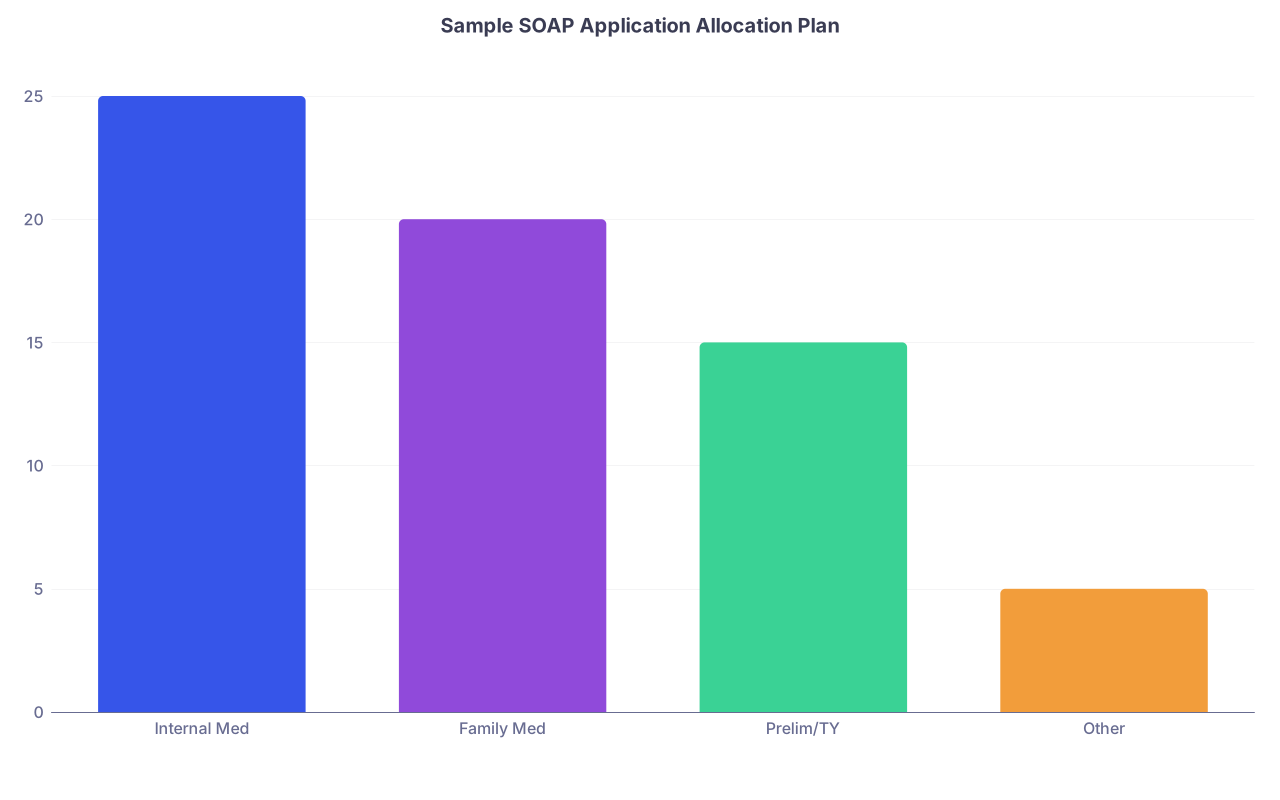
| Category | Value |
|---|---|
| Internal Med | 25 |
| Family Med | 20 |
| Prelim/TY | 15 |
| Other | 5 |
End-of-day 3 checklist
- Decide how aggressive you will be by specialty (IM vs FM vs prelim).
- Built a simple spreadsheet/Note structure for SOAP program triage.
- Practiced scanning 3–5 real program websites in under 3 minutes each.
2 Days Before Lock: Interview Readiness (SOAP-Style)
SOAP interviews are not like your Zoom faculty tea party from October. They are short, often abrupt, and focused on: “Can this person safely function as an intern in July?”
At this point you should:
Write and rehearse a 60–90 second “SOAP pitch” This is your opener when a PD calls with zero notice.
Core skeleton:
- Who you are and what you are seeking.
- Why this specialty (or track) is aligned with your skills and goals.
- Why you are ready to start as an intern this July.
- If needed, one line on your biggest “issue” with how you have grown from it.
Example: “I am a fourth-year at X, seeking a PGY-1 position in Internal Medicine. My sub-I in IM and my night float rotation showed me that I enjoy managing complex, hospitalized patients and working closely with multidisciplinary teams. I am comfortable cross-covering 20–25 patients overnight, handling admissions, and escalating appropriately. My record includes a Step 1 fail during second year, but since then I have passed all exams on the first attempt and honored both my IM and EM clerkships. I am looking for a program where I can be a reliable intern from day one and grow into a hospitalist role.”
Prepare tight responses for the 5 questions you will definitely get
- “Why are you interested in our program / this specialty?”
- “Why do you think you did not match?” (they might not say it this bluntly, but that is the subtext)
- “Tell me about a challenging clinical situation and what you did.”
- “What are your plans if you do not get a position through SOAP?” (Yes, it gets asked.)
- “Anything you want us to know about your application?”
Keep answers:
- Under 90 seconds.
- Concrete, with 1 example each.
- Free of self-pity. You can acknowledge disappointment, but you cannot wallow.
Run 1–2 mock phone interviews Phone, not Zoom. SOAP calls are often audio only.
- Ask a friend, resident, or advisor to:
- Call you at an unannounced time in a 2-hour window (simulate the jolt).
- Ask 3–4 rapid questions.
- Give blunt feedback: did you sound desperate, scattered, or ready?
- Ask a friend, resident, or advisor to:
End-of-day 2 checklist
- 60–90 second SOAP pitch scripted and rehearsed aloud.
- Bullet-point answers written for the 5 core SOAP questions.
- At least one mock phone interview completed.
1 Day Before Lock: Final Rank List and Contingency Map
The day before rank list lock should not be dramatic. Most of the real work is already done. Now you align your list with your realistic backup plan.
At this point you should:
Finalize your rank list with SOAP in mind
- Rank every program where you would be legitimately willing to train.
- Do not:
- Leave off a program you would accept in SOAP “to send a message.”
- Play 4D chess with a short rank list to avoid an “unhappy match.” Unmatched with SOAP chaos is worse than a less-than-ideal geographic outcome.
Write down your SOAP day playbook On one sheet of paper or a single-page note:
- Primary contact at your school + backup contact.
- Your application priorities (e.g., IM > FM > Prelim).
- The number of applications you will likely send per specialty.
- Your 60–90 second pitch outline (just in case your brain blanks).
Do a technical and logistics check
- Confirm:
- NRMP login works.
- ERAS login works.
- Your phone number and email in ERAS/NRMP are correct.
- Decide:
- Where you will physically be on SOAP Monday and Tuesday.
- That environment should allow:
- Stable internet.
- Privacy.
- Ability to take unexpected phone calls without chaos.
- Confirm:

- Sleep like an adult professional, not a panicked applicant No, this is not “self-care talk.” If you go into SOAP week with 4 hours of accumulated sleep debt and caffeine tremors, you will sound messy on the phone. Programs feel that.
End-of-day 1 checklist
- Rank list certified and double-checked.
- One-page SOAP plan written and accessible.
- Logins tested; phone and email verified; physical workspace chosen.
Quick Reference: What Should Be Ready Before Rank List Locks?
| Area | Must Be Ready By Lock |
|---|---|
| Risk assessment | Completed with advisor |
| SOAP PS drafts | 2–3 versions finalized |
| Letters plan | 2–3 usable LoRs picked |
| ERAS application | Tightened and updated |
| Interview pitch | Rehearsed and confident |
| Triage system | Spreadsheet/template set |

FAQ (Exactly 2 Questions)
1. If I only have 1–3 interviews, should I change my rank list based on SOAP fears?
You should not sabotage your current interview specialty out of anxiety, but you should be pragmatic. Rank all programs in your current specialty where you would truly train. If your specialty is very competitive and you have minimal interviews, speak with your advisor about whether to add a parallel plan (e.g., ranking a few FM or IM programs if you interviewed there). What you must avoid is a short, “all-or-nothing” rank list in a competitive specialty with no realistic backup. Use SOAP as insurance, not as the primary plan for a reach specialty.
2. Can SOAP actually work if my application has serious red flags?
Yes, but only if you approach it with precision and honesty. I have seen applicants with a Step failure, a repeat year, or limited interviews pick up solid IM or FM spots through SOAP because they:
- Owned their issues in 1–2 sentences, without excuses.
- Showed concrete improvement (later honors, strong sub-I, strong recent Step/COMLEX scores).
- Presented as reliable, humble, and ready to do the unglamorous intern work.
SOAP will not erase red flags, but it can give you a path forward if your materials are tight, your expectations are grounded, and you sound like someone a PD would trust on nights in July.
Key points to walk away with:
- Use this week before rank list lock to build real SOAP infrastructure: statements, letters plan, ERAS cleanup, and interview pitch.
- Decide your SOAP specialty hierarchy and hard boundaries now, before stress clouds your judgment.
- Treat SOAP prep as insurance. If you match, no harm done. If you do not, you will be ready on Monday instead of trying to assemble your career in 90 panicked minutes.