
It’s March. The email just came in. “We are sorry to inform you…” and your stomach drops. You’re staring at the NRMP screen that basically says: you’re in SOAP.
Your brain goes to the worst possible place instantly:
“I’m done. I’m damaged goods. Every future PD will see this red flag in neon. I’ll never switch specialties. I’ll never do a fellowship. I’ll be ‘the SOAP person’ forever.”
Let’s talk about that. Because you’re not crazy for thinking it. People whisper about SOAP like it’s radioactive. And the silence around it makes it feel way worse than it is.
First: What PDs Actually See About SOAP (Not What You Imagine)
You’re probably picturing this huge blinking banner on your future ERAS: “UNMATCHED IN 202X – ENTERED SOAP!!!”
That’s not how it looks.
Program directors don’t get a dramatic play-by-play narrative. They see data. Boxes. Years. Gaps. They infer.
The big things they can know or reasonably deduce:
- You graduated year X.
- You either matched or didn’t that year.
- If you SOAPed successfully, they see your current residency listed as PGY-1 starting in July after that March.
- If you re-applied after a SOAP year, they see an extra year or a gap and what you did with it (prelim, research, non-match year, etc.).
There are ways they can figure out you went through SOAP. For example:
- You did a prelim or transitional year you clearly didn’t intend at first (e.g., applying anesthesia but end up IM prelim).
- There’s a one-year non-categorical position followed by a categorical somewhere else.
- The timeline just doesn’t match a direct, clean Match.
But here’s the key thing: it’s not labeled as “SOAP – disgrace” in the system. It’s part of your training path, not a giant scarlet letter coded in red.
Do some PDs mentally tag it as a concern? Yes, some.
Do many of them also not care at all if the rest of your story makes sense? Also yes.
And I know that sounds like vague reassurance, so let’s get more concrete.
The Ugly Fear: “Am I Permanently Damaged if I SOAP?”
This is the nightmare loop.
“If I SOAPed:
- I’ll never switch specialties.
- I’ll never get a competitive fellowship.
- They’ll always assume I was the bottom of the barrel.
- My career ceiling just dropped by 50 floors.”
I’ve watched applicants spiral so hard on this that they almost sabotage their SOAP round because they think their “real” life is already over.
Let me be blunt: SOAP is not a trophy. No one is proud to be there. But it’s also not a career death sentence.
Here’s the hierarchy of how PDs judge you, roughly:
| Factor | Typical PD Priority |
|---|---|
| Current residency performance | Very High |
| Letters from current faculty | Very High |
| Fit with specialty/program | High |
| Board exams (pass/fail, scores if visible) | High |
| SOAP / match history | Low–Moderate |
SOAP matters most when there are other red flags and there’s no explanation.
SOAP matters a lot less when:
- You’re now doing great clinically.
- Your PD and faculty write strong, specific letters.
- You have a coherent explanation and trajectory.
The more years between your SOAP year and your next application, the less anyone cares—unless you give them reasons to.
What PDs worry about isn’t “you SOAPed.”
They worry about: “Are you unreliable? Toxic? Disengaged? Dangerous with patients? Going to quit again?”
SOAP doesn’t answer any of that. Your behavior afterward does.
How Future PDs Actually Think About SOAP (The Stuff You Won’t Hear Out Loud)
Let’s walk through the ways PDs mentally process someone with SOAP in their past.
1. The “Context Matters” PD
This is more common than you think.
They look at your file and think:
- You graduated from a newer med school or an international school.
- You applied to 8 derm programs with a 225 Step 1 back when scores still showed.
- You didn’t have home program support.
- Or you couples matched in a very constrained way.
They chalk your SOAP up to: “Risky strategy, tough year, bad luck, system constraints.”
They’ll ask: “What changed since then?”
If your answer is solid—more clinical strength, focused interest, strong letters—they move on.
2. The “Red Flag Hunter” PD
These are the ones you’re scared of.
They scan for mismatch:
- SOAP year
- Multiple attempts at board exams
- Significant professionalism concerns
- Leaves of absence, unexplained gaps
They don’t hate SOAP candidates by default.
What they hate are unanswered questions and vague excuses.
If you walk in acting like SOAP is unspeakable, like you’re trying to hide it, they’ll imagine something worse than reality. That’s how humans are.
What they want from you: clean explanation, ownership, and evidence that you learned and stabilized.
Something like:
“I overestimated how competitive I was that year and didn’t apply broadly. When I didn’t match, I entered SOAP and took a prelim IM year. Since then, my clinical evaluations have been strong, and I realized I’m actually much more aligned with [specialty X] for [concrete reasons].”
That’s miles better than mumbling, “Yeah, that was an unfortunate time,” and changing the subject.
3. The “Resilience Appreciator” PD
These PDs have actually been through chaotic career paths themselves or seen their residents struggle then succeed.
They see SOAP and think:
“Rough year. You still showed up, did the work, and now you’re applying again with good letters. That’s grit.”
They won’t say that in the interview, but I’ve seen the shift in tone when someone tells a real, honest, non-dramatic version of their SOAP story. It can actually work in your favor if framed as: fall → adjust → grow.
Not a sob story. Not a victim narrative. More like:
“Yeah, I got hit in the face by the Match once. Here’s what I did next.”
SOAP and Future Applications: Switching, Fellowship, Moving Programs
Here’s where the spiral usually hits maximum intensity:
“Okay, fine, I might survive this year. But what about 3–5 years from now? When I want to move. Or specialize. Or do something even slightly competitive?”
Let’s break down the main scenarios.
Scenario 1: You SOAPed into a categorical spot and stay in that specialty
If you SOAPed into, say, categorical IM, prelim never, and you just continue in IM and apply for a fairly standard fellowship (cards, GI, pulm/crit, etc.):
Most fellowship PDs barely care about your SOAP history if:
- You’re strong in residency.
- Your letters are legit and specific.
- You didn’t have patient safety or professionalism issues.
They’re flooded with internal candidates and external applicants. They don’t have the time or emotional energy to psychoanalyze a SOAP event 4 years ago if everything else looks solid now.
Will they notice? Maybe, if they stare at your timeline hard enough.
Will many of them shrug and move on? Yes.
Scenario 2: You SOAPed into a prelim / transitional year and reapply
This is the rougher path emotionally because it looks “messier” on paper.
Future PDs will ask:
- Why didn’t you match the first time?
- What did you do with that prelim year?
- Are your current faculty backing you strongly?
If you reapply to the same specialty with stronger support, it looks like persistence and course correction.
If you reapply to a different specialty, they need a believable story that this isn’t just you ping-ponging out of desperation.
The good news: plenty of people have done this and landed where they wanted.
The bad news: yes, you’ll have to talk about SOAP. Probably more than once. It’ll sting every time at first. Then less. Then it becomes just a fact of your story.
Scenario 3: You SOAPed into something you didn’t love and want to switch
This is where the paranoia about stigma hits hardest.
Especially if you feel trapped: “If I tell my current PD I want to switch, they’ll be mad. If I don’t get out, I’ll be miserable. But if I try to leave, future PDs will think I’m flaky and I SOAPed.”
Here’s the truth: switching is always harder than staying. SOAP history or not.
You need:
- A PD who will at least not sabotage you.
- Strong rotations, preferably in the new specialty if you can swing it.
- A very clear, non-flimsy explanation for the switch.
SOAP becomes one piece of the narrative, not the whole thing.
Something like:
“I entered SOAP and accepted a position in [X] because I wanted to train and not sit out a year. During intern year, I realized my strengths and long-term interests align more with [Y]—specifically [clinical aspect]. I’ve sought out experiences and mentorship in [Y], and my evaluations reflect that fit.”
This isn’t magical. Some programs will still screen you out. But that’s already true for non-SOAP switchers too.
How to Talk About SOAP Without Sounding Defensive or Broken
This is the skill you actually need to build.
Not rewriting history. Not pretending SOAP didn’t happen. Just being prepared so you don’t ramble and self-destruct when someone asks.
Aim for three beats:
- What happened – briefly, factually.
- What you did next – actions you took, not feelings.
- Who you are now – how it changed or clarified your path.
Example:
“In my initial match cycle, I aimed too narrowly and didn’t apply broadly enough. I went through SOAP and accepted a prelim IM spot so I could keep training and strengthen my clinical skills. Over that year, I improved my evaluations, got strong letters, and clarified that [specialty] is the right place for me because [specific reasons]. Now I’m applying with that experience and a much clearer fit.”
That’s it. Not an autobiography. Not a trauma narrative.
If you can say it out loud without your voice shaking, you’re in good shape.
What Actually Hurts You More Than SOAP
You’re convinced SOAP is the worst part of your application. Often it isn’t.
PDs are more seriously bothered by:
- Unexplained gaps – a year with no clear plan or vague “personal reasons” with no structure.
- Weak or generic letters – “hard-working, showed up, quiet” is code for “forgettable.”
- Repeated failures with no trajectory – same mistakes, same exam issues, same feedback not addressed.
- Defensiveness or blame – “The match isn’t fair,” “my school didn’t help,” “I was robbed.”
SOAP plus any of the above looks bad.
SOAP plus growth, structure, and strong mentorship looks… like someone who had a crappy year and kept going.
Which is basically everyone in medicine at some point.
Quick Reality Check: You’re Not the Only One
Look at the numbers for a second.
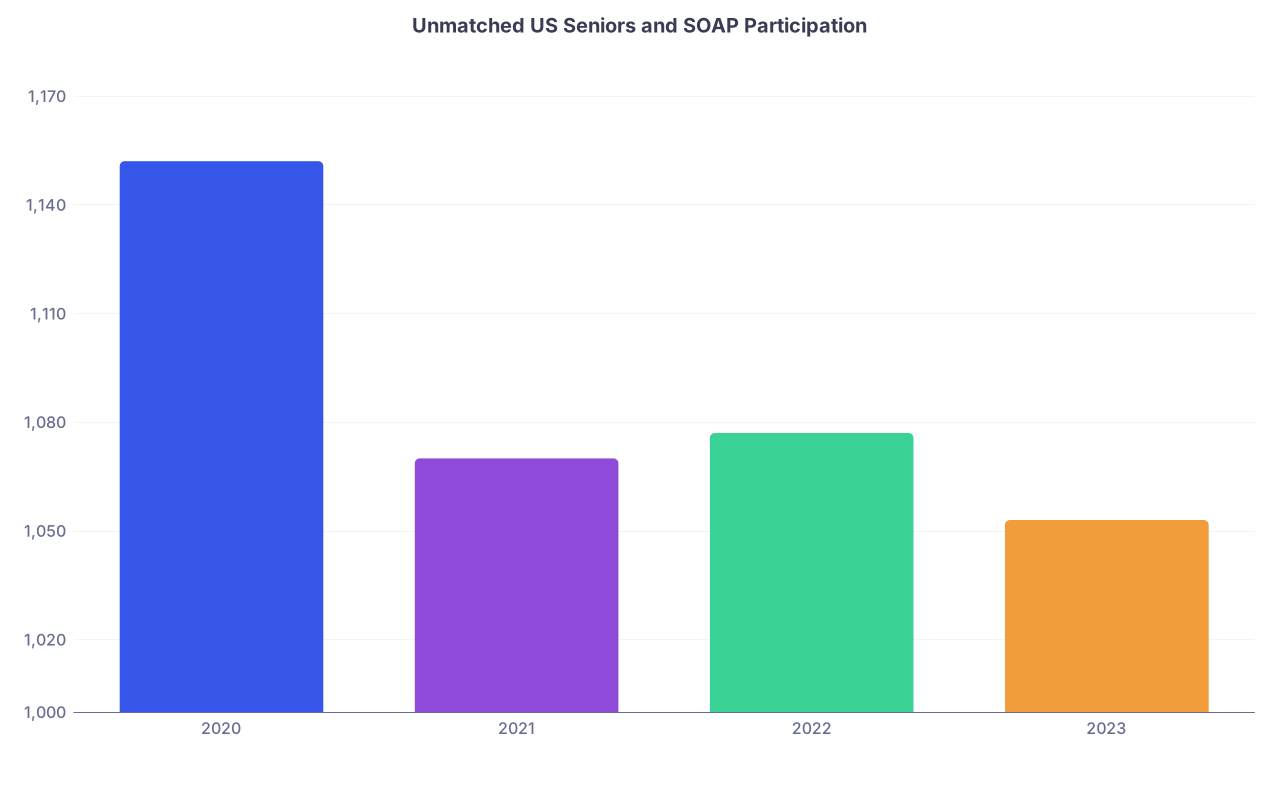
| Category | Value |
|---|---|
| 2020 | 1152 |
| 2021 | 1070 |
| 2022 | 1077 |
| 2023 | 1053 |
That’s rough ballpark for unmatched US seniors any given year. Thousands of total unmatched when you include IMGs and DOs. Many of them go through SOAP.
You’re not some bizarre outlier case study. You’re one of many smart, competent people trying to squeeze through a bottleneck that’s partly about merit, partly about numbers, and partly about luck.
PDs know that. They’ve watched excellent students get wrecked by a bad year, a new program starting down the street, a shift in visa rules, or just inappropriate application strategy.
SOAP isn’t the label that defines you. It’s one line in a larger timeline.
And if you want a visual of that timeline:
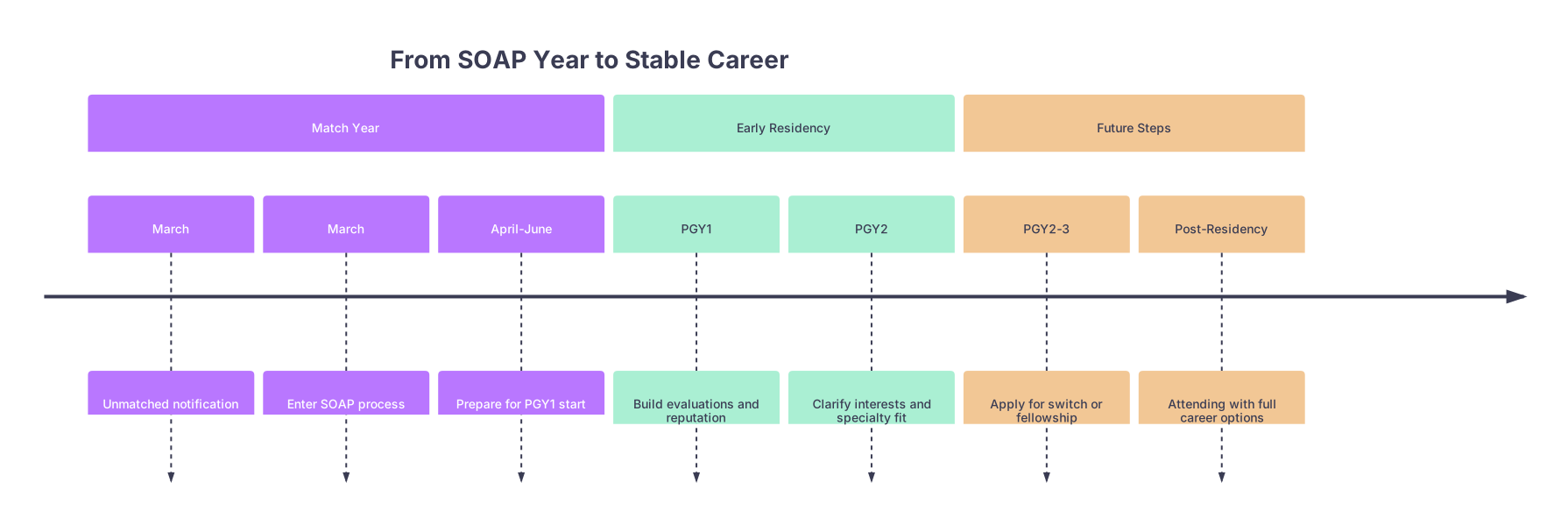
| Period | Event |
|---|---|
| Match Year - March | Unmatched notification |
| Match Year - March | Enter SOAP process |
| Match Year - April-June | Prepare for PGY1 start |
| Early Residency - PGY1 | Build evaluations and reputation |
| Early Residency - PGY2 | Clarify interests and specialty fit |
| Future Steps - PGY2-3 | Apply for switch or fellowship |
| Future Steps - Post-Residency | Attending with full career options |
FAQ: Six Questions You’re Probably Too Embarrassed to Ask Out Loud
1. Will PDs automatically think I was the bottom of the barrel because I SOAPed?
No. They’ll think you were in a group of people caught in a very rough process during a specific year. Some might wonder about your initial application choices or competitiveness, but “bottom of the barrel” is a story your anxiety tells you, not how most PDs actually frame it.
2. Should I proactively mention SOAP in my personal statement?
Only if it’s essential to explaining your path. If SOAP led directly to your prelim year, which clarified your specialty choice or showed growth, you can mention it briefly and matter-of-factly. Don’t write a full essay centered on your pain in SOAP. A few lines in the context of your trajectory is enough.
3. Will SOAP ruin my chances at competitive fellowships later (cards, GI, etc.)?
Not by itself. Your fellowship chances hinge far more on residency performance, letters, research (for some fields), and fit. If you crush residency and get strong, specific support from faculty, a distant SOAP year becomes background noise for many programs.
4. Do I have to tell my current PD I SOAPed if I’m reapplying or switching?
If you’re already in a residency, they probably already know or can infer how you got there. For switching or reapplying, you absolutely need your PD’s support or at least non-obstruction. Hiding SOAP or your history is not realistic. Controlled honesty beats awkward half-truths every time.
5. Are there programs that will silently blacklist anyone with SOAP in their past?
Yes, a few will be extremely risk-averse or snobbish. You won’t always know who they are. But there are also plenty that will not care if your current performance is strong. Your job isn’t to win over the most rigid PD on earth. It’s to find the ones who look at the full picture, not just the worst year you ever had.
6. How do I stop obsessing that every rejection now is “because I SOAPed”?
You probably won’t stop completely. But remind yourself: people with pristine match histories get rejected constantly too. Programs have limited spots, internal candidates, weird preferences, politics. If you get feedback that SOAP was a concern, fine, factor it in. Otherwise, don’t fill the silence with self-blame. Focus on the pieces you can still strengthen: your performance, your letters, your storytelling, and your strategy.
Bottom line – 3 things to hold onto:
- SOAP is a rough chapter, not your entire book.
- PDs care way more about who you are now than about your worst professional week years ago.
- A clear explanation, solid current performance, and real support from your faculty will matter more than the word “SOAP” ever will.