
The way program directors really use SOAP lists when you have few interviews is far more mechanical—and more brutal—than anyone tells you.
You are imagining nuance. They are running filters.
You are picturing committee discussions about “potential” and “fit.” They are staring at an Excel export of SOAP candidates, sorting by exam status, school, and whether your dean’s letter sounds even remotely reassuring.
Let me walk you through what actually happens behind those doors when you end up in SOAP with very few interviews.
What SOAP Looks Like From the Program Director’s Side
Students see SOAP as chaos. Emails, calls, advisors in panic mode. From the program office side, it’s controlled triage.
Most programs start Match Week Monday with three numbers in mind:
- How many spots unfilled
- How many applicants in the SOAP pool
- How much time and staff they realistically have to review anyone
No one has time to “holistically” review 500 SOAP applicants for 3 unfilled positions. That fantasy dies about five minutes into the first SOAP cycle.
Instead, they lean on lists, filters, and shortcuts.
Here’s what a typical program director in IM, FM, or peds does when SOAP opens and the list of eligible applicants appears:
Step 1: Export the SOAP list into Excel or some internal system.
Step 2: Apply hard filters.
Step 3: Create a “priority call list” of 20–60 applicants.
Step 4: Speed-read a tiny fraction of those applications.
Step 5: Offer quickly. And then stop.
If you think your beautifully crafted personal statement is saving you at this stage, it is not. SOAP is about risk control and speed, not romance.
How They Actually Build the SOAP List
Let me be very concrete here. You want the ugly details, not brochure language.
Picture this: Community internal medicine program, mid-tier, university-affiliated but not “prestige.” They expected to fill. They did not. They have 5 unfilled prelim IM and 2 unfilled categorical IM spots.
Monday morning, 11:00 a.m. Their SOAP applicant list goes live. They see 700+ candidates.
They do not start reading 700 files.
They open filters.
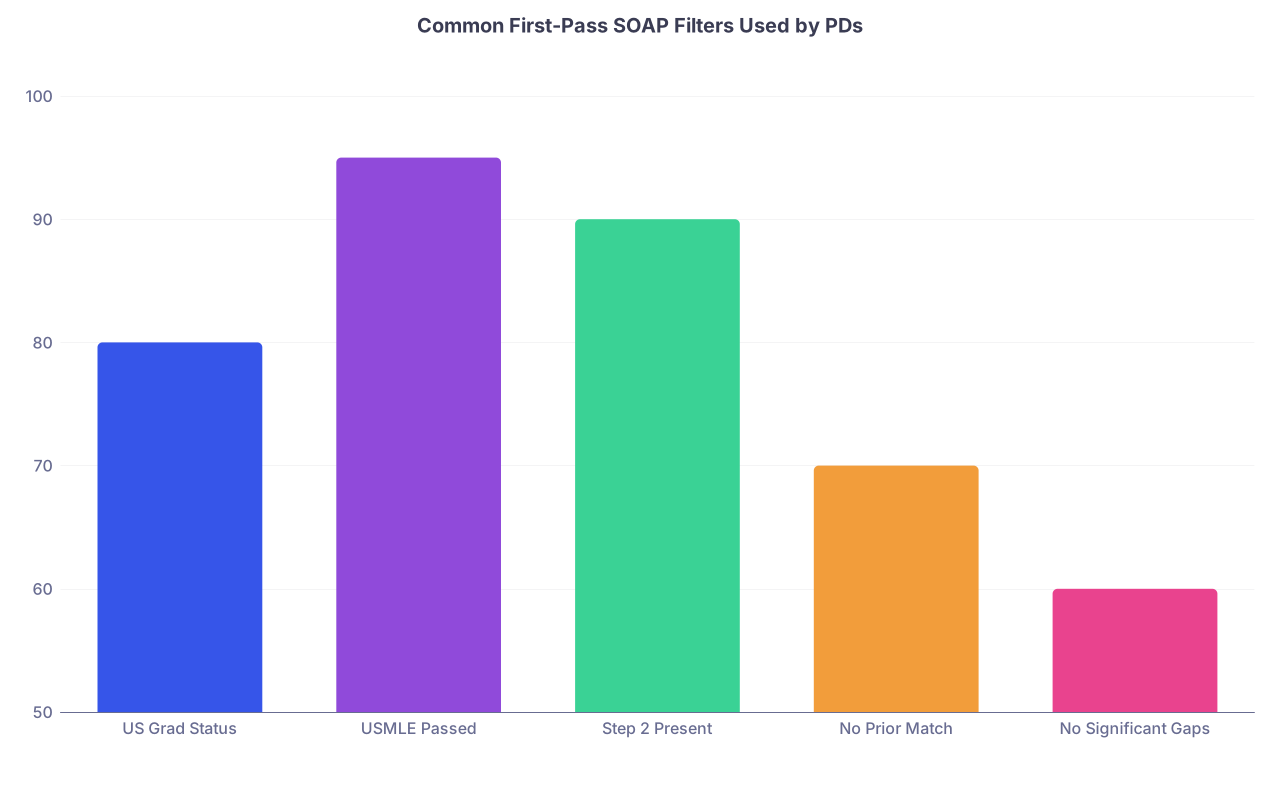
| Category | Value |
|---|---|
| US Grad Status | 80 |
| USMLE Passed | 95 |
| Step 2 Present | 90 |
| No Prior Match | 70 |
| No Significant Gaps | 60 |
Numbers here are illustrative, but the point stands: the first pass is exclusionary, not selective.
The actual filter order looks something like this:
Citizenship / Visa
Some programs absolutely will not touch a visa during SOAP. Others will, but only after US citizens / green cards. I have literally heard a coordinator say: “Run citizens and green cards first, we’ll get to the rest if we still have holes by Wednesday.”US vs. Non-US Grads
US MD and DO get prioritized. Then U.S. IMGs. Then non-U.S. IMGs. Not because of merit necessarily. Because the perception is that onboarding, communication, and credentialing risk are lower.USMLE/COMLEX status
Step 1: Pass vs. fail
Step 2: Present vs. missing
A missing Step 2 during SOAP is a massive red flag for most programs, especially if you had few interviews.Previous training / prior match
If you’ve matched before and resigned, or are coming from another specialty, many PDs are cautious. SOAP is a terrible time to convince someone to take a “project” or a second-chance trainee.Gaps and red flags
Large unexplained gaps, professionalism concerns, withdrawals, failed rotations. PDs scan for these before they ever read your heartfelt explanation in your personal statement.
Once those filters are applied, that list of 700 might drop to 150. Then they start actually looking at names.
Where Your “Few Interviews” Really Hurts You
Here’s the part people do not say out loud: your interview count absolutely colors how PDs interpret your SOAP profile.
PDs talk. PDs know the ballpark competitiveness of your application. If you have a reasonable Step 2, decent grades, no catastrophic red flags, but you had 0–2 interviews across the entire season, that is data.
Behind closed doors, the conversations sound like this:
“Why did this guy only get one interview?”
“Is there something we’re not seeing?”
“Did they tank an away?”
“Is there some professionalism issue that’s not in the MSPE?”
They may never find the answer. But the doubt is there. So they become conservative about you.
This is how they use that information:
- You get pushed down the priority call list unless something else is strongly in your favor (home student, strong letter from someone they know, very strong Step 2, or a personal connection).
- You may only get a serious look after they’ve tried safer, better-known candidates who also went unmatched but had more interviews.
Now, here’s the bitter twist:
Your file often doesn’t look that much worse on paper than people who matched. But your interview count makes PDs think: “The market rejected this candidate for some reason. I do not have time to find out why.”
SOAP is compressed risk assessment. Few interviews = unexplained market signal = caution.
The Hidden Priority Tiers PDs Create
No one writes this in an official document, but almost every program director I know ends up with three mental tiers during SOAP. And they move fast.
| Tier | Description | Your Chances If You Have Few Interviews |
|---|---|---|
| Tier 1 | Known entities (home students, rotators, strong referrals, previously interviewed) | Highest, even with few interviews |
| Tier 2 | Clean, standard profiles (solid scores, no big red flags, decent schools) | Moderate; interview count may hurt |
| Tier 3 | Risk profiles (fails, big gaps, strange paths, very few interviews) | Low, unless need is desperate |
Let me spell these out.
Tier 1: Known entities
These are people the program already knows. Home students. People who rotated there. Applicants they interviewed but did not rank high enough to match. Or someone with an email from a trusted colleague saying, “I’ve worked with this student; take them.”
If you had few interviews but did an away there and crushed it, you can still be Tier 1. That’s the escape hatch. Relationships override the signal of low interviews.
Tier 2: Clean but unknown
Average or above-average candidate, no major red flags, no strong personal link to the program. This is where your low interview count starts to hurt.
You’re competing against people who look similar on paper but maybe had 5–10 interviews. PDs lean toward the ones whose application “the market” seemed to like more, even if nobody says that explicitly.
Tier 3: Work and risk
Prior failures. Extended leaves. Switchers. People from extremely weak schools or unstable training histories. Also: applicants with inexplicably few interviews relative to their stats.
Tier 3 is not automatic rejection. It’s the “if we’re still empty by Thursday” list.
If you’re in Tier 3, your best shot is not “Wait and hope.” It’s to force your way up by making yourself known. I’ll come back to how.
How SOAP Calls and Mini-Interviews Actually Work
You imagine 30-minute conversations with thoughtful questions.
Reality: 5–12 minute phone or video calls, often scripted, sometimes done by the APD or senior residents, while the PD is doing three other things.
Think of these as liability checks, not full interviews.
They’re trying to answer just a few questions fast:
- Can you speak English clearly enough to function on the phone at 3 a.m. with a nurse?
- Do you seem reasonable, not blatantly odd or combative?
- Do your explanations for gaps / failures make sense and match what’s written?
- Are you geographically realistic? (If you’re from Florida, all training in the South, and you’re calling about a program in rural North Dakota, they will ask themselves if you’ll leave after PGY-1.)
In other words, at the SOAP stage they already want to like you. They just don’t want to get burned.
This is where your “few interviews” might come up, though not always explicitly. A PD might say:
- “How did your interview season go?”
- “Did you apply broadly?”
- “Were there any late issues that affected interviews?”
They’re looking for a story that converts you from mysterious to understandable.
An honest, concise, owning explanation plays better than a vague, over-defensive one.
What You Can Control: Positioning Yourself On Those Lists
You cannot stop them from looking at your interview count. You can influence how your name lands when that SOAP list appears.
1. Make sure your Step 2 is in and solid
No Step 2 by SOAP is death at many programs, especially if you had few interviews. PD assumptions are harsh: lack of Step 2 = hiding a bomb.
If your Step 2 is borderline or just okay, that’s still better than missing. Programs want something objective to hang their risk on.
2. Fix your ERAS profile for SOAP before Monday
Most students never update anything. Massive mistake.
Right before SOAP, you should:
- Tighten your experiences descriptions. PDs skim; clear beats poetic.
- Add any new letters or experiences (sub-I feedback, new clerkships).
- Clarify any major gaps in time with a brief, professional explanation.
No PD wants to play detective during SOAP. The clearer your narrative, the less your low interview count scares them.
3. Use your dean’s office and mentors strategically
Behind the scenes, a good dean or advisor is making calls and sending specific emails like:
“Dr. X, we have a student who is a strong clinician, had a rough interview season, great on the wards, no professionalism issues. Would you be willing to take a serious look during SOAP?”
PDs trust people they know. A one-line reassurance from a former co-fellow carries more weight than three pages of your personal statement.
If you have few interviews, you need that kind of backchannel more than the average applicant.
What PDs Privately Think When They See Your File
Let me give you a window into the actual thought process. This is the part no one shares with students.
Imagine your profile:
- US MD
- Step 1: Pass
- Step 2: 225
- No failures
- Clinical comments: “Hardworking, pleasant, quiet, needs to speak up more.”
- 1–2 interviews only during the season.
- Ends up in SOAP.
PD’s internal monologue while looking at your SOAP file:
“Okay, US MD, decent Step 2, no obvious toxicity in the MSPE. Why did nobody else bite? Is it just late app? Weird personal statement? Something on social media? Or did they interview terribly?”
They’re not going to solve that mystery in 5 minutes. So your job is to give them an explanation that feels plausible, contained, and non-threatening.
For example:
- “I applied late because of a personal medical issue that is now fully resolved; I did not get as many interviews as I’d hoped, but my clinical evaluations have been strong and I’m fully ready to start residency.”
- “I dual-applied and split my interviews; I realize that was a mistake, and I’m now fully committed to Internal Medicine.”
I’m not telling you to lie. I’m telling you that a coherent story changes how they process “few interviews” from “market rejection” to “circumstance plus suboptimal strategy.”
How Aggressive You Should Be During SOAP (More Than You Think)
Programs do not want 100 calls. But they also do not want empty spots on Thursday.
The truth: a short, targeted, well-timed outreach can pull you out of the middle of the spreadsheet into the PD’s short list.
The worst version is “Dear Program, please consider me,” sent to 50 places. That’s useless.
The better version is:
- 4–8 carefully chosen programs where you are geographically or contextually realistic
- A brief email via your dean/faculty or directly if that’s not possible
- A subject line that signals substance, not desperation
Something like:
“Re: SOAP applicant – US MD, strong clinical, Step 2 225 – interested in your IM program”
Two or three tight paragraphs:
- Who you are (school, type of grad, exam status)
- Why this program / location makes sense for you
- One line acknowledging your limited interviews without sounding defeated
- A clear, professional closing
You’re not begging. You’re making it easy for them to justify pulling your file from the pile.
What Happens Once They Decide To Offer
Once a program decides you’re acceptable, things move very fast.

| Step | Description |
|---|---|
| Step 1 | SOAP List Filtered |
| Step 2 | Short List 20-60 |
| Step 3 | Quick Application Review |
| Step 4 | Move to Next Applicant |
| Step 5 | Brief Phone Call |
| Step 6 | Offer Sent |
| Step 7 | Position Filled |
| Step 8 | Any Red Flags |
| Step 9 | Comfort Level |
Here’s what you need to understand: they’re not ranking candidates like in the main Match. They’re cycling through the list and stopping as soon as the positions are full.
If they call you and like you, but you hesitate, they may move to the next name. If they send you an offer and you sit on it for hours “to think,” they might not wait.
From their perspective, it’s simple:
“We have holes. We need people. We pick the first acceptable candidates who say yes and we shut this down.”
So if you’re serious about a program, you need to be ready to commit quickly.
The Quiet Biases That Matter More During SOAP
There are some ugly, unspoken factors that become more pronounced when time is short.
- Geographic bias: They trust people who already have some tie to the region more. They assume you’ll stay. Rural programs especially care about this.
- School bias: Unknown Caribbean or offshore schools, or very low-resource schools, make them nervous in SOAP because they don’t have time to understand your training context.
- Communication style: If your email is chaotic, your voicemail greeting is unprofessional, or you sound scattered on calls, it kills you. SOAP rewards the calm, direct, and clear.
This is why you see objectively “weaker” candidates match in SOAP while “stronger” ones go unmatched. The stronger candidate is confusing. The weaker one is simple and safe.
How To Think About This If You’re Heading Into SOAP With Few Interviews
You have to stop thinking like a traditional applicant and start thinking like someone doing crisis damage control.
You’re not selling your highest ideal version anymore. You’re trying to remove doubt faster than the other 500 people on that list.
That means:
- Own your narrative. Don’t let “few interviews” be the story. Make “clear, stable, explainable candidate who’ll show up and work” the story.
- Make it easy to say yes. Updated ERAS, clear contact info, professional voicemail, check your email obsessively, phone on loud.
- Use every human connection you have. If a PD has seen your name twice—once from a colleague, once in the SOAP list—you’re already ahead of 95% of the pool.
You are not trying to be perfect. You’re trying not to look like work.
FAQ: SOAP, Low Interviews, and How PDs Really Use Those Lists
1. Do program directors actually see how many interviews I had during the normal Match?
They don’t see a literal number of interviews you attended. They infer it. They see your profile, your school, your scores, your timing, and they know what kind of applicant usually gets 10–15 interviews. When someone with that profile is in SOAP, they assume your actual interview count was low or your interviews went poorly. They won’t say this to you, but they talk about it among themselves.
2. If I had only one or two interviews, am I automatically in the “risk” category during SOAP?
Not automatically, but you start off under suspicion. The only thing that reliably pulls you out of the risk bucket is being a known quantity: home rotation, strong personal connection, or direct reassurance from someone the PD trusts. Without that, your story has to make sense very quickly when they glance at your file or talk to you.
3. Is it worth emailing programs during SOAP, or do they hate that?
They hate mass, generic emails. They respect concise, targeted outreach that clearly fits their program. If you choose 5–10 realistic programs and send sharp, personalized messages (ideally via your dean or a faculty advocate), you can absolutely move yourself up their SOAP call list. This is one of the few levers you actually control.
4. Do PDs read my personal statement during SOAP?
Sometimes, but usually not first. In SOAP, they start with filters, then scan your MSPE, scores, and any obvious red flags. The personal statement is more of a tie-breaker or a risk-check than a selling tool. If it’s weird, rambling, or full of red-flag language, it can hurt you. A simple, straightforward personal statement that doesn’t contradict your story is ideal.
5. If I do not match through SOAP this year, does that doom me for next cycle?
No, but it makes the next cycle harder unless you change the story. If you spend the year in a productive, explainable role—research, prelim year, structured clinical role with strong supervision—and you come back with better letters, a clearer narrative, and someone vouching for your growth, PDs can treat you very differently. If you disappear for a year with no coherent explanation, the doubts that hurt you in SOAP will be even louder the next time.
With this reality in mind, you’re better prepared for what Match Week really looks like from the other side of the screen. The next step is figuring out how to present yourself in those rushed SOAP calls and emails so that “few interviews” becomes a footnote, not your headline. That’s a conversation we’ll have next time.