
Not matching in SOAP last year is brutal—but staying stuck this year is optional.
You did not just “get unlucky.” With limited interviews and no SOAP offers, something in your strategy, execution, or profile is off. The good news: those are fixable. What is not fixable is pretending last year was a fluke and reapplying with the same plan.
Let me walk you through a serious, no‑nonsense recovery plan if you:
- Had few or no interviews last cycle, and
- Went through SOAP and still got no offers.
You are in the danger zone. But you are not done—unless you decide to be.
1. Diagnose Last Year With Surgical Precision
Before you do anything else, you need a cold, honest post‑mortem. Feelings off to the side for a moment. You need data.
Step 1: Collect the hard numbers
Write this down in a one‑page summary (not in your head):
USMLE / COMLEX
- Step 1 / Level 1: Pass / Fail (and if numeric, what score)
- Step 2 CK / Level 2 CE: actual score
- Any failures? Which exam, how many attempts, how long between attempts
Academic metrics
- Medical school: US MD, DO, Caribbean, or other IMG
- Graduation year
- Any leaves of absence, repeats, remediation
- Class rank, AOA, Gold Humanism, etc. if applicable
Application stats from last cycle
- Number of programs applied to, by specialty
- Number of interview invites vs. scheduled vs. attended
- How many programs you ranked
- SOAP:
- How many programs applied to in each SOAP round
- Any interviews during SOAP? How many?
Specialty choices
- Primary specialty
- Backup specialty (if any)
- Competitiveness of those specialties relative to your stats
You are looking for mismatch. For example:
- IMG with Step 2 CK 220 applying to Dermatology and Ortho with 60 apps, no backup, no interviews. That is not “bad luck.” That is fantasy planning.
- US MD with decent scores but applied to only 20 IM programs, all top‑tier academic, with mediocre LORs and generic personal statements. Again, not unlucky. Just under‑applied and poorly targeted.
Step 2: Identify the main failure modes
Be blunt with yourself. Most applicants in your situation are dealing with one or more of these:

Under‑applying or mis‑targeting
- Applied to 30–40 programs in a competitive specialty when the average matched applicant applied to 80–100+.
- Focused on prestige or geography instead of match probability.
- Chose a specialty that does not match your scores or graduate status.
Red flags not addressed
- Exam failures not explained or supported with improvement.
- Gaps in training, professionalism issues, leaves, or disciplinary actions left vague or ignored.
- Older graduate (≥ 3–5 years out) with no current US clinical experience.
Weak application package
- Generic or poorly written personal statement(s). Sounded like 10,000 other applicants.
- LORs from non‑US physicians, unknown faculty, or obviously template letters.
- Poor or confusing ERAS entries. Typos, clutter, or weak descriptions of activities.
Interview problems
- You actually got some interviews but did not convert them to ranks effectively.
- Unstructured, rambling answers. Red flag vibes. Poor explanation of failures or gaps.
- In virtual interviews: poor eye contact, bad lighting, awkward setup.
-
- You treated SOAP like a mini‑Match instead of an emergency scramble.
- Applied too narrowly (e.g., only one specialty, only big cities).
- Did not prepare SOAP‑specific materials or scripts.
- You froze on the phone or screen when programs contacted you.
You must decide which category (or categories) describe you. If you cannot do this yourself, get outside eyes—an advisor who has actually placed unmatched students, not just a generic “career office.”
2. Decide: Reapply, Pivot, or Exit (On Purpose)
You cannot fix everything at once. You need a decision tree.
Step 1: Look at your “matchability profile”
Here is a blunt comparison snapshot of typical risk profiles:
| Profile | Risk Level | Key Barriers |
|---|---|---|
| US MD, no fails, low interviews | Moderate | Strategy, targeting, LORs |
| US DO, 1 fail, decent Step 2 | Moderate–High | Specialty choice, red flag |
| IMG recent grad, no fails | High | Visa, competition, USCE |
| IMG older grad (>5 years) | Very High | Recency, USCE, bias |
| Multiple exam failures | Very High | Program screening filters |
If you are in the Very High category, you can still match. I have seen it. But it will not happen by accident, and it will almost never be in a hyper‑competitive specialty.
Step 2: Make an intentional choice
You have three real options:
- Reapply to the Match with a stronger, re‑engineered strategy
- Pivot specialty or pathway (e.g., from competitive to primary care, from categorical to prelim/transitional)
- Exit clinical training track (temporarily or permanently)
What I see too often: people drift into option 3 by half‑heartedly doing option 1. They reapply with minimal changes, burn another year, and then quit medicine completely, bitter and broke.
Do not drift. Decide. If you choose to reapply, treat this like a structured remediation year, not a gap year.
3. Build a 12‑Month Recovery Plan (Month‑by‑Month)
Assuming you are reapplying: you have roughly one cycle to fundamentally change your profile and your strategy.
Let’s anchor to a standard timeline where ERAS opens in June and programs start reviewing in September.
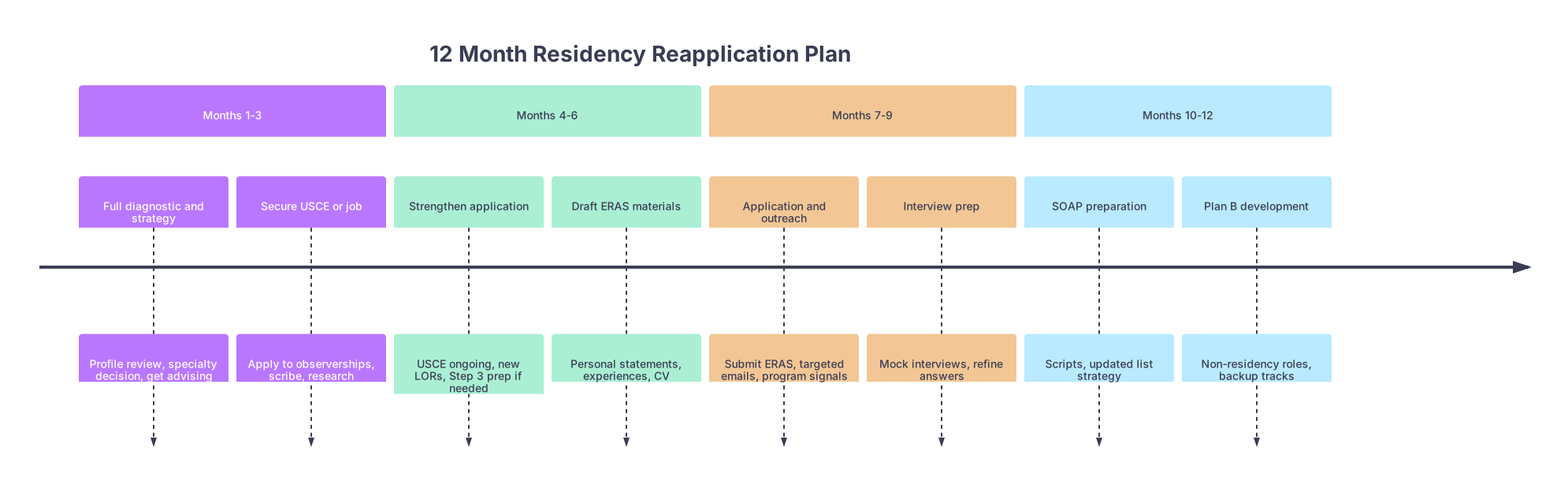
| Period | Event |
|---|---|
| Months 1-3 - Full diagnostic and strategy | Profile review, specialty decision, get advising |
| Months 1-3 - Secure USCE or job | Apply to observerships, scribe, research |
| Months 4-6 - Strengthen application | USCE ongoing, new LORs, Step 3 prep if needed |
| Months 4-6 - Draft ERAS materials | Personal statements, experiences, CV |
| Months 7-9 - Application and outreach | Submit ERAS, targeted emails, program signals |
| Months 7-9 - Interview prep | Mock interviews, refine answers |
| Months 10-12 - SOAP preparation | Scripts, updated list strategy |
| Months 10-12 - Plan B development | Non-residency roles, backup tracks |
Months 1–3: Fix direction and get clinical activity
Concrete tasks:
Clarify specialty
- If you aimed too high: seriously consider switching to IM, FM, Psych, Peds, or Prelim Medicine/Surgery.
- If you are dead‑set on a competitive field despite weak stats, accept that you may be choosing low match probability. Own that.
Get into a clinical environment Priority order:
- US clinical experience (USCE) in your intended specialty (observerships, externships, sub‑internships).
- Related clinical employment: hospitalist scribe, clinical research coordinator, MA, ED tech (if licensed).
- Volunteer clinical work with consistent patient contact.
Secure at least 2–3 new potential letter writers
- You want US attending physicians who see you working, not just old faculty who barely remember you.
- Tell them early: “I did not match last year; I am working to reapply and need honest feedback and, if appropriate, a strong letter.”
Months 4–6: Upgrade your application content
By now you should be in an ongoing role (USCE or job). Here is what to focus on.
Strengthen the numbers (where possible)
Step 2 CK / COMLEX 2
- If your Step 2 is below ~230 (US MD/DO) or below ~240 (IMG), you need every other part of your application to be ridiculously strong, or you need Step 3.
Step 3 (for certain profiles) You should strongly consider Step 3 before September if:
- You are an IMG or older graduate
- You have prior exam failures
- You are aiming at IM, FM, Psych, or other non‑surgical fields
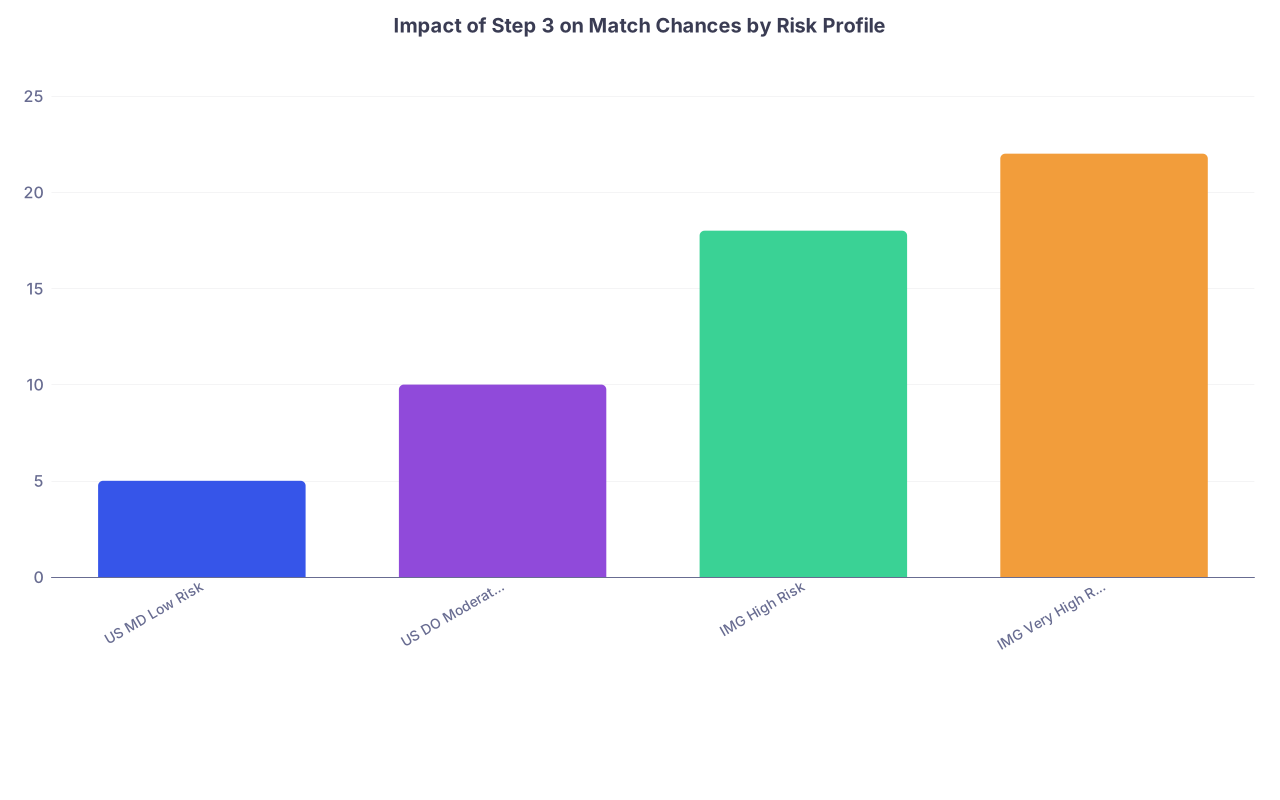
| Category | Value |
|---|---|
| US MD Low Risk | 5 |
| US DO Moderate Risk | 10 |
| IMG High Risk | 18 |
| IMG Very High Risk | 22 |
(Percent absolute bump I have seen anecdotally when a solid Step 3 is added—especially for IMGs. Not magic. But sometimes the difference between auto‑screen out and “let’s take a look.”)
Rewrite your personal statement and ERAS entries
You do not get to recycle last year’s materials. Programs will recognize it, and more importantly, you will drag the same weaknesses forward.
Your new personal statement must:
- Explain briefly what changed since last cycle (one tight paragraph, not a confessional)
- Show insight: “Here is what went wrong, here is what I did about it”
- Demonstrate current clinical engagement and growth
- Align with specialty in a way that makes sense for your history
Examples of what I want to see:
- “After not matching last cycle, I secured a full‑time position as a clinical research coordinator in a busy internal medicine practice, where I now manage data for over 150 patients with chronic disease…”
- “To address my earlier Step 1 failure, I sought structured feedback, passed Step 2 CK on my first attempt, and am currently preparing for Step 3 with a focus on test‑taking strategy and time management.”
Not:
- “I have always dreamed of being a physician since I was a child.”
- “I am passionate about helping people.”
Everyone says that. It does not move the needle.
Your ERAS experience section:
- Update all activities with current dates and clear outcomes.
- Use specific, impact‑oriented descriptions:
- “Coordinated care for 15–20 patients daily as a scribe, improving documentation accuracy and enabling attendings to see 2–3 additional patients per clinic.”
- Not: “Helped doctors with patients.”
Months 7–9: Apply aggressively and intelligently
When ERAS opens, your goal is to compensate for last year’s limited interviews with:
- Better targeting
- Higher volume (within reason)
- Much stronger outreach
Application strategy this time
If you had limited interviews last time, minimum baseline this cycle:
- Primary care or IM: often 100–150+ programs (US MD/DO may be lower; IMGs often need higher)
- Psych, Peds: 80–120+
- Surgery/competitive fields: nearly every program that is not clearly out of reach
Stop picking programs by “nice city” or “friends live there.” Instead, prioritize:
- Community programs
- Newer programs (<10 years old)
- Programs with a history of taking:
- IMGs (if you are one)
- Older grads
- Lower‑tier scores
Filter by:
- Visa sponsorship (if needed)
- USMLE/COMLEX requirements clearly posted
Then apply broadly within that filtered list.
Outreach without being annoying
No, you cannot spam every PD with a generic email. But you can do focused, targeted outreach that sometimes flips a “no” to a “maybe.”
Structure it like this:
- Identify:
- Programs where you have any connection: alum, faculty, geographic tie, prior rotation, research collaborator.
- Send:
- One concise, respectful email per program, ideally in mid‑September, after applications are in but before most interview slots are filled.
- Content:
- Who you are (1 line), what changed since last cycle (1–2 lines),
- Why this program (specific reason, 1–2 lines),
- Attach ERAS CV / PS or mention your AAMC ID.
Do not write novels. PDs do not have time.
4. Fix the Interview Problem (Because SOAP Will Test It Again)
If you had:
- Zero interviews: that is an application / targeting issue.
- A few interviews but no rank offers or SOAP spots: that is at least partly an interview problem.
Build a specific interview plan
You are not “bad at interviews.” You are untrained. Fixable.

Core tasks:
Script your red‑flag answers If you have:
- Exam failures
- Gaps
- SOAP history
You must have crisp, practiced answers to:
- “Tell me about your Step failure.”
- “You did not match last year. Why should we take you now?”
- “What did you do in the last year?”
Structure:
- Own it (no blaming)
- Explain the cause in one sentence
- Emphasize what you changed
- Show evidence of improvement
Rehearse core questions Not with your friend who says “you are great.” With:
- A faculty advisor
- A resident
- A professional coach (if you can afford it and they know residency interviews)
Focus on:
- “Tell me about yourself.”
- “Why this specialty?”
- “Why our program?”
- “Describe a conflict / mistake / challenging patient.”
You want clear, 2–3 minute answers that:
- Show self‑awareness
- Highlight specific experiences from your recovery year
- Stay structured (Situation – Action – Result – Reflection)
Fix your virtual setup If interviews are virtual again (and many are):
- Neutral background
- Camera at eye level
- Good lighting (front, not overhead only)
- Wired internet if possible
- Test everything with a friend or mentor on Zoom BEFORE interview day
5. Prepare Now for a Better SOAP Outcome
You have already felt how vicious SOAP can be with limited interviews. You do not get to improvise this year.
Understand what SOAP actually is
SOAP is not a second Match. It is an emergency staffing solution for programs. They want:
- Warm bodies who can start July 1
- Reliable, low‑maintenance interns
- Applicants who accept quickly and will not cause headaches
They are not optimizing for your dream specialty. You must decide in advance how far you are willing to pivot.
Pre‑SOAP checklist (that almost nobody does properly)
By January–February of your new application year, you should have:
A realistic SOAP specialty list
- IM prelim, FM, Psych, Peds, transitional year, or even less‑popular fields that leave spots.
- Decide now which specialties you will consider in SOAP. Not in the 10‑minute SOAP window while panicking.
SOAP‑specific personal statements
- Shorter, more direct, aligned with each potential SOAP specialty.
- Explicitly mention: adaptability, willingness to serve in underserved areas, readiness to start.
SOAP scripts for calls You will get 5–10 minutes sometimes. If you ramble, you are done.
Prepare 30–60 second versions of:
- Who you are + where you are now (clinical role)
- Why you are interested in their program’s specialty
- Why you did not match previously and what you changed
Logistics
- Reliable phone and backup line
- Email you check constantly
- Time blocked off during SOAP week (do not plan full clinic days if you can avoid it)
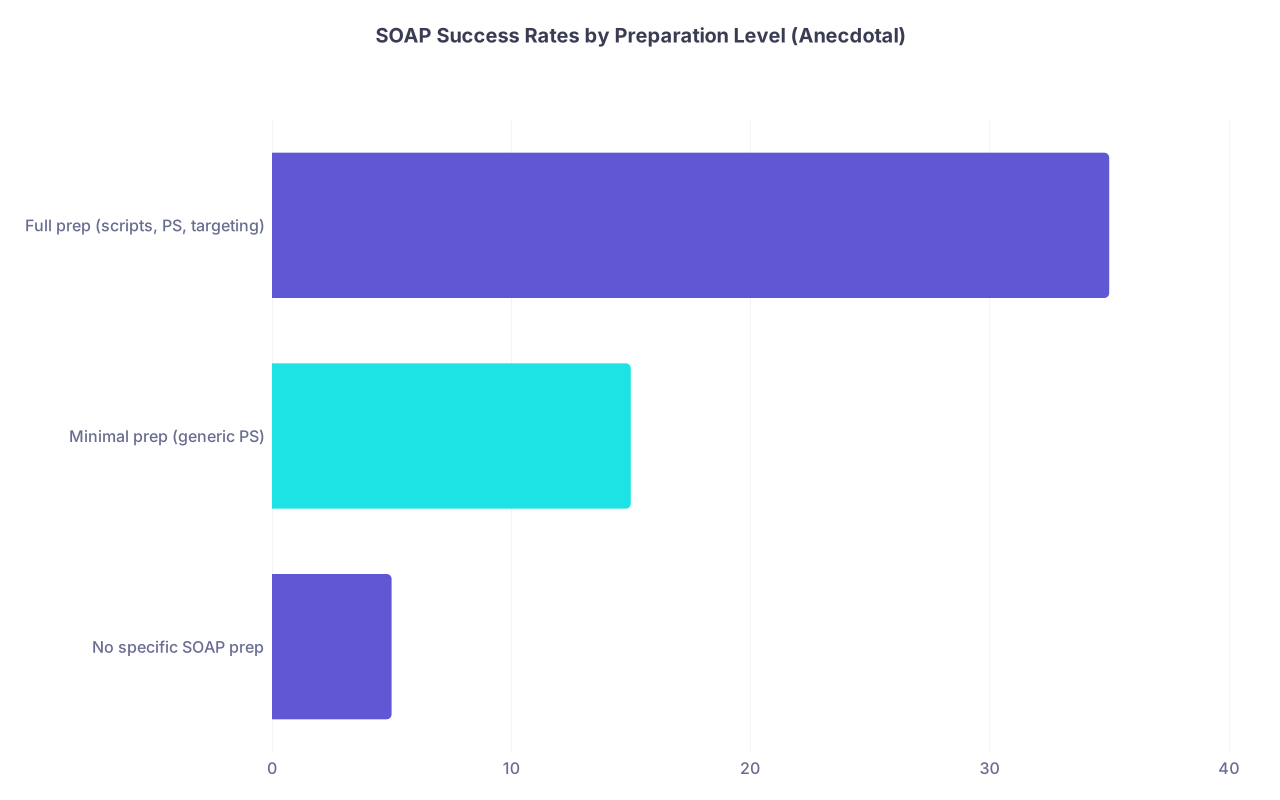
| Category | Value |
|---|---|
| No specific SOAP prep | 5 |
| Minimal prep (generic PS) | 15 |
| Full prep (scripts, PS, targeting) | 35 |
Those numbers are not from a randomized trial. They are from watching hundreds of unmatched applicants over multiple cycles. The pattern is obvious: people who treat SOAP like an exam to prepare for do better.
6. Protect Your Sanity and Financial Reality
Let us not pretend this is just “professional development.” This is your life, money, and mental health on the line.
Financial planning
You cannot just keep paying ERAS fees, exam fees, and living expenses forever.
- Build a simple budget:
- Fixed costs: rent, food, utilities, minimum debt payments
- Variable costs: exam fees, application fees, coaching if used
- Get work that:
- Pays your bills
- Adds to your clinical profile
- Keeps you in a healthcare environment if possible
If your plan requires money you do not have, it is not a plan. Adjust scope.
Mental health and identity
Not matching wrecks people. I have seen residents treat unmatched applicants like failures, which does not help.
You need:
- One or two people who are allowed to hear you be angry and scared
- One mentor who is allowed to tell you hard truths
- Some boundary between “me as a human” and “me as an applicant”
If you find yourself stuck in shame loops and paralysis, get professional mental health support. That is not overkill. It is what keeps you moving.
7. If You Decide To Pivot Away From Residency
Some of you will read all this and realize: you are done chasing residency. That is a valid decision if made consciously.
You can:
- Move into non‑residency clinical roles (depending on country): advanced clinical assistant, research clinician roles, informatics.
- Transition to industry: pharma, med‑tech, consulting, medical writing, clinical trials.
- Go academic in another way: PhD programs, public health (MPH), health administration (MHA).

What you should not do is:
- Float for years doing low‑wage work unrelated to healthcare, telling yourself you will reapply “someday” without changing anything real.
If you pivot, pivot hard. Use your MD/DO knowledge in a direction where people will value it.
8. A Sample Recovery Blueprint (Putting It All Together)
To make this concrete, here is how a realistic one‑year plan might look for someone who:
- Is an IMG
- Graduated 3 years ago
- Step 1: Pass
- Step 2 CK: 226
- No matches, no SOAP spot, 2 interviews last cycle in IM
Goal: Match into Internal Medicine (categorical or prelim) in the next cycle.
Month 1–2
- Secure USCE: 3‑month observership in IM in a community hospital.
- Start Step 3 prep with a clear test date 6–8 months before next July 1.
- Meet with program director or experienced faculty for brutally honest feedback.
Month 3–5
- Perform well on USCE: show up early, volunteer for presentations, ask for feedback.
- Request 2 strong LORs from US attendings by month 5.
- Finalize decision: aim mainly at community IM programs and prelim spots as backup.
Month 5–6
- Take Step 3 (target score ≥ 220–225).
- Rewrite personal statement around:
- Growth
- Current hands‑on clinical work
- Clear motivation for IM
Month 6–7
- Build ERAS:
- Update all entries
- Add USCE, any research or QI projects, teaching
- Identify 150–200 IM programs with a history of taking IMGs and Step 3‑completed applicants.
Month 7–9
- Submit ERAS early.
- Conduct 3–5 mock interviews.
- Targeted emails to 20–30 programs where you have some connection or realistic interest.
Month 10–12
- Continue clinical work to avoid gaps.
- Build SOAP toolkit: specialty list (IM prelim, FM, Psych), SOAP PSs, call scripts.
- Clarify personal line: what you will and will not accept in SOAP (location, specialty).
If this person executes strongly, they are not guaranteed a match. But their odds go from “very low” to “realistic.” I have seen those exact stats succeed when the plan and the follow‑through were this disciplined.
Quick Recap: What Actually Changes Your Outcome
If you had no SOAP offers last year and limited interviews, here is what matters:
Radical honesty about last cycle
No more “I think it was just bad luck.” You identify and own the specific reasons your application and SOAP strategy did not work.A structured 12‑month plan with real upgrades
New USCE or clinical work, stronger LORs, better targeted specialties, possible Step 3, and dramatically better written and interview performance.Serious SOAP preparation—not improv
Specialty choices, personal statements, and answer scripts built before SOAP week, with logistics and mindset ready for rapid decisions.
If you do those three with discipline, your story stops being “the person who did not match in SOAP twice” and becomes “the person who recovered from a rough cycle and still got into residency.” That is a story programs actually respect—when the work behind it is real.
FAQ
1. Should I switch specialties if I had zero SOAP offers and very few interviews?
Often, yes. If you applied to a competitive specialty (Derm, Ortho, Radiology, Anesthesia, EM in many regions) with below‑average stats or as an IMG and got almost no traction, a pivot to IM, FM, Psych, or Peds significantly improves your odds. Staying in the same specialty is only reasonable if you can show major upgrades (Step 3, new research, extremely strong connections) and you accept a lower probability of success.
2. Do I really need to take Step 3 before reapplying?
Not everyone. But if you are an IMG, older graduate, or someone with prior exam failures, a solid Step 3 score is one of the few levers you still control. It does not erase Step 1/2 issues, but it reassures programs that you can pass licensing exams and handle residency boards. For US MDs with no red flags and decent Step 2, Step 3 is less critical before matching.
3. Is it worth paying for professional advising or coaching after an unsuccessful SOAP?
It depends who you hire and what you need. Good advising can shorten your learning curve, especially for interview prep and specialty targeting. Bad advising will happily take your money and recycle generic advice. If you invest, demand specificity: they should review your full prior application, give concrete feedback, and help you build a customized strategy—not just tell you to “apply broadly” and “improve your personal statement.”