
The way you told your story this season did not work. If you go into SOAP with the same narrative, you are going to repeat the same outcome—just faster and with higher stakes.
You do not need a new personality or a miracle. You need a reframed, tighter, more honest application story calibrated specifically for SOAP: compressed timeline, different programs, different expectations, and a much harsher filter.
Let me walk you through exactly how to rebuild your story so it actually lands this time.
1. Accept the Failure, Then Frame It – Fast
SOAP moves on a clock. You do not have time for a week of reflection. You have about an evening.
Here is the mindset reset you need to do in a single sitting:
Name what went wrong in one sentence.
- “Applied too top-heavy with a 220 Step 2.”
- “Switched to EM late with weak EM letters.”
- “US-IMG with no home program, limited US LORs.”
- “Red flag: failed Step 1, not addressed well.”
Decide what story you are telling now.
Your SOAP story cannot be “I’m a strong applicant whose only issue is bad luck.” Programs know the numbers. They saw your ERAS. Your new story must be:- Specific
- Plausible
- Aligned with the specialties that are actually open in SOAP
Pick one of these honest SOAP narratives (adapted to your reality):
- “I am a solid, reliable clinician who was over-ambitious in my initial list and am now prioritizing fit and service.”
- “I overcame [specific academic issue] and my recent performance shows who I am now.”
- “I am pivoting to a specialty where my skills and record actually fit, and I am all-in.”
- “I am an IMG/FMG bringing real clinical experience and maturity, and now I am being realistic about training location and program type.”
Do not overcomplicate this. You need a clean through-line that every part of your SOAP application repeats: personal statement, emails, calls, interviews.
2. Diagnose Why Your Season Fell Flat – With Evidence
Stop guessing. Before you reframe, you need an accurate autopsy of your season.
A. Look at your data, not your feelings
Pull up your ERAS and your spreadsheet (and if you do not have one, make it now from memory):
- Number of programs applied per specialty
- Distribution of program tiers (community vs university vs big-name academic)
- Your core stats:
- Step 1: Pass/Fail (and any fails)
- Step 2 CK score
- Class rank/quartile
- Any remediation/leaves
- Letters:
- How many in-specialty LORs?
- Any chairs/program directors?
- Geography:
Now, compare to what programs actually want. Use your specialty’s NRMP data and known competitiveness.
| Specialty Tier | Typical Step 2 Target | Comment |
|---|---|---|
| Very competitive (Derm, Ortho, ENT, Plastics) | 250+ | SOAP rarely an option |
| Competitive (EM, Anes, Rads, Gas) | 240+ | Borderline below 235 |
| Mid (IM, Gen Surg, OB, Peds) | 230+ | Many community take 220–230 |
| Less competitive (FM, Psych, Neuro) | 220+ | Some accept below 220 |
| Prelim/TY/Transitional | Widely variable | Heavily context-dependent |
(These are rough; your exact year will have its own data, but you get the idea.)
B. Common “season fell flat” patterns
I see the same patterns over and over:
- Overreach only: 30–40 applications, but nearly all to big university or top-tier programs with an average Step 2 and no standout research.
- IMG blind spot: US-IMG/IMG applies almost exclusively to university programs in major cities, with few or no community/university-affiliated community programs.
- Specialty mismatch: Middle-of-the-road scores for a very competitive specialty, weak in-specialty letters, no back-up.
- Unaddressed red flag: Failed Step 1 or repeated course brushed under the rug with vague language instead of direct explanation and concrete improvement.
- Late pivot: Decided specialty late, had only one rotation or one letter, and tried to compensate with generic statements.
Pick your top two real issues. Those become the axis of your SOAP reframing:
- One: what hurt you.
- Two: how you have already responded and why you are better positioned now.
3. Choose a SOAP-Realistic Specialty Strategy
SOAP is not “Match 2.0.” It is a scramble for unfilled spots in specialties that, by definition, struggled to fill or have geographic/institutional challenges.
You must adapt your story to where the openings actually are.
A. Understand what SOAP really offers
Historically, SOAP has more openings in:
- Family Medicine
- Internal Medicine (especially community and smaller hospitals)
- Pediatrics (varies by year)
- Psychiatry (increasingly competitive, but still present)
- Preliminary positions (IM prelim, surgery prelim)
- Transitional Year (some years tight, others more open)
Rare in SOAP:
- Derm, Ortho, ENT, Urology, Plastics, Neurosurgery, Ophthalmology
- Top-tier academic categorical positions in competitive fields
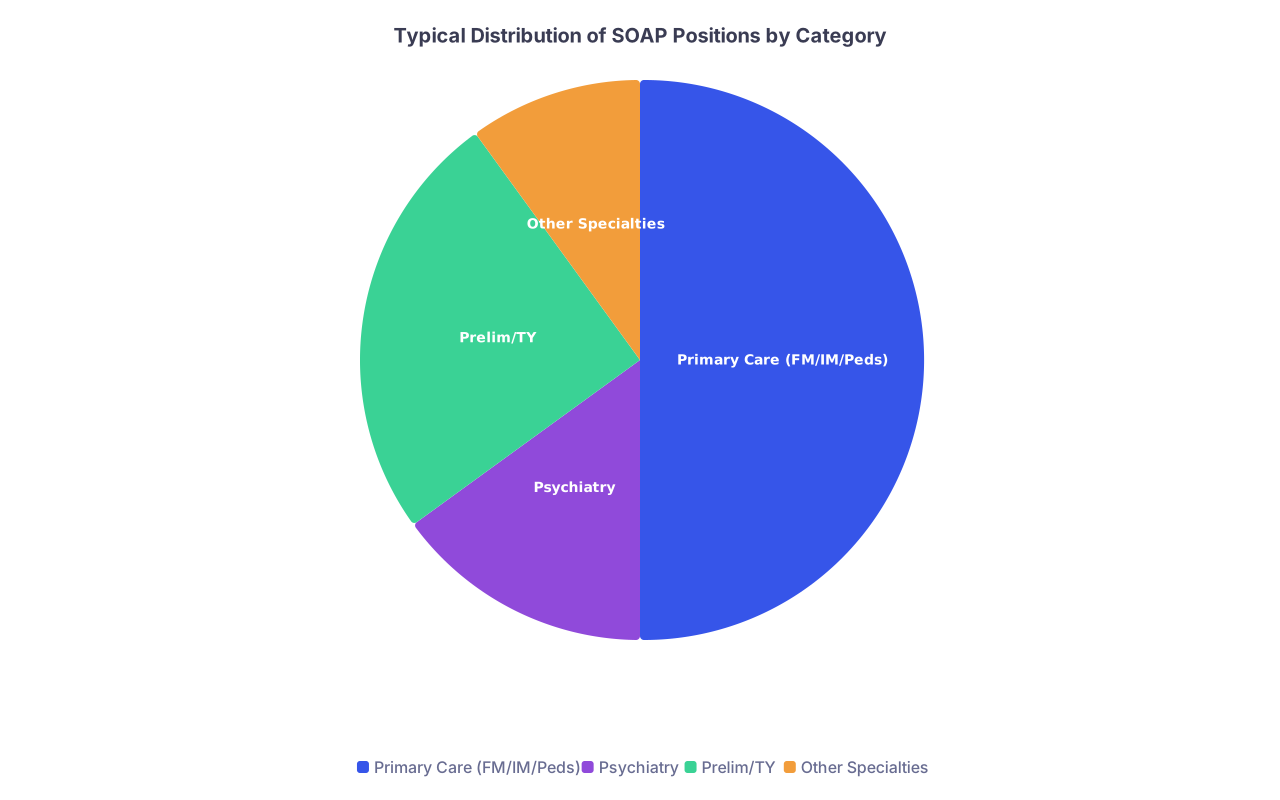
| Category | Value |
|---|---|
| Primary Care (FM/IM/Peds) | 50 |
| Psychiatry | 15 |
| Prelim/TY | 25 |
| Other Specialties | 10 |
You cannot force SOAP to give you spots that do not exist.
B. Decide your SOAP target in 15 minutes
Brutal but fair decision tree:
If your stats and record were already marginal for your original specialty:
→ Strongly consider pivoting to a less competitive field where you can genuinely commit and explain the pivot.If you targeted a competitive specialty but also did significant work in IM/FM/Peds/Psych:
→ You can credibly pivot if you reframe your clinical experiences and letters fast.If you are dead-set on your original specialty and will only consider prelim/TY: → Then your story must clearly articulate:
- Long-term goal in the specialty
- Why a prelim year with strong IM/Surg training is a logical, committed step
- What you will bring to their program in that one year (workhorse, low-drama, reliable)
Be clear: programs know when you are only using them as a “holding pattern.” You need to show that you will show up, do the work, and not be a problem for 12 months.
4. Rewrite Your Personal Statement for SOAP – Tighter and Targeted
Your SOAP personal statement is not a novel. It is a surgical document.
Goal: 600–800 words, tightly focused, clearly answering three questions:
- Who are you as a clinician and person?
- Why this specialty/role now (including after an unsuccessful main match)?
- Why you will be a safe, reliable, teachable resident on day one?
A. Core structure that works
Use this 4-part format:
Opening anchor (1 short paragraph)
One clear clinical vignette or defining moment that:- Is in the SOAP specialty (or clearly linked)
- Shows you doing real work: listening, thinking, managing, following through
- Hints at your reliability and team mentality
Trajectory + strengths (2–3 short paragraphs)
Focus on:- Concrete clinical strengths: pattern recognition, communication with patients, thoroughness, calm under pressure
- Specific examples: sub-I performance, night float responsibility, running a family meeting
- Any recent positive trend: improved Step 2, strong sub-I evals, leadership roles
Addressing the flat season (1 paragraph)
Do not write a sob story. Two or three precise sentences:- Acknowledge the unsuccessful season without over-explaining.
- Name one or two key factors succinctly.
- Emphasize what you learned and how you adjusted (more realistic specialty, broadened geography, clearer understanding of fit).
Example:
“I did not match in the main cycle. I aimed almost exclusively at large academic programs in [specialty] despite a profile that fit better with community-based training. Since then, I have reassessed my goals and realized that my strengths—longitudinal patient relationships, clear communication, and team-based care—align more naturally with Family Medicine programs that prioritize continuity and service.”Closing: commitment + fit (1 short paragraph)
Reiterate:- Why you are committed to this specialty or prelim/TY path.
- The kind of resident you will be: dependable, coachable, steady.
- One sentence that signals you understand the reality of their work (night coverage, underserved populations, high-volume service).
5. Reframe Your Experiences and CV for SOAP
You are not rewriting ERAS entirely, but you are reframing emphasis.
A. Reorder and re-label experiences mentally (and where possible)
You cannot change ERAS fields post-submission, but you can change how you talk and write about them:
Clinical experiences:
For primary care SOAP (IM/FM/Peds/Psych):- Emphasize continuity clinics, longitudinal care, complex multi-morbidity.
- Highlight communication, follow-up, and care coordination rather than rare procedures.
For prelim/TY:
- Emphasize high acuity, night float, cross-cover, call, triage.
- Highlight efficiency, time management, familiarity with floor workflows.
Research:
- If you have a bunch of research in a competitive non-SOAP specialty (e.g., Ortho) but are SOAPing into IM:
→ Present it as evidence of your ability to think critically, analyze literature, and persist through long-term projects. Do not pretend it “proves” an interest in IM; let it show work ethic and discipline.
- If you have a bunch of research in a competitive non-SOAP specialty (e.g., Ortho) but are SOAPing into IM:
Leadership & extracurriculars:
- Highlight roles that show:
- Reliability (class rep, committee work followed through)
- Service (free clinics, community outreach)
- Working with limited resources (fits many SOAP program realities)
- Highlight roles that show:
B. Build a 3–4 sentence “CV narrative” you can use everywhere
This is the spine of your SOAP story in emails, calls, and interviews:
Example for IM SOAP:
“I am a US-IMG with strong recent performance in internal medicine, including a sub-internship where I received top evaluations for clinical judgment and ownership of patient care. I had a limited number of interviews this season after applying too narrowly to university programs, despite having a profile that fits well with community-based IM. I am looking for a program where I can work hard, take responsibility, and grow as a reliable, thorough intern who supports the team.”
Write your own version and actually memorize it.
6. Rewrite Your Email and Phone Script: Direct, Respectful, Focused
You will be reaching out to programs—often fast and with little notice. Sloppy, desperate messages get ignored. Tight, respectful ones get read.
A. SOAP outreach email template (adapt it, do not copy-paste blindly)
Subject line options:
- “SOAP Applicant – [Your Name], [Specialty] Interest”
- “SOAP Candidate with strong IM Sub-I – [Your Name]”
- “SOAP – US-IMG applicant with recent 240 Step 2 – [Your Name]”
Body:
Dr [Program Director Last Name],
My name is [Name], and I am a [US MD / US DO / US-IMG / IMG] graduating from [School]. I am participating in SOAP and very interested in [Program Name]’s [Specialty] positions.
Briefly, my strengths include [1–2 concrete strengths: e.g., strong recent IM sub-I with excellent evaluations, 235 Step 2, extensive experience in underserved clinics]. I did not match in the main cycle after focusing my applications on larger academic centers despite a profile that aligns better with community-based programs like yours.
I am committed to [Specialty] and to contributing as a reliable, hard-working intern. I would be grateful if you would consider my application during SOAP. I have attached my CV for quick reference and am happy to provide any additional information.
Thank you for your time and consideration.
Sincerely,
[Name]
AAMC ID: [ID]
Phone: [Number]
Notice:
- One sentence explaining the flat season.
- Clear statement of fit and commitment.
- No whining. No life story.
B. Phone script for when they actually call
You need a 20–30 second opener that hits your reframed story:
“Thank you for calling. I am very interested in your program. Briefly, I am a [US-IMG] graduating from [School]. My strengths are [clinical strengths]. I did not match in the main cycle after applying narrowly to larger academic centers, but I have realized that a program like yours, with strong clinical training and a diverse patient population, fits my strengths much better. I am ready to work hard and be a reliable member of your team from day one.”
Practice it. Out loud. It should feel natural, not memorized, but you need the bones ready.
7. Prepare for SOAP Interviews: How to Talk About the Failed Season
They will ask: “So, what happened this cycle?”
If you freeze or ramble, you are done.
A. Use this 3-part formula for the “why did you not match” question
Own it simply.
One sentence:- “I aimed too high with my program list relative to my application strength.”
- “I switched specialties late and did not have enough in-specialty exposure and letters.”
- “I had a prior exam failure and did not address it directly or early enough.”
Show insight and adjustment.
- “Since then, I have taken a hard look at my application and realized my strengths align better with community-based [specialty] programs like yours.”
- “I have broadened my geographic preferences and focused on programs where my clinical work and personality are a good fit.”
Reaffirm commitment and future focus.
- “I am fully committed to [specialty], and my priority now is to find a program where I can work hard, learn, and contribute for the long term.”
Keep it under 45 seconds. Then stop. If they want more detail, they will ask.
B. Hit three points every SOAP interview
No matter what they ask you, keep threading these:
Reliability:
- Specific example of showing up early, staying late, carrying extra patients.
- What attendings/residents say about you in evaluations: “thorough,” “dependable,” “calm under pressure.”
Coachability:
- Times when you incorporated feedback and improved quickly.
- How you handled a setback (bad evaluation, exam struggle) and what changed.
Fit for their flavor of training:
- If they are community-based: talk about liking hands-on work, direct patient care, continuity, limited resources.
- If they are safety-net: talk about underserved care, social determinants, comfort with complexity and limited follow-up.
- If they are prelim: talk about work ethic, being a good teammate even if you are leaving after one year.
8. Protect Your Mind and Behavior During SOAP Week
SOAP breaks people who treat it like a referendum on their worth instead of what it really is: an ugly, compressed labor market.
You will make worse decisions if you are spiraling.
A. Set clear behavioral rules for yourself
Write them down:
- “I will not send angry or emotional emails to any program.”
- “I will not talk badly about any previous program or PI in interviews.”
- “I will not lie or exaggerate my experience to try to look stronger.”
- “I will apply to all programs I would realistically attend; I will not be overly picky during SOAP.”
You would be surprised how many people blow themselves up on this.
B. Control your inputs
- Limit social media. Watching others post Match success while you are SOAPing is gasoline on a fire.
- Pick 1–2 people to talk to about the process (mentor, advisor, one friend). Not ten.
- Work in short, focused bursts:
- 30–60 minutes: write/edit.
- 10–15 minutes: break.
- Repeat.
This is not about wellness platitudes. It is about not sabotaging yourself with panic.
9. After SOAP: Keep the Story Moving Forward
If you match in SOAP, your story becomes: “I adjusted, I found the right place, I showed resilience.” Great.
If you do not match, your reframed SOAP story still matters. Because now you are setting up:
- Reapplication next cycle
- Possible research year, prelim year, or non-training clinical work
Your narrative shifts again to:
- “Here is how my performance / portfolio has changed since last cycle.”
- “Here is the concrete value I bring now (new letters, stronger exams, more US clinical experience).”
But you are not there yet. Right now, your job is to execute a precise, reframed, SOAP-specific story.

10. A 24-Hour Action Plan to Reframe Your Story for SOAP
If SOAP is coming and your season fell flat, you do not need a philosophy. You need a checklist.
Hour 1–2: Autopsy and decision
- Write down:
- Step scores, class rank, red flags.
- Number and type of programs you applied to and how many interviews you got.
- Identify the two main reasons your season failed.
- Decide your SOAP specialty strategy:
- Pivot vs same specialty vs prelim/TY.
- Write your 3–4 sentence CV narrative.
Hour 3–5: Rewrite core documents
- Draft a new SOAP-focused personal statement:
- Clinical anchor.
- Strengths.
- One paragraph on the failed season and what changed.
- Clear commitment and fit.
- Revise your CV (if sending separately) to emphasize SOAP-relevant experiences.
Hour 6–7: Build outreach templates
- Write:
- One base outreach email template.
- Subject lines for different scenarios.
- Write:
- Phone script for answering unknown numbers.
- 45-second answer for “Why did you not match?”
Hour 8–10: Rehearse and tighten
- Practice your CV narrative and “no match” answer out loud 10–15 times.
- Call a friend/mentor and have them ask you:
- “Tell me about yourself.”
- “Why this specialty now?”
- “Why our program?”
- “What happened this season?”
Hour 11–12: Logistics and mental prep
- Confirm:
- Your phone is charged and will receive calls.
- Email forwarding/notifications are working.
- Write your behavioral rules on paper and put them next to your workspace.
- Sleep. Seriously. Groggy, scattered answers ruin chances.
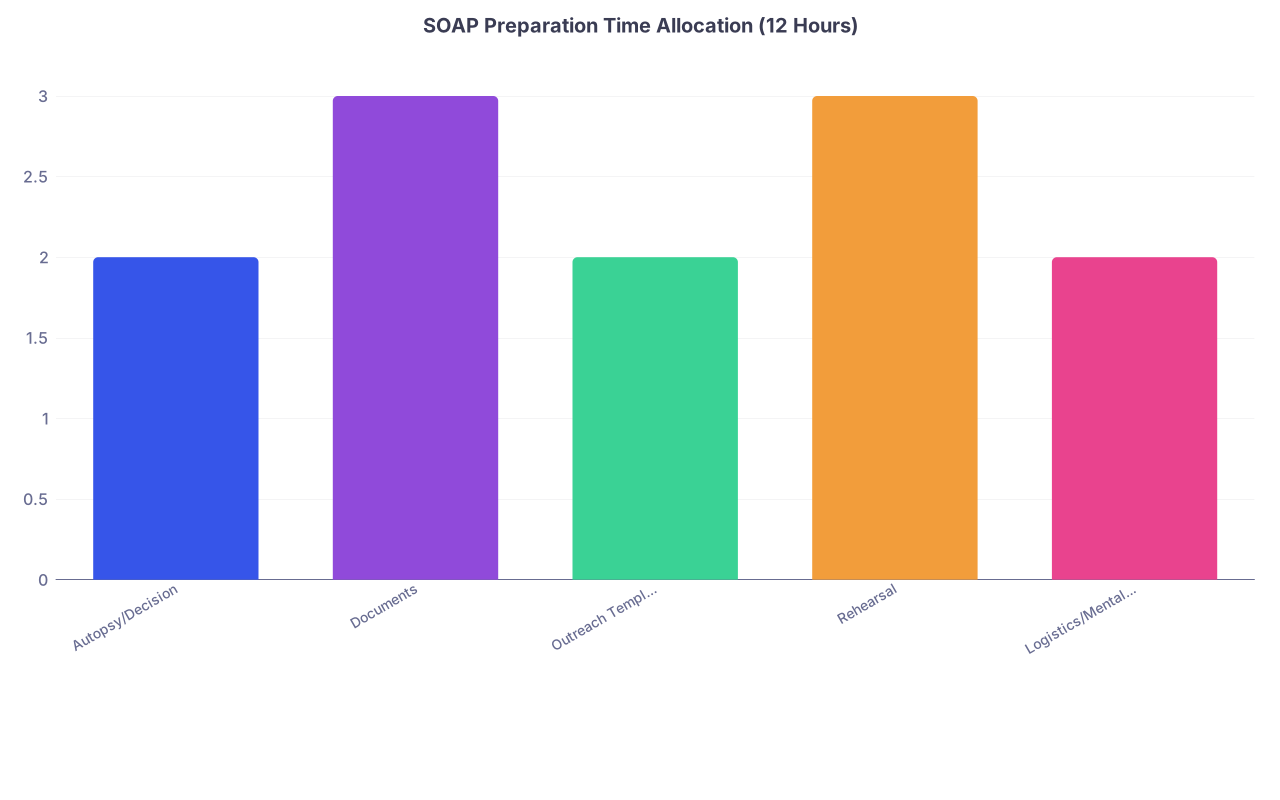
| Category | Value |
|---|---|
| Autopsy/Decision | 2 |
| Documents | 3 |
| Outreach Templates | 2 |
| Rehearsal | 3 |
| Logistics/Mental Prep | 2 |
Key Takeaways
- Do not reuse the same story that failed in the main Match. Identify why your season fell flat and build a new, honest, and SOAP-realistic narrative.
- Aim your reframed story at where SOAP actually has positions, not where you wish it did. Pivot or accept prelim/TY strategically if needed.
- Make every touchpoint—personal statement, emails, phone calls, interviews—hit the same three beats: responsibility for the failed season, clear adjustment, and a credible, specific commitment to the specialty and type of program you are now pursuing.