
You should not accept a preliminary or transitional SOAP offer by default. You should accept it only as part of a clear, brutally honest strategy.
If you are in SOAP with only prelim or TY offers on the table, you are at a crossroads. One path gives you a job next year but can trap you in limbo. The other path is riskier in the short term but might save your long–term career. Most people around you will tell you, “Just take anything.” That is lazy advice.
Let me walk you through how to handle this like a strategist, not a panicked applicant.
Step 1: Stop the Spiral and Get the Facts Straight
First thing: do not click “accept” on anything until you understand exactly what is in front of you.
You are likely seeing one or more of:
- Preliminary internal medicine (1-year)
- Preliminary surgery (1-year)
- Transitional year (1-year, often cushier than prelim)
- Possibly a mix of community and academic programs
Here is what these actually mean.
Preliminary year
- One year only
- Often designed for advanced specialties (radiology, anesthesia, derm, ophtho, PM&R, neuro) that start at PGY-2
- You are not automatically promoted into a categorical spot
- IM prelim can be decent; surgery prelim is notoriously brutal and uncertain
Transitional year (TY)
- One year, usually a mix of medicine, outpatient, electives
- Often easier lifestyle than prelim surgery, sometimes similar to prelim IM
- Used by advanced specialty applicants to bridge PGY-1
- Same problem: does not guarantee an advanced or categorical spot anywhere
Right now your brain is probably running three competing scripts:
- “I must match into something this year.”
- “I do not want to lock myself into a dead end.”
- “What if I decline and then never match at all?”
You need data, not feelings.
Get the hard information down in writing
Open a blank document and for each offer (or likely offer) write:
- Program name and ACGME ID
- Type: prelim IM, prelim surgery, TY
- Location and hospital system
- PGY-1 salary and benefits
- Call schedule / reputation (ask quickly: classmates, residents, Reddit, SDN – but filter noise)
- Known track record:
- Do prelims successfully move into:
- Categorical IM/FM/other at that institution?
- Advanced positions (anesthesia, rads, etc.)?
- Or do they disappear after a year?
- Do prelims successfully move into:
If you cannot find this last piece, email or call the program coordinator today and ask a simple, direct question:
“For your most recent three prelim/TY classes, approximately what percentage obtained a PGY-2 position, and in what specialties or programs?”
If they dodge, that is data. If they say, “We do not keep track,” that is also data. Strong programs know where their trainees go.
Step 2: Decide Your Realistic Career Target (Not Your Fantasy One)
You cannot make a good prelim/TY decision until you are honest about where you are actually headed.
Ask yourself:
- What specialty were you originally aiming for this year?
- How many interviews did you get in that specialty before SOAP?
- Is your application competitive for that specialty on paper:
- USMLE/COMLEX scores
- Red flags (fails, leaves of absence, professionalism issues)
- Research and letters in that specialty
- Visa needs (huge factor)
- Have you already applied to categorical back-up specialties (IM, FM, psych, peds) this cycle?
If you applied broadly to IM/FM and still ended up in SOAP with only prelim/TY, that is very different from the person who applied only to derm and rads and ignored backup entirely.
Be brutally honest and put yourself in one of these buckets
| Bucket | Description |
|---|---|
| A | Competitive for realistic categorical backup next year |
| B | Borderline but salvageable with improvements |
| C | Weak applicant, serious red flags, limited options |
Bucket A – Competitive with proper targeting
Example: US MD, 225+ Step 1 (when it had scores) and 235+ Step 2, no fails, some research, solid clinical evaluations. You aimed high (e.g., anesthesia, rads) with almost no backup.
You probably can match categorical IM/FM/psych next year if you correct your strategy.
Bucket B – Borderline but fixable
Example: US or IMG with some weaknesses – one exam fail, late Step 2, inconsistent clinical performance, or limited interviews even for backup. But not a train wreck.
You may need a year to fix narrative, get stronger letters, maybe improve scores (Step 3), and target less competitive locations or community programs.
Bucket C – Major structural issues
Multiple exam failures, professionalism problems, very low scores, or non-US grad with big time gap and weak clinical experience. You struggled even to get SOAP prelim/TY.
You must consider whether medicine training in the US is realistically still on the table or if you are pushing against a closed door.
Your bucket determines how aggressively you should use (or avoid) a prelim/TY.
Step 3: Understand What Each Path Actually Looks Like
You have three real options when you only have prelim/TY SOAP offers.
- Accept a prelim/TY and use it strategically.
- Decline all prelim/TY and plan a re-application year.
- Exit the match/residency path and pivot.
Let us walk through each, but not in abstract. I will tell you what actually happens.
Path 1: Accept a prelim/TY – But With a Plan, Not Blind Hope
This path makes sense for:
- Bucket A, sometimes B
- People who cannot afford a gap year for financial, visa, or personal reasons
- Those targeting advanced specialties with a realistic chance of PGY-2 spots
If you go this way, you must treat your prelim/TY not as “I matched” but as “I purchased 12 months to fix my application with an income.”
You do not:
- Assume the program will “find you a spot somehow.”
- Count on magical internal transfers that “always happen.”
- Just work, be nice, and hope someone hands you a PGY-2.
You do:
Clarify internal possibilities before accepting
- Ask the PD directly (by email or phone):
- “Do prelims ever convert to categorical at your institution?”
- “How many in the last 3 years?”
- “Under what circumstances?”
- If they say “rarely” or “almost never,” believe them.
- If they say “often” but cannot name specifics, be skeptical.
- Ask the PD directly (by email or phone):
Commit to a specific target for PGY-2
- Categorical IM at same / other hospitals
- Advanced anesthesia/rads/PM&R if you are actually competitive
- FM or psych as a pivot
Start the re-application work before July 1
- Update your CV and ERAS now.
- Draft a new personal statement reflecting:
- Why you did not match this year.
- What you are doing about it (not excuses).
- Identify 3–4 potential letter writers for next year who will see you early in your prelim/TY (July–September).
Use the first 3–4 months of the prelim/TY like a job interview
- Show up early, stay late, be clinically sharp.
- Fix any reputation issues from med school.
- Tell trusted attendings:
“I am re-applying in internal medicine / FM / psych this fall. I would value your feedback on what I can improve and whether you would feel comfortable supporting me with a letter if I demonstrate strong performance.”
- Request letters early (September–October) before they get swamped.
Apply early and broadly during your prelim/TY year
- Submit ERAS early in September.
- Do not wait for perfect letters; you can assign updated ones later.
- Apply widely enough that your response rate is not a coin toss.
Take Step 3 strategically (if appropriate)
- For IMGs or those with borderline Step scores, a solid Step 3 (220+ range) sometimes helps.
- But do not fail Step 3. If you are not prepared, do not sit for it just to “show effort.”
The hidden risk of Path 1:
You work like a dog all year, over 60–80 hours per week, have limited time to re-apply well, and end the year still unmatched into a PGY-2. Now you are “the prelim who did not get picked up.” That can make you look worse on paper.
This is why your baseline competitiveness (those buckets above) matters.
Path 2: Decline prelim/TY and take a structured re-application year
This is more rational than people admit, especially for:
- Bucket A or B who want categorical IM/FM/psych/peds and received zero or only one or two interviews
- People who have major fixable issues this year:
- Late or missing Step 2
- Weak letters
- Poor specialty strategy (applied to 20 derm with no backup)
- Significant personal statement or CV red flags that can be re-framed
You are not giving up medicine. You are refusing to burn a year working 70 hours a week in a job that does not move you forward.
This only works if you treat the re-app year like a full-time job.
What a smart re-application year looks like
Do clinical work that produces letters and narrative
- US clinical experience (observerships, research assistant with clinic time, hospitalist scribe in an academic setting)
- Consistent interactions with attendings who can write strong, recent letters. Not lukewarm “met once, seems fine” notes.
Fix the obvious holes
- Retake failed exams? No – but shore up knowledge and, when possible, pass Step 3 with a solid score.
- Address leaves of absence or professionalism issues with a coherent, owned narrative in your personal statement and interviews.
Rebuild your application structure
- Rewrite personal statement to:
- Own what went wrong this cycle without self-pity.
- Highlight concrete changes and maturity.
- Trim dead weight ECs; emphasize longitudinal commitments and leadership.
- Rewrite personal statement to:
Target specialties rationally
- If you could not match into IM or FM after 60+ applications and 10+ interviews, you are not going to match ortho next year.
- Accept that switching to a more competitive specialty usually requires a miracle narrative (and it rarely pays off).
Protect your mental and financial health
- Get a paying job if you can: research fellow, MA, scribe, telemedicine assistant.
- Therapy is not weakness. I have seen re-applicants blow interviews because they never processed the trauma of not matching.
The risk of Path 2 is obvious: you might re-apply and still not match. If you squander the year, if you do nothing but “wait for next ERAS,” then yes, you are wasting time.
But if you are truly competitive for categorical IM/FM/psych with smart adjustments, this path often gives you a better shot than getting crushed in a prelim year and re-applying while exhausted.
Path 3: Pivot out of US residency altogether
No one likes to talk about this, but it is reality for some Bucket C applicants.
If:
- You already went through multiple cycles (including SOAP)
- You have serious, non-fixable issues (multiple exam failures, long time since graduation, major professionalism marks)
- And even prelim/TY offers are scarce or low-quality with horrible track records
Then you owe it to yourself to at least explore alternative futures:
- Non-residency clinical roles (NP/PA school if early enough, clinical research coordinator, pharma, consulting, public health).
- Careers in health tech, medical education, or data science.
- Practicing in another country if that fits your citizenship and training.
I am not saying “quit.” I am saying do not blindly chain yourself to a 1-year prelim just to delay an honest conversation.
Step 4: Use a Decision Matrix – Not Panic – to Choose
You need a structured way to compare your real options. Here is a simple framework I use with advisees.
| Factor | Prelim/TY Now | Re-Apply Without Prelim |
|---|---|---|
| Income next year | Yes | Maybe/No |
| Visa continuity | Often easier | Often harder |
| Time to improve application | Limited | Maximal |
| Burnout risk | High | Moderate |
| Perceived trajectory by PDs | Mixed | Depends on narrative |
Now, answer these blunt questions in writing:
- If I start a prelim/TY this July, what exactly will be better about my application by next September?
- Will I realistically have the time and energy to re-apply well during that year?
- Does this specific program have a documented history of getting prelims into PGY-2s?
- If I skip prelim/TY, can I secure strong new letters, newer US clinical experience, and/or a better Step 3 result?
- How many cycles am I willing to go through mentally and financially?
If your honest answers favor:
- “I can significantly upgrade my narrative and letters while being paid and programs will view me as more experienced” → lean toward a good prelim/TY.
- “This prelim will grind me down, and I have a realistic shot if I take a focused improvement year” → strongly consider declining.
Step 5: If You Accept a Prelim/TY, Run It Like a 12-Month Campaign
Let us say you take a prelim IM spot. Here is how to not waste it.
Month 0–1: Set the stage
Meet the PD and APDs early. Be transparent but strategic:
“I am grateful to be here. I am planning to re-apply in internal medicine this fall. My goal is to be one of your strongest interns and to represent this program well. I would appreciate any feedback you can give me as I go.”
Identify three attendings you want letters from (wards, clinic, maybe ICU).
Start keeping a simple log of:
- Complex patients you managed
- Times you took ownership and solved problems
- Positive feedback
This becomes raw material for personal statements and interviews.
Month 2–4: Build your reputation and your letters
Be clinically excellent in the boring stuff:
- Call consults early.
- Return pages.
- Know your patients cold.
Ask your chosen attendings explicitly for letters before the end of their rotation with you:
“I am applying again this year and would be honored if you could write a strong, detailed letter on my behalf.”
Draft ERAS updates and a new personal statement on your lighter weekends, not the week before submission.
Month 5–7: Application and interviews
Submit ERAS early September.
Keep PD in the loop:
“I have applied broadly to X, Y, Z programs. Thank you again for your support and for the opportunity to train here this year.”
Schedule interviews around your schedule but do not be a martyr. Use your designated interview days or vacation if allowed.
Month 8–12: Secure PGY-2 and close loops
- If you get PGY-2 offers, communicate clearly and early with your current program. Most will be supportive.
- If you do not, you must decide whether:
- To do another cycle,
- Try SOAP again,
- Or pivot out.
By this point, you will know whether your prelim/TY actually moved the needle.
Step 6: Protect Your Mental Health and Identity (Yes, This Matters)
SOAP with only prelim/TY offers feels like a public verdict on your worth. It is not. It is a verdict on how your paper file compared this year with thousands of others in a highly skewed, opaque system.
But here is what actually derails people:
- Shame → hiding → not asking for help → terrible strategy.
- Panic → reflexively clicking “accept anything” → no plan.
- Bitterness → bad attitude → bad letters → worse next cycle.
You need a small, brutally honest support team:
- One or two mentors (faculty, not just co-applicants).
- One friend or family member who can tell you when you are catastrophizing.
- If you are spiraling, a therapist. Yes, really.
And you need to separate two things in your head:
- Your worth as a person.
- Your current positioning in a dysfunctional match marketplace.
The first is intact. The second can be fixed or redirected with strategy.
Step 7: Concrete 48-Hour Action Plan
SOAP moves fast. You do not have the luxury of “thinking about it for a while.” So here is what you do in the next two days.
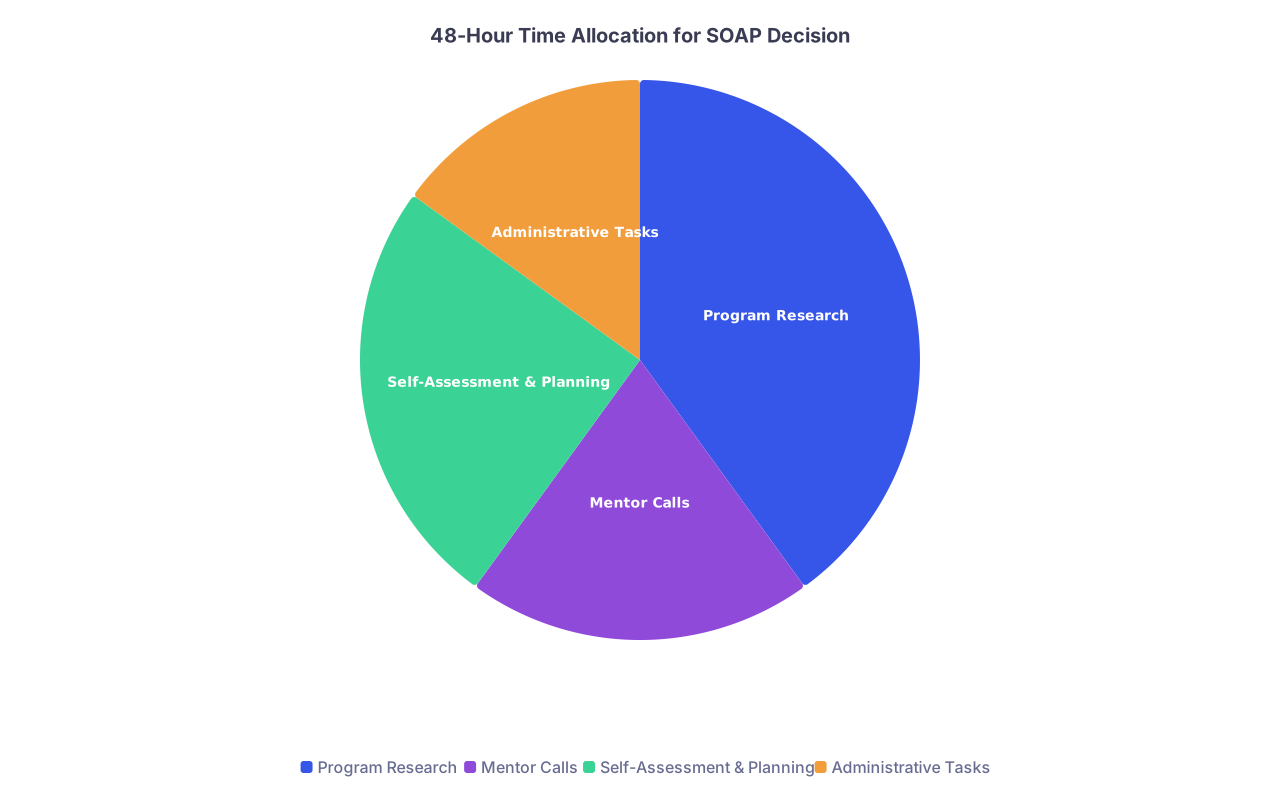
| Category | Value |
|---|---|
| Program Research | 40 |
| Mentor Calls | 20 |
| Self-Assessment & Planning | 25 |
| Administrative Tasks | 15 |
In the next 24 hours
- List every prelim/TY option you actually have or are likely to get.
- Research each program:
- Call / email PC: ask about outcomes for past prelims.
- Check with alumni or current residents if possible.
- Clarify your bucket (A/B/C) based on competitiveness and red flags.
- Schedule at least one call with a trusted advisor (faculty who will actually be honest, not just kind).
In 24–48 hours
Run each option through the decision questions:
- What gets better about my application by next ERAS if I do this?
- What gets worse?
Choose one of three paths and commit:
- Take the prelim/TY with a written, month-by-month plan as above.
- Decline and design a structured re-app year with specific roles, goals, and mentors.
- Start exploring non-residency or non-US options if you are truly in Bucket C.
Document your plan in one page:
- Target specialty(ies) for next cycle
- Concrete steps (letters, exams, experiences) and rough timeline
- People you will involve (PDs, mentors, mental health support)
Print that page or pin it somewhere you will see it. You are not drifting; you are executing.
Visualizing the Re-Application Path
A quick look at how the year ahead changes depending on your choice:

| Step | Description |
|---|---|
| Step 1 | SOAP with only prelim or TY offers |
| Step 2 | Prelim or TY Year |
| Step 3 | Re-application Gap Year |
| Step 4 | Build strong letters |
| Step 5 | Apply early next cycle |
| Step 6 | Continue training |
| Step 7 | Reassess path |
| Step 8 | Clinical or research work |
| Step 9 | Strengthen application |
| Step 10 | Accept prelim or TY? |
| Step 11 | PGY2 or categorical offer? |
The One Thing You Should Do Today
Open a blank document and write two headings:
- “If I take a prelim/TY this year…”
- “If I do a re-application year instead…”
Under each, list three specific, measurable ways your next ERAS application will be stronger.
If you cannot write three believable items under “take a prelim/TY,” you have your answer. If you can, and they are truly substantial (better letters, proven clinical performance, Step 3, documented program support) – then accept the spot and run that year like a campaign.
You are not choosing between “success” and “failure.” You are choosing between different strategies in a messy system. Make that choice like a clinician: assess, diagnose the real problem, and then treat it with intention.