
You did not “just get unlucky” in SOAP. With limited interviews, you are almost never dealing with pure bad luck. You are dealing with patterns. And patterns can be fixed.
I am going to walk you through a structured post‑SOAP debrief that treats your limited interviews like data, not a personal indictment. You will dissect what happened, identify exactly where you are weak, and build a plan that actually changes your outcome next cycle—instead of sending the same application back into the same grinder.
This is not emotional processing. This is a performance review. Of you, your application, and your strategy.
Step 1: Get Out of “Vibes,” Get Into Data
You cannot fix what you refuse to measure. Most unmatched applicants talk in vibes:
- “I think my interviews went okay.”
- “Programs just did not look past my Step score.”
- “SOAP is random.”
That mindset is how you repeat the same mistakes next year.
You are going to build a one‑page, brutally honest, objective snapshot of your SOAP performance.
1.1 Build a SOAP Debrief Sheet
Open a spreadsheet or a notebook page and create the following columns:
- Program name
- Specialty
- Interview type (phone, Zoom, in‑person, group, asynchronous)
- Interview date and round (early SOAP day vs later)
- Number of interviewers / their roles (PD, APD, faculty, chief, resident)
- Your pre‑interview confidence (1–10)
- Your post‑interview feeling (1–10)
- Major questions asked (bullet list)
- Where you felt strong
- Where you felt weak or caught off guard
- Any red flags mentioned or implied
- Outcome (offer / no offer / no response)
- Notes on program fit (location, visa, DO/IMG friendliness, etc.)
Now fill it out for every single SOAP interview you had. Do not rely on memory alone; go back through:
- Calendar invites
- Emails
- Texts to friends (“I think I bombed that one”)
- Any notes you scribbled during or after interviews
You are not trying to be nice to yourself here. You are trying to be accurate.
Step 2: Classify the Type of Problem You Actually Have
Most people misdiagnose why they got limited SOAP interviews, then misdiagnose why those few did not convert. You need to separate three layers:
- Application volume problem – Not enough interviews in main Match and SOAP
- Application content problem – Red flags or weak sections that screeners hate
- Interview performance problem – You get chances, but you do not close
You can have all three. But we need to know which one is driving the car.
2.1 Compare Your Numbers to Reality
Use this as a reference point, not a verdict.
| Factor | Strong Position | Borderline | High Risk / Weak |
|---|---|---|---|
| Step 1 (if scored) | ≥ 235 | 220–234 | < 220 or fail |
| Step 2 CK | ≥ 245 | 230–244 | < 230 or multiple attempts |
| US Clinical Experience | 3+ US LORs + 8–12 weeks hands-on | 1–2 US LORs or 4–8 weeks | Observer only / no US LORs |
| Specialty Choice | FM, IM, Peds, Psych (non‑prestige) | OB/GYN, Anesthesia, EM | Derm, Ortho, Plastics, Rad Onc |
| Number of Programs | 60–120 (core specialties) | 40–60 | < 40 in main Match |
If you matched none or few interviews both in the main cycle and SOAP, and the table above puts you in high‑risk territory on multiple fronts, you do not have a “bad SOAP” problem. You have an overall application problem that SOAP just exposed.
If you had decent main Match interviews but SOAP dried up, then you probably had:
- Overly narrow SOAP strategy
- Poor document updates
- Weak or disorganized outreach
We will fix both, but do not confuse them.
Step 3: Autopsy Each Interview, Not Your Self‑Worth
You are going to perform a structured interview autopsy on each SOAP encounter. No drama. Just a breakdown.
3.1 Use the “3–3–3” Debrief Framework
For every SOAP interview, write out:
- Top 3 questions that mattered
- Top 3 answers you handled well
- Top 3 answers you handled poorly or awkwardly
Do this quickly—do not overthink. You will start to see repeated weak points.
Common failure categories I see over and over:
- Poor explanation of gaps / failures / repeats
- Confused story about switching specialties
- Vague interest in the program (“I like teamwork and diversity”)
- No clear plan for remediation or growth
- Defensive or over‑apologetic about red flags
Mark each weak answer into one of these buckets:
- Story/trajectory – Why medicine, why now, why this specialty
- Red flags – Scores, gaps, failures, prior attempts, leaves
- Fit – Why this location, why this program level (community vs academic)
- Competence – Clinical reasoning, cases, actual knowledge
- Professionalism – Communication, maturity, handling pressure
You are looking for patterns, not one‑offs.
Step 4: Identify Your Core Weak Point(s)
You do not need to fix everything at once. You need to identify the 1–3 areas that are costing you interviews and offers.
Here is how to categorize yourself based on what your SOAP experience probably looked like.
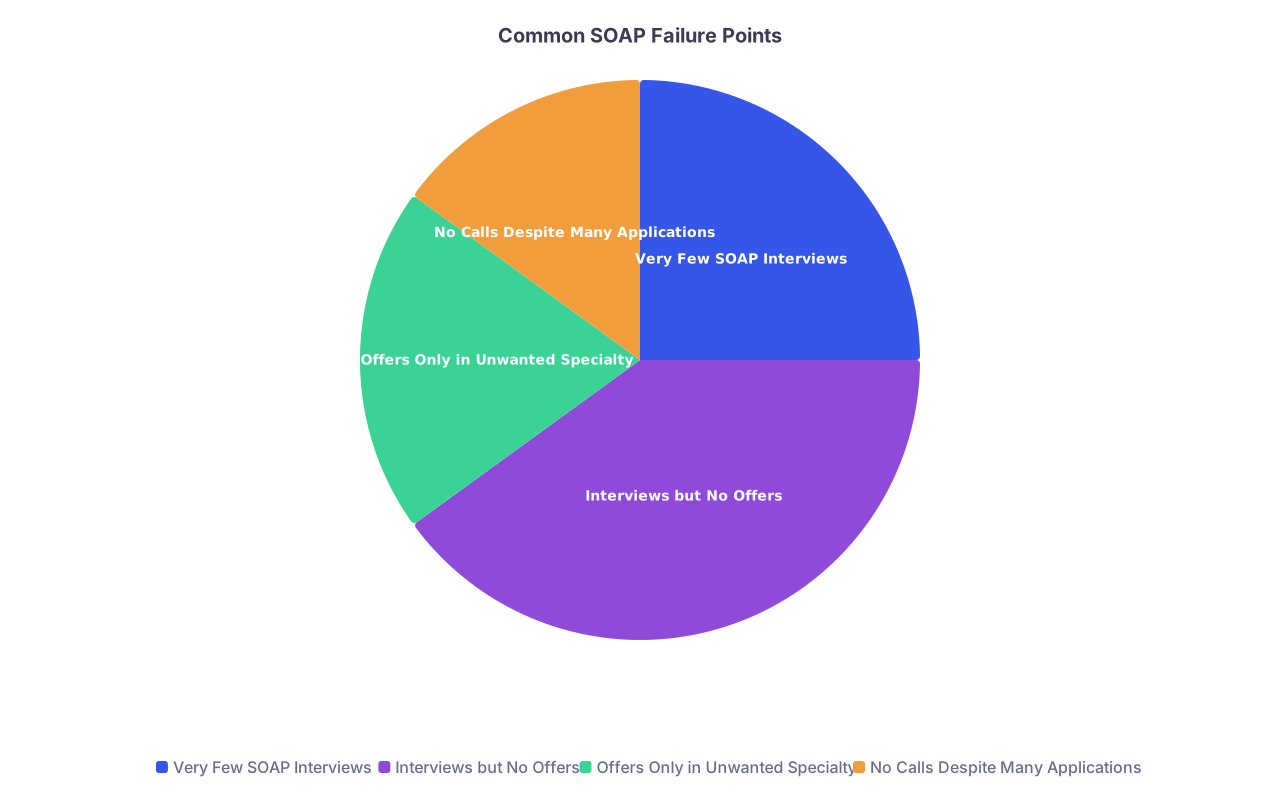
| Category | Value |
|---|---|
| Very Few SOAP Interviews | 25 |
| Interviews but No Offers | 40 |
| Offers Only in Unwanted Specialty | 20 |
| No Calls Despite Many Applications | 15 |
4.1 Pattern A: Very Few SOAP Interviews
Signs:
- You applied to many SOAP positions but had 0–2 interviews
- You heard nothing or only template rejections
- Your friends with similar scores got more calls
Core issues usually include:
- Weak or generic SOAP‑era CV and personal statement
- No updated narrative addressing recent attempts or failures
- Poor or nonexistent program outreach strategy
- Significant red flag (multiple failures, probation, long gap) with no clear repair plan
If this is you, your main task is improving your paper application and targeting.
4.2 Pattern B: Decent Number of Interviews, No Offer
Signs:
- You had 4–10 SOAP interviews
- You got along with people, but offers did not materialize
- You leave interviews thinking “that was fine” but outcomes say otherwise
Core issues:
- Interview skills, especially around red flags and motivation
- Lack of a coherent career story
- Unconvincing specialty switch explanation
- You sound desperate or “I will take anything” without a genuine case
Your main job: rebuild your story and practice high‑risk questions until you are bulletproof.
4.3 Pattern C: Only Offers in Places/Specialties You Do Not Want
Signs:
- Programs that like you are all in geographic areas or specialties you said you did not want
- More community‑heavy, lower‑tier, or historically IMG‑friendly programs show interest
- Academic or competitive locations do not call
Core issues:
- Misalignment between expectations and market value
- Overly picky geographic list
- Weak research / academic portfolio for where you tried to land
Your reality check: you are fishing in the wrong ponds. Next cycle, your SOAP strategy must match your actual competitiveness, not your dream LinkedIn headline.
Step 5: Fixing the Document Side Before Next Cycle
You cannot show up to next year’s SOAP with the same personal statement, same LORs, and same “updated” CV that just says you worked as a scribe.
You will build an “Application Repair Package” over the next 6–12 months.
5.1 Rewrite Your Personal Statement With a SOAP Lens
You need:
- A main Match personal statement
- A SOAP‑specific, shorter, more direct statement ready to deploy
SOAP PDs scan, not study. Your SOAP PS must:
- Explain any major red flags in 2–3 sentences, owning responsibility and directly stating what you have done about it.
- Show a realistic, grounded commitment to the specialty you are applying to in SOAP (often different from your original one).
- Emphasize action and growth in the last 6–12 months, not old achievements.
Example of bad vs fixed language:
- Bad: “I faced some challenges during medical school that affected my performance.”
- Fixed: “I failed Step 1 on my first attempt due to poor study structure and testing anxiety. Since then, I completed a dedicated remediation course, worked with a counselor, and improved my test‑taking strategies, resulting in a Step 2 score of 235 on the first attempt.”
You see the difference. One is fog; one is a plan.
5.2 Update Your CV With Real Substance
SOAP PDs are looking for immediate utility and reliability. Strong updates include:
- Recent US clinical experience (preferably hands‑on, supervised, with LORs)
- Quality improvement projects or registry work in your target specialty
- Teaching roles, tutoring, or simulation assistant work
- Consistent clinical or near‑clinical involvement—no month‑long blank gaps
Your goal: when someone asks “What have you been doing since graduation?” you never have to hesitate.
Step 6: Fixing Interview Performance the Right Way
If your SOAP debrief shows a pattern of interviews without offers, your next cycle hinges on fixing your performance in front of other humans.
6.1 Build a Targeted Question Bank From Your Debrief
From your 3–3–3 analysis, pull out:
- Every red‑flag question you stumbled on
- Every question about your trajectory that felt muddled
- Every time someone seemed confused or skeptical about your answer
Common high‑risk questions you must master:
- “Walk me through your path since graduation.”
- “Tell me about your Step failures / attempts.”
- “Why did you switch from [original specialty] to [SOAP specialty]?”
- “We are a demanding community program. Why do you actually want to be here?”
- “If you do not match again, what will you do?”
For each, write:
- A direct, 3–5 sentence core answer
- One brief example or anecdote that proves your point
- One closing line tying it back to reliability and growth
Do not aim for memorized scripts. Aim for clear structure.
6.2 Use the “Red Flag Formula”
Here is a simple structure that works for most red-flag answers:
- Name the issue clearly
- Take specific responsibility
- Describe concrete changes you made
- Show evidence of improvement
- Link it to why you are now reliable
Example:
- “I failed Step 1 on the first attempt. At that time, I underestimated the volume and studied passively without tracking my progress. After that failure, I met with my dean and a study coach, built a daily schedule with question blocks and spaced repetition, and checked in weekly with a mentor. Using those changes, I passed Step 1 and scored 240 on Step 2 on the first attempt. The process forced me to build the same disciplined habits I would use to keep up with residency.”
Clean. Honest. Forward‑looking.
6.3 Rehearse Under Pressure, Not In Your Head
Reading answers in your mind is useless. You need reps under stress.
- Do 3–5 full mock interviews on Zoom with:
- A resident or fellow you know
- A faculty member from your home institution
- A structured prep service if you can afford it
- Ask them to stop you mid‑answer whenever you ramble or dodge. That discomfort is where you fix things.
- Record the calls. Yes, it is painful. Watch yourself. Look for:
- Long, wandering sentences
- Over‑apologizing or sounding defeated
- Talking too fast or too quiet
- Not actually answering the question asked
You are not trying to sound slick. You are trying to sound like a reliable colleague who knows exactly where they have been and where they are going.
Step 7: Design a Rational SOAP Strategy for Next Time
Your SOAP weakness was probably not only performance, but also targeting. Next time, you need a plan before Monday of SOAP week, not a panic on Tuesday afternoon.
7.1 Build a Tiered Target List Now
You will rank possible SOAP targets three ways:
Tier 1 – Aligned Programs
- Specialty you can genuinely commit to
- Geographic regions you can realistically move to
- Programs with historical openness to your profile (IMG/DO, prior failures, older grad)
Tier 2 – Acceptable but not ideal
- Less desired locations but viable training
- Heavier service, fewer bells and whistles
Tier 3 – Last‑resort safety
- Very remote areas, tough call schedules, lower support
- Only if your priority is “any residency > no residency”
Create a simple reference:
| Tier | Specialty | Example Programs Type |
|---|---|---|
| 1 | FM / IM | Community, IMG‑friendly |
| 2 | Peds/Psych | Mixed academic/community |
| 3 | Prelim IM | Safety, high‑service |
You are not committing to specific programs now (lists change), but you are defining your philosophy: which trades you are willing to make between location, specialty, and training type.
7.2 Prepare Your Outreach and References
SOAP week is chaos. You win by being the applicant who can respond fast, send a clean packet, and get a reference on the phone in 2 hours.
Before SOAP:
- Identify 2–3 attendings who can agree now:
- “If programs call during SOAP, may I give them your number and email?”
- Prepare a brief one‑page summary of you for them:
- Key strengths
- How you want them to frame your red flag
- Your target specialties
During SOAP:
- When you apply to a program you really want, email or call their coordinator if allowed by ERAS rules that year. Keep it short:
- Who you are
- Why their program specifically
- Mention that Dr. X is available for a quick call
- Have your updated CV and SOAP PS ready as a PDF to send instantly if they ask.
Most applicants do this sloppily or not at all. A focused, professional outreach + immediately available references can be enough to bump you from “maybe” to “let us talk to this person.”
Step 8: Build a 6–12 Month Repair Timeline
You need structure between now and the next Match cycle. Not vague intentions.
Here is a sample structure that works for many SOAP‑unmatched applicants.
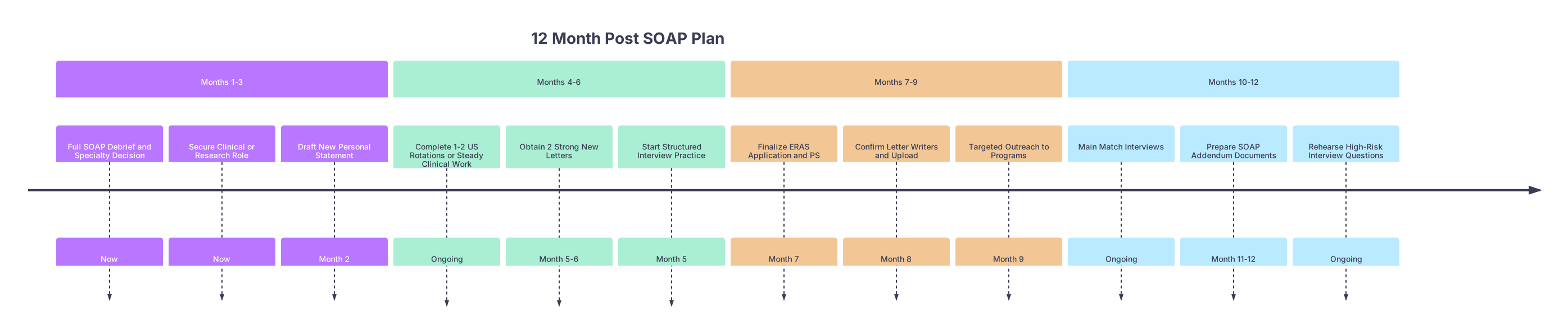
| Period | Event |
|---|---|
| Months 1-3 - Full SOAP Debrief and Specialty Decision | Now |
| Months 1-3 - Secure Clinical or Research Role | Now |
| Months 1-3 - Draft New Personal Statement | Month 2 |
| Months 4-6 - Complete 1-2 US Rotations or Steady Clinical Work | Ongoing |
| Months 4-6 - Obtain 2 Strong New Letters | Month 5-6 |
| Months 4-6 - Start Structured Interview Practice | Month 5 |
| Months 7-9 - Finalize ERAS Application and PS | Month 7 |
| Months 7-9 - Confirm Letter Writers and Upload | Month 8 |
| Months 7-9 - Targeted Outreach to Programs | Month 9 |
| Months 10-12 - Main Match Interviews | Ongoing |
| Months 10-12 - Prepare SOAP Addendum Documents | Month 11-12 |
| Months 10-12 - Rehearse High-Risk Interview Questions | Ongoing |
If you are already close to the next cycle, compress the timeline, but keep the structure: review → fix docs → get fresh experience → practice interviews → plan SOAP.
Step 9: Mental Framing That Actually Helps (Not Toxic Positivity)
You do not need inspirational quotes. You need a stable mindset that lets you execute the repair plan without self‑destructing.
Three points I have seen matter:
Separate identity from performance.
Your SOAP outcome is data about a system match, not a verdict on your worth as a human. Use the data. Drop the verdict.Treat this like remediation, not exile.
Residents remediate all the time—procedures, rotations, even exams. Strong ones improve, weak ones collapse into shame. You are doing the same, just earlier.Measure actions, not hope.
At the end of each week, ask:- What did I do this week that will make a PD trust me more next year?
- What did I fix from my debrief list?
If the answer is “nothing” for many weeks, you know why your outcome repeats.
The Bottom Line
You do not fix a bad or limited SOAP experience by waiting and crossing your fingers next cycle. You fix it by:
- Running a ruthless, structured debrief of every SOAP interview to find your actual weak points instead of guessing.
- Repairing both sides of the equation: your documents and your live performance, especially around red flags and your career story.
- Designing a realistic, pre‑planned SOAP strategy—with target tiers, ready references, and updated narratives—so you are not improvising in chaos.
Do this work properly, and SOAP stops being a black box and becomes what it should have been all along: a second‑chance system you understand and are prepared to exploit.