
The official narrative about SOAP is sanitized. The reality is that back‑channel calls, quiet emails, and whispered texts absolutely influence who gets picked off those lists.
Not always. Not everywhere. But enough that you need to understand how the game is actually played.
I’ve sat in those SOAP war rooms. I’ve watched coordinators refresh ERAS while their phones buzz. I’ve seen PDs ignore beautifully written applications because a trusted colleague texted: “This one is solid, we liked him on our interview day, just didn’t have room.”
So let me walk you through what really happens when the clock starts on SOAP—and how those back‑channel communications actually shift outcomes.
What SOAP Looks Like From the Inside
Everyone tells you SOAP is “structured” and “equitable.” That’s only half true.
On paper, programs:
- Receive your SOAP application packets
- Review applications during the designated windows
- Create preference lists
- Submit lists to NRMP
- Offers go out electronically in rounds
Clean. Algorithmic. Impersonal.
From the inside, it feels very different. It’s controlled chaos.
Coordinators are triaging hundreds of applications in a few hours. PDs are bouncing between the rank list portal, their email, and their phones. Faculty are spinning from clinic to “Can you look at this applicant quickly?” Judgement calls are being made in minutes, sometimes seconds.
And in that kind of chaos, you know what acts as a shortcut? Relationships. Signals. Back‑channel nudges.
Back channels don’t replace the official SOAP process. They steer who even makes it onto those preference lists in the first place.
The Hierarchy of Influence: Who Can Actually Sway SOAP
Let me be blunt: not all calls are equal. A random attending who once worked at a program is not the same as a PD from a sending institution calling directly.
Here’s the rough influence ladder most programs follow, whether they admit it or not:
| Contact Type | Typical Impact Level |
|---|---|
| Current or recent PD of applicant | Very High |
| Chair / Associate Chair of applicant | High |
| Known PD from another specialty | Moderate–High |
| Known faculty with strong relationship | Moderate |
| Unknown faculty from applicant’s school | Low–Moderate |
| Applicant self-contact (email) | Low |
And even that table is too polite. The truth: a 60‑second call from a PD your target PD actually knows and respects can be worth more than 40 SOAP applications carefully crafted.
I’ve watched a PD say, “We’ve got 80 apps. Just flag anyone from X School, I know their PD, he’ll text me if there’s someone we should really look at.”
That’s not in any policy manual. But it happens.
What Kinds of Back Channels Actually Matter
Back‑channel influence in SOAP comes in a few main flavors. Not all are equally effective.
1. PD‑to‑PD Calls and Texts
This is the nuclear option in terms of power.
Example I’ve seen more than once:
- Applicant doesn’t match EM
- Their home EM PD calls a community IM PD:
“Listen, he’s one of our best. Strong team player, no professionalism issues, just got crushed by the EM collapse this year. If you pick him up, you’re getting a very good resident.” - That name moves from “one of 50” to “top 3 on our SOAP list.”
PDs call each other because they know how high the stakes are. They also know how much garbage comes through SOAP: people with professionalism issues, incomplete stories, quiet red flags. A PD calling to vouch for someone is doing two things:
- Reducing the perceived risk.
- Making it socially harder for the receiving PD to ignore the candidate.
Does this guarantee an offer? No. But it very often gets you on the list when you otherwise would have been buried in the pile.
2. Chair or Associate Chair Emails
These carry more weight at academic programs, especially university‑based ones.
Typical pattern:
- Chair emails: “We have a well‑regarded student who went unmatched in categorical surgery, we think they’d be an excellent fit for prelim or categorical IM if you have SOAP positions.”
- Program sees “Chair of Medicine at X” in the signature. They at least open the application and take a real look.
The content of the email matters less than who is sending it and whether there’s any hint of “hidden problem.” A lukewarm “nice student, worked hard” is almost worse than silence. A strong, specific endorsement like “we would absolutely take this student into our program if we had an open slot” gets attention.
3. Cross‑Specialty PD Contacts
This is the one most students underestimate.
You think: “My OB/GYN PD can’t help me get into FM during SOAP, right?” Wrong. If they know each other from committees, conferences, or prior institutions, that call matters.
A PD thinking: “I don’t really know this school or this student, but if Sarah (the OB PD) says he’s solid, I believe her” is common. The relationship is the currency, not the specialty alignment.
4. Known Faculty and Trusted Attending Voices
Below the PD level, there’s a second tier: faculty who’ve built trust with other programs over years.
I’ve watched an IM PD accept the word of a surgical intensivist at another institution because they’d staffed boards together and trusted each other’s judgement. The email was short: “We had her on our ICU month; you’d be lucky to have her. Strong, teachable, no attitude.” That line carried more weight than the personal statement.
The key is trust history. Cold‑calling a random attending you barely worked with to “make a call” rarely moves the needle.
The Role of Applicant Emails and Calls (And Where They Backfire)
Let me be cruelly honest: your own emails are low on the influence ladder. But they’re not useless.
Most programs during SOAP are drowning in:
- ERAS notifications
- NRMP system messages
- Random applicant emails that all say, “I’m very interested in your program”
Your email has to do something different:
- Remove doubt (“No red flags, just bad luck”)
- Clarify fit and flexibility
- Make it easy for them to say yes
What doesn’t work? Essays, drama, or desperation.
Example of a bad SOAP email I’ve seen forwarded around (anonymized):
“I worked so hard and really thought I would match. I am devastated and my family is counting on me. Please, I will do anything for a spot at your program.”
The reaction from the PD was: “This reads unstable. We don’t need that risk in SOAP.”
Harsh? Maybe. Real? Absolutely.
A better email is clinical, focused, and calm under pressure. Something like:
Subject: SOAP Applicant – US-IMG Applying to Your Open IM Positions
Dr. [Name],
I applied to your program through SOAP and wanted to briefly introduce myself. I am a US citizen, US-IMG who graduated in 2024, Step 1 pass, Step 2 CK 238, with strong evaluations in inpatient internal medicine and night float. I have full ECFMG certification, no leaves of absence or professionalism concerns, and I am fully available to start PGY‑1 this July.
I am very interested in your program’s [specific feature] given my prior experience with [concise link]. If it would be helpful, I can provide a direct contact for my medicine clerkship director or sub‑I preceptor who can speak to my clinical work this year.
Thank you for considering my application during this busy week.
Sincerely,
[Name, AAMC ID, contact info]
Calm. Clear. No emotional dumping. Offers a reference, but doesn’t demand attention.
Do many of these get ignored? Yes. But some get forwarded to faculty with, “Anyone worked with this school? Anybody know this student?” and that’s where back channels can be born in real time.
How Programs Actually Use Back Channels During SOAP
Let’s lift the curtain on a typical SOAP day at a mid‑sized IM program with, say, 4 unfilled categorical spots.
They open the ERAS SOAP pool and see 250+ applications tagged to them.
Here’s the rough rhythm:
- First pass filtering: US grads vs IMGs, Step 2 thresholds, failure filters.
- Quick sort: obvious “yes to review,” obvious “no,” and huge gray middle.
- Pulled‑out candidates: anyone from known schools, anyone with back‑channel mention, anyone that caught the PD’s eye in the first half‑second.
Now layer in the back channels:
- PD text pops up: “We have a strong student who didn’t match, applied to you. Name is [X]. Please take a look.”
That name goes in the review now pile. - Email from Chair: “Highly recommend [Y], no concerns.”
That name likely gets elevated on the preference list if they’re already in contention. - Faculty group chat: “Anyone know this student from Regional Med?”
If a faculty member responds “Yes, worked with her at prior institution, would take her,” that might bump her above a similar-looking but unknown applicant.
You’re not competing in a vacuum. You’re being sorted within bands:
- Definitely interview / top of list
- Probably usable / mid‑list
- Backup if desperate
- Never
Back channels move you between those bands.
Who Loses When Back Channels Dominate
Let’s be honest about the dark side.
Back‑channel games hurt:
- Applicants from schools with weak or disengaged leadership
- Students who burned bridges and now have nobody willing to vouch for them
- Quiet, competent people who never cultivated any faculty relationship
- Late bloomers whose PD barely knows their name
Programs during SOAP are terrified of “problem residents.” Any hint of risk—even imagined—sends you down the pile. Back‑channel silence can sometimes be interpreted as, “If nobody is speaking up for this person during SOAP, maybe there’s a reason.”
Is that fair? No. Is it real? Yes.
I’ve seen two almost-identical files:
- Same Step 2 score
- Same number of publications (zero)
- Similar grades
One had a PD email saying, “I’ll be honest—this student underperformed early but improved significantly; no professionalism issues, just took longer to mature.” The other had nothing.
Guess who got ranked higher.
Timing: When Back Channels Actually Matter During SOAP Week
You can’t spam people randomly all week and expect magic. There’s a rhythm to SOAP.
Let me spell out the internal logic with a simple timeline:
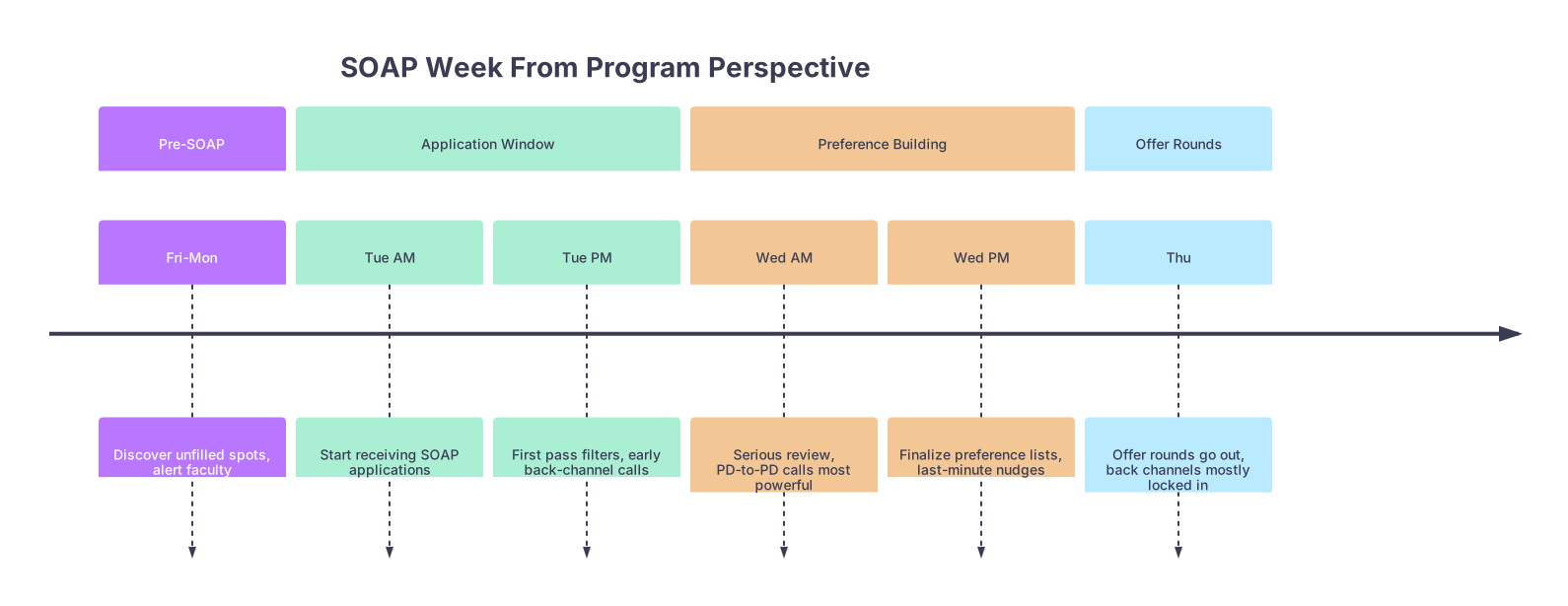
| Period | Event |
|---|---|
| Pre-SOAP - Fri-Mon | Discover unfilled spots, alert faculty |
| Application Window - Tue AM | Start receiving SOAP applications |
| Application Window - Tue PM | First pass filters, early back-channel calls |
| Preference Building - Wed AM | Serious review, PD-to-PD calls most powerful |
| Preference Building - Wed PM | Finalize preference lists, last-minute nudges |
| Offer Rounds - Thu | Offer rounds go out, back channels mostly locked in |
The sweet spot for influential back channels is Wednesday morning to early afternoon:
- Programs have seen the pool
- They’ve filtered out obvious no’s
- They’re forming the real preference lists
- They’re still flexible enough to adjust based on new information
A PD calling Thursday afternoon saying “Did you rank my student?” is mostly theater. The list is already in.
How to Ethically Leverage Back Channels Without Looking Desperate
Here’s the part nobody teaches you in school: how to ask for help without ruining your own credibility or putting your faculty in a bad position.
Before SOAP (ideally months before)
You should already have:
- At least one attending who knows your work well and likes you
- Some relationship with your clerkship director or residency PD
- A clean record with no lingering professionalism black clouds
You don’t need to be their favorite resident‑to‑be. You need to be someone they can authentically endorse without flinching.
When you do not match and are headed into SOAP
Your communication with your PD or dean should be simple and direct:
“I understand this is a difficult week. If there are programs you think I’d be competitive for during SOAP, I’d be grateful if you’d be willing to reach out or take calls on my behalf. I’m prepared to pivot specialties if needed and am open to [realistic options].”
Notice what you’re doing:
- Acknowledging their bandwidth is strained
- Not dictating which programs they must call
- Signaling flexibility, which makes them more likely to help
If you start demanding: “Please call these 8 programs, here’s a list,” you’ll get eye rolls and noncommittal promises.
Who to ask, in descending order of impact
- Your home specialty PD (even if you’re pivoting)
- The PD of the specialty you’re targeting now (if you know them)
- Clerkship directors who liked you
- Sub‑I attendings who explicitly told you they’d support you
- Mentors with real relationships at target programs
Do not ask random faculty you barely worked with to “make calls.” Empty calls or generic “I don’t really know them but they seemed fine” endorsements can actually hurt.
The Stories Program Directors Don’t Tell You
Let me share a few composites from real SOAP seasons. Names and specifics altered, logic preserved.
Story 1: The Anesthesia Applicant Who Landed in IM
US MD, aimed for anesthesia, decent but not stellar scores, 0 interviews in gas. Ended up unmatched.
Monday of SOAP week, his Anesthesia PD sends a quiet message to a friendly IM PD across state lines: “We have one who missed the mark in this market, but he’s good. Would be a strong IM resident. No baggage.”
The IM PD had 2 unfilled categorical spots.
When SOAP opened, the IM program saw 200+ apps. They filtered aggressively. The anesthesia student was in the “maybe” pool at best—no IM research, no IM AOA, nothing flashy.
PD remembers the text, pulls the app, skims the LORs, calls the home PD to confirm. End result? That applicant ended up in the top 5 on their preference list. Got an offer in the early round.
Without that quiet PD‑to‑PD exchange, there is no chance he’s that high on the list.
Story 2: The IMG Who Outperformed US Grads in SOAP
US‑IMG, higher Step 2 than many US MDs in the pool, excellent clinical feedback abroad, but no US letter longer than a paragraph.
Internal Medicine program reviewing SOAP apps had a strong bias toward US grads. Typical, frankly.
Then a faculty member on their committee said, “I worked with this student last year during an away elective, she was one of the hardest working students we had. I didn’t write a full LOR at the time, but I’d absolutely vouch for her.”
That one sentence—face‑to‑face in the SOAP meeting—bumped her up a tier. US MDs with slightly lower scores and weaker narratives stayed mid‑list. She got pulled into the serious consideration pile.
You don’t see that in any data. But it’s reality.
Story 3: The Self‑Sabotaging Over‑Texter
One more, from the opposite side.
Applicant went unmatched in a competitive specialty and tried to pivot to IM through SOAP. Reasonable scores, no obvious red flags on paper.
What killed them wasn’t their application. It was their post‑unmatched behavior.
They:
- Emailed personally every single program with an unfilled spot with a long, emotional story
- Sent multiple follow‑ups within hours: “Just checking if you saw this”
- Had already been known at their home institution as “high maintenance”
Word travels. PDs talk. One PD literally said in a Zoom room: “I’ve already gotten three emails from this person today; that tells me everything I need to know.” They were quietly dropped down on multiple preference lists.
That’s how thin the margin can be.
What You Should Actually Do During SOAP Week
Let me pull this into something actionable, without sugarcoating.
Lock down your story.
If anyone calls your PD and asks, “What happened with this student? Why did they not match?” your PD needs a clean, consistent, non‑dramatic answer. If you’ve been evasive or constantly shifting explanations, they will not stick their neck out for you.Have 1–3 realistic specialties you’re open to.
If you tell your PD you “only want Derm, even in SOAP,” do not expect them to fight for you anywhere else. People are more willing to help if they know you’ll say yes to reasonable options.Ask a small number of high‑yield people to vouch for you.
Not ten. Two or three. Focus on PDs and directors who can be reached by other PDs quickly.Send short, targeted emails to a limited list of programs.
Not 80. You’re not special if you blanket everyone. Pick places where you have:- Geographic ties
- Alumni connections
- Faculty relationships
Make those emails lean and professional, like the example earlier.
Stay calm and boring.
You want any word about you during SOAP to be: “Reliable, mature, handled not matching with grace.” Programs are terrified of drama. Do not give them any.
What Program Directors Wish You Knew About SOAP Back Channels
If I had to distill what I’ve heard PDs mutter behind closed doors, it would be this:
- “I’ll take a known quantity over an unknown superstar in SOAP.”
- “If your own PD won’t vouch for you, that tells me more than your Step score ever will.”
- “I can’t fix your entire application during SOAP. But I can ignore you if you and your school come off as chaotic.”
- “We notice who’s professional in their emails. And who isn’t.”
You can’t force your PD to call anyone. But you can make it much more likely they want to, by how you’ve conducted yourself the past four years.
Back channels are not magic. They’re multipliers. They magnify whatever you’ve already built—good or bad.
The Perspective You’ll Only Get from the Back Room
Years from now, you won’t remember every detail of how you worded that SOAP email or who exactly your PD called at 10:30 on Wednesday morning.
What will stick with you is this: in a moment when the system felt utterly mechanical and indifferent, human relationships still mattered. They always do.
SOAP feels like a cold algorithm, but in those cramped offices with stale coffee and too many browser tabs open, people are still making judgement calls based on trust, reputation, and how you showed up long before you missed on Match Day.
Work the back channels ethically, ask for help without entitlement, and carry yourself like someone a PD can confidently say yes to under pressure. Because in SOAP, that quiet “yes” behind the scenes is often the difference between another empty year and a contract in your inbox.