
The fastest way to kill your SOAP chances is with a bad email or a poorly timed phone call.
Not your Step score. Not your school. Your mouth and your inbox.
If you’re in SOAP with limited interviews, every communication you send is either helping you or quietly eliminating you. Programs will not tell you when you cross the line. They’ll just move on.
Let’s keep you out of the “absolutely not” pile.
1. The Single Most Dangerous SOAP Myth
Here’s the myth that burns more applicants every March:
“During SOAP, you should call and email as many programs as possible. Show them how interested you are.”
No. That’s how you get labeled as “needy,” “pushy,” or “does not understand boundaries.”
Here’s what actually happens behind the scenes:
- A coordinator opens their email and sees 120 SOAP messages in the first hour.
- They skim subject lines, auto-delete anything that looks generic, desperate, or irrelevant.
- Attendings and PDs say things like:
- “Why is this person emailing us? We already have our list.”
- “We said no calls in the posting—why did they call three times?”
- “If they can’t follow simple instructions now, imagine working with them.”
You think you’re “advocating for yourself.”
They think you’re a future problem.
The first rule of SOAP communication:
If the program tells you how they want to be contacted (or not contacted), you obey that like it’s federal law.
2. Emails That Quietly Kill Your Application
You can tank your chances with a single bad SOAP email. I’ve watched it happen in real time:
- Applicant sends one sloppy mass email.
- Coordinator prints it, circles the worst lines, and says, “Nope. Not this one.”
Let’s go through the common disasters.
Mistake #1: The Obvious Copy‑Paste Blast
Programs are allergic to this one:
Subject: Dear Program Director,
“Dear Program Director, I am extremely interested in your esteemed program. Your program’s reputation for excellence in patient care and research is unparalleled…”
This screams:
- You sent this to 80+ places.
- You know nothing about them.
- You’re not careful with details.
Red flags they look for:
- “esteemed program,” “world-class,” “renowned institution” — generic fluff
- “I would be honored to match in your program” — during SOAP, nobody cares about your honor; they care if you can safely do the job
- Wrong program name, wrong specialty, or wrong city — instant delete
How to avoid this:
- If you cannot customize at least two concrete details (location, program structure, track, patient population, etc.), don’t send the email.
- Keep a short SOAP email template, then adjust 2–3 sentences per program.
Bad subject lines vs better ones:
| Bad Subject Line | Better Subject Line |
|---|---|
| SOAP Applicant Interested in Your Program | SOAP – FM Applicant – US-IMG with strong inpatient |
| URGENT: Please Consider Me for SOAP | SOAP – Categorical IM – Available for immediate start |
| Dear Program Director | SOAP Applicant – Reapplicant with prior US clinical |
If your subject line looks like it was written by a robot in 2010, change it.
Mistake #2: Oversharing and Trauma Dumping
SOAP emails are not therapy sessions.
Lines that get you mentally blacklisted:
- “I am in SOAP because my mother was very sick and I could not study…”
- “I have had a lot of bad luck in life…”
- “My Step scores do not reflect my intelligence due to severe depression…”
Is your context valid? Maybe.
Does the program have 30 seconds to read your life story during SOAP? Absolutely not.
Worse: you flag yourself as someone who may struggle with boundaries and emotional regulation under stress.
How to fix it:
- One short line of context is fine if it explains something specific and is followed by what you did to correct it.
Example:
- Acceptable: “A family health crisis affected my first Step attempt; since then I’ve passed Step 2 on the first try and strengthened my clinical evaluations.”
- Not acceptable: three paragraphs about your family, breakup, or mental health without any evidence of stability or improvement.
If you’re not sure whether it’s oversharing, don’t include it in a SOAP email. Save it for an actual interview if the PD asks.
Mistake #3: Vague, Empty Compliments
Programs are tired of reading the same weak praise:
- “I am very impressed by your program.”
- “Your program is my top choice.”
- “I am excited by your strong clinical training and research opportunities.”
These statements mean nothing, because you could send them to 200 programs.
Instead of this fluff, do this:
- Mention one concrete feature: “your strong outpatient HIV clinic,” “your community-focused curriculum,” “your large Spanish-speaking patient population,” “your night float system.”
- Then tie it to what you actually bring: language skills, prior clinic work, future career goal.
If your email could be sent to any program in any city without changes, it’s garbage. Rewrite it.
Mistake #4: Sounding Desperate or Entitled
This is where many SOAP applicants self-destruct.
Danger phrases:
- “I beg you to consider me.”
- “This is my dream program, please give me a chance.”
- “I deserve an opportunity to prove myself.”
- “I will accept any position you offer.”
Programs smell desperation. It does not make them want you more.
It makes them worry you’ll be emotionally volatile, clingy, or difficult to manage when things get hard.
On the other side, entitlement is just as bad:
- “I believe I would be an excellent fit and hope you can recognize this.”
- “Given my scores and experience, I should be considered strongly.”
- “I am confident I will be an asset anywhere I match.”
You’re in SOAP. Tone down the ego.
Better pattern:
- Calm, professional, specific, and short.
- Focus on what you offer, not what they “owe” you.
3. Phone Calls That Get You Blacklisted
Let me be blunt: most SOAP applicants should not be calling programs at all.
In many institutions, the unofficial rule is:
- “If they’re calling during SOAP without us inviting it, that’s a red flag.”
Does every program feel that way? No. But you don’t know which ones do.
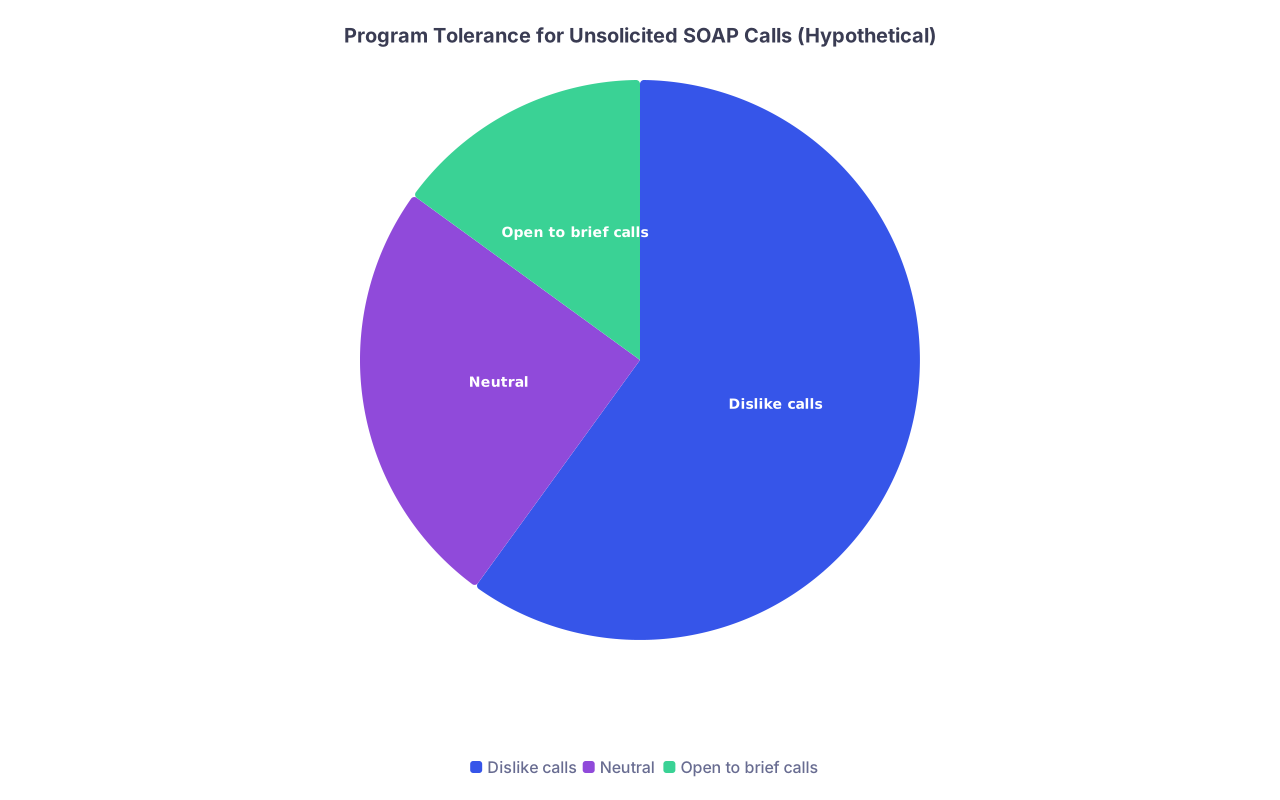
| Category | Value |
|---|---|
| Dislike calls | 60 |
| Neutral | 25 |
| Open to brief calls | 15 |
Again: programs won’t tell you this is the reason you didn’t get ranked.
Mistake #5: Calling When They Explicitly Said Not To
This should be obvious, but it isn’t.
When the SOAP list opens and you see:
- “No phone calls”
- “Please do not contact program”
- “We will review through ERAS only”
…that’s the end of the discussion.
If you call anyway, you’ve just told them:
- You don’t read instructions.
- You think rules don’t apply to you.
- You might behave the same way with hospital policies.
In a liability-conscious environment, that’s poison.
If they say “no calls,” your communication options are:
- No contact at all, or
- At most, one very short, professional email (if not explicitly banned).
If they say “do not contact” at all: you respect it. Full stop.
Mistake #6: Rambling or Emotional Phone Messages
Scenario I’ve actually seen:
- Applicant calls.
- Leaves a 2-minute voicemail explaining their entire situation, scores, family context, and “dream to be a surgeon.”
- Coordinator plays it for the PD.
- PD says: “We’re not doing this.”
Your voicemail is not an oral personal statement.
It’s a 15–20 second “hello, I exist” at most — if calling is acceptable.
If the program allows contact and you must call (for a specific reason, not “just to show interest”), your script should be:
- Who you are (name, applicant ID or AAMC ID).
- What you’re applying for (specialty, PGY level).
- One brief, factual reason for the call (e.g., confirming receipt of something, or clarifying a technical issue).
- Thank you and goodbye.
If you feel yourself about to say “this is my dream” or “I beg you,” hang up. Don’t leave a message. You’re about to hurt yourself.
Mistake #7: Harassing With Repeated Calls
Calling more than once in 24 hours without a very good reason? You’ve moved from “interested” to “annoying.”
Calling every line you can find (PD office, department secretary, hospital operator) to try to get someone live? You’ve graduated to “do not touch.”
SOAP week is chaos for programs too. They’re:
- Reviewing hundreds of applications in compressed time.
- Attending meetings about positions, funding, and service coverage.
- Answering to GME and hospital leadership.
You are not the center of their world, and you do not want to become the applicant they’re complaining about in the office: “Why does this person keep calling? We don’t even have their application open.”
Respect their time. You’re trying to look like a future colleague, not a problem.
4. Content Mistakes: What You Say Without Realizing It
You can make an email sound awful without a single curse word. Just with tone.
Mistake #8: Trashing Other Programs or the Match
Nothing turns a PD off faster than bitterness.
Red flags:
- “I did not match due to bias against IMGs…”
- “Programs unfortunately do not look beyond Step scores…”
- “I was unfairly not ranked at programs where I interviewed…”
Even if you think all of that is true, your SOAP communication is not the place to say it.
You want to come across as:
- Resilient
- Reality-based
- Focused on improvement and patient care
Not:
- Bitter
- Conspiratorial
- Stuck in March’s disappointment
If you need to vent, talk to a friend, roommate, or therapist. Not a PD.
Mistake #9: Being Vague About Your Status or Red Flags
Hiding important facts is another trap.
Examples:
- Not mentioning you still need a Step result that’s pending.
- Ignoring a prior attempt or failed exam that’s clearly in ERAS.
- Acting like your long gap in training doesn’t exist.
Programs will see it in your file. If your email tone is “nothing to see here,” they’ll assume you lack insight or honesty.
You don’t need to write a full explanation, but you should avoid misleading them.
Example of bad phrasing:
- “I have a strong academic record” – when you have multiple attempts or failures.
Better:
- “While I have had challenges with standardized exams, I have since passed Step 2 and received strong clinical evaluations, particularly in inpatient medicine.”
You cannot delete your weaknesses in SOAP. You can show that you understand them and have worked to compensate.
Mistake #10: Being Unclear About Your Real Availability
Programs despise surprises.
Things that will spook them:
- You hint you might have another offer and “need to know quickly.”
- You suggest you’re “considering multiple specialties.”
- You sound like they’re a backup plan.
During SOAP, they want one thing:
If we offer this person a spot, will they accept and show up?
Do not imply:
- You’re hedging.
- You might not be fully committed.
- You’re treating their specialty as a temporary plan.
If you email, your message should imply:
- You’re ready to start.
- You’re fully committed to training in that specialty and location if chosen.
- You understand SOAP offers move fast, and you’ll respond promptly.
5. Safe Communication Framework During SOAP
Let’s build something you can actually use.
When to Email
Reasonable triggers:
- Program explicitly says “you may email” or lists an email for questions.
- You have a true connection or specific fit (geography, language, prior rotation).
- You’re clarifying logistics (visa, start date, missing document) — briefly.
Don’t email:
- Just to “say hi” or “introduce yourself” if you have nothing to add.
- If they explicitly say “do not contact program” or “no emails.”
What a Reasonable SOAP Email Looks Like
Skeleton:
- Clear subject line (SOAP + specialty + one key identifier)
- Direct greeting (Dr. X if known; otherwise “Program Director” or “Program Coordinator”)
- One sentence: who you are + what position
- One–two sentences: specific fit (skills, geography, experiences)
- One sentence: acknowledgment you’re in SOAP and available
- One sentence: gratitude and that’s it
That’s all.
When to Call (Rarely)
Only consider calling if:
- The program explicitly invites calls in their SOAP posting.
- You have a technical issue that prevents them from seeing your application or documents.
- You were instructed to call by someone in the program (e.g., “Call us if you do not see the invite in 30 minutes.”)
If you must call:
- Prepare a 15-second script.
- Do not argue, explain your whole life, or try to “sell” yourself over the phone.
- If they say “we’re reviewing applications through ERAS only,” you say “Thank you for your time” and get off the line.
6. Hidden Red Flags You Don’t Realize You’re Sending
SOAP exposes habits that might’ve hurt you earlier in the season too.
Watch for these unconscious signals:
Poor grammar and typos in a 5–6 sentence email.
Translation to PD: this person might chart like this.Overly casual tone.
“Hey there,” smiley faces, exclamation marks everywhere, texting abbreviations.
Translation: might not understand professional boundaries.Writing at 3 a.m. in an obviously agitated tone.
SOAP is stressful, but you can’t sound unstable.Contradicting your own ERAS.
Saying “your program is my top choice” to 12 places in writing is a bad idea when staff sometimes share stories and applicants’ names.Involving friends/family to call on your behalf.
Yes, people actually do this. PDs remember it, and not fondly.
Your guiding question before sending anything:
“If they printed this email and read it aloud in a faculty meeting, would I feel proud or embarrassed?”
If the answer is anything but “proud,” rewrite it.
7. A Quick Visual: Safe vs Dangerous Behaviors in SOAP Communication

| Safe Behaviors | Risky Behaviors |
|---|---|
| 1–2 concise, tailored emails | Mass generic emails to dozens of programs |
| Respecting ‘no contact’ instructions | Calling or emailing when told not to |
| Brief, factual voicemails (if needed) | Long emotional voicemails explaining your story |
| Specific program fit mentioned | Generic praise and copy-paste compliments |
| Neutral, professional tone | Desperate, pleading, or bitter tone |
FAQ (Exactly 5 Questions)
1. Should I email every program I apply to in SOAP to show interest?
No. That’s a fast way to annoy already overwhelmed coordinators and PDs. Only email when:
- The program doesn’t prohibit contact
- You have something specific and relevant to say
- You can keep it short, professional, and individualized
Spraying generic emails everywhere does more harm than good.
2. Is it ever okay to call a program during SOAP just to introduce myself?
Almost never. If they haven’t invited calls or indicated that phone contact is appropriate, don’t do it. A cold call just to “introduce yourself” signals poor judgment and can get you mentally blacklisted. Use ERAS and, if allowed, a brief email instead.
3. Can I tell multiple programs they’re my “top choice” during SOAP?
You can, but you absolutely shouldn’t in writing. Programs sometimes share stories and names. If you’re caught telling five places they are your #1, you look dishonest. Better: say you’re “very interested” and “would be excited to train there,” without ranking language.
4. How honest should I be about why I’m in SOAP or why I didn’t match?
Be honest but extremely concise. One sentence of context plus what you’ve done to improve is fine. A long narrative about unfairness, bad luck, or personal crises makes you look unstable or lacking insight. SOAP communication is not where you unpack your whole story.
5. What’s one thing I can do today to check if my SOAP emails are safe?
Take your current draft and run this test:
- Delete every generic compliment.
- Highlight any sentence that could apply to any other program with no changes.
If more than half your email is generic, rewrite it so at least two sentences are specific to that exact program and two sentences clearly state what concrete strengths you bring.
Open your SOAP email draft right now and read it out loud, word for word, like you’re the PD hearing it in a busy office. If you’d roll your eyes or hit delete, fix it before they ever see your name.