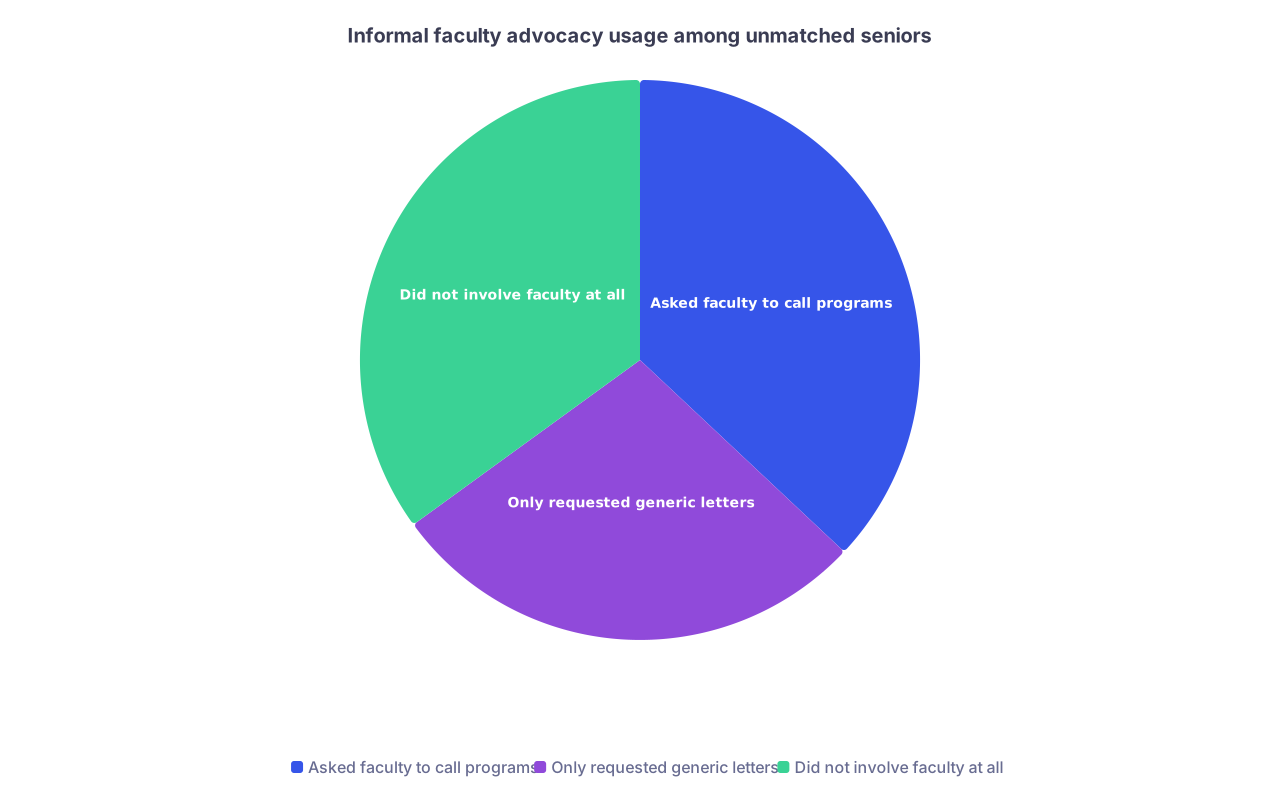
Only 37% of unmatched seniors ever ask a home institution faculty member to directly call a program during SOAP. The rest assume “the system will work out” or “my application speaks for itself.” It does not. Not during SOAP.
SOAP is not a fair, orderly re-evaluation of everyone’s credentials. It is a four-day scramble driven by speed, relationships, and who is on the phone advocating for you at the right moment. If you do not actively leverage your home institution faculty, you are voluntarily playing with a handicap.
Let me break this down specifically.
1. How SOAP Actually Works Behind the Curtain
You already know the rough structure: Monday list, applications submitted, programs review, offer rounds Wed–Thu. That is the brochure version. The real thing is messier and much more relational.
Here is what is actually happening at many programs:
- A PD or APD is sitting with a spreadsheet of unfilled spots and 300–800 applications.
- They have maybe 60–90 minutes per round to pick who to call.
- They sort quickly on Step scores, red flags, geography, and known schools.
- While they are skimming ERAS, their email and phone are lighting up with messages from colleagues: “Hey, I have a strong student in SOAP—can you take a look?”
You want to be in that email. Not in the anonymous pile.
| Category | Value |
|---|---|
| Asked faculty to call programs | 37 |
| Only requested generic letters | 28 |
| Did not involve faculty at all | 35 |
Programs are under time pressure. During one SOAP year, I watched an APD skim 300+ applications between 8am and noon, flag 25 people, and tell the coordinator: “Call these 10 this round.” Seven of those ten had some sort of personal advocacy—faculty email, text, or call.
You cannot control your Step score on SOAP week. You can very much control who is talking about you.
2. Which Faculty Actually Matter During SOAP
Not all faculty are equally useful in SOAP. Some can move the needle. Some will write you a lovely, utterly irrelevant paragraph in your Dean’s letter addendum.
Think in tiers.
| Tier | Faculty Type | Typical Impact |
|---|---|---|
| 1 | Program leadership (PD/APD), Chair, Clerkship Director in your target specialty | High – can directly influence interview/offer decisions |
| 2 | Well-known faculty in your target specialty, especially with national roles | Moderate–High – their email gets opened fast |
| 3 | Any faculty who know you well and are willing to hustle | Moderate – can humanize you, tip borderline choices |
Tier 1: People who can pick up a phone and actually get someone’s attention
This group includes:
- Your home program’s PD/APD in the specialty you are targeting
- Department Chair
- Core Clerkship Director (Internal Medicine, Surgery, Pediatrics, etc.)
- Designated “SOAP lead” for the medical school (some schools have one)
These people:
- Already have each other’s phone numbers and institutional emails
- Sit on listservs where PDs are actively talking during SOAP
- Are allowed to send “this is a strong student we are supporting” emails without being ignored
If your own institution has unfilled spots in your specialty, these are the people who can say, “We will take you.” That does happen. It is not guaranteed. But if you have not spoken to them clearly, you are invisible.
Tier 2: Faculty with national or regional clout
Think:
- Faculty who present at national conferences (AAIM, APDIM, ACGME, specialty societies)
- People who sit on specialty committees or exam boards
- Anyone who offhandedly mentions, “Oh, I know the PD at X…”
Their advocacy often works like this:
- Quick, direct email: “Hi [First name], we have a student in SOAP who would be a great fit for your program. Attached is their CV; happy to talk briefly if helpful.”
- Short reply back: “Sure, have them apply—will flag their file.”
That “flag” moves you from page 8 of their ERAS filters up to the top 30 they actually review.
Tier 3: Faculty who know you well and will actually push
This is the most underrated group. People like:
- The hospitalist who said “If you ever need a letter, let me know” on your IM rotation
- The surgeon who trusted you to run the list
- The pediatrician who wrote your MSPE comment: “Top 10% student I have worked with in 10 years”
They may not know PDs personally, but:
- They can write a short, time-stamped support email to programs you applied to
- They can email your school’s SOAP lead with specific, credible detail about your performance
- They can pick up their own contacts in community programs or smaller residencies that are less “networked” nationally
During SOAP, volume of credible advocacy matters. Two or three pointed notes from different faculty saying the same thing about you is powerful.
3. What Advocacy During SOAP Should Actually Look Like
Faculty advocacy during SOAP is not a 2-page letter. It is short, targeted, and fast. If you ask for “a letter” during SOAP week, you are already framing it wrong.
What you need faculty to do:
- Identify 5–15 realistic programs from your SOAP list
- Send those PDs/APDs an ultra-brief email referencing you by name and AAMC ID
- Offer to talk by phone if the PD wants a quick gut-check
- For home institution spots, advocate internally in real time (“We should strongly consider this student.”)
Here is roughly what a useful advocacy email looks like (this is the sort of thing I have seen work):
Subject: Strong SOAP applicant from [Your School] – [Your Name], AAMC #[ID]
Dear Dr [PD Last Name],
I am faculty at [Your Institution] and work closely with our senior medical students. I wanted to briefly highlight [Your Full Name], AAMC #[ID], who has applied to your [specialty] SOAP positions.
I supervised [Your Name] directly on [rotation] and can say without hesitation that they functioned at or above the level of an incoming intern. Specifically:
– Took primary responsibility for complex patients with minimal oversight
– Communicated clearly and reliably with the multidisciplinary team
– Was consistently described by residents as “someone I would want on my team”If you are reviewing applications for your SOAP positions today, I would strongly encourage you to take a close look at [Your Name]. I am happy to speak briefly by phone if that would be helpful.
Best regards,
[Faculty Name, Title, Contact Info]
Notice what is missing: excuses, long CV details, or angle-spinning about why you went unmatched. This is not the place for that. This is one person saying “This applicant is safe. You will not regret interviewing them.”
4. Preparing for SOAP Before You Need It (Even Late in the Game)
The worst SOAP conversations start with: “Hi, we have never met, but I did not match. Can you help me?” Does it happen? Yes. Is it optimal? No. You want faculty to at least recognize your name when you show up on Monday of SOAP.
If you are reading this before Match Week, you still have time to set the table.
a) Identify potential advocates now
Go through your rotations mentally and write down:
- Who has ever said “You are doing great” and meant it
- Who has written you a strong evaluation
- Who holds any leadership role (PD, APD, clerkship director, site director)
You are not looking for the “famous” person first. You are looking for the person who would fight for you.

| Step | Description |
|---|---|
| Step 1 | Review 3rd and 4th year rotations |
| Step 2 | List faculty who know you well |
| Step 3 | Mark those with leadership roles |
| Step 4 | Schedule brief check in |
| Step 5 | Discuss career goals and programs |
| Step 6 | Ask if open to supporting during SOAP |
b) Have a frank conversation before SOAP
This can be a 15-minute meeting or even an email, before Match week:
“Dr X, I wanted to thank you again for your mentorship on my [rotation]. I am applying in [specialty], and while I am hopeful about the Match, I am also preparing for the possibility of SOAP. If that happens, would you be comfortable speaking with programs on my behalf or sending a brief email for programs I apply to in SOAP?”
If they hedge or give vague answers, they are probably not your Tier 1 advocate. If they say anything like “Of course—just send me the list if it comes to that,” that is who you keep on your short list.
c) Equip them with a one-page “SOAP advocacy packet”
I have seen this save hours on SOAP Monday. You prepare a one-page PDF or document with:
- Your name, AAMC ID, contact info
- Specialty(ies) you are willing to SOAP into
- Three bullet points: your strengths residents consistently note
- Red flag (if any) and one-line explanation (so they are not blindsided)
- List of geographic regions you prefer and those you will not consider
That way, when you email them in crisis, they are not asking, “What are you applying to again?”
5. Monday of SOAP: How to Actually Mobilize Faculty
SOAP Monday is controlled chaos. If you try to improvise everything, you will waste the first critical hours doing admin instead of advocacy.
Here is a concrete sequence that works.

| Step | Description |
|---|---|
| Step 1 | Get Unmatched Notification |
| Step 2 | Meet with Dean or SOAP lead |
| Step 3 | Clarify realistic specialties and list size |
| Step 4 | Generate program list from SOAP positions |
| Step 5 | Rank programs into top, mid, backup tiers |
| Step 6 | Identify faculty best matched to each tier |
| Step 7 | Send targeted emails to faculty with lists |
| Step 8 | Faculty sends advocacy messages to programs |
Step 1: Meet the right person at your school in the first 1–2 hours
Most schools have someone like:
- Dean of Student Affairs
- Director of Career Advising
- An appointed “SOAP coordinator”
Their job is to help you not panic and to steer you away from completely unrealistic choices. This is also where you identify your highest-impact internal advocates (PDs, chairs).
Step 2: Define your realistic SOAP target lanes
You cannot spray 45 programs across four specialties and ask faculty to meaningfully advocate for all of them. You need clear lanes. Example:
- Primary lane: Categorical Internal Medicine (university-affiliated, community-based)
- Secondary lane: Transitional Year / Preliminary Medicine
- Backup lane (if truly open): Family Medicine at specific geographic sites
Once those lanes are clear, you prioritize.
Step 3: Segment programs into advocacy tiers
Take your SOAP list and quickly rough-sort:
- Top priority: 8–12 programs where you would be happy to land
- Middle: 10–20 programs that are acceptable
- Safety/backup: the rest you would still actually attend
Now map faculty to those:
- Home IM PD and Chair → top-priority IM programs
- Hospitalists you worked closely with → community IM / prelim spots
- Dean / Student Affairs → programs where they know leadership personally
This is the difference between: “Here is a list of 35 programs, please help” and “Can you email these 6 PDs by noon?”
6. Exactly How to Ask Faculty for Help During SOAP
Most students either under-ask (“Do you mind writing a letter?”) or over-ask (“Can you get me a spot?”). You want something between: bold but specific.
Here is the structure of the email you send Monday mid-day:
Subject: Request for brief SOAP support – [Your Name]
Body (short):
Dear Dr [Name],
I hope you are well. I wanted to let you know that I unfortunately did not match in [specialty], and I am now participating in SOAP. Our Dean’s office and I have identified [specialty/lanes] as appropriate for my applications.
I have attached a one-page summary with my AAMC ID and key information. I was wondering if you would feel comfortable briefly reaching out to a small number of programs on my behalf. Specifically, I am applying to the following programs where your support could be especially helpful:
– [Program A]
– [Program B]
– [Program C]A short email to the PD or APD along the lines of “I have worked with this student directly and strongly support them for your program” could make a real difference.
I know this is a very busy time, and I genuinely appreciate any help you are able to provide.
Sincerely,
[Your Name]
[Cell number]
You are doing several things here:
- Acknowledging reality without drama
- Showing you already coordinated with the Dean (you are not freelancing)
- Giving them a very specific, bite-sized task
- Showing you respect their time
If they respond positively, follow up fast with your CV and any requested details. You have hours, not days.
7. The Home Institution Angle: Trying to Land Where You Trained
A lot of schools end up in SOAP with a few unfilled spots in core specialties: IM, FM, Psych, sometimes Surgery or OB. These are political spots. Faculty advocacy inside your own institution matters more here than anywhere else.
I have seen this play out two ways.
Scenario 1: Student is known, solid, and faculty are on board
Monday 10:00 am:
- PD asks: “Which of our unmatched seniors would we feel good about bringing into our own program?”
- Clerkship director: “[Your Name] was excellent on wards; residents loved them.”
- Chair: “If they apply to our SOAP spots, we will review them seriously.”
That internal conversation gives them permission to consider you like any other external SOAP applicant. Better, actually, because they already know your work ethic, your evaluations, and your likely fit.
Scenario 2: Student never connected, no one knows their work
Same meeting, different vibe:
- PD: “We have three unfilled spots. Any strong unmatched seniors?”
- Silence. Someone vaguely remembers your name but cannot attach a story.
- Comment from a faculty: “I think their scores were okay, but I did not work with them.”
You just became one of the many anonymous SOAP files they may or may not review.
Your job before SOAP is to make sure, if your own program has open spots, at least 1–2 key faculty can honestly say, “Yes, I would take this person.”
If you are already at SOAP and did not do this? You still make the ask. Directly:
“Dr [PD], I am in SOAP and I see there are unfilled positions in our program. I would be very interested and committed to training here, and I would be grateful if you would consider my application.”
No drama. No “This is my dream” monologue. Clear interest. Then let them talk.
| Category | Value |
|---|---|
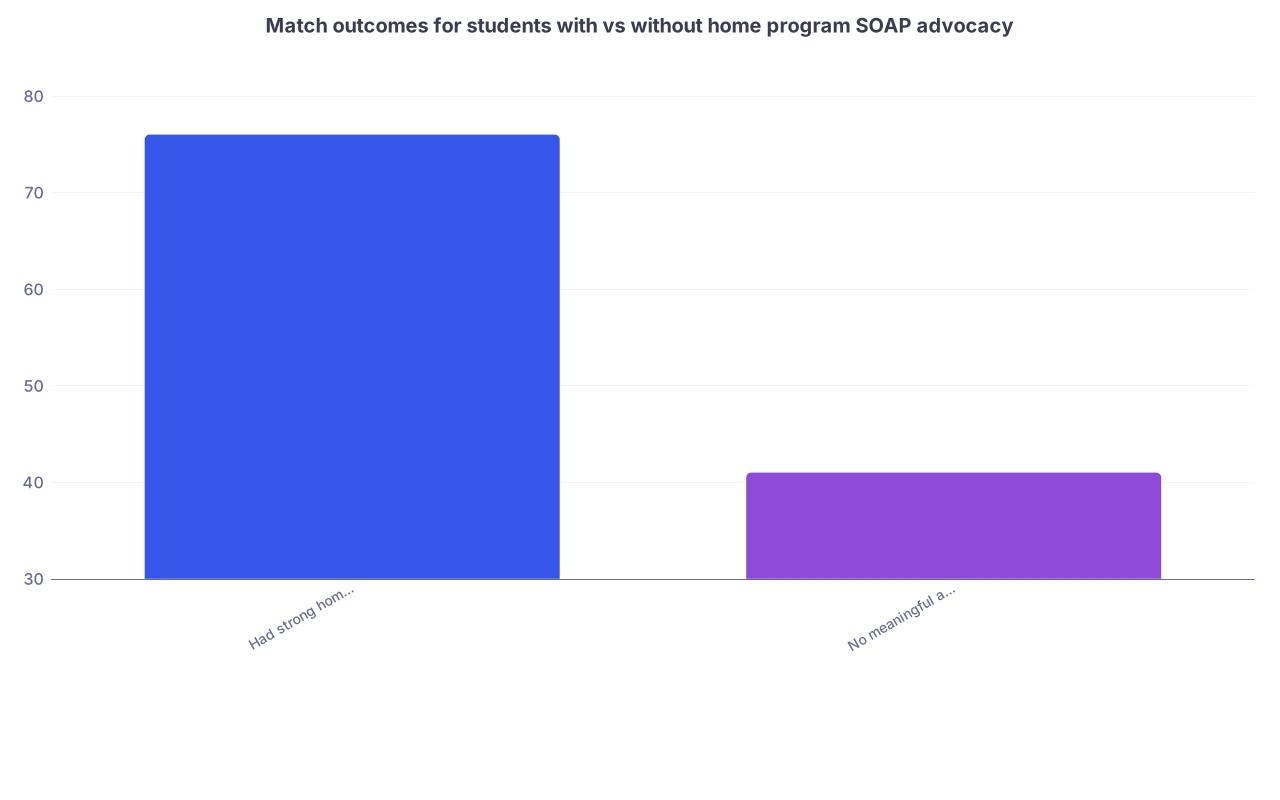
| Had strong home program advocacy | 76 |
| No meaningful advocacy | 41 |
(Those numbers are representative of patterns I have seen across years: consistent, not subtle.)
8. What Faculty Can Not Do For You (Reality Check)
Let me be blunt. Faculty advocacy is not magic.
They cannot:
- Override program minimums (if a program hard-filters below a certain score or visa status, one email does not change that)
- Turn a disastrous professionalism history into a minor footnote
- Guarantee you an offer from a competitive academic program that is already flooded with strong applicants
What they can do:
- Get your file actually opened and read in full instead of discarded by filters alone
- Reassure a PD that your “risk” is lower than your paper application suggests (older grad year, leave of absence, slight score dip)
- Help a marginal choice break in your favor when the PD is down to “these 3 applicants all look fine”
I have watched PDs say, “We have 5 interview slots left this round. Four are obvious. For the fifth, let us go with the one Dr [Trusted Colleague] emailed about.” That is the margin you are playing for.
9. Special Situations: Dual Applications, Career Pivots, and Red Flags
SOAP gets especially tricky when you are changing direction or have baggage. This is precisely when faculty narrative matters most.
a) Switching specialties during SOAP
Example: You applied to General Surgery, did not match, and are now SOAPing into Preliminary Surgery, Prelim Medicine, or possibly categorical IM.
You need two things:
- Your Surgery folks not torpedoing you (“We would not take them; they are unsafe”).
- Your Medicine folks understanding the story and being willing to say, “We would be happy to have them.”
Here is how you coach faculty to frame it:
- Emphasize your core competencies (work ethic, clinical acumen, team function)
- De-emphasize “lifelong passion for surgery” if you are now asking IM to take you
- Be honest but contained about the switch: “Interested in high-acuity care and prepared to commit fully to Internal Medicine training.”
Do not ask a die-hard surgery attending to email an IM program saying you are secretly an internist at heart. That reads false. Use faculty who can speak to your general medicine performance.
b) Explaining gaps or red flags without letting them dominate
You do not want faculty writing:
“Although [Name] failed Step 1 on their first attempt, they have worked hard to overcome this…”
That leads with the red flag and now the PD is stuck thinking about it.
You want:
“[Name] has had a nontraditional timeline in medical school, but on the rotations where I supervised them directly, they functioned at or above the level of their peers. I would have no hesitation about them caring for patients in our hospital as an intern.”
If a PD calls for details, the faculty can then explain the specifics. The email is the door-opener, not the confession booth.
10. After SOAP: Debriefing with Faculty Whether You Match or Not
Assume you did everything above. Two possibilities.
You secure a position in SOAP
You follow up with everyone who helped:
- Short thank-you email the day or day after
- Optional handwritten note later if someone clearly went above and beyond
Something like:
“Thank you again for your support this week. I matched into [Program] through SOAP and am very grateful for your advocacy. Your willingness to reach out on my behalf made a real difference.”
People remember who closes the loop. Those same faculty may matter for fellowship letters, job searches, and beyond.
You do not secure a position
This is brutal. And you will not feel like emailing anyone. Do it anyway.
Pick 2–3 faculty who were most involved and request a short debrief in the next 2–3 weeks. You are asking three questions:
- What do you think limited my options during SOAP?
- What realistic strategies exist for re-application or an alternate path?
- Would you be willing to stay involved as I plan the next cycle?
You are not trying to relive humiliation. You are extracting data from people who saw how you looked in the market. That is how you avoid repeating the same plan next year.
| Category | Value |
|---|---|
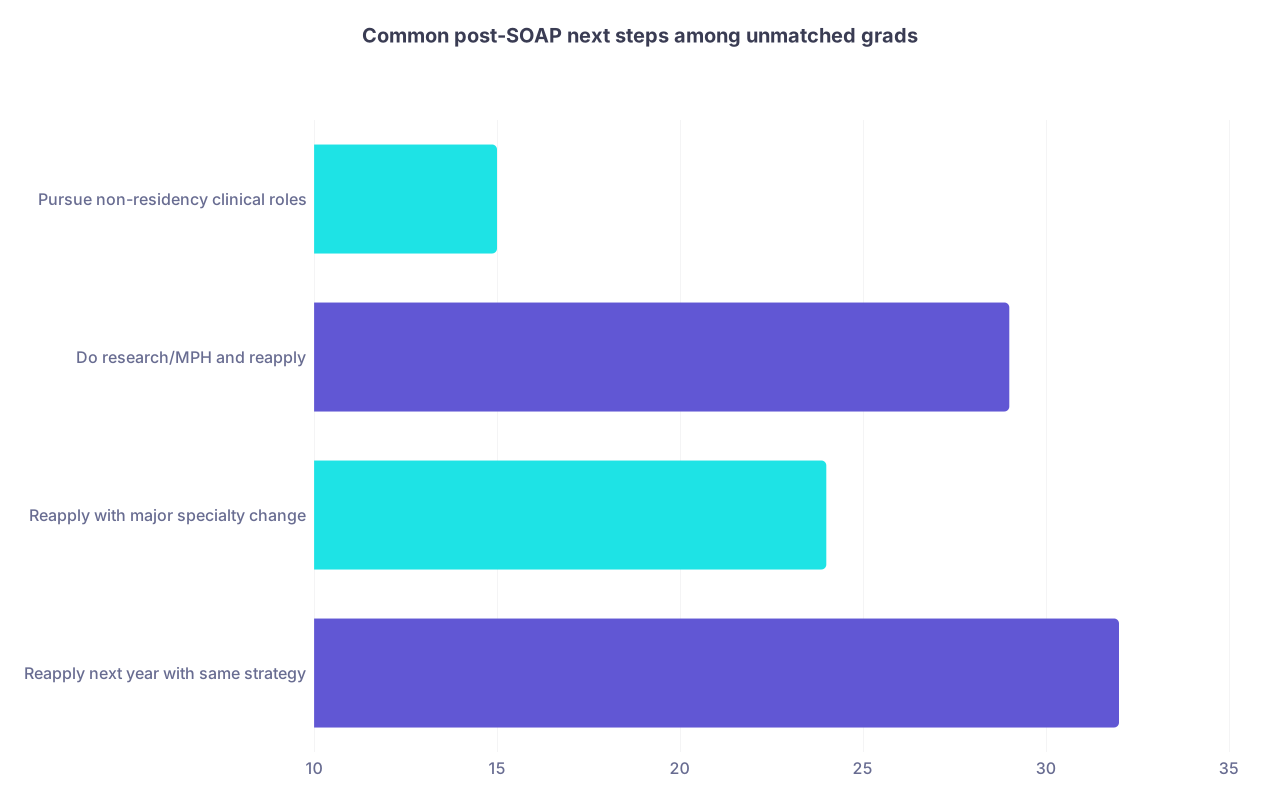
| Reapply next year with same strategy | 32 |
| Reapply with major specialty change | 24 |
| Do research/MPH and reapply | 29 |
| Pursue non-residency clinical roles | 15 |
Faculty who took the time to advocate for you once are often willing to help you rebuild. They just need you to show up and be honest.
11. Common Mistakes Students Make With Faculty During SOAP
I am going to list these bluntly because I see them every year.
Waiting until Tuesday to involve faculty.
By then, many programs have already created shortlists.Sending one mass email to 15 faculty with a huge list of programs.
No one feels personally responsible. The list looks unmanageable. Result: inaction.Asking for long letters instead of short, targeted emails.
SOAP moves in hours. No one is drafting a two-page letter for a Wednesday morning offer round.Over-selling themselves to faculty.
“I am a top-tier, exceptional candidate who just had bad luck.” Faculty read your MSPE and scores. Be accurate and focused on your fit, not your self-promotion.Ignoring non-academic mentors.
That hospitalist who loves your work? Gold. The associate PD at the community affiliate where you rotated? Gold. Do not chase only the “big names” while ignoring people who actually know you well.Failure to coordinate messages.
Three different faculty emailing three different stories about why you did not match just confuses PDs. Align your narrative with your Dean and stick to it.
12. Two Realistic Example Scenarios
To make this less abstract, here is how this plays out.
Case 1: Average metrics, strong clinical feedback, IM SOAP
- US MD, 220s Step 1, 230s Step 2, applied IM only, 6 interviews, did not match.
- On IM wards, consistently strong comments: “Hard-working, team player, good clinical reasoning.”
SOAP week:
- Monday: Meets with Dean, targets university-affiliated community IM and prelim IM.
- Faculty mobilized: Home IM PD, Clerkship Director, 2 hospitalists.
- They each email 3–4 programs they know or where student rotated.
- PD friend at regional program emails back: “We will prioritize their file.”
Outcome: 2 SOAP interviews, 1 offer accepted.
Without those emails, the program likely never looks past “mid-range scores, generic application.”
Case 2: High metrics, surgical applicant pivoting to IM/Prelim
- US MD, 250+ Steps, applied General Surgery, 8 interviews, no match.
- Limited IM exposure in MS4, but solid MS3 medicine comments.
SOAP week:
- Realization: Gen Surg SOAP spots extremely limited and hyper-competitive.
- Dean: “You should include IM prelim and possibly categorical IM in certain regions.”
- Faculty mobilized: One surgical attending, one IM clerkship director, Dean.
Messaging:
- Surgeon: “Strong work ethic, reliable in OR and wards.” (sent to prelim surgery/IM)
- IM clerkship: “On medicine, functioned well above level; we would be happy with them as an intern.”
- Dean: “High scoring applicant pivoting toward internal medicine–oriented training; no professionalism issues.”
Outcome: Multiple prelim medicine interviews, eventual SOAP offer at solid academic-affiliated program. That offer hinged heavily on the IM clerkship director providing reassurance that this is not just “a failed surgical applicant,” but a safe and capable intern.
Key Takeaways
SOAP is relationship-driven. Faculty voices—especially PDs, chairs, and clerkship directors—can move your application from ignored to seriously considered.
You must give faculty something specific and manageable to do: a short program list, a one-page summary, and clear permission to advocate.
The work starts before SOAP. Build real connections, identify advocates in advance, and make sure at least a few people in your home institution would honestly say: “Yes, I would take this student in my own program.”