
Only 41% of SOAP applicants with 1–3 interviews end up in the same “tier” of program they targeted before Match Week.
Let me translate that: if you are going into SOAP with few interviews and a strong preference for academic vs community programs, your pre-SOAP strategy often does not survive contact with reality. And that mismatch between expectations and SOAP behavior is where people quietly lose their chance to match at all.
You asked about: “Targeting Community vs Academic Programs in SOAP With Few Interviews.”
This is exactly the fork in the road that trips people up.
I am going to break this into what actually matters on SOAP week:
- What “academic” and “community” really mean in SOAP terms (not brochure terms).
- How your interview count and profile change the risk calculus.
- When it is rational to still prioritize academic.
- When you should stop chasing the prestige dragon and load your list with community spots.
- Concrete SOAP-day tactics, not vague “be flexible” nonsense.
1. Academic vs Community in SOAP: What Those Labels Mean This Week
In normal application season, “academic vs community” is about brand, research, fellowship prospects, and letters.
In SOAP, those labels quietly shift to something more primitive:
Academic program =
- Often more applicants per open seat in SOAP
- Higher Step/COMLEX expectations (even in SOAP)
- Stronger preference for traditional applicants (US MD > DO > IMG)
- More likely to screen quickly and ruthlessly
Community program =
- More variability in competitiveness
- Often more interested in people who will show up, work, and stay local
- More forgiving of gaps, lower scores, prior SOAP, non-traditional paths
- Frequently fill a large proportion of their class in SOAP
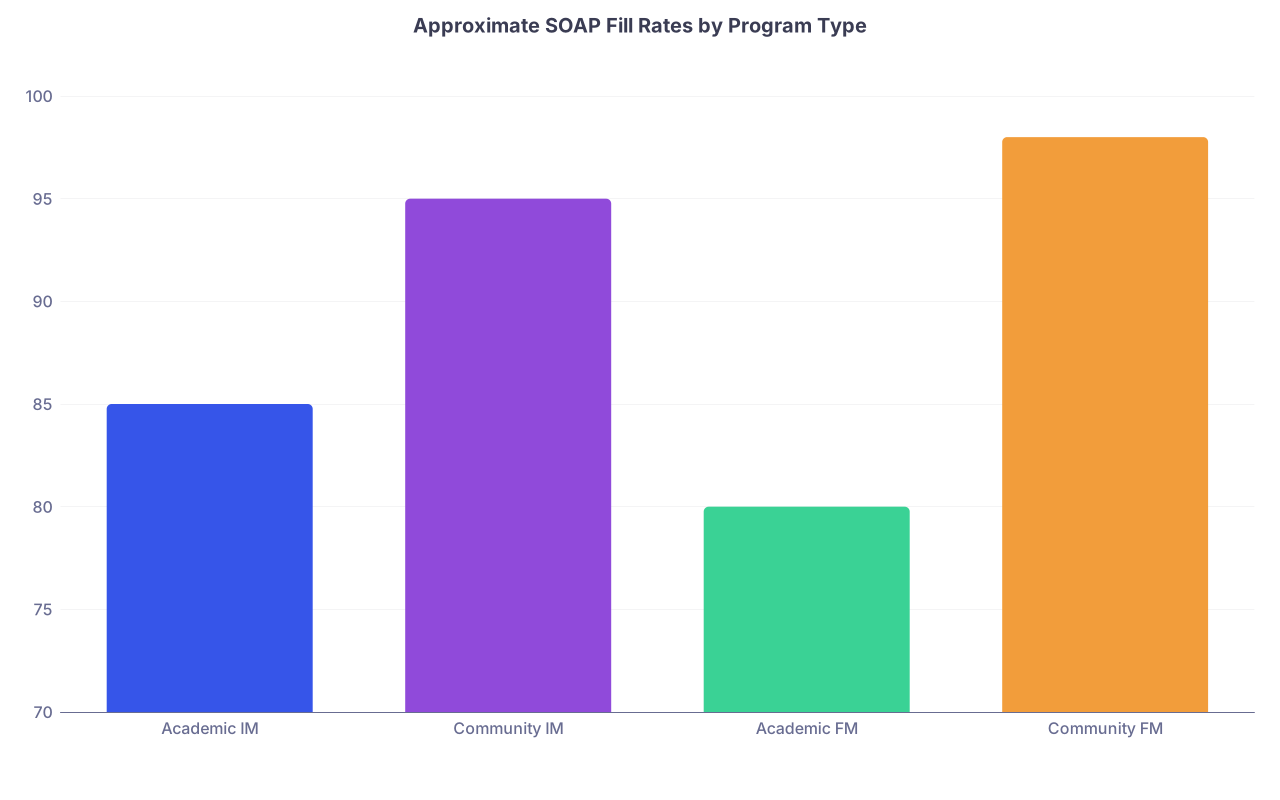
| Category | Value |
|---|---|
| Academic IM | 85 |
| Community IM | 95 |
| Academic FM | 80 |
| Community FM | 98 |
These numbers are stylized, but directionally accurate from what I have seen watching program fill lists: community programs tend to fully fill in SOAP, academic often come close but still have more selective filters.
The painful truth: in SOAP, “academic vs community” is not only about training environment. It is about probability of employment in July.
2. Your Interview Number Changes Everything
You said “few interviews.” That phrase gets thrown around loosely, so let’s define it in Match-risk language:
0–2 interviews:
- You are in serious danger of going unmatched.
- If you match, it is partly luck.
- SOAP is not a backup; it is your main path now.
3–5 interviews:
- Still high risk, depending on specialty.
- In competitive specialties (EM, anesthesia, ortho, derm, etc.), 5 is not “safe.”
- In primary care, it is borderline, but still not comfortable.
6–8 interviews:
- Risk is moderate.
- You may match, but SOAP still needs a real plan.
SOAP behavior should vary by which group you fall into. People ignore this and apply in SOAP like everyone else is in the same boat. Big mistake.

How interview count should shape your SOAP targeting
If you are:
0–2 interviews:
- You have almost no leverage to be picky.
- Community-heavy SOAP targeting is not “settling.” It is called survival.
- You should treat academic programs as luxury options, not core strategy.
3–5 interviews:
- You can still have a preference, but your SOAP list cannot be precious.
- You can sprinkle in some academic programs where your profile fits sharply (home region, strong research match, Step ≥ their usual mean).
- But the bulk of your list needs to be programs that are realistically interested in you: usually community or less-known university-affiliated community hybrids.
6–8 interviews:
- You have some flexibility but should still not get cocky.
- A balanced SOAP approach is reasonable: targeted academic + high-yield community.
- But if you went 0 for 8 on interviews at higher-tier places, that is a signal: in SOAP, they probably will not suddenly love you.
3. How Programs Think During SOAP (And Why It Matters)
SOAP is speed dating with employment contracts. Programs are not running a full holistic review. They are running triage.
Let me spell out how a typical academic vs community internal medicine (IM) program director thinks on Monday of SOAP when they see 60 unfilled spots nationwide in their specialty.
Academic PD mindset in SOAP
Rough internal monologue from an academic PD at a mid-tier university program with 3 unfilled IM spots:
- “We missed a couple of applicants we wanted.”
- “But we are not blowing up our standards over this.”
- Filter cuts:
- US MD / DO first
- US grads over IMGs (most of the time)
- Step 1 and 2 scores near or above their usual median
- Clean professionalism / no repeats / no unexplained gaps
- Extra points for:
- Research that matches their faculty interests
- Prior rotations or known letters
- Geographic/economic reason to stay (partner job, family here)
Bottom line: academic programs often still behave like academic programs. SOAP does not suddenly make them egalitarian.
Community PD mindset in SOAP
Now the monologue from a 12-resident-per-class community IM program with 6 unfilled spots:
- “We cannot cover our service in July if we do not fill.”
- “We will widen our filters but not bring in disasters.”
- Filter cuts:
- Some willingness to consider lower scores, multiple attempts
- More open to DO and IMG
- Heavy attention to:
- Will this person work hard?
- Are they likely to stay or at least not quit mid-year?
- Any scary professionalism issues?
They still screen. But the floor is lower. The bandwidth to take a chance on a nontraditional or imperfect applicant is higher.
That difference should directly drive your SOAP strategy if your application is anything less than pristine.
4. When It Makes Sense To Still Chase Academic in SOAP
There are scenarios where continuing to prioritize academic programs in SOAP is defensible, even with few interviews. Not common, but real.
You are allowed to be strategic, not just desperate.
Scenario 1: Strong academic profile, unlucky interview distribution
You are:
- US MD
- Step 2 CK ≥ 245
- Honors in medicine/surgery
- Solid research output
- But:
- Very regional application strategy that backfired
- Personal issues that limited how many interviews you could accept
- Couples match misalignment
In that case, SOAP can be a second chance at academic programs that did not initially screen you, but now see your numbers and CV.
Targeting:
- Academic or university-affiliated programs in your geographic region.
- Programs where your med school has a track record of graduates going.
- Places whose faculty share your research interests (these actually care).
You still add community programs, but you do not need to abandon academic entirely.
Scenario 2: Clear subspecialty goal where academic training is high-yield
Example: You are absolutely set on cards, GI, heme/onc, or critical care, with:
- Strong research and LORs in that field.
- Documented commitment (poster, QI project, maybe a year of research).
Here, prioritizing academic IM programs in SOAP may be rational even with fewer interviews, if:
- Your overall application is competitive for academic IM.
- You are not carrying major red flags (failed Step, prior dismissal, etc.).
You still list a decent number of solid community programs, but you can justify focusing your top preferences on academic environments that actually feed into your fellowship goal.
Scenario 3: You already have a safety net (e.g., guaranteed job, home-country residency)
I see this most with some IMGs:
- They have a viable training pathway in another country.
- Coming to the US is a “better” option, not the only option.
In those cases, it is not irrational to say: “I will only SOAP into academic or strong university-affiliated community programs, and if it does not work, I will take the other path.”
Most US grads do not have this luxury. Do not copy this strategy if you do not have a fallback.
5. When You Need To Stop Chasing Academic and Load Community
This is the part students do not like hearing. But it is the difference between matching somewhere decent and reapplying from a research assistant job next year.
If any of the following are true, your SOAP list should be heavily weighted — often >75% — toward community programs:
- Multiple Step/COMLEX failures or significant score issues.
- Category fail on a core clerkship.
- Gap year without a strong academic narrative.
- Prior SOAP, prior unmatched cycle, or withdrawal from a residency.
- IMG status without standout scores or heavy US-based research.
Ask yourself bluntly: “How did the market respond to my application pre-Match?”
If you had:
- Applied widely in a realistic specialty,
- And still got only 0–3 interviews,
that is the market telling you your profile is marginal for academic programs in that field.
You can fight the signal, or you can react strategically.
| Profile Feature | Academic Emphasis Reasonable | Community Emphasis Strongly Preferred |
|---|---|---|
| Step 2 CK ≥ 245, no failures | Yes | Maybe |
| Step failure or CK < 220 | Rarely | Yes |
| US MD, strong research | Yes | Sometimes |
| IMG with average scores | Rarely | Yes |
| 0–2 interviews in realistic field | Rare | Yes |
If three or more boxes fall in the right-hand column for you, you already know where your SOAP emphasis should be.
6. Building a Rational SOAP Preference Strategy
SOAP is not the time for vibes. You need a structured way to decide where to put your energy.
Step 1: Rank your actual priorities
Harsh but necessary order for most people in your situation:
- Matching somewhere in your chosen specialty.
- Matching somewhere, even if in a backup specialty you can tolerate.
- Within that, getting the best mix of training quality, location, and future options.
Notice academic vs community is not #1 or #2. It sits inside #3.
If your internal priority list is “academic-or-bust,” and you have few interviews, you are setting yourself up for a very predictable crash.
Step 2: Map your competitiveness honestly
Use three simple buckets:
- High: US MD / strong DO, good scores, clean record, some research.
- Middle: Reasonable scores, maybe a small blemish, DO or IMG with solid US experience.
- At-risk: Score/gap/red flag issues, or prior unmatched.
Your bucket tells you how aggressive you can be with academic targeting.
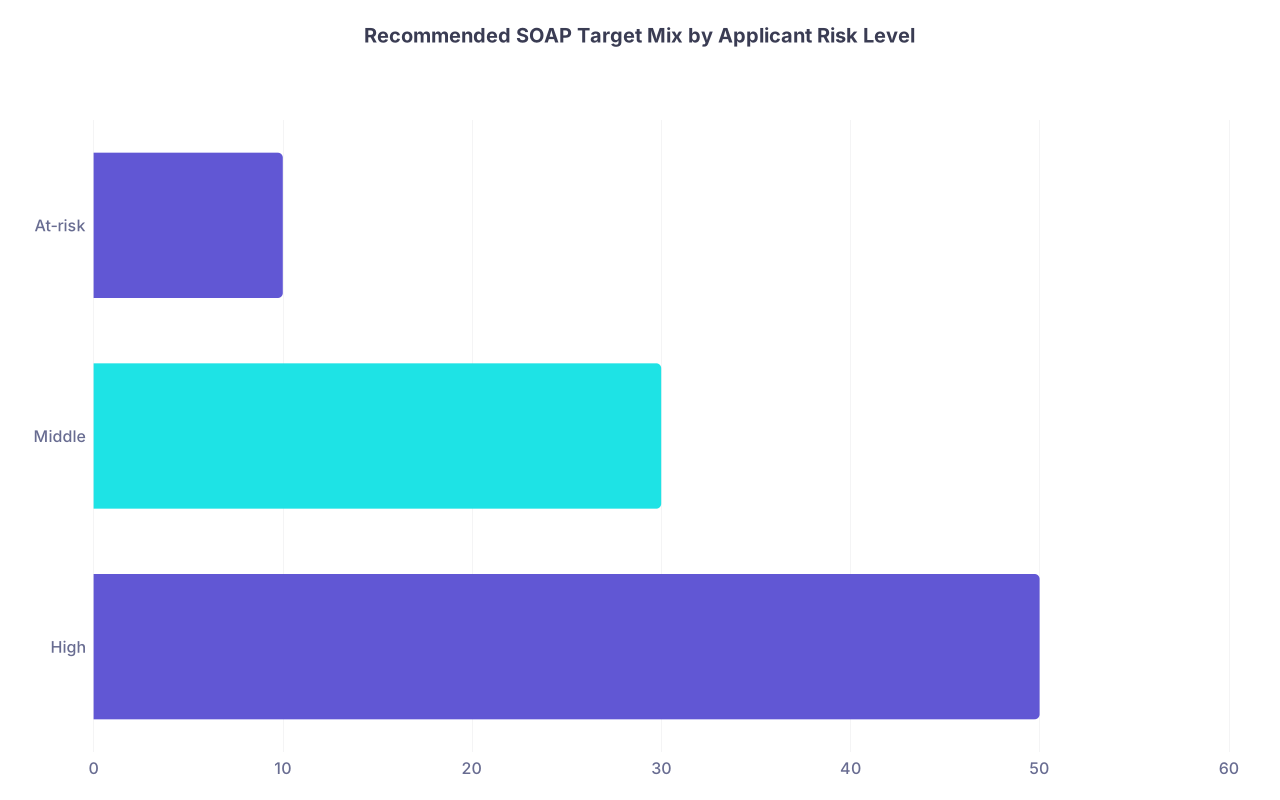
| Category | Value |
|---|---|
| High | 50 |
| Middle | 30 |
| At-risk | 10 |
Interpretation: percentage of your SOAP list that can reasonably be “academic/university-affiliated.” The rest needs to be community or more forgiving programs.
Step 3: Create three lists before SOAP opens
You should go into Monday with:
“Dream but not delusional” list
- Academic or hybrid programs you might plausibly interest.
- Limited slots. Maybe 10–20% of your applications.
“Realistic solid” list
- Community or university-affiliated community programs that routinely take applicants like you.
- This is the backbone of your list.
“Safety net” list
- Programs known to be more flexible historically (DO-friendly, IMG-heavy, less competitive regions).
- You do not lead with these if you have any leverage, but you include them.
Your few interviews do not change this structure. They just push more of your list into #2 and #3.
7. Specialty-Specific Nuances: Where Academic vs Community Really Bites
SOAP is not the same in family medicine as in categorical surgery. You know this, but people still apply with a one-size-fits-all brain.
Internal Medicine / Family Medicine / Pediatrics
- Academic vs community gap is important but not absolute.
- Plenty of community FM/IM programs have solid fellowship match lists and good training.
- If you are at-risk, community-heavy is almost always the correct SOAP move.
- You can still find university-affiliated community programs that give you academic flavor without academic selectiveness.
Emergency Medicine (especially after recent turbulence)
EM has been a mess recently: unfilled spots, shifting competitiveness.
- Some academic EM programs have had unfilled positions for more than one year.
- But their screening behavior in SOAP can still be rigid.
- Community EM often provides fantastic procedural and clinical volume.
If you have few EM interviews this cycle, heavily targeting community EM in SOAP is not “selling out.” It is the rational way to make sure you are actually in residency learning to manage airways instead of rewriting your personal statement next year.
Surgery / OB-GYN / Anesthesia
These fields remain competitive enough that academic SOAP spots are often scooped quickly by applicants who were competitive but misaligned geographically or in couples match.
If you are:
- With few interviews,
- And not a strong-on-paper candidate (scores + letters + no red flags),
then hanging your hopes on academic surgery/OB/anesthesia via SOAP is fantasy. In those specialties, even community SOAP spots are tight.
Here, the painful but smart play sometimes is:
- SOAP into a different field (prelim year, transitional, IM),
- Then consider reapplying later or pivoting permanently.
8. Tactical SOAP Day Decisions: How To Actually Choose
SOAP is fast. You do not have time to agonize over every “what if.” You need rules.
Here is a decision flow that mirrors what I have walked students through in real time:

| Step | Description |
|---|---|
| Step 1 | Start SOAP Planning |
| Step 2 | High risk - emphasize community |
| Step 3 | Balance academic and community |
| Step 4 | Build list 75 percent community |
| Step 5 | Build list 50 percent community |
| Step 6 | Submit applications early |
| Step 7 | Interviews 0-2? |
| Step 8 | Any major red flags? |
| Step 9 | Strong scores and research? |
Practical rules of thumb:
- Do not spend >5–10 minutes debating any single program. You do not have that luxury.
- If your gut says, “This academic program is a reach for my paper stats,” treat it as a bonus, not a cornerstone.
- If you are torn between a solid, realistic community program and a borderline academic one, prioritize the community option earlier on your internal target list.
9. Common Mistakes I See With Few Interviews in SOAP
Let me be blunt. These are the patterns that keep repeating.
Treating SOAP like a second primary application, not an emergency hiring process
People write beautiful, thoughtful preference lists that are dead on arrival because the programs they chose were never actually going to bite.Overestimating how much academic programs “loosen” standards in SOAP
They loosen a little. Not a lot. If they demanded 240+ median Step 2 before, they are not suddenly thrilled with 212 plus two failures.Underestimating the training quality at many community programs
I have seen community IM grads match into cards, GI, critical care at major centers. The game is not “academic or no fellowship.” It is more nuanced.Letting pride dictate the list
“I do not want to end up at some random community program” has been said by a nontrivial number of people who then ended up unmatched and scrambling for research positions.Not having backup specialties ready
If your primary specialty has almost no SOAP positions, you must have thought through which other field you can realistically tolerate — and adjusted your academic vs community expectations accordingly.
10. Practical Takeaways For You, Right Now
You are going into SOAP with few interviews. You are worried about whether to target community vs academic programs. Here is what I would tell you if we were sitting in a quiet corner of the hospital cafeteria on Sunday night of Match Week:
Decide your real priority:
- If it is “I must be employed as a resident in July,” then community programs need to be the spine of your SOAP list.
- If you already have a viable backup career or foreign residency and are willing to gamble, you can skew more academic. But that is a conscious gamble, not a default.
Use your pre-Match results as data, not an insult.
- Few interviews after broad applications = the market already spoke.
- That signal should push you firmly toward community-heavy SOAP targeting.
Stop romanticizing academic branding.
- A solid community program that trains you well, supports you, and gets you a job or fellowship is better than an imaginary academic program that never ranked you.
Build your list in tiers and lock it in early Monday.
- A handful of realistic academic or hybrid programs that fit your profile.
- A large core of bread-and-butter community spots where you actually match the residents they have historically taken.
- A safety set of more flexible programs, especially if you are at-risk.
Remember: residency is a phase, not your identity.
- Where you end up matters. But not as much as whether you actually end up anywhere.
FAQ (exactly 5 questions)
1. If I have 3–4 interviews at mid-tier academic programs, should I still prioritize community programs in SOAP?
Yes, unless your application is clearly strong on paper (high Step 2, no red flags, solid research). Those interviews do not guarantee a match. SOAP should still lean toward programs most likely to take a chance on you, which, for many applicants, are community or university-affiliated community programs.
2. Are community programs worse for fellowship chances than academic programs?
Not automatically. Some community programs have excellent fellowship outcomes, often via strong clinical training and good mentorship. Fellowship selection cares about your performance, letters, and scholarly activity. A mediocre academic program without mentorship can handicap you more than a strong community program that supports your ambitions.
3. Should I prioritize location over academic vs community status in SOAP?
With few interviews and high match risk, location usually moves down the priority list. Matching in a less desirable location at a solid community program is almost always better than going unmatched while holding out for an academic program in a preferred city.
4. Do academic programs ever take applicants with Step failures in SOAP?
Occasionally, but it is uncommon and usually requires a strong counterbalancing story: impressive research, powerful letters, institutional connections, or a demonstrated upward trajectory. For most people with Step failures, community programs are far more realistic SOAP targets.
5. Is it reasonable to SOAP only into academic programs and reapply if I do not match?
It is reasonable only if you have a genuine backup (another country’s training system, a funded research position, or an alternate career path) and you accept the risk of remaining unmatched this year. For US grads without a safety net, this strategy is usually reckless. For them, a community-heavy SOAP approach is far safer and more rational.