
Most applicants build SOAP lists like they are still in regular Match season. That is why they get crushed.
SOAP is not “ERAS, but faster.” SOAP is triage. And if you have limited interviews, your program list has to be engineered, not improvised.
Let me break this down specifically.
You are in one of the highest‑risk groups on Match Monday: few or no interviews, borderline scores, maybe a red flag, or you were too top‑heavy on your initial list. The good news: people in your exact situation Match through SOAP every single year. The bad news: most do not. The gap is usually not stats; it is strategy.
This article is about one thing only: how to build a high‑yield SOAP program list if you walk into Monday with limited interviews and real risk of going unmatched.
1. Understand the SOAP Game You Are Actually Playing
SOAP has different physics than the main Match. If you do not respect that, you will waste your four rounds on fantasy.
What SOAP really is
SOAP is:
- Compressed: hours instead of months
- Asymmetric: programs hold most of the power
- Opaque: limited time, limited data, lots of rumor
- Ruthless: programs want “ready to work on July 1,” not “future star in ten years”
And crucially: programs are solving their own problems, not yours.
- They lost one or more candidates unexpectedly.
- They have a service that must run (night float, ICU, ED).
- They got burned before by high‑risk SOAP applicants and are skittish.
- They need visas, or they cannot support visas.
- They need someone to show up in clinic, not someone who wants to reapply to Derm.
If your list does not map directly onto program pain points, you are just sending PDFs into a black hole.
Why limited‑interview applicants must think differently
A student with 18 categorical IM interviews can tolerate some vanity in SOAP if they go unmatched (they probably won’t). You, with 0–5 interviews, cannot.
You do not build your SOAP list around “what I ideally want.” You build it around:
- Where you are actually competitive on paper
- Where your story is believable (and documentable)
- Where programs historically fill SOAP spots with people like you
That is it. Everything else is noise.
2. Step Zero: Know Your Exact Risk Profile
You cannot build a high‑yield list if you are delusional about your standing. I will be blunt because your career is on the line.
Core risk factors
Here is how I mentally triage SOAP candidates on Monday:
| Risk Level | Interviews | Step/Level | Red Flags | Specialty Choices |
|---|---|---|---|---|
| Low | ≥10 | At/Above avg | None | Mix of competitive + core |
| Moderate | 5–9 | Slightly below | Minor | Mostly core, 1–2 stretch |
| High | 1–4 | Below avg or fail | Yes | Some core, some competitive |
| Critical | 0 | Below avg or fail | Yes | Heavy competitive focus |
If you are in High or Critical, your SOAP list must be almost purely pragmatic.
Hard constraints you must define by Sunday
Write this out in a document. Yes, literally.
- USMD / DO / IMG (and year of graduation)
- Step/Level scores; any failures (and what you did after)
- Visa status (no, “hoping for green card soon” does not count)
- Specialty(ies) you applied to originally
- Geographic hard stops (family, visas, licensure, financial reasons)
- Realistic willingness to do a prelim or transitional year
That list will control which programs are even possible. If you ignore it, SOAP will punish you.
3. Know the SOAP Environment: Where the Open Spots Actually Are
You are not building a program list in a vacuum. You are matching yourself to a moving target: the set of unfilled positions in your year.
Typical SOAP landscape (ballpark)
The exact numbers shift year to year, but the pattern is stable:
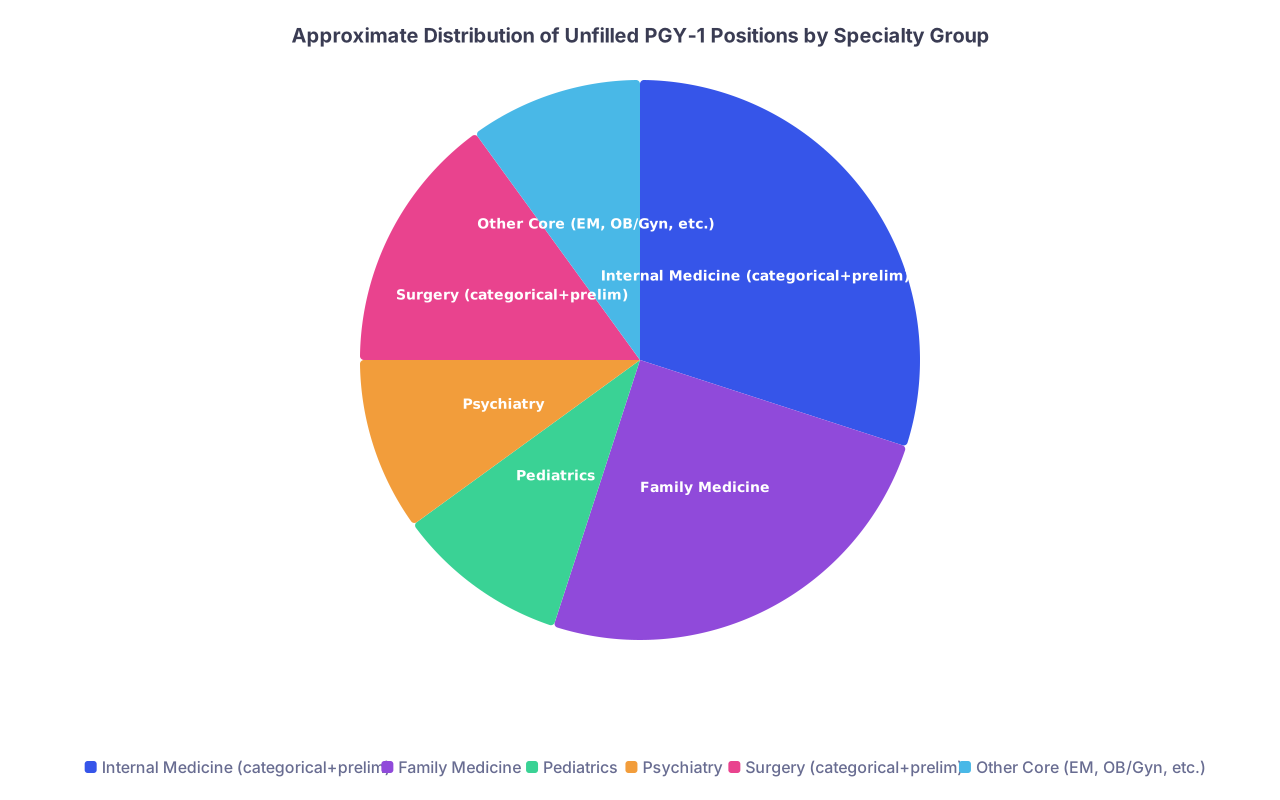
| Category | Value |
|---|---|
| Internal Medicine (categorical+prelim) | 30 |
| Family Medicine | 25 |
| Pediatrics | 10 |
| Psychiatry | 10 |
| Surgery (categorical+prelim) | 15 |
| Other Core (EM, OB/Gyn, etc.) | 10 |
You will see:
- Many IM categorical and prelim spots (community programs, some university affiliates)
- Consistent FM and peds presence
- Psych and surgery spots, but often in less desirable locations or with demanding service loads
- A scattering of EM, OB/Gyn, Neurology, Path, etc., often with very specific requirements
MISUNDERSTANDING #1: “I will just SOAP into my original competitive specialty”
For limited‑interview applicants, this is almost always fantasy. Radiology, anesthesia, EM, even psych in some regions – very few SOAP spots, heavily hunted by strong unmatched candidates who had 15+ interviews but got squeezed by numbers.
If you had:
- 0–3 interviews,
- average or below scores, and
- no home‑program advocacy in that same specialty,
…building a list heavily weighted toward that specialty in SOAP is career self‑sabotage.
You can keep 1–2 slots as reach if there is a clear angle (home program, strong away rotation), but your high‑yield list will live in the core specialties.
4. Core Framework: The 4‑Tier SOAP Program List
You need structure before you start clicking. Here is the framework I use with unmatched applicants.
Tier 1: “Bullseye Fit – Max Probability”
These are the programs where your profile, geography, and program history line up almost perfectly.
Typical patterns:
- Community IM / FM / Peds programs in regions where you have genuine ties
- Programs that have taken multiple graduates from your school in SOAP previously
- Institutions that explicitly state they accept your visa or IMG status
- Prelim IM/surgery in hospitals with a reputation for heavy workload but solid training
Goal: At least 50–70% of your applications should be here if you have limited interviews.
Tier 2: “Realistic Stretch – Solid Rational Story”
Programs where your metrics are slightly below their typical range, or geography is more of a stretch, but you can clearly argue fit:
- Slightly stronger university‑affiliated IM programs
- FM/Peds programs in regions without direct ties but with clear commitment to underserved populations which your CV matches
- Psych programs that typically fill but now have a few unexpected SOAP spots, and you have psych research or strong letters
Goal: 20–30% of your list.
Tier 3: “Strategic Prelim / Transitional Bets”
This is where many limited‑interview applicants refuse to think clearly.
Prelim or TY spots can:
- Get you licensed
- Buy you another year of US clinical experience and letters
- Create internal transfer possibilities
But they also:
- Do not guarantee PGY‑2
- Are brutal in some institutions
- Can trap you if you do not keep reapplying actively
You put programs here where you would honestly be willing to work hard for a year, learn, and re‑apply with a stronger application.
Goal: 10–20% depending on your risk level and appetite.
Tier 4: “Low Probability / Vanity”
This is the dangerous category:
- Competitive specialties that rarely fill
- Big‑name university programs you liked on VSLO but never interviewed at
- Programs obviously outside your score/visa range
For someone with limited interviews, Tier 4 should be almost zero. If you place more than 2–3 programs here, you are treating SOAP like a fantasy draft.
5. Data Sources: How to Build Your Longlist Fast
Time is your enemy. You cannot manually review 300 program websites on Monday afternoon. You need a short, ruthless pipeline.
Step 1: Use your school’s data
Most med schools and DO schools quietly maintain an internal database of where students matched and SOAPed in prior years. Your dean’s office or Student Affairs knows this, even if they never advertised it.
Ask explicitly:
- “Can you show me where unmatched students from our school have SOAPed into internal medicine / family medicine / etc. in the last 3 years?”
- “Which programs have historically been receptive to our grads with my kind of scores?”
Those names go directly to Tier 1/2.
Step 2: Scrape past SOAP lists and unfilled programs
Many specialties and forums (NRMP, some specialty organizations) release:
- Lists of unfilled programs by specialty after SOAP
- Or de‑identified data of unfilled positions by state
You are looking for patterns:
- Same community IM program appears unfilled 3 out of 5 years
- A particular FM program takes multiple IMGs annually
- Specific psych programs that consistently have 1–3 unfilled spots
Those go on your pre‑SOAP “watch list.”
Step 3: Use program websites and filters intelligently
When the unfilled list drops:
Sort by specialty and state
Immediately cross off programs that obviously exclude you:
- “No visas.”
- “Graduation within 3 years only” if you are older.
- “USMLE required” if you are COMLEX‑only and have no time to take Step 2.
Prioritize programs that explicitly mention:
- Community focus / underserved populations
- History of DO/IMG acceptance
- Strong inpatient volume (they want workhorses, not prestige)
6. Geographic Strategy: Stop Thinking like MS4 You
Your geographic preferences from September do not necessarily survive into SOAP week.
SOAP reality:
- Programs in less desirable or rural locations tend to have more unfilled spots.
- Programs in high‑cost coastal metros fill more easily, even in SOAP.
- Your “I will only live in [two coastal cities]” rule is now mostly theoretical.
You need to define three categories for yourself:
- Green Zones – clearly acceptable: family nearby, reasonable cost of living, no major licensure issues.
- Yellow Zones – not your dream, but workable for training. You would not be thrilled, but you accept it for the sake of having an MD/DO job.
- Red Zones – truly impossible (documentable family issues, immigration constraints, medical/licensing reasons).
Your program list should heavily favor Green and Yellow zones. If half your SOAP list is places you would be miserable or refuse to rank, you are wasting precious applications.
7. Specialty Tactics for Limited‑Interview Applicants
Let’s be specific. You are not choosing in a vacuum; your original specialty matters.
If you originally applied IM
This is the most “forgiving” scenario.
High‑yield strategy:
- Load up on IM categorical community programs (academic affiliates second).
- Include FM or Peds only if you can tell a coherent story and genuinely would practice there.
- Add IM prelim in hospitals with decent reputations as your Tier 3.
Red flags that shift you more heavily toward prelim:
- Step 1 fail
- Multiple attempts on Step 2
- Graduation > 3 years ago with limited recent clinical work
If you originally applied FM or Peds
You already chose a core specialty. You are in better shape than you think.
Strategy:
- Hit FM/Peds SOAP spots broadly in Green and Yellow zones.
- Consider IM categorical only if your CV and letters are not exclusively FM/Peds flavoured. Programs smell misalignment very fast.
- Use prelim IM sparingly. It is a very different job from outpatient‑heavy FM.
If you originally applied Psych
Psych has become far more competitive. Limited interviews is a sign you are on the margin.
High‑yield SOAP list:
Some psych programs if:
- You rotated there
- You have strong psych letters or research
- Your scores are not catastrophic
Heavy presence of IM categorical and FM as true backups.
A small number of prelim IM in case you need a foothold for reapplication.
A SOAP list that is “25 psych, 3 IM” for a limited‑interview psych applicant is reckless.
If you originally applied a highly competitive field (Derm, Ortho, ENT, etc.)
You are in the danger zone.
Your SOAP strategy must be almost entirely:
- IM categorical
- FM
- Prelim/TY in reputable training environments if you are adamant about reapplying
You can keep 1–2 programs in your original specialty:
That is it. The rest is survival and a plan to re‑enter your competitive field after a strong PGY‑1.
8. Scoring and Ranking Programs Fast
You will be staring at a long list Monday morning. You need a way to score programs quickly, without emotional noise.
Use a simple 1–3 scale in each category; do this in a spreadsheet.
Categories to score
Eligibility (must have)
- 3 = clearly eligible (meets all cutoff criteria)
- 2 = borderline but plausible (slightly old grad, slightly below score)
- 1 = very unlikely (strong stated preferences you do not meet)
Fit and Story
- 3 = clearly aligned with your CV (community focus, similar patient population, similar past grads)
- 2 = generic but not conflicting
- 1 = feels mismatched
Program Track Record with Your Profile
- 3 = has taken DO/IMG/older grads like you
- 2 = mixed
- 1 = strongly favors profiles unlike yours
Training and Life Reality
- 3 = you can live and work there without burning out or going broke
- 2 = doable but tough
- 1 = you would be miserable / might not rank
Total score out of 12.
Programs scoring 10–12 → TIER 1
8–9 → TIER 2
6–7 → TIER 3
≤5 → usually discard (or very limited vanity picks)
9. The SOAP Application Timeline: Where the List Fits
You are not just building a list; you are coordinating it with calls, emails, and letter writers.
Here is how a well‑run SOAP week looks for a limited‑interview applicant:

| Step | Description |
|---|---|
| Step 1 | Sunday - Pre-SOAP |
| Step 2 | Build longlist by specialty and state |
| Step 3 | Score programs into tiers |
| Step 4 | Draft specialty-specific personal statement variants |
| Step 5 | Identify programs needing direct outreach |
| Step 6 | Monday - Unfilled list releases |
| Step 7 | Cross-check longlist with actual unfilled spots |
| Step 8 | Finalize 45 program selections |
| Step 9 | Submit SOAP applications early |
| Step 10 | Coordinator outreach and faculty advocacy |
| Step 11 | Interview rounds and same-day thank yous |
You see where the list sits: front‑loaded. If you are building your criteria from scratch at 1 PM Monday, you are already behind.
10. Special Considerations for Red Flags and Nontraditional Paths
If you have limited interviews and a red flag, your list must be even more strategic.
Step/COMLEX failures
Programs vary wildly in how they handle fails.
High‑yield moves:
- Explicitly seek out programs that write “we review applications holistically” and have prior residents with similar histories (ask your dean if they know).
- Heavily favor community programs with strong service workloads; they often care more about demonstrated improvement than boards perfection.
- Avoid programs with explicit hard cutoffs (“no Step fails considered”).
Older grads / gap years
Programs want to see:
- Recent clinical activity
- Proof you can still function at resident pace
- No professionalism issues in your gap
Your list should emphasize places that:
- Have previously taken older grads or IMGs with gaps
- Are in regions with physician shortages (they are often more flexible)
Visa needs
If you require a visa and have limited interviews, you must be brutal with your list:
- Only apply to programs that clearly support your visa type.
- Do not waste slots on “maybe they changed their policy” dreams.
- Lean heavily on your school’s prior data: which programs have sponsored visas for your grads.
11. Concrete Example: Two Different SOAP Lists
Let me draw two composite examples from people I have worked with.
Case 1: US DO, applied Psych, limited interviews
- DO, graduate 2024
- Step 1 pass, Step 2 223, COMLEX solid
- 3 psych interviews, 2 IM interviews
- No psych match; SOAP eligible
High‑yield SOAP list:
- 20 IM categorical community programs in states where school has prior matches
- 8 FM programs with strong behavioral health integration (aligned with psych interest)
- 7 psych programs (home, away rotation sites, plus those with historical DO acceptance)
- 5 IM prelim spots in well‑regarded hospitals as safety
- 5 FM/IM programs in Yellow‑zone geography but clear need for physicians
Dangerous low‑yield list (what some applicants actually do):
- 25 psych spots, including big‑name programs that never took a DO from their school
- 10 IM programs all in one coastal metro
- 5 prelim surgery “just to get in the hospital”
- 5 random programs friends mentioned on Reddit
You can guess which list performed better.
Case 2: IMG, applied IM, no interviews
- IMG, grad 2021
- Step 1 220 (pass), Step 2 231, no USMLE fails
- US clinical experience in IM for 6 months, good letters
- Zero interviews, SOAP eligible
High‑yield SOAP list:
30 community IM categorical programs that:
- Explicitly accept IMGs
- Have taken IMGs from same region previously
- Are in less competitive states (Midwest, South)
10 IM prelim positions in hospitals where prior IMGs have later converted or matched into PGY‑2
5 FM programs familiar with IMGs
0 vanity academic IM university programs
Is this glamorous? No. Is it your best shot? Absolutely.
12. Common Mistakes That Destroy SOAP Lists
Let me be very clear on what not to do.
Chasing reputation.
Applying heavily to big‑name academic programs “because they have good fellowship placements” when they have 200 SOAP applicants per spot and you are below their usual range.Ignoring your own story.
Sending 15 applications to rural FM programs when your entire CV screams high‑end lab research and coastal urban background with zero primary care exposure. Programs notice.Pretending geography does not matter – until it suddenly does.
Applying all over the country, then realizing you actually will not move to certain regions if they call you.Under‑applying prelim / transitional options.
Telling yourself “I will only take categorical” when your profile is marginal and prelim is a realistic foothold.Building the SOAP list alone in a vacuum.
Not looping in your dean, advisor, or a faculty mentor who actually knows program reputations.
13. How to Use Your SOAP List in Real Time
The list is not static. It shapes how you talk to programs and advocates.
Once you have your Tier 1 programs identified, you:
Flag them for your dean or advisor:
“These 10 programs are my highest‑yield. If you know any PDs or APDs there, now is the time.”Adjust your personal statement subtly by specialty and tone.
Your IM‑focused statement should look different from one you send to FM or psych.Prepare program‑specific talking points:
One or two sentences on why they are a logical fit for you: patient population, training structure, region, prior grads, etc.
Your list is not just where you click in ERAS. It is your battle map for all SOAP communication.
FAQ (Exactly 6 Questions)
1. How many SOAP programs should I apply to if I have limited interviews?
Use the maximum allowed (usually 45 total) unless you have very strong reasons not to. For limited‑interview candidates, that typically means 30–35 in your most realistic core specialty (IM/FM/Peds), 5–10 prelim/TY depending on risk, and only a few stretch programs in your original specialty if appropriate.
2. Should I include programs where I interviewed but did not match?
If those programs appear on the unfilled list and you would still gladly train there, yes. You already passed their initial screen. However, be honest: if the interview felt disastrous or there were clear misfits, focus those slots on fresh options that align better with your profile.
3. Is it smart to SOAP into a prelim year if I really want a categorical spot?
For many high‑risk applicants, yes. A strong prelim year in IM or surgery at a solid institution is often better than going unmatched and reapplying with the same paper file. The key is going in with a plan: keep taking Step 3 early if needed, build relationships for letters, and reapply broadly for PGY‑2 or categorical the following cycle.
4. How much should my SOAP list differ from my original application strategy?
If you had limited interviews, your SOAP list should usually be more conservative. That means shifting away from competitive specialties towards core fields (IM, FM, Peds, Psych) where your metrics and experiences fit, and away from prestige towards programs with a track record of taking applicants like you.
5. Do programs care that I am using SOAP as a ‘backup’ to my original specialty?
They care if it shows. If your entire file screams “I only care about ortho” and you send a generic, last‑minute IM application with no coherent reason for internal medicine, it hurts you. If you present a thoughtful narrative about caring for complex medical patients and back it up with rotations and letters, most programs will not hold your original specialty against you.
6. How do I know if a program is truly high‑yield for me in SOAP?
Look for three things: you clearly meet their published eligibility criteria (scores, visa, graduation year), they have historically taken applicants with profiles like yours (school, DO/IMG status, red flags), and you can tell a believable story about why you fit their mission and setting. If any of those three are weak, that program is no longer “high‑yield”; it is a stretch at best.
With a list built this deliberately, you stop treating SOAP like a desperate lottery and start using it like a targeted, last‑chance Match. Do this right, and on July 1 you will be wearing a badge that says “PGY‑1,” not refreshing forums wondering what went wrong. The next move after that—turning a SOAP spot into the career you actually want—is a conversation for another day.