
Most people do SOAP pivots backwards—and then wonder why PDs do not buy it.
You are trying to convince a program director, who has 30 seconds per application, that your sudden interest in their specialty is not desperate, random, or fabricated at 2 a.m. on SOAP Monday. That is the game. And you cannot win it with vague “I love working with my hands” or “I discovered my passion late” nonsense.
You win it by weaponizing your past rotations.
Let me break this down specifically.
The Reality: SOAP Pivots Are Presumed Guilty
SOAP is not a neutral process. Program directors start from a default assumption:
- If you really wanted this specialty, you would have applied here in September.
- If you did not, either:
- You were focused on something else (and did not match), or
- You were not competitive and are now scrambling.
Your job is not to pretend this did not happen. Your job is to build a coherent, documented narrative that:
- Connects your prior rotations directly to this new specialty.
- Shows progressive interest and responsibility, not random exposure.
- Explains the pivot in a way that still sounds like good judgment.
You are not creating a new identity in SOAP week. You are excavating the evidence that already exists in your rotation history and making it legible to a suspicious PD skimming under time pressure.
Step 1: Audit Your Rotations Like a Lawyer, Not a Tourist
Start with a hard inventory. Not “what did I enjoy?” but “what can I prove?”
Pull up your transcript, MSPE, and any written feedback you have from:
- Core clerkships (IM, surgery, peds, OB/GYN, psych, family, neuro)
- Sub‑Is / acting internships
- Electives (clinical, not just research or admin)
- Away rotations
Now sort them by relevance to your SOAP target specialty.
| Rotation Type | Rotation Name | Months Ago | Direct Relevance | Strength of Evaluation |
|---|---|---|---|---|
| Core | Internal Medicine Inpatient | 10 | High | Strong |
| Core | Pediatrics | 9 | High | Moderate |
| Core | OB/GYN | 8 | Moderate | Strong |
| Elective | Outpatient IM Clinic | 6 | High | Strong |
| Sub‑I | General Medicine Sub‑I | 4 | Very High | Strong |
| Elective | Cardiology Consults | 7 | Low | Moderate |
You care about three things for each rotation:
Clinical overlap with SOAP specialty
Example:- SOAP target = Internal Medicine
Relevant: IM core, ICU, cardiology, nephrology, heme/onc, hospitalist medicine - SOAP target = Pediatrics
Relevant: peds core, NICU, newborn nursery, peds subspecialties, FM with strong peds exposure
- SOAP target = Internal Medicine
Evaluations that mention behaviors PDs care about
Look for phrases like:- “Patient ownership”
- “Reliable, early, stayed late”
- “Strong clinical reasoning”
- “Great with families”
- “Calm under pressure”
- “Excellent team player”
Timing relative to SOAP
Recent rotations are more believable as “shaping” your interests. A sub‑I 3–4 months ago carries more narrative weight than a shadowing experience M2 year.
Make a short list: 3–5 rotations that can plausibly be used as pillars of your pivot story.
Step 2: Understand What Each Specialty Wants You to Prove
You cannot just say “I really liked my IM rotation.” That tells a PD nothing. You must map rotation experiences to specialty‑specific values.
Here is the rough mental checklist PDs in common SOAP specialties are using.
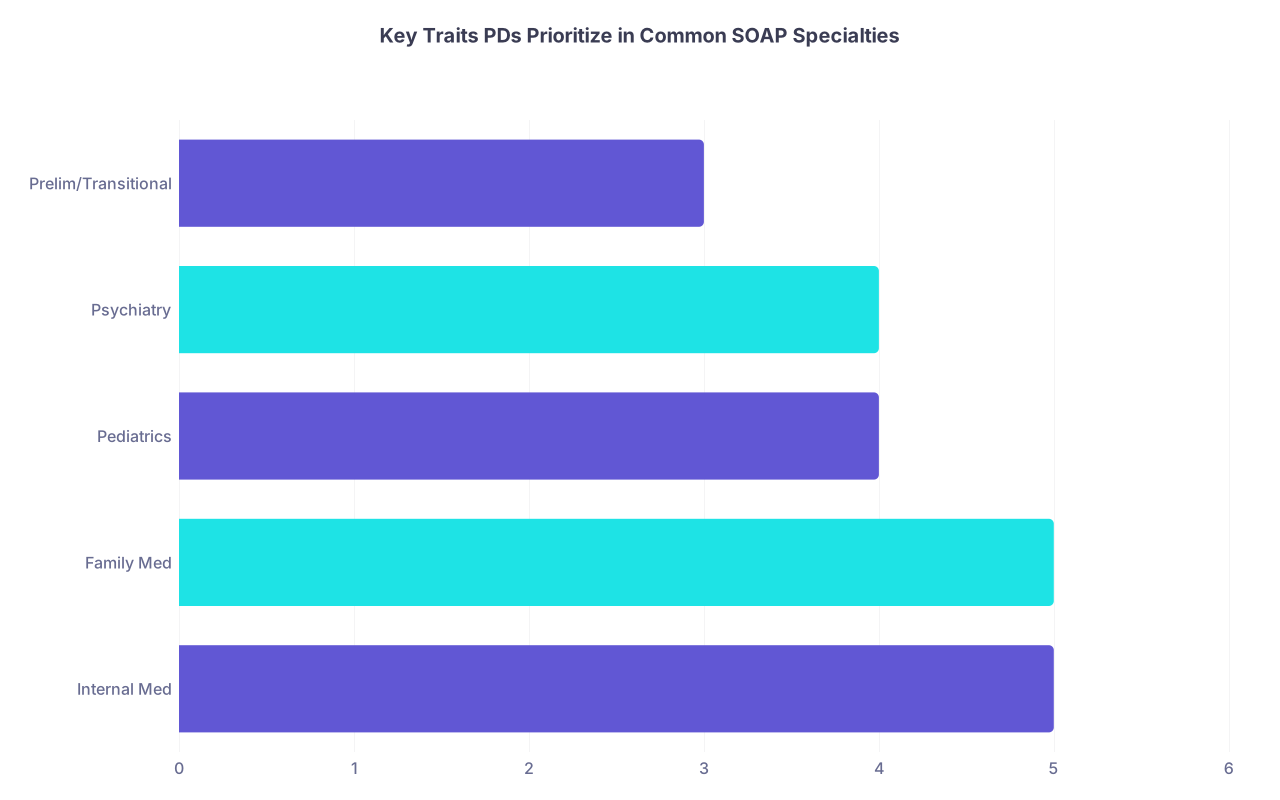
| Category | Value |
|---|---|
| Internal Med | 5 |
| Family Med | 5 |
| Pediatrics | 4 |
| Psychiatry | 4 |
| Prelim/Transitional | 3 |
Ignore the numbers, focus on the themes below.
Internal Medicine (Categorical or Prelim)
They want to see:
- Longitudinal thinking and follow‑through
- Comfort with inpatient complexity
- Ability to synthesize data, not just follow orders
- Professionalism and reliability on busy ward services
Excellent anchors:
- IM core clerkship
- Medicine Sub‑I
- ICU
- Cardiology, nephrology, heme/onc electives
Family Medicine
They want:
- Breadth: adult, peds, women’s health
- Comfort in outpatient, longitudinal care
- Communication with diverse patients and families
- Flexibility and “no drama” teamwork
Great anchors:
- Outpatient IM
- FM elective (obvious if you have it)
- Peds core
- OB/GYN (especially clinic)
- Psych (for behavioral health in primary care)
Pediatrics
They want:
- Ability to connect with kids and parents
- Patience, teaching, and reassurance
- Team orientation with nurses, therapists, etc.
- Attention to growth and development over time
Anchors:
- Peds core
- NICU / PICU
- Nursery, peds ED
- FM with high peds volume
Psychiatry
They want:
- Strong communication and listening
- Non‑judgmental attitude with vulnerable patients
- Tolerance for ambiguity; longitudinal thinking
- Teamwork with social work, psychology, etc.
Anchors:
- Psych core
- IM (for consult‑liaison overlap)
- Neurology
- ED (crisis management, behavioral health exposure)
Transitional / Prelim Year (Medicine or Surgery)
They want:
- Someone who can function on day 1 without being babysat
- Work ethic and reliability on call
- Maturity with floor management or basic post‑op care
- Evidence you do not implode when tired
Anchors:
- Medicine or surgery cores
- Sub‑Is
- Busy services: ICU, night float, ED
Once you know what they want, you comb your rotation narratives for concrete examples of you doing exactly those things.
Step 3: Re‑Frame Your Rotation History Around the New Specialty
You are not lying. You are re‑ordering the story.
Before SOAP, your “story” might have been:
“I am an EM applicant who did EM away rotations, an EM Sub‑I, and a couple of IM electives.”
SOAP week, pivoting to IM, the story becomes:
“My clinical trajectory has consistently gravitated toward internal medicine complexity and inpatient management, even while I explored other acute care interests.”
Notice the difference: same facts, different foreground.
Let’s go through a couple of common pivot scenarios and how to use rotations strategically.
Scenario 1: Originally Applied to EM, Now Pivoting to Internal Medicine
Common profile:
- EM Sub‑I
- EM away rotation
- Strong IM core
- ICU elective
- Some ambulatory IM or cardiology
Bad SOAP explanation:
“I did not match in EM so I am applying to IM because I like inpatient care and complex patients.”
Good SOAP explanation uses rotations:
Start with IM anchor:
- “During my core internal medicine rotation at [Hospital], I found I was most energized by managing multi‑morbid patients through several days of hospitalization…”
Connect ICU:
- “This interest deepened on my MICU elective, where I learned to manage respiratory failure, vasopressors, and complex fluid status under close attending supervision.”
Reframe EM time as complementary, not contradictory:
- “My EM rotations sharpened my initial assessment and stabilization skills, but I consistently found myself wanting to follow patients beyond the first few hours and guide their full diagnostic and therapeutic course, which aligns more directly with internal medicine training.”
That sequence tells the PD:
- IM was there early.
- Critical care consolidated it.
- EM was an exploration of a related area, not your “true north.”
Scenario 2: Originally Applied to General Surgery, Now Pivoting to Family Medicine
Profile:
- Surgery core + Sub‑I
- OB/GYN
- IM core
- One FM elective or outpatient IM
Weak version:
“I realized late in the year that I value continuity more than the OR, so I am pivoting to FM.”
Stronger, rotation‑anchored version:
- “My internal medicine and OB/GYN rotations showed me how much I enjoy longitudinal conversations about chronic disease and preventive care, especially in clinic visits where I could follow the same patient multiple times.”
- “On my FM elective at [Clinic Name], I saw this breadth in one specialty—adult medicine, pediatric visits, prenatal counseling—and recognized that my favorite part of surgery had actually been the clinic days where I reconnected with post‑op patients and their families.”
Notice the trick: you do not trash surgery. You mine your surgical experience for FM‑compatible behaviors: follow‑up visits, pain management counseling, lifestyle guidance.
Step 4: Build a Pivot‑Ready Personal Statement in SOAP Time
You do not have days to write this. You have hours. So you use a template that forces you to plug in rotation‑level evidence.
Think like this:
- Paragraph 1: Present your current interest in the SOAP specialty, anchored to a specific rotation case or pattern from that specialty’s domain.
- Paragraph 2: Show how your previous rotations collectively support that interest.
- Paragraph 3: Briefly and non‑defensively acknowledge the earlier specialty focus.
- Paragraph 4: Connect your skills and trajectory to what that specialty’s residency actually looks like.
Concrete Example: Pivot to Internal Medicine
Skeleton you can adapt:
Opening case (from IM‑relevant rotation):
“On my internal medicine core rotation at [Hospital], I was assigned to follow a patient with decompensated cirrhosis through a two‑week hospitalization. Each day I adjusted diuretics, monitored labs, and discussed prognosis with his family, gradually understanding how thoughtful, longitudinal inpatient care could stabilize an otherwise dire situation.”Evidence across rotations:
“That experience, along with my MICU elective and subsequent general medicine Sub‑I, consistently drew me toward the diagnostic reasoning and continuity that define internal medicine. I enjoyed presenting multi‑day plans on rounds, tracking small objective changes, and coordinating consulting teams.”Addressing prior focus without groveling:
“While I initially pursued emergency medicine because I was drawn to acute stabilization and team‑based care, my later rotations reaffirmed that I derive the most satisfaction from following patients beyond initial stabilization and managing their complex conditions over time. The skills I honed in the ED—rapid assessment, prioritization, and comfort with high acuity—are directly applicable to caring for hospitalized medicine patients.”Close with training‑aligned fit:
“I am seeking internal medicine training that will challenge me on busy inpatient services, expose me to high‑acuity care, and allow me to develop as a primary physician for medically complex patients, whether in the hospital or continuity clinic.”
No drama, no oversharing. Rotations front and center.
Step 5: Re‑Align Your LoRs and MSPE Without Time Travel
You cannot magically get new letters during SOAP week. So you have to:
- Re‑interpret existing letters in a way that matches your pivot.
- Highlight specific mentions from your MSPE or narrative evaluations in your communications.
If you are lucky, you already have at least:
- One IM‑related letter (for IM/FM pivots)
- One peds‑related letter (for peds)
- One psych letter (for psych)
If not, you lean heavily on core clerkship comments quoted in the MSPE:
- “On my internal medicine rotation, my attending described me as ‘taking ownership of complex patients and staying late to ensure tasks were complete.’ This is the environment I am drawn to in internal medicine training.”
- “My pediatrics clerkship feedback emphasized my ability to connect with families and adjust my communication for different developmental levels.”
Do not assume PDs will dig through 12 pages of MSPE text. Surface the key lines in your personal statement or brief email (if allowed) to the program.
Step 6: Use Rotations to Answer the “Why Now?” Question Directly
Every SOAP pivot lives or dies on one question:
“If you are so interested in this specialty, why did you not apply here in September?”
You cannot dodge it. You have to answer it cleanly, with rotation‑based logic.
Here are three acceptable frameworks.
1. “Late but Logical Consolidation”
Story: Your early rotations pushed you one way. Later, higher‑responsibility rotations clarified where you fit better.
Example (EM to IM):
- “My earliest clinical experiences were in the ED, where I initially fell in love with acuity and rapid decision making. Later, as I took on more responsibility in my IM Sub‑I and MICU, I realized I was most fulfilled by managing complex hospital courses and longitudinal decision making. That clarity came after ERAS submission, which is why I am now pursuing internal medicine through SOAP.”
Key: the sequence of rotations justifies the timing of your change in insight.
2. “Field Adjacent, Now Committed”
Story: You always liked aspects of this SOAP specialty, but your primary focus was a close neighbor.
Example (Surgery to FM):
- “I have always enjoyed broad clinical medicine, and on surgery I gravitated toward clinic conversations, post‑op follow up, and long‑term planning with patients. I initially believed I would find this balance within surgery, but my FM elective, peds core, and OB clinic experience demonstrated that family medicine brings together exactly the kind of continuity, breadth, and relationship‑building that I value. This realization came as my fourth‑year outpatient rotations accumulated.”
3. “Dual Interest, One Path Did Not Work Out”
Careful with this one. You can acknowledge you applied in a different direction without sounding like FM/IM/etc. is your consolation prize.
Example (Orthopedics to IM Prelim / Transitional):
- “I applied to orthopedic surgery because I have longstanding interest in musculoskeletal medicine and procedural work. At the same time, my internal medicine and ICU rotations confirmed that I enjoy complex inpatient management and cross‑specialty collaboration. I am now seeking a strong preliminary year where I can continue to care for acutely ill patients and build a foundation applicable to both hospital medicine and potential future specialty training.”
You are telling them: I am serious about doing good work in this year, even if my long‑term path remains flexible.
Step 7: Align Your Program Signaling with Rotation‑Supported Strengths
You cannot spray and pray in SOAP and still sound coherent. Your rotation history should shape where you apply.
Example: Your strongest evaluations and real enthusiasm are in:
- IM core (honors)
- MICU elective (honors)
- General medicine Sub‑I (strong letter)
Then:
- SOAP strategy that makes sense: IM categorical, IM prelim, transitional year, maybe FM if you have reasonable outpatient exposure.
- SOAP strategy that looks desperate: applying to psych, peds, OB, anesthesia, and FM all at once with an IM‑heavy transcript.
Does that mean you never cast wider? No. But if you go wide, you must have at least some rotation‑level evidence for each cluster and adjust your PS accordingly.
This is where people fail: one generic “I love primary care” statement sent to IM, FM, and peds. PDs can smell that laziness through the screen.
Step 8: Use Rotations in SOAP Interviews Without Over‑Explaining
If you are lucky enough to get a SOAP interview, your rotation‑based narrative needs to be crisp and repeatable.
Expect three predictable questions:
- “Why this specialty now?”
- “Tell me about a rotation experience that shaped you.”
- “Given your prior focus on [other specialty], how do you see yourself fitting here?”
Use a structured but conversational approach.
Example Answer: “Why Internal Medicine Now?”
“I realized I wanted to train in internal medicine over the course of my core IM rotation and later my MICU elective. On IM wards at [Hospital], I loved following patients day after day, adjusting management for heart failure or cirrhosis, and coordinating with consultants. The MICU then showed me the depth of physiology and clinical reasoning that internists bring to the sickest patients. I did pursue emergency medicine in the match because I also enjoyed acute stabilization, but looking back, the experiences that stuck with me most were those where I followed patients through their entire hospitalization. That is why I am now focused on internal medicine training.”
Short. Rotation‑anchored. No emotional confessional.
Example Answer: “You Applied in X, Why Are You Here Now?”
“I applied in general surgery because I enjoyed the technical aspects of the OR and the intensity of surgical teams. That said, my FM elective and outpatient IM experiences made it clear that I am most energized by continuity visits—managing chronic disease, preventive care, and seeing families over time. I see family medicine as where my strengths from surgery—work ethic, comfort with sick patients, collaborating with multidisciplinary teams—can be applied to a broader patient population over many years, not just one procedure.”
Again: rotations, strengths, present focus. Not a therapy session about failure.
Step 9: Know Where the Line Is: What Not to Say
A few things will kill your credibility faster than a low Step score.
Do not:
- Blame the original specialty: “I realized surgeons are too malignant” or “EM is too toxic now.” PDs read this as: difficult team member.
- Over‑dramatize your “epiphany”: “One night on call I had a vision that I was meant to be a family doctor.” Save that for Instagram, not SOAP.
- Claim lifelong passion that contradicts your ERAS history:
“I have always known I wanted to be a pediatrician” when you did zero peds electives beyond the core and applied ortho. - Sound like you are here only because you lost elsewhere:
“I did not match in my preferred specialty, so I am applying broadly.” That line ends in the recycle bin.
Instead, stay grounded:
- “My interests clarified over time as I took on more responsibility.”
- “This specialty aligns better with what I valued most across multiple rotations.”
- “My evaluations and experiences in [IM/peds/FM/psych] reflect how I show up clinically now.”
Frequently Asked Questions (SOAP Specialty Pivot Edition)
1. I have almost no electives that match my SOAP specialty. Can I still make a credible pivot?
Yes, but you have to squeeze everything you can from core rotations and sub‑Is. For example, pivoting to pediatrics with only a peds core: talk specifically about the patients you followed, your interactions with parents, and any narrative comments that support your fit. If your transcript is thin on direct overlap, emphasize transferrable behaviors—teamwork, patient ownership, longitudinal thinking—rather than trying to fake depth of exposure you do not have.
2. Should I explicitly mention that I did not match in my original specialty in the SOAP personal statement?
Usually no. The PD already knows you are in SOAP. Use that limited real estate to explain what draws you to their specialty and how your rotations support that, not to narrate your failure. If pressed in an interview, you can acknowledge it briefly and pivot quickly to what you learned and how you will show up now.
3. I have a fantastic letter from my original specialty. Can I still use it when pivoting?
You can, but only if it highlights qualities that matter to the SOAP specialty. An outstanding EM letter emphasizing clinical reasoning, calm under pressure, and patient communication can help in IM or FM. A surgery letter focused only on technical skills and OR speed is less helpful for psychiatry. If you must use a non‑ideal letter, frame it as evidence of your work ethic and team value, not specialty‑specific expertise.
4. How different should my SOAP personal statements be across specialties if I am applying to more than one?
They should be meaningfully different. If you apply to both IM and FM, you can reuse some core content about longitudinal care and complex patients, but you need distinct sections for inpatient‑heavy IM vs. community‑focused FM. If a PD swapped your FM and IM statements and it still sounded fine, you did not go specific enough. Specialty‑specific rotation examples are what force real differentiation.
5. Can I say that SOAP specialty X was always a “close second choice”?
You can, but it has to be believable from your rotation record. If you claim FM was always a close second but you never did an FM or outpatient rotation, that falls flat. If your schedule actually shows outpatient IM, peds, OB clinic, and maybe one FM elective, that story holds. Always make sure your claimed “close second” has at least some real rotation backing.
6. How much should I emphasize my sub‑internship in a pivot?
Heavily, if it aligns with your SOAP specialty or is at least adjacent. Sub‑Is are the closest approximation to intern life, and PDs know that. If your Sub‑I was in general medicine, it is gold for IM/FM/peds prelim. Describe concrete responsibilities: managing cross‑cover, writing orders, calling consults, handling pages. If your Sub‑I was in your original specialty, emphasize the behaviors (ownership, communication, functioning at intern level) rather than the specific specialty tasks, and then connect those behaviors to your new specialty’s environment.
Three things to remember.
Your rotations are not just a history; they are ammunition.
Use specific rotations and evaluations to build a coherent, time‑anchored story for your pivot.
Answer “why now?” with rotation‑based logic, not emotion, and your SOAP application will read like a thoughtful redirection—not a last‑minute scramble.