
It is Monday afternoon of SOAP week. You finally get an email: “Program X would like to schedule a brief phone conversation.” You look at the calendar invite. 5 minutes. That is it. No Zoom link, no multiple faculty, just “PD + you” and a brutally short time slot between their 40 other calls.
This is the reality of SOAP interviews now. Overbooked program directors, 3–7 minute “chats,” and you trying to rescue an unmatched cycle in less time than it takes to pre-round on one patient.
If you walk into those 5 minutes rambling, improvising, or “just wanting to be yourself,” you lose. The programs are screening in bulk. You need a tight, rehearsed, high-yield pitch that hits exactly what busy PDs care about—fast.
Let me break down exactly how to do that.
The SOAP Reality: What 5-Minute Calls Are Actually For
Most applicants completely misread what these SOAP “interviews” are.
They are not full interviews. They are high-speed triage.
Program directors are trying to:
- Confirm you are not a professionalism risk
- See if you can speak clearly and concisely
- Get a quick sense of your story and trajectory
- Decide if you match their immediate service needs
They are not trying to:
- Explore the depths of your research philosophy
- Hear long stories about your “passion for medicine”
- Walk through every red flag in granular detail
On SOAP Monday/Tuesday, many PDs are running an assembly line: 20–60 calls, 5–10 minutes each. You are not having a conversation. You are delivering a micro-pitch.
Think of it like this: first rotation with a malignant attending. You present a sick patient. You have 90 seconds. You cannot ramble. You need structure, signal, and calm delivery.
Same principle here.
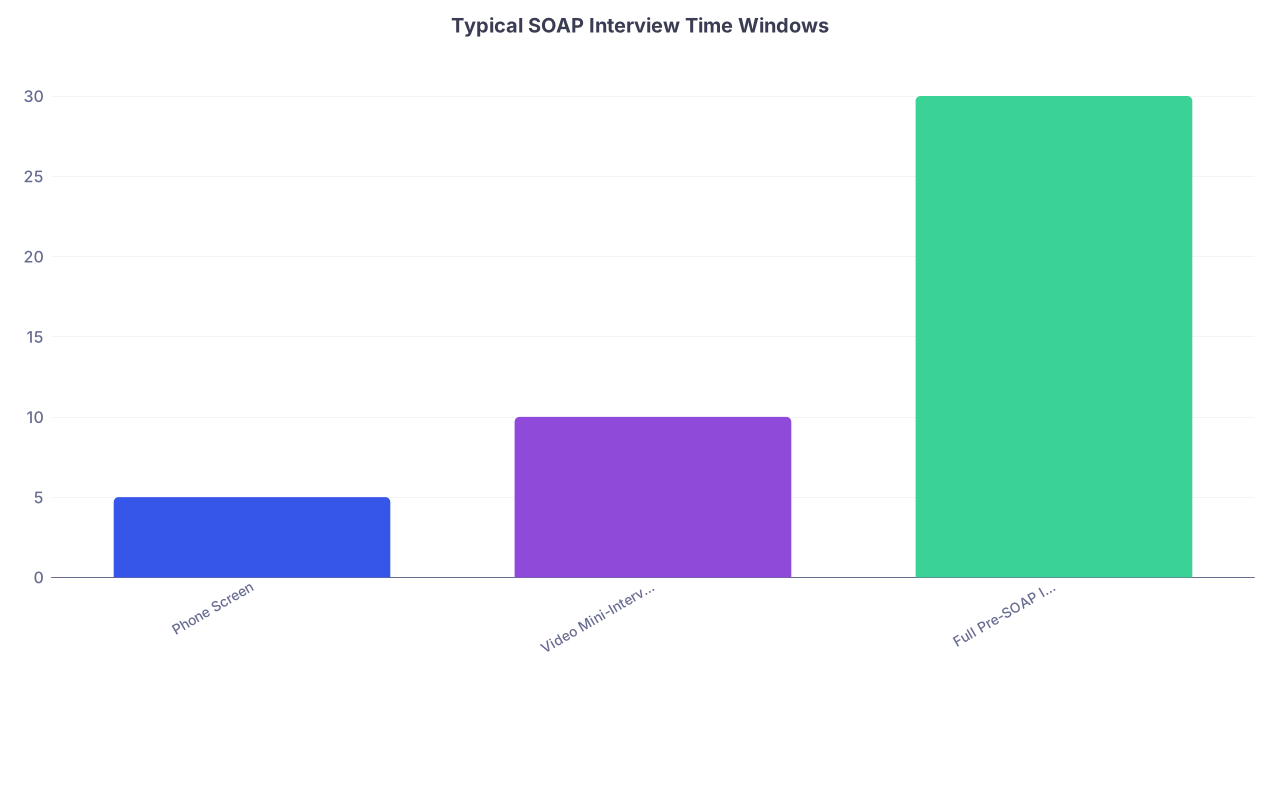
| Category | Value |
|---|---|
| Phone Screen | 5 |
| Video Mini-Interview | 10 |
| Full Pre-SOAP Interview | 30 |
Your strategy has to match that time frame. Five minutes means:
- You need a scripted spine (not memorized word-for-word, but structurally rehearsed).
- You need pre-digested sound bites for your red flags.
- You need to stop trying to be comprehensive and instead be surgical.
The 5-Minute SOAP Pitch Framework (Exact Timeline)
You do not “wing” a 5-minute call. You build a template. Here is the one I have seen actually work repeatedly.
You are aiming for this rough breakdown:
- 0:00–0:30 – Greeting, quick rapport, anchors
- 0:30–1:30 – 60-second “Who I am and what you get if you take me”
- 1:30–3:00 – Targeted fit pitch + address 1 key concern (if needed)
- 3:00–4:15 – Answer their question(s) in tight responses
- 4:15–5:00 – A single sharp question from you + close
Let’s break it down.
0:00–0:30 – Start Clean: Greeting + Anchor
Goal: Sound composed, adult, and already in the role of resident.
You answer on first or second ring, quiet background, sitting at a desk, notes in front of you.
“Hello, this is [Name].”
They introduce themselves.
You:
“Dr [PD], thank you for taking the time today. I know your schedule is extremely packed this week.”
Then stop. Do not oversell. Do not launch into your life story. Let them lead. If they throw it back to you—“So tell me a little about yourself”—you are ready with the next piece.
0:30–1:30 – The 60-Second Core Pitch
This is the most important chunk of the entire call. You get ~120–150 words. That is all.
Your 60-second pitch needs 4 components, in this order:
- Your current status (what you are, where you are sitting in the process now)
- What kind of resident they get (clinical strengths / work style)
- Why this specialty and this kind of program (especially in SOAP)
- One line that subtly addresses your biggest concern (failed exam, gap year, switch, etc.) without spiraling
Here is a solid template:
“I am [Name], a [US-IMG / DO / MD] from [School], Class of [Year]. I completed my core clinicals with strong evaluations, particularly in [relevant rotations]. I am a very steady, dependable team resident—comfortable managing a high patient load, following through on details, and I have strong feedback about my communication with nurses and ancillary staff. I am committed to training in [Specialty] in a program with a strong [inpatient volume / community focus / underserved population], and I am prepared to step into a high-service role from day one. I had a [Step 1 failure / extended timeline], which I addressed with structured remediation and ultimately passed [Step 2 with X], and my recent performance reflects that change. I am looking for a program where I can contribute immediately and grow long-term.”
That is about 110–130 words spoken calmly in ~50–60 seconds.
A worse version of this pitch sounds like:
“I have always been passionate about [Specialty], ever since I was a kid, and I think your program is a great place for me to grow and learn from great mentors.”
Vague. Could be anyone. PDs tune it out instantly.
You have to sound like a functioning PGY-1, not a motivational speaker.
1:30–3:00 – Program-Fit Pitch + One Targeted Red-Flag Line
Once your core identity is on the table, you pivot quickly to: “Here is why I am actually relevant to you in SOAP.”
You are not trying to flatter. You are trying to prove operational usefulness.
Pick 2–3 specifics about the program that matter in SOAP:
- Geography (you have support there, can stay long-term, no visa hassles)
- Patient population (FQHC, safety net, rural, VA)
- Structure (night float, q4, heavy inpatient vs ambulatory)
- Their pain points (recent site closure, increased volume, new service line)
Example, internal medicine community program with high service load:
“I am particularly interested in your program because of the strong inpatient volume and the chance to manage a broad range of pathology early. During my IM sub-I at [Hospital], I handled 8–10 patients daily, wrote my own notes, and coordinated directly with case management and social work. That kind of structured autonomy is what I am looking for, and I know your program’s graduates tend to stay in hospital-based practice, which is my long-term goal.”
If they already know your red flag (they saw your ERAS), you add one sharp, non-apologetic sentence:
“I know you may have noticed [the Step 1 failure / extended graduation]. That period forced me to overhaul how I study and work, and my performance since then—especially on [Step 2 / CK / rotations]—reflects a consistent upward trajectory.”
Then shut up. Do not over-explain. They are not your therapist. They are quietly logging: “Owning problem, non-defensive, improved trend.”
Anticipating PD Question Patterns in SOAP
SOAP calls are weirdly predictable. The questions are basic. The trap is over-answering.
Here are the common patterns and how to answer them in 30–45 seconds each.

1. “Why did you go unmatched?”
This is radioactive if you answer it emotionally. Your job is to sound like root cause analysis, not self-flagellation.
Good structure:
- Name 1–2 external process issues (strategy, specialty choice, timing)
- Acknowledge your own key statistical weakness
- State what you changed
- Land on: “I am ready now.”
Example:
“I aimed mostly at very competitive [Specialty] programs with limited geographic flexibility and under-applied as a backup. My application was also vulnerable because of [Step 1 failure / late Step 2 / fewer home rotations]. Since then, I have strengthened my profile with [X: additional rotations, stronger letters, improved exam performance] and focused on programs where I can contribute meaningfully from day one. The SOAP process is giving me a chance to align better with programs where my work ethic and clinical reliability matter more than pure test scores.”
What you do not do: cry, rant about bad advising, or blame “the system.” That is an instant no.
2. “Why our program specifically?”
PDs are allergic to generic answers here. They can tell when you are using a template.
You need 2–3 program-specific details. That means actual effort in advance.
Before SOAP hits, you should have a spreadsheet with:
- Location, visa status
- Community / academic / hybrid classification
- Hospital type (county, VA, private, FQHC-affiliated)
- One or two distinctive features (rural track, QI emphasis, strong OB in FM, etc.)
| Program Type | Emphasis | Good Fit If You… |
|---|---|---|
| County IM | High service | Thrive with volume |
| Community FM | Outpatient heavy | Like continuity clinics |
| Rural FM/IM | Breadth of care | Value broad skill set |
| Academic Neuro | Tertiary care | Have strong exam scores |
| VA-Based IM | Older population | Patient communication |
Example answer:
“I am interested in your program because you are a high-volume community hospital with a strong ICU exposure but still a collaborative environment. I saw that your residents rotate through [Name] FQHC, and I have prior experience working with underserved patients during my rotations at [Site]. I am also geographically tied to [Region]—my family is here—and I am looking to build my long-term career in this area.”
This says: I know who you are, I know what I am walking into, and I am not using you as a generic safety net.
3. “Do you see yourself staying in this area long-term?”
During SOAP, programs are very suspicious about flight risk. They do not want a warm body for a year then a transfer request.
Answer directly. Yes or no, with reasoning.
If yes:
“Yes. I have family support here, and my long-term plan is to practice in [region]. I am not viewing this as a 1-year stepping stone. I want to train and then work in this community.”
If no but you cannot say no:
“I am open long-term. My main priority is strong training and a stable environment, and I know many graduates stay in the area. I could absolutely see myself continuing to work here if it is the right mutual fit.”
Just do not give some vague: “I am open to anything anywhere in the United States.” That sounds like you have zero roots and will bolt.
4. “Tell me about a challenge or conflict…”
You are not in a 30-minute behavioral interview. The story must be tiny and punchy.
Pick something:
- Concrete
- Resolved
- Shows you can communicate under stress
Example:
“During my sub-I, I had a disagreement with a senior about how to prioritize tasks for a complex patient with multiple consults. We were both overwhelmed, and I realized information was getting dropped. I suggested we take 2 minutes to clarify roles, wrote out a quick task list, and confirmed it with the resident. That small reset prevented missed orders and we discharged on time. I learned that speaking up respectfully and organizing the chaos can help the whole team.”
That is under 45 seconds.
Designing Your “Tight 5”: Script Skeleton + Reps
If you have ever seen a stand-up comic, you know they have a “tight five.” A 5-minute set they can perform in their sleep. You need the SOAP equivalent.
This does not mean memorizing paragraphs. That will make you sound robotic. You memorize beats, not lines.
Your SOAP “tight five” has:
- Opening greeting line
- 60-second identity pitch
- 2 mini-pitches for different program types (county vs community, FM vs IM, etc.)
- 2–3 prepared red-flag sentences
- 2 strong, reusable questions for PDs
- Closing line
You should be able to outline it on a single sheet.

What Your One-Page SOAP Sheet Should Look Like
Top half:
- 3 bullet points: who I am, what I bring, why this specialty
- 1 line per red flag: “Step 1 fail → what changed → later success”
Bottom half:
- 4 program notes per site (volume, type, unique feature, geography tie)
- 2 go-to questions
- Closing phrase
No paragraphs. No essays. Just triggers.
Handling Red Flags in 1–2 Sentences
SOAP applicants nearly all have something ugly in the file: failed exam, gap, failed rotations, switch in specialty, previous SOAP attempt, professionalism write-up. The goal is not to hide it. They already saw it. The goal is to compress it.
The structure:
- Name it without euphemisms
- One phrase cause + action you took
- One phrase current performance
- Done
Let me show you what not to do:
“I had some personal issues during my Step 1 prep, and then COVID happened and things were just really hard, and I had some mental health challenges…”
PD brain: “I see instability and excuses.”
Do this instead.
Failed Step 1 / CK
“I failed Step 1 on my first attempt. I realized my study approach and test strategy were not structured enough, so I enrolled in a formal prep course, used NBME benchmarks, and treated it like a full-time job. I passed on the next attempt and scored [higher score] on Step 2, which better reflects my current consistency.”
Extended Graduation / Gap
“I had an additional year in medical school because of [family medical emergency / health issue], which I addressed fully before returning. During that time and afterwards, I stayed clinically engaged through [X: research with clinical context, observerships, additional electives], and I am now ready to start residency without restrictions.”
Switching Specialties into SOAP
“I originally applied in [Neuro/Ortho/etc.] because of strong early exposure, but as I moved through clinical rotations, I realized my strengths and long-term goals align better with [IM/FM]. I am looking for a program where I can be a reliable, broad-based clinician and stay long-term, which is why I am fully committed to [new specialty] now.”
The points: real ownership, no over-sharing, clear forward motion.
Adapting Your Pitch: IM vs FM vs Prelim vs Transitional
Here is where many SOAP applicants blow it. They use the same pitch for an FM community program and a prelim surgery year. That sounds lazy and unfocused.
Your core 60 seconds stays the same. You then swap out the “fit” section.
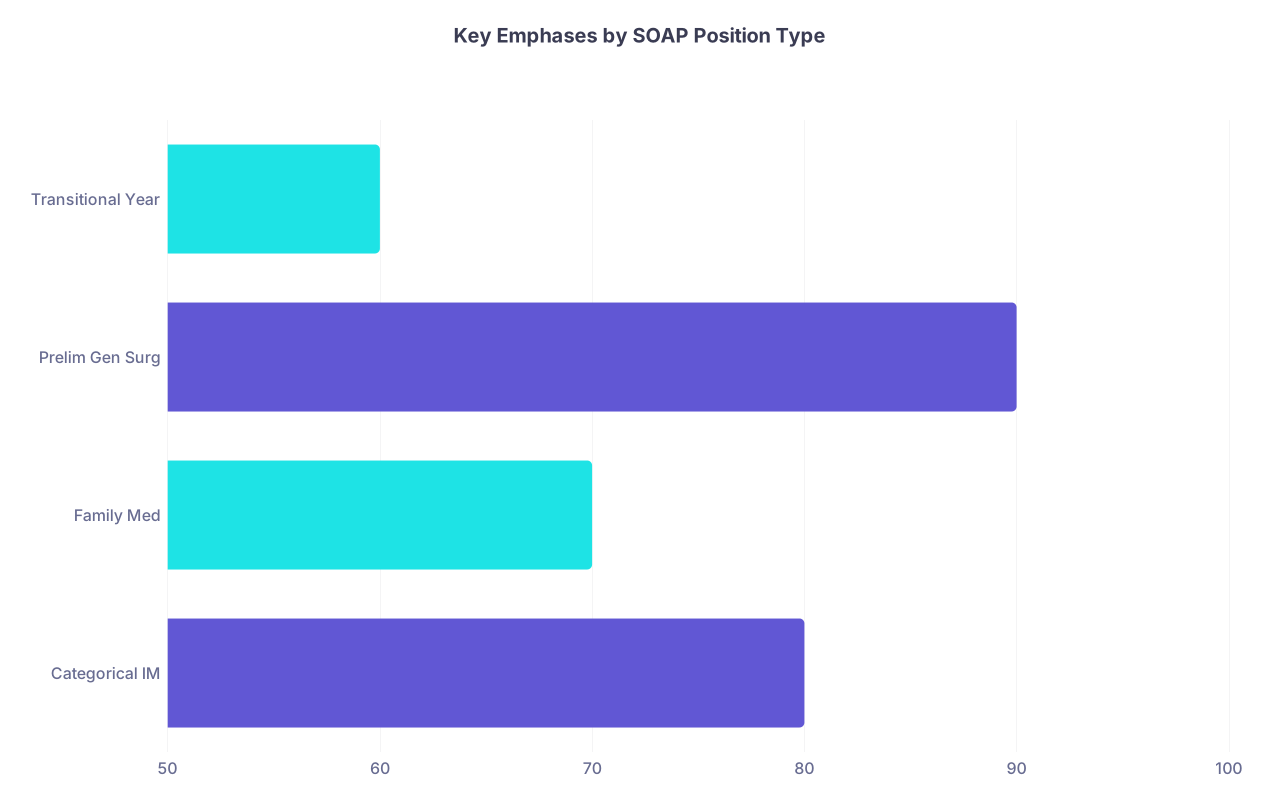
| Category | Value |
|---|---|
| Categorical IM | 80 |
| Family Med | 70 |
| Prelim Gen Surg | 90 |
| Transitional Year | 60 |
(Interpretation: higher value = heavier emphasis on service / workload handling during SOAP.)
Internal Medicine (Community / County)
Emphasize:
- High-volume inpatient experience
- Comfort with sick patients, ICU/step-down exposure
- Reliability with notes, signouts, overnight calls
Example:
“I have strong inpatient experience from my IM sub-I, where I routinely handled 8–10 patients and participated in ICU rotations. I like high-acuity settings and am comfortable with cross-cover, frequent pages, and working closely with nursing. I am looking specifically for a program with strong inpatient exposure and a culture where residents support each other under service pressure.”
Family Medicine
Emphasize:
- Continuity, outpatient communication
- Breadth: peds, OB exposure, geriatrics, procedures
- Long-term community ties
Example:
“My best evaluations have been in longitudinal clinics and on FM rotations where I followed patients over months. I enjoy managing chronic disease, counseling patients, and working with interdisciplinary teams. I am particularly interested in [OB continuity / procedures / rural medicine], which your program highlights, and I plan to practice broad-scope family medicine after graduation, ideally in this region.”
Prelim Surgery / Prelim Medicine
This is a service job. Do not pretend it is a 3-year dream. Emphasize:
- Work ethic, call endurance
- Comfort being the junior who grinds
- Willingness to do unglamorous tasks, no ego
Example (Prelim Surgery):
“I am applying to a prelim surgery year because I want a high-intensity, hands-on clinical experience with significant OR and floor exposure. I am very comfortable with long hours, night float, and high service demands. On my surgery rotations, I was often the first one in and last one out, managing floor tasks so the team could stay on schedule. I understand the role of a prelim and I am prepared to work hard in it.”
Transitional Year
These are rare in SOAP, but if they come up:
- Emphasize flexibility, broad foundation
- Clear plans for PGY-2 specialty (if truly relevant)
- But you still sound committed to doing PGY-1 well
Example:
“I am interested in a transitional year to build a broad foundation across medicine, surgery, and electives, as I prepare for [advanced specialty]. I am committed to doing a complete, high-quality PGY-1, not just checking a box, and I know your TY program has strong internal medicine and ICU components that will help me be more effective in my future field.”
One Strong Question and a Clean Close
PDs often wrap up with: “Do you have any questions for me?”
You do not have time for three. You should have one that:
- Signals you understand their program type
- Is easy for them to answer in 45–60 seconds
- Does not sound like fishing for benefits (vacation, moonlighting)
Good options:
For community IM:
“How do you see a strong PGY-1 intern contributing most on your services in the first 3–6 months?”
For FM:
“How does your program support residents who want to stay and practice in the local community after graduation?”
For prelim:
“What do you think distinguishes the prelim interns who really succeed in your program?”
That is it. One question. Then you close.
Closing line template:
“Thank you again for your time, Dr [Name]. I appreciate the chance to speak with you, and I would be very happy to join your team if offered a position.”
You are not ranking. This is SOAP. They know the game. You just sound professional and clear.
Practice the Way PDs Experience You: Compressed, Distracted, Tired
Most applicants practice their pitches in quiet rooms, reading from a screen, imagining an attentive listener. That is not SOAP.
You need at least 3–5 reps where you simulate the chaos:
- Friend or mentor calls you at a random time
- They give you a random program type: “County IM in Midwest,” “Rural FM in South,” “Prelim surgery at university hospital”
- You have 15 seconds, then you start your greeting + 60-second pitch
- They interrupt you once with: “So why did you go unmatched?”
- They hard-stop at 5 minutes
Use your one-page SOAP sheet. Keep a timer visible. Record at least two of these and listen back. You will hear:
- Filler words (“umm,” “like,” “sort of”)
- Tangents when you got nervous
- Overlong answers to basic questions
Refine. Tighten. Repeat.

| Step | Description |
|---|---|
| Step 1 | Answer Call |
| Step 2 | Greeting |
| Step 3 | 60 sec Pitch |
| Step 4 | Program Fit |
| Step 5 | Red Flag Sentence |
| Step 6 | Clarify Fit |
| Step 7 | Your One Question |
| Step 8 | Professional Close |
| Step 9 | PD Questions |
Tactical Details That Quietly Matter
A few “small” things that absolutely change how you come across in 5 minutes:
- Audio quality. Use wired headphones or a quiet room on speaker. No driving, no cafeteria, no hallway. Background noise screams “unserious.”
- Posture and breathing. Sit upright, feet flat, one-page note in front of you. Slow breath before answering tough questions. You will sound calmer.
- Name usage. Use the PD’s title once at the start and once at the end: “Dr [Last]…” It creates a subtle professionalism frame.
- Smiling voice. Yes, even on the phone. A slight smile actually changes tone. You sound less defeated.
- No over-sharing personal trauma. SOAP is not the venue. Keep explanations tightly professional.

Example: Full 5-Minute Flow (Put Together)
Let me stitch one together so you can hear rhythm and structure. Imagine: you are a US-IMG applying IM SOAP at a busy community hospital.
PD: “Hi, this is Dr Smith, program director at Valley Community Internal Medicine.”
You: “Hello Dr Smith, this is Alex Patel. Thank you for taking the time to speak with me today.”
PD: “Sure. Tell me a bit about yourself.”
You:
“I am Alex Patel, a US citizen IMG from St. George’s University, Class of 2024. I completed my core clerkships in New York and New Jersey, and my strongest evaluations have consistently been on internal medicine and ICU rotations. I am a steady, reliable team member—comfortable managing a high patient load, communicating directly with nurses and case management, and making sure details get done on busy services. I am committed to a career in internal medicine with a focus on hospital-based practice. I did have a setback with Step 1, which I failed on the first attempt, but after completely restructuring my study methods and schedule, I passed on the second attempt and scored 238 on Step 2, which better reflects my current consistency. I am looking for a program where I can contribute from day one in a high-volume setting and grow into a strong hospitalist.”
PD: “Why our program?”
You:
“I am particularly interested in your program because of the strong inpatient volume and the fact that you are the main community hospital for your area. I saw that your residents rotate through both the ICU and step-down unit early, and that aligns with my interest in acute care. On my sub-I at [Hospital], I typically carried 8–10 patients, pre-rounded independently, wrote my own notes, and presented on rounds, so I am comfortable stepping into a similar structure. I also grew up about an hour from your hospital—my parents are still in [City]—and I plan to stay in this region long-term, likely in a hospitalist role after residency.”
PD: “You went unmatched in the main Match. Why do you think that happened?”
You:
“I aimed almost exclusively at categorical internal medicine positions in a few very competitive metro areas and did not apply widely enough to community programs like yours. Combined with my initial Step 1 failure, that made my application vulnerable. Since then, I have focused on programs where my clinical work ethic and reliability can really matter, and I am using SOAP to correct that initial strategy. I am fully ready to start as a PGY-1 this July.”
PD: “Do you have any questions for me?”
You:
“Yes, thank you. How do you see a strong PGY-1 intern contributing most on your services in the first three to six months?”
[PD answers.]
You:
“Thank you, that is very helpful. I appreciate your time today, Dr Smith, and I would be very happy to join your team if offered a position.”
That is it. Clean. No monologues. No apologies. Just a professional, focused 5 minutes.
Final Tight Points
You are not trying to win a personality contest in SOAP. You are trying to sound like a safe, useful, low-drama PGY-1 in five compressed minutes.
Three things to remember:
- Build and rehearse a tight five-minute structure: 60-second identity, 60–90-second fit, 2–3 short prepared answers, one strong question, clean close.
- Compress your red flags into one or two sentences: name it, state what changed, show improved performance, then move on.
- Treat each call like a high-yield signout to a tired attending: clear, specific, and calm. No fluff, no rambling, no drama.
Get those right, and your odds of turning a 5-minute SOAP phone call into an actual spot go up dramatically.