
The biggest mistake after an unsuccessful SOAP is pretending you still have endless time. You do not. April through June will quietly decide whether next cycle is a reset or a repeat.
You are in the “post‑SOAP gap” now. No residency, no structure, no deadlines unless you build them yourself. I am going to walk you week‑by‑week from April to June so that by July 1 you have:
- A concrete next‑cycle strategy
- Documented, real clinical or academic activity
- Clean, realistic targets by specialty and program tier
Follow the clock. Do not drift.
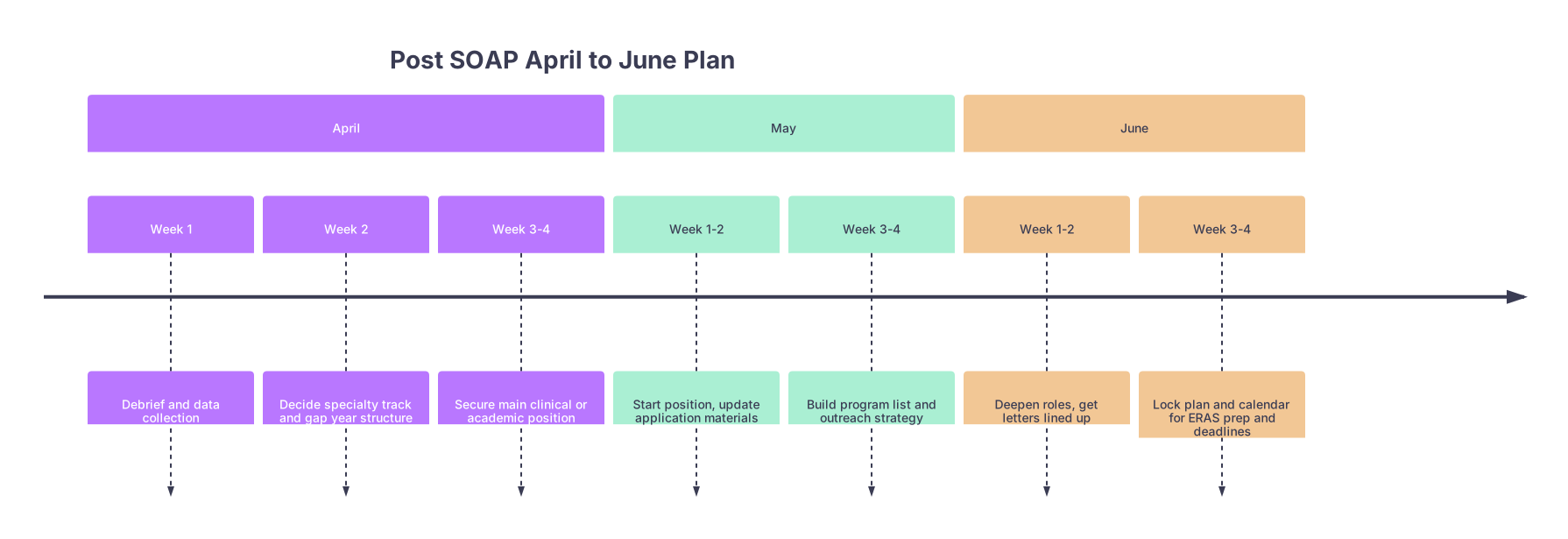
Big‑Picture Timeline: April–June
| Period | Event |
|---|---|
| April - Week 1 | Debrief and data collection |
| April - Week 2 | Decide specialty track and gap year structure |
| April - Week 3-4 | Secure main clinical or academic position |
| May - Week 1-2 | Start position, update application materials |
| May - Week 3-4 | Build program list and outreach strategy |
| June - Week 1-2 | Deepen roles, get letters lined up |
| June - Week 3-4 | Lock plan and calendar for ERAS prep and deadlines |
That is the spine. Now the details.
April: Autopsy, Decision, and Position Hunt
April 1–7: Brutal Debrief Week
At this point you should stop speculating and get hard data.
Pull your full application packet
- ERAS application PDF
- Personal statement(s)
- CV
- USMLE/COMLEX transcript
- MSPE and transcript
- Letters list (who, how many, from where)
Quantify where you stood this cycle
Create a one‑page snapshot:
| Metric | Your Data |
|---|---|
| Step 1 | |
| Step 2 CK | |
| Attempts | |
| Specialty applied | |
| Total programs applied | |
| Interview offers (main) | |
| SOAP offers |
Fill it out. No fluff. Just numbers.
- Do a short, honest failure analysis
One focused afternoon. Not three weeks of rumination.
Ask and answer, in writing:
- Were my scores below, at, or above the median for my target specialty?
- Did I overreach on program tiers or under‑apply to community programs?
- Were there obvious red flags (failures, leaves, professionalism notes)?
- Did I have real recent clinical activity in the US (past 12–18 months)?
- How many interviews did I actually get, and where did they cluster?
If you cannot see patterns, show your snapshot to:
- A trusted faculty advisor
- A PD or APD who knows you (or will give you 15 min)
- A dean of students / career advisor
You want someone to say, “This is why you did not match.” In plain language.
- Sort yourself into a realistic category
By the end of this week, you should roughly know which bucket you are in:
| Category | Typical Profile |
|---|---|
| Strong but unlucky | Solid scores, interviews but bad yield |
| Borderline competitive | OK scores, few interviews, no glaring red flag |
| Red flag | Exam failure, gap years, big professionalism concern |
| Specialty misaligned | Applied too competitive for your metrics |
This categorization will drive your next decisions. Denial here costs you a full year.
April 8–14: Decide Your Track and Target Specialty
At this point you should commit to a path, not “keep options open forever.”
1. Decide: reapply same specialty vs. pivot
Use some blunt thresholds (not perfect, but they stop you from fantasy planning):
- For highly competitive fields (Derm, Ortho, Plastics, ENT, Urology, IR):
- If you had 0 interviews and are not adding a major new asset (research year with publications at a big center, top mentor, or a very strong backup), a full pivot to a more attainable specialty is usually wiser.
- For mid‑competitiveness (IM, Peds, FM, Psych, Neuro, OB/GYN, Gen Surg):
- If you had ≤2 interviews and Step 2 < 220–225 (USMD/DO) or < 230 (IMG), you must at least consider pivoting to FM or Psych, or broadening to prelim/transitional years.
Get concrete advice from a PD in your target field if you can. Ask: “If my application were unchanged except for one strong year of X (research/clinical), would I realistically match next year?”
2. Choose your gap‑year “anchor role”
You need one main activity you can describe cleanly on ERAS:
- Research fellow or coordinator
- Clinical research assistant
- Non‑ACGME clinical fellow (observerships alone are weak; hands‑on beats shadowing)
- Hospitalist scribe with strong mentorship
- Instructor / teaching fellow (anatomy, clinical skills, etc.)
- MPH or other formal degree program (only if it makes sense for your goals)
Your anchor must:
- Start by late May / early June
- Be at least 20–30 hours/week
- Be documentable with a supervisor who will write a letter
By the end of this week, you should have:
- A clear primary specialty target (or two, if doing a true dual‑strategy like IM + Psych or IM + FM)
- A ranked list of possible anchor roles and institutions
April 15–30: Aggressive Position Hunt and Networking
Now you execute. This half-month is about getting yourself attached to something real.
1. Build a target list of institutions
Focus on:
- Places that already interviewed you this year
- Safety‑to‑mid programs in your target specialty
- Hospitals with large residency programs and active research
Use program websites, clinical research pages, and LinkedIn.
2. Fire off a structured outreach campaign (10–20 emails/week)
Your emails should go to:
- Program coordinators and PDs (for research/observer/fellow roles)
- Department chairs and section chiefs
- Directors of clinical research or quality improvement
Short, tight email:
- Who you are (grad year, school, scores in one line)
- That you went unmatched and are seeking a structured gap‑year role
- What you can offer (research experience, language skills, teaching, procedural help)
- A one‑sentence ask: “Would you consider me for any research or clinical position in your department, or suggest who I should contact?”
Attach:
- 1‑page CV
- USMLE/COMLEX transcript
Track responses in a simple sheet. You are doing sales now, not wishful thinking.
3. Apply to formal positions
Do not rely only on cold emails. Also:
- Hospital/University job boards (research assistant, coordinator, scribe)
- Large academic centers’ “research fellow” postings
- Official post‑doc or clinical scholar roles
Yes, they are competitive. Still better than waiting for something to fall in your lap.
4. Fill the gap with short‑term clinical exposure if needed
If no anchor role is secured by end of April:
- Line up observerships / externships for May–June
- Even 2–4 week blocks can show recent US clinical exposure
Just know: observership alone will not rescue a weak application. It is a short‑term patch, not the plan.
By April 30, you should:
- Have at least 5–10 real conversations (email or Zoom) with potential supervisors
- Be in late‑stage discussion for at least one anchor role, or
- Have several defined observerships / short contracts scheduled for May–June
May: Build Credibility and Rebuild Your Application
May is where drift usually destroys people. Do not let that be you.
May 1–15: Start the Role, Stabilize, and Update Your Story
At this point you should be starting your main position or, worst case, your first observership.
1. Show up like a first‑year resident
Your attitude this month is your future letter of recommendation.
- Be early. Look prepared. Learn systems quickly.
- Ask directly: “What projects can I own that will lead to a poster, abstract, or paper by early next year?”
- Volunteer for the unglamorous tasks. Data cleaning, chart review, teaching prep. People remember that.
2. Begin documenting everything
Start a simple log:
- Projects (title, PI, your role, date started)
- Clinical duties (hours/week, types of patients, EMR used)
- Any teaching or presentations
This becomes bullet points for ERAS later.
3. Rewrite your narrative
You need a clean, non‑whiny explanation for being unmatched:
- One sentence in your personal statement
- One short explanation ready for interviews next year
Template idea:
“I did not match in 2025 after receiving a small number of interviews. Since then, I have focused on strengthening my application through [research/clinical work/teaching] at [institution], where I have been involved in [specifics]. This experience has reinforced my commitment to [specialty] and sharpened my skills in [X, Y].”
No blaming SOAP. No blaming “the system.” Own it, show growth, move on.
May 16–31: Rebuild ERAS Core + Program Targeting
Now we shift from “career salvage” to “application overhaul.”
1. Update your CV and ERAS content
By end of May you should have:
- A tight, updated CV with your new role at the top
- Draft ERAS experience entries for:
- Current research/clinical role
- Any new projects, posters, or QA initiatives
- Significant non‑clinical work (if relevant)
Write your bullets as if you are submitting ERAS today. Focus on:
- Action verbs
- Concrete outcomes (numbers if possible)
- Your specific responsibilities
2. Decide your program strategy with actual numbers
You are applying again soon. This time, you need volume + realism.
| Specialty | Total Programs | Reach | Mid | Safety/Prelim |
|---|---|---|---|---|
| Internal Med | 140 | 20 | 70 | 50 |
| Family Med | 80 | 10 | 40 | 30 |
| Psychiatry | 60 | 10 | 30 | 20 |
You will adjust for your own stats and citizenship status, obviously. But the pattern stands: broad, heavy on mid and safety, not just a few “dream” places.
3. Start a PD / faculty list for later outreach
Build a spreadsheet with:
- Program name
- PD name + contact
- Coordinator email
- Notes (did they interview you before? alumni there? research connection?)
You will not start heavy outreach in May, but you want the list ready.
4. Revisit your exam situation
Ask blunt questions:
- Do I need a stronger Step 2 CK or Level 2 CE score?
- If I have a fail, do I need another exam success (e.g., Step 3) before ERAS opens?
If you already took Step 3 and passed, good. If not, be strategic:
- Step 3 before ERAS can help IM/FM/psych, especially for IMGs or red‑flag applicants.
- But do not tank Step 3. A second fail is catastrophic.
If you plan to take Step 3, sketch possible dates (late summer / early fall) now so prep does not collide with core application work.
June: Lock Letters, Deepen Roles, and Set ERAS Calendar
June is about making your application “real” and your next 6 months scheduled.
June 1–15: Solidify Letters and Responsibilities
At this point you should be 4–6 weeks into your new role. People have seen your work.
1. Identify 2–3 strong potential letter writers
Ideal targets:
- Supervisor in your anchor role (research PI, attending, medical director)
- Clinical faculty who see you work regularly
- Prior letter writers who are still supportive – but only if you refresh their letter with updated info
Start the conversation early:
“I plan to reapply to residency this fall and would be honored if you might consider writing a letter on my behalf once we have worked together a bit longer. Is that something you would be comfortable with if my performance continues at this level?”
You are not asking them to write it now. You are checking temperature and planting the seed.
2. Expand your role into something letter‑worthy
Letters that say “hard‑working and nice” do not move the needle. Letters that say “owned X project and presented Y” do.
So:
- Take ownership of a small project: QI metric, clinic workflow change, brief curriculum for students, case report.
- Ask: “Is there a case/issue we could turn into a poster or abstract by late fall?”
Concrete deliverables create concrete praise.
3. Clean up any lingering administrative mess
By mid‑June:
- Request official transcripts if anything changed
- Resolve any licensing/ECFMG/credentialing issues that might block interviews
- Make sure your contact info and NRMP/ERAS accounts are active and correct
You do not want bureaucratic surprises in September.
June 16–30: Build the ERAS Calendar and Commit the Plan
Now we shift from “what went wrong” to “exactly how I will not repeat it.”
1. Draft your ERAS preparation calendar
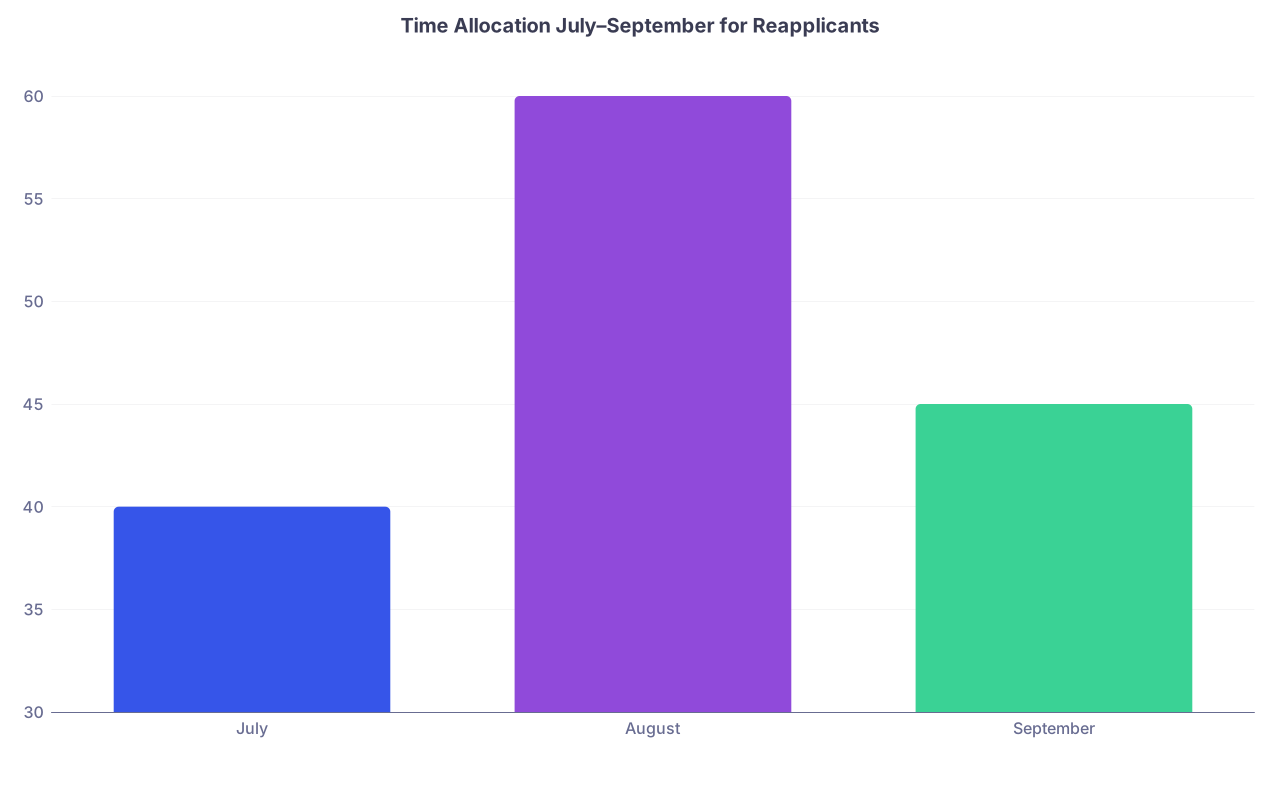
From July through September, you will be doing:
- Personal statements (often multiple versions)
- Finalizing program list and filters
- Updating experiences with new achievements
- Requesting and tracking letters
- Possibly Step 3 preparation and exam
Lay this out now.
| Category | Value |
|---|---|
| July | 40 |
| August | 60 |
| September | 45 |
Think of those numbers as “hours per month dedicated purely to application prep,” not your job. If that looks impossible, you need to free time somewhere.
2. Lock your personal statement themes
You do not need polished drafts yet, but you must know:
- What changed since last year
- How this year’s work connects to your specialty
- How you will address being a reapplicant in 1–2 sentences
If you are pivoting specialties, this is even more critical. A sloppy, copy‑pasted PS that clearly belonged to another field is an instant red flag.
3. Reality‑check your backup plan
If next cycle also fails, what then?
You do not need every detail, but you should know:
- Am I willing to accept a prelim year in a different field?
- Would I take a categorical EM/FM/Psych spot if my dream specialty falls through?
- Is there a point where I will pivot to non‑residency clinical work or another pathway?
You will sleep better if this is at least sketched out in your head.
4. Confirm your ongoing role through interview season
You want your current supervisor to be able to say, “Yes, they are still here and working well” during interviews.
So by end of June, have clarity:
- Will you be staying in this role through at least February–March?
- If not, what will your next step be and when?
Programs dislike unexplained gaps. Keep your timeline continuous.
Where You Should Stand on July 1
If you use April–June correctly, by July 1 you should be able to say, without spinning:
- “Here is why I did not match last year, and here is exactly what I have done about it since April.”
- “I am currently working at [institution] doing [clear role] with [2–3 defined projects/activities] and have [X] potential letter writers watching my work.”
- “I have a realistic specialty and program strategy, an ERAS prep calendar, and a backup plan if next cycle does not go perfectly.”
Miss those three, and you are mostly hoping the system is kinder to you next time. It will not be.
Hit them, and SOAP not rescuing your match becomes a painful detour, not the end of the road.