
The most dangerous SOAP plans are the ones you start in March.
You build a real SOAP safety net months before Match Week. While everyone else is “waiting to see how interviews go,” you will quietly structure your entire fourth year so that, if your interview season stalls, you are not scrambling with a blank ERAS, no letters, and zero idea where you can pivot.
Here is the month‑by‑month, then week‑by‑week, then Match‑week‑by‑day breakdown of how to do that.
Big Picture: Your Fourth-Year SOAP Timeline
I will anchor this around a typical cycle:
- ERAS opens: June
- Application submission: September
- Interviews: October–January
- Rank list due: late February
- Match Week + SOAP: mid‑March
If your school runs early/late by a few weeks, slide the blocks accordingly. The logic does not change.
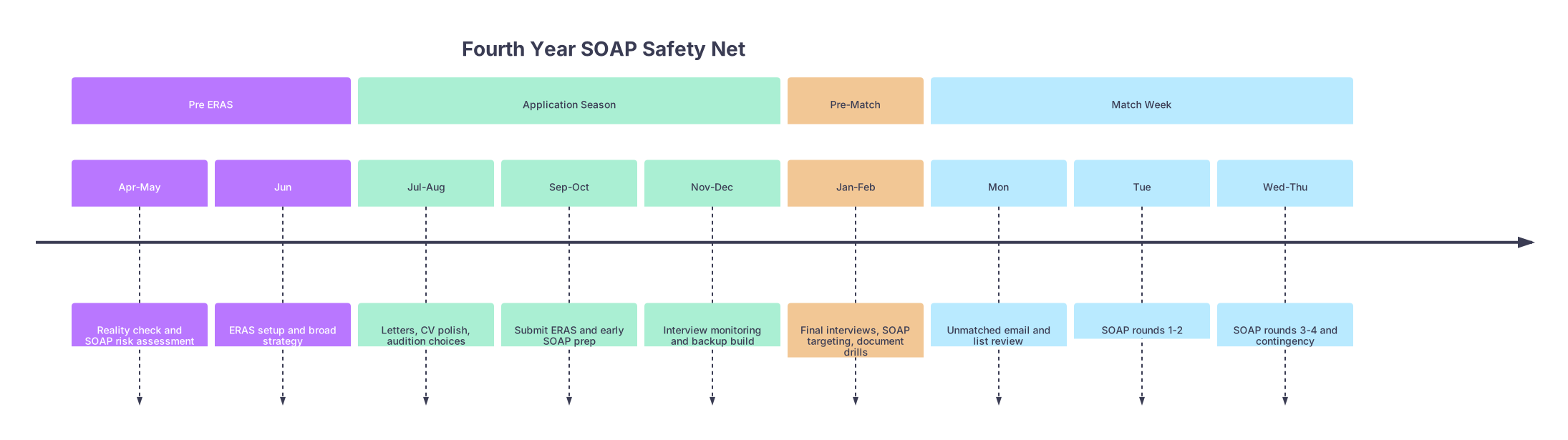
| Period | Event |
|---|---|
| Pre ERAS - Apr-May | Reality check and SOAP risk assessment |
| Pre ERAS - Jun | ERAS setup and broad strategy |
| Application Season - Jul-Aug | Letters, CV polish, audition choices |
| Application Season - Sep-Oct | Submit ERAS and early SOAP prep |
| Application Season - Nov-Dec | Interview monitoring and backup build |
| Pre-Match - Jan-Feb | Final interviews, SOAP targeting, document drills |
| Match Week - Mon | Unmatched email and list review |
| Match Week - Tue | SOAP rounds 1-2 |
| Match Week - Wed-Thu | SOAP rounds 3-4 and contingency |
April–May (End of MS3): Decide If You Are at SOAP Risk
At this point you should stop telling yourself “it will probably be fine” and actually quantify your risk.
Week 1–2: Risk Assessment
Sit down with:
- Your Step/COMLEX scores
- Class rank / MSPE draft comments
- Specialty choice and program competitiveness
- Home advisor or PD input
If any of the following are true, you must treat SOAP planning as mandatory, not optional:
- Step 1: fail or just‑above‑pass in a competitive specialty
- Step 2 CK: < 220 for IM/FM, < 230 for most others, or a fail
- No home program in your chosen field
- Switching specialties late (after winter of MS3)
- You plan to apply to:
- Dermatology, ortho, ENT, plastic surgery, neurosurgery, ophthalmology, urology
- Or any surgical subspecialty without a strong application
At this point you should:
Categorize yourself:
SOAP Risk Categories for Fourth-Years Risk Level Typical Profile SOAP Planning Intensity Low Strong scores, 1+ aways, home program, 12+ realistic interviews expected Basic safety plan Moderate Average scores, no home program, 6–10 interviews likely Full SOAP safety net High Score issues, red flags, very competitive specialty, < 6 interviews projected Aggressive SOAP-first design Decide whether you need:
- A backup specialty (FM, IM, Psych, Peds, Prelim IM/TY)
- Or a backup track (same specialty but prelim vs categorical, community vs academic, different region)
Week 3–4: Align Your Fourth-Year Schedule
At this point you should lock in rotations that support both your primary plan and your backup.
Non‑negotiables if SOAP risk is moderate or high:
- One acting internship / sub‑I in your primary specialty (July–September)
- One sub‑I or heavy inpatient month in a backup‑friendly field (IM, FM, Psych, Peds) by December
- A block of interview‑friendly time (light electives / research) Oct–Jan so you can travel without failing rotations
If your schedule is already set and inflexible, you compensate later with letters and targeted networking. But if you can still change, do it now.
June: ERAS Setup with SOAP in Mind
Most students build ERAS for Plan A only. That is how they get burned.
First Half of June: Build a Two‑Track ERAS
At this point you should:
Draft two personal statement frameworks
- Primary specialty statement (e.g., EM, general surgery, OB/GYN)
- Backup specialty statement (e.g., FM, IM, Psych, Peds, TY/Prelim IM)
Do not wait until Match Week to write about why you “love Family Medicine.” It always reads fake when done under duress.
Structure your experience section so it can flex
Emphasize:
- Longitudinal clinical activities (free clinics, hospital volunteering)
- Teaching/tutoring
- Research framed broadly (patient care, quality improvement), not only “I want to be a neurosurgeon.”
You want entries that make sense to multiple specialties without aggressive rewriting.
Create a school‑approved program list framework
Some schools require pre‑approval to contact programs during SOAP. Build a spreadsheet now with:
- Program name
- Specialty and track (categorical vs prelim vs TY)
- Region
- Minimum scores / visa info
- “Good for SOAP?” yes/no
You will fill scores and filters over the next few months.
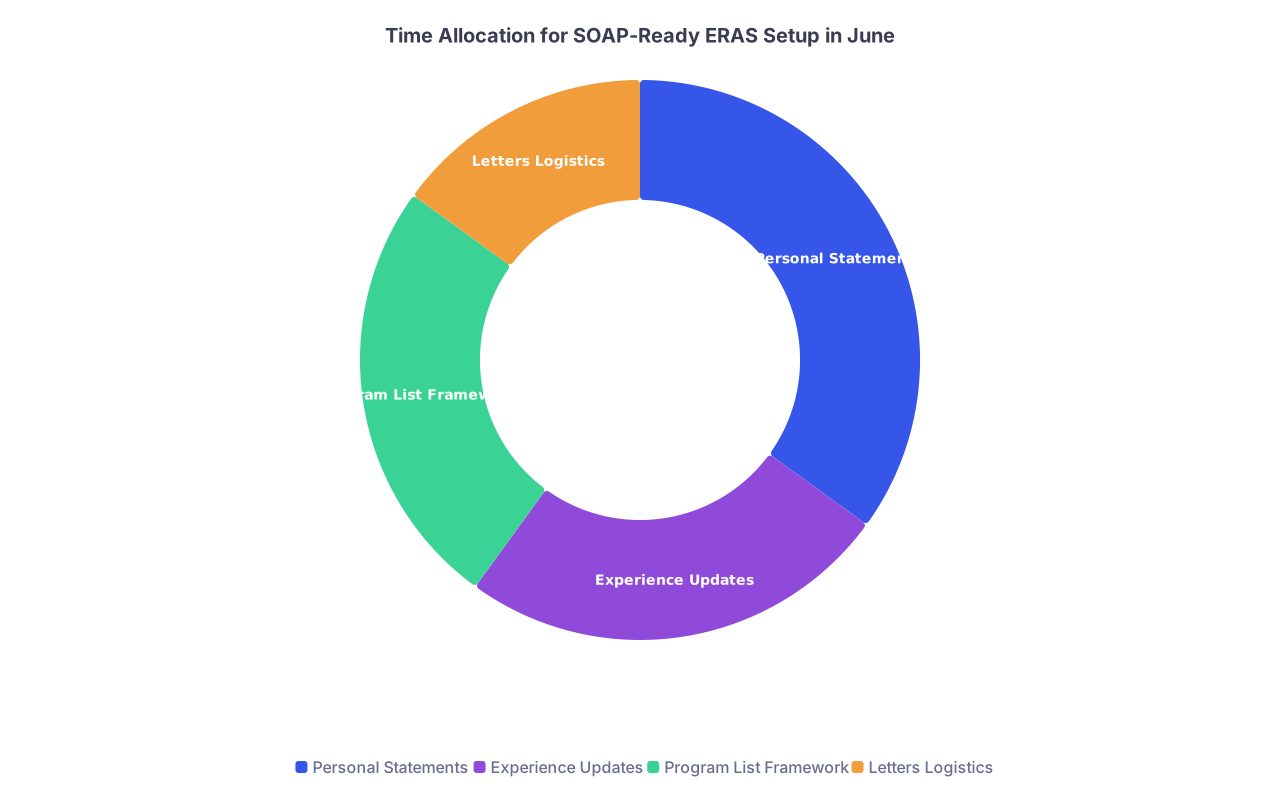
| Category | Value |
|---|---|
| Personal Statements | 35 |
| Experience Updates | 25 |
| Program List Framework | 25 |
| Letters Logistics | 15 |
Second Half of June: Letter Strategy (For Plan A and Plan B)
At this point you should:
- Identify 4–5 potential letter writers:
- 2–3 in your primary specialty
- 1–2 in a broad field that SOAP specialties respect (IM or FM attending, medicine Sub‑I director, core clerkship director)
Explicitly tell at least one generalist letter writer:
“I am very interested in IM/FM/Psych as a potential path and I want a letter that could support that direction.”
Awkward? Slightly. Necessary? Absolutely.
July–August: Rotations and Letters with SOAP Built In
You are starting MS4 in earnest. Interviews have not started. This is where you quietly collect all the raw material you might need later.
During Each Rotation (Especially Sub‑Is)
At this point you should:
- Run like you are already being compared in SOAP:
- Be present, early, and reliable
- Ask for mid‑rotation feedback and fix things quickly
- Signal interest in backup‑friendly fields:
- If on an IM sub‑I and you are an aspiring surgeon with risk, say:
“I am applying to surgery, but I am also seriously considering IM. I would value feedback on whether I would be a good fit.”
- If on an IM sub‑I and you are an aspiring surgeon with risk, say:
That one sentence opens the door to a strong letter you can redirect toward IM or prelims if needed.
End of Each Key Rotation
- Ask for letters within 48–72 hours of finishing while they still remember you.
- Provide:
- CV + ERAS draft
- Bullet list of 3–4 concrete things you did (patients you followed, projects, teaching)
- Explicit note: “I may apply in X and Y specialties; would you be comfortable if I used your letter for either?”
You want:
- 3 letters for Plan A
- At least 1–2 that will not sink you if you pivot to Plan B
September–October: Submit ERAS While Quietly Building the Net
You submit ERAS in September. This is exactly when most people relax. You will not.
Early September: Application Submission
At this point you should:
- Submit Plan A programs as usual
- For moderate/high‑risk applicants:
- Add a limited set of backup applications now (10–20 programs) in your backup specialty if:
- You have at least one decent letter
- Your advisor is not strongly opposed
- Add a limited set of backup applications now (10–20 programs) in your backup specialty if:
This does two things:
- Gets your name in front of backup PDs early
- Builds a compliant pathway if you later need a SOAP‑level pivot
Late September–October: Interview Tracking and Thresholds
You must stop guessing and start counting.
Create a simple running log:
| Date | Total Invites | Primary Specialty | Backup Specialty | SOAP Flag |
|---|---|---|---|---|
| Oct 1 | 1 | 1 | 0 | Low |
| Oct 15 | 3 | 3 | 0 | Moderate |
| Nov 1 | 4 | 4 | 0 | High |
| Dec 1 | 5 | 5 | 0 | Critical |
Rough specialty‑agnostic rule of thumb:
- By Nov 1:
- < 3 realistic interviews → treat as high SOAP risk
- By Dec 1:
- < 5 total interviews → plan for SOAP as the default outcome, not a contingency
At this point you should:
- Meet with your advisor again with actual numbers
- Decide:
- Do you expand Plan A list (late applications)?
- Do you aggressively grow a backup list (if not already done)?
- Do you start explicitly preparing SOAP documents (you should)?
November–December: Active SOAP Preparation While Interviews Continue
You will feel like you are “jinxing” yourself by doing this. Ignore that. I have watched students go unmatched because they were superstitious about planning.
November: Build a SOAP‑Ready Program Target List
SOAP has strict application limits. You cannot just carpet‑bomb every open spot.
At this point you should:
Review historical SOAP data
Many schools share de‑identified lists of where their grads matched through SOAP in prior years. Pay attention to:- Programs that routinely have unfilled positions
- Specialties that actually fill through SOAP (FM, IM, Peds, Psych, TY, prelim IM/Surgery)
Construct a ranked target list for each plausible SOAP specialty:
Columns to include:
- Program name
- Specialty / track
- ACGME ID
- Location
- Minimum Step scores / red flag policies (if known)
- Pros: why you might be a good fit (geography, previous rotation, research focus)
- Notes (visa, DO‑friendly, prior contacts)
You will not know which programs have unfilled spots until Match Week, obviously. But when the list drops, you want to be able to filter and plug in quickly.
December: Documents, Scripts, and Logistics
At this point you should:
Finalize backup specialty personal statement(s):
- One for broad IM/FM/Peds
- One short variant if you might do TY/prelim IM
Draft a generic but strong SOAP email template to PDs:
- 3–4 concise paragraphs:
- Who you are (school, year, exam scores)
- Why this specialty and setting
- Any regional / family ties
- One concrete way you add value (sub‑I performance, research, leadership)
- 3–4 concise paragraphs:
Confirm institutional rules:
- Who at your school must approve SOAP program lists
- Whether you can directly e‑mail/fax materials or must go through the dean’s office
- Space you can use during Match Week (quiet room, reliable internet)

January–February: Final Interviews and Hard SOAP Scenarios
By this point the interview season is mostly declared. You know the truth now.
Early January: Interpret Your Interview Count Like an Adult
At this point you should face the numbers:
For FM/IM/Peds/Psych:
- 10+ solid interviews → SOAP risk lower but not zero
- 6–9 → intermediate risk
- ≤ 5 → high SOAP risk
For competitive specialties (ortho, derm, ENT, plastics, neurosurgery, etc.):
- < 10 interviews → you should already be in full backup mode
If you are high risk and have no backup specialty interviews:
- Meet with your advisor immediately
- Decide if you will:
- Rank your primary specialty anyway and treat SOAP as Plan B
- Or effectively “soft switch” and use SOAP as your main pathway into a different field
Late January–February: Rank List and SOAP Targeting
When you build your rank list, you must also, silently, build a SOAP rank reality.
At this point you should:
Finish your SOAP target spreadsheets:
- Label targets as:
- Tier 1: strong fit and realistic scores
- Tier 2: slightly above your stats but possible
- Tier 3: stretch or distant locations you would still accept
- Label targets as:
Confirm all documents are final and uploaded where needed:
- ERAS CV and experience entries accurate and neutral
- Both personal statements on standby (you can swap in SOAP)
- Photo professional and uploaded
- Letters uploaded, with at least one that works for your backup specialty
Practice SOAP‑week scripts:
- 30‑second version of who you are and why that program
- 2–3 minute version for phone calls / quick interviews
You want to enter March able to execute, not think.
Match Week: Day‑by‑Day SOAP Execution Plan
This is where timelines matter down to the hour. The worst‑case scenario: you open your email Monday and see “We are sorry to inform you…” and have no plan.
You will have a plan.
Monday Morning (9–11 am ET): The Email and the First 2 Hours
At this point you should:
- Check your status as a group:
- “Fully matched”
- “Partially matched”
- “Unmatched”
If you are partially or fully unmatched:
- Take 10–15 minutes. Breathe. Rage in private if you need to. Then switch modes.
Immediate actions (before the List releases):
- Contact your dean / student affairs:
- Confirm your eligibility for SOAP (you must be ERAS‑registered, etc.)
- Ask about the school’s plan: where to be, who coordinates, any restrictions
- Open your SOAP documents:
- Backup specialty personal statement(s)
- CV / ERAS printout
- Letter list (you cannot change letters during SOAP, but you must know what is in play)
- Contact your dean / student affairs:
Monday Noon–Afternoon: List Release and Target Selection
Once the NRMP releases the list of unfilled programs, the clock is brutal.
At this point you should:
Filter the list using your prebuilt spreadsheet logic:
- Exclude:
- Programs with absolute cutoffs you do not meet
- Locations where you truly will not move (be honest)
- Prioritize:
- Regions where you have ties
- DO/IMG/step‑friendly programs aligned with your profile
- Programs that already took grads from your school in SOAP before
- Exclude:
Build your first SOAP application batch:
Remember: There are caps on how many SOAP applications you can send per round. You want your best‑fit mix first.
- Choose Tier 1 programs that match your profile
- Add some Tier 2 to fill to the limit
Tailor your PS quickly but intelligently:
For each specialty:
- Minor tweaks up top:
- Mention type of program (community IM, rural FM, urban psych)
- Align one or two experiences (e.g., community clinic for FM; inpatient team leadership for IM)
- Minor tweaks up top:
Do not try to micro‑customize 30 different versions. You do not have the time.
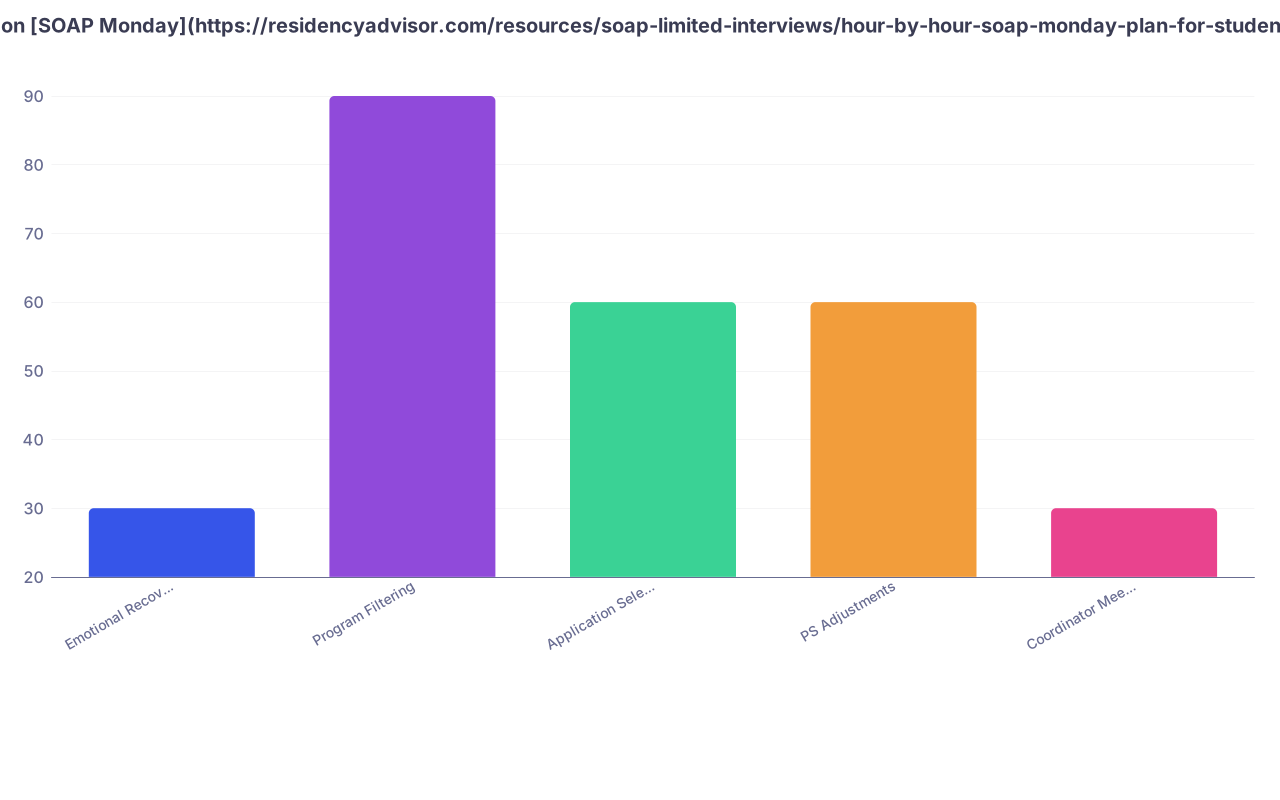
| Category | Value |
|---|---|
| Emotional Recovery | 30 |
| Program Filtering | 90 |
| Application Selection | 60 |
| PS Adjustments | 60 |
| Coordinator Meetings | 30 |
Tuesday–Thursday: SOAP Rounds and Rapid Response
Each SOAP round follows a pattern. You cannot contact programs before they contact you. But once they do, speed and clarity matter.
At this point you should:
- Keep your phone fully charged, ringer on, voicemail professional
- Stay in the same physical space with:
- Laptop
- Program list
- Scripts
- Advisor / dean available
When a program contacts you:
Answer or call back immediately
Use a structured 3‑part script:
- 20–30 seconds: Who you are (school, year, brief background)
- 1 minute: Why their program (location, mission, patient population, prior exposure)
- 1 minute: What you bring (sub‑I performance, Step improvement, resilience, teamwork)
After the call:
- Write a 2–3 sentence thank‑you email (if allowed by rules)
- Note:
- Name of caller
- Main points they emphasized (night float, underserved, research, etc.)
- Your interest level (1–3)
You repeat this across rounds. Between rounds, you:
- Review rejections / silence from earlier batches
- Shift toward Tier 2 and Tier 3 programs as needed
- Stay in constant communication with your dean’s office

Thursday Afternoon: Final Decisions and Contingency
By late Thursday, if you still have no SOAP offer, you must also think about the “no match, no SOAP” scenario.
At this point you should:
If you receive any SOAP offer that is:
- Accredited
- In a specialty you can tolerate
- Not catastrophic for your life situation
Strongly consider accepting. “I will just reapply next year and get derm” is how careers get stuck.
If you end SOAP with no position:
- Meet with your dean and advisor quickly
- Outline:
- Remediation or extra coursework if needed
- Research or prelim year options outside the Match
- Concrete plan to strengthen your next cycle (scores, letters, rotations)
The 3 Moves You Should Make Now
You do not need more inspiration. You need a checklist.
This month:
- Quantify your SOAP risk honestly
- Adjust your MS4 schedule to include at least one backup‑friendly rotation
- Identify at least one letter writer who can support a non‑primary specialty
Before interviews peak (Oct–Nov):
- Build two‑track ERAS (Plan A and legit Plan B)
- Start a real interview count log with explicit SOAP thresholds
- Draft backup personal statements instead of waiting for March panic
Before February ends:
- Finalize SOAP target spreadsheets and scripts
- Confirm every document is SOAP‑ready and institutional rules are clear
- Accept that planning for SOAP does not jinx you. It protects you.
If you do these on time, SOAP becomes a controlled emergency, not a blind free‑fall. That is the difference between “I never saw this coming” and “This hurts, but I am ready.”