
She was still in scrubs from her sub‑I when the email hit. “We are sorry, you did not match.”
He was at the next desk, staring at his own screen – “Congratulations, you have matched.”
They were couples matched. Now one of them had a spot. The other was headed straight into the SOAP. And they had four days to figure out how not to end up 800 miles apart.
If that’s you right now, let’s be blunt: you do not have time for theory. You need a concrete, hour‑by‑hour survival plan that accounts for both of you, not just the unmatched partner. Here is how to handle SOAP as a couples match pair when one partner falls short.
1. First Hour After the Email: Stabilize and Get the Facts
You have two problems at once:
- One of you is unmatched and entering SOAP.
- The other is matched but has no idea where yet, so you can’t fully plan geography.
You cannot fix either one in the first 10 minutes. So your first job is to stop the panic spiral.
What to do in the first 60–90 minutes:
Separate emotion from action.
Take 15–20 minutes where the unmatched partner is allowed to fall apart a bit. Cry, swear, call a trusted person. Whatever. Then put a line in the sand: “For the next 3–4 days, we’re in execution mode.”Clarify your couple priorities.
Sit down together and answer, out loud, in one sitting:- Are we willing to do long distance for 1 year? 3 years?
- Is there any location where one of us absolutely cannot go (visa, kids, caregiving, finances)?
- Is it more important that the unmatched partner gets any residency this year, or that you stay in the same city/region?
Do not skip this. Your SOAP strategy will collapse if your priorities are fuzzy.
Know your unmatched reality.
The unmatched partner needs a hard look at their profile:- US MD vs DO vs IMG?
- Any red flags (fails, leaves, professionalism issues)?
- Desired specialty before today?
- Step/COMLEX scores?
- Visa needs?
Because the strategy for a US MD with 1–2 interviews in IM is very different from an IMG who aimed for Derm and got zero interviews.
2. Before the List Drops: Pre‑SOAP Game Plan for the Couple
The SOAP unfilled list drops Monday at 10 AM ET. The panic at 10:01 happens in people who didn’t plan on Sunday.
You, as a couple, should have a pre‑SOAP war room setup.

| Step | Description |
|---|---|
| Step 1 | Unmatched notice |
| Step 2 | Clarify couple priorities |
| Step 3 | Analyze unmatched profile |
| Step 4 | Pre SOAP list research |
| Step 5 | SOAP list drops |
| Step 6 | Filter programs by fit and geography |
| Step 7 | Build application tiers |
| Step 8 | Submit SOAP applications |
| Step 9 | Prepare for interviews |
Create three core documents (shared between you)
Use Google Docs/Sheets so both of you can edit in real time.
Program/Location Master Sheet
Columns:- Program name
- Specialty
- City/State
- Affiliated hospital system
- Historically couples friendly? (Y/N/Unknown)
- Presence of other specialties (IM + FM + Psych, etc.)
- Geographic acceptability (Ideal / Acceptable / Last resort)
Unmatched Partner Snapshot
One page. Bulleted. This becomes your elevator pitch and phone script.- Degrees, med school, grad year
- Steps/COMLEX scores, with “pass” if numeric is weak
- Red flags and how you’ll frame them
- Strengths: research, leadership, language skills, geography ties
- Specific reason you’re a good fit for community/hard‑to‑fill programs
Couple Constraints & Options Doc
List:- The matched partner’s applied specialties and where they ranked heavily (regions)
- Family / support locations
- Financial realities (can one of you be unemployed for a year if absolutely necessary?)
- Backup if unmatched partner doesn’t SOAP this year (reapp, prelim, research year, etc.)
If you do this prep before the unfilled list drops, you’re not starting from zero when everyone else is refreshing and freaking out.
3. When the SOAP List Drops: Filter Fast, Ruthlessly, and Together
When the unfilled programs list appears, the clock explodes. You have a limited number of SOAP applications (typically 45). You cannot spray and pray.
You need a triage system that blends:
- Realistic chances for the unmatched partner
- Geography that could plausibly work with wherever the matched partner might land
Since you do not yet know the matched partner’s actual program, you play the odds.
Step 1: Reality filter for the unmatched partner
For the unmatched partner, look at:
- Specialty competitiveness
- Score requirements
- US clinical experience (for IMGs)
- Historical SOAP fill patterns (if you know them)
Example:
If you’re a US MD who applied categorical surgery and got 2 interviews, then went unmatched, your realistic SOAP targets are:
- Prelim surgery
- Internal medicine, family medicine, psych, peds, prelim medicine, transitional year
Not radiology, not ortho, not derm.
Be ruthless about what’s off the table. The most common SOAP mistake I see: people burn half their apps on things that were unrealistic even in main match.
Step 2: Geography overlay for the couple
While the unmatched partner filters by feasibility, the matched partner needs to flag:
- Regions where they ranked multiple programs (e.g., “We heavily ranked Northeast, then Midwest, almost nothing in the South/West”).
- Health systems where there are multiple affiliated programs (HCA systems, big university systems, etc.).
You then overlay geography:
- High match likelihood specialties (FM, IM, Psych, Peds, TY) in:
- Regions where the matched partner likely will end up (where you ranked a lot).
- Regions where you have strong personal or family ties (gives you a talking point).
Step 3: Build application tiers
You’re going to roughly tier programs before you hit “submit.”
| Tier | Description | Approx. # of Apps |
|---|---|---|
| Tier 1 | Best fit + best geography + realistic | 15–20 |
| Tier 2 | Realistic fit, geography less ideal | 15–20 |
| Tier 3 | Safety / last resort, geography poor | 5–10 |
Keep Tier 1 focused: places you’d actually be happy and are plausible. Tier 3 is your “I would rather be in residency anywhere than SOAP‑unmatched” pile.
4. Division of Labor: Who Does What During SOAP
If one of you is unmatched and the other has matched, you are not equally free this week. The unmatched partner is in a full‑time crisis project. The matched partner becomes support staff and strategist.
Here is how to split roles.
Unmatched partner: CEO of Content
Your job:
- Update and tailor your ERAS content where possible (within what’s allowed).
- Draft quick, program‑specific messages (email templates) based on:
- Geographic ties
- Specific interest in that health system
- Willingness to start prelim-only or switch specialties.
- Prepare your talking points for phone calls and interviews:
- “Why this specialty?” (even if it’s not your original)
- “Why your program + this region?”
- Polished explanation of any red flags
You are the product. You focus on how it’s packaged and pitched.
Matched partner: Chief Operating Officer
Your job:
- Manage the spreadsheets, watch the clock, track program contacts and responses.
- Research each unfilled program quickly:
- Hospital size, reputation, scut vs training, fellowship opportunities.
- Do they have the matched partner’s specialty at the same institution or nearby?
- Draft communication lists:
- PD emails
- Program coordinator contacts
- Phone numbers and time zones
You also handle the logistics:
- Food, sleep, blocking interruptions.
- Pushing the unmatched partner to take breaks so they do not sound destroyed on the phone.
This division seems obvious, but what I actually see is both people “sharing” everything and doing all of it halfway. Don’t do that.
5. Communicating as a Couple Without Looking Desperate
The word “couple” is both an asset and a liability in SOAP.
Programs do not want:
- To feel like a consolation prize.
- To be pressured into taking someone only because their partner is nearby.
- Drama.
But some programs will try to help if they know they can recruit and retain a physician long‑term by supporting a dual‑physician household.
When to mention you are a couples match
Use it strategically, not in every first contact.
Good moments:
- In a short follow‑up email if the PD or coordinator already responded positively.
- If the program is in a region where the matched partner ranked heavily.
- On the phone if you sense they’re on the fence and location/retention might tip them.
Bad moments:
- In a cold initial email that sounds like, “Please take me because my boyfriend might be nearby.”
- When the matched partner’s program is a competitor/local rival.
How to phrase it without drama
Use calm, factual language. Something like:
“I couples matched with my fiancé who did successfully match this year. We do not yet know their final placement, but we both strongly prioritized the [Midwest/Northeast/etc.] on our rank lists and are hoping to build our careers in this region long term.”
Or later in the process:
“I wanted to mention one additional factor: my partner has matched and we anticipate they’ll be in this region. We are committed to staying here long term, and that’s a big part of why I’m especially interested in your program and community.”
Notice:
- No guilt.
- No begging.
- Framed as a retention advantage for the program.
6. Specialty Pivot: When One Dream Dies (Temporarily)
If you went into the match shooting for something like ortho, ENT, derm, EM at an over‑saturated year, or competitive academic IM with weak research, SOAP is where you may have to pivot.
The couples context makes that decision harder. Here is how to think ruthlessly but rationally.
Ask three blunt questions
“If I do not start any residency this July, what is my realistically improved position a year from now?”
- Do you have a stellar research year lined up, or will you be scrambling for unpaid observerships and Step 3?
“Is there any non‑negotiable reason I cannot do a different specialty (family medicine, psych, prelim year, transitional year) and later re‑pivot if doors open?”
- Some people find that once they are actually in FM or psych, they stop caring about the original plan.
“As a couple, can we financially and emotionally survive another application cycle with one of us not in training?”
- Loans, visas, mental health, relationship strain.
If the honest answer is: “There is no guaranteed improvement next year and we can’t hold off,” then you use SOAP to get into the system and build from there.
Strategic pivots that often work
I’ve seen these work more often than others:
- Surgery → Prelim surgery or prelim IM/TY with plan to reapply later.
- Competitive IM → Community IM or FM in the same region you’d be happy long term.
- EM during bad years → IM or FM with a plan to seek EM‑adjacent roles later.
- Any IMG with low scores → FM, psych, IM prelim, or community peds where visas are possible.
The couple angle:
If the matched partner is locked into 3–7 years somewhere, the unmatched one choosing a stable, available specialty in that region often beats chasing the original dream in a vacuum.
7. Handling the Reveal: When the Matched Partner Gets Their Program
On Monday you know you’re unmatched.
On Friday, the matched partner finds out where they actually landed.
That gap matters.
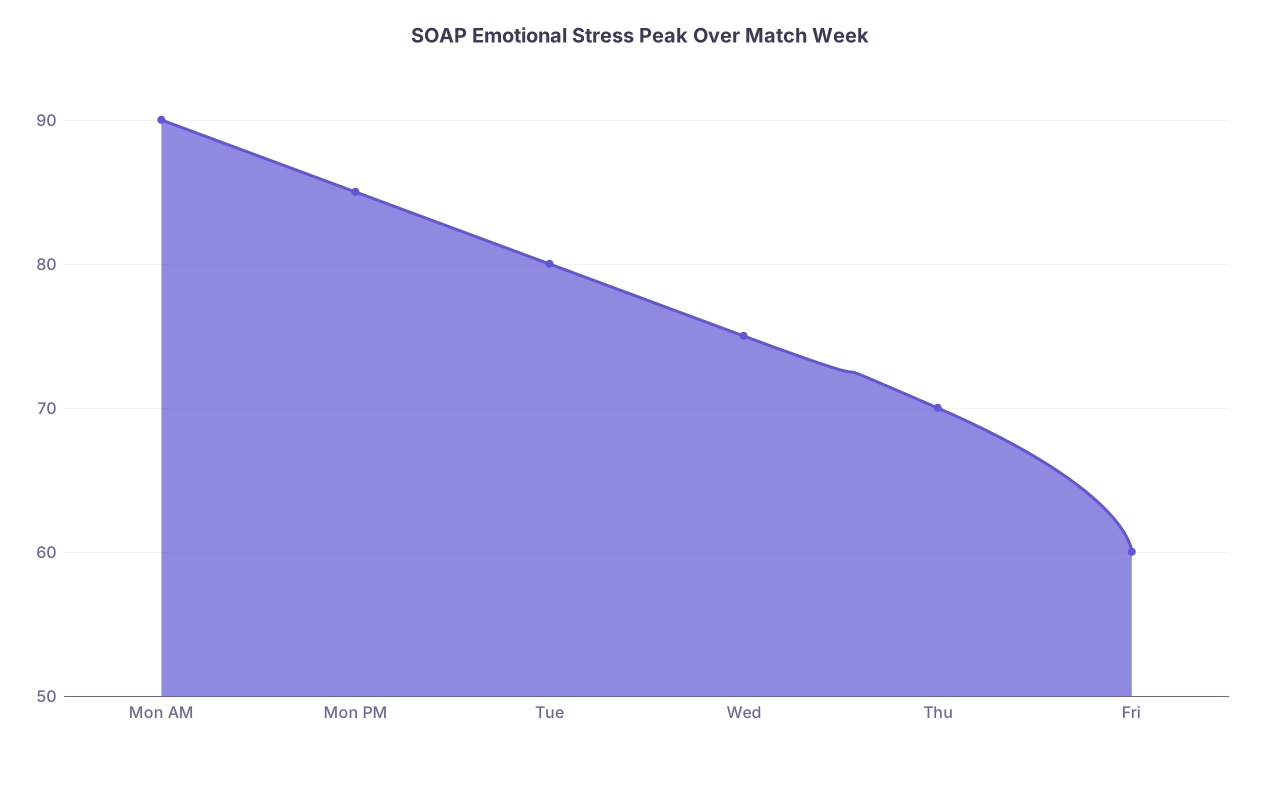
| Category | Value |
|---|---|
| Mon AM | 90 |
| Mon PM | 85 |
| Tue | 80 |
| Wed | 75 |
| Thu | 70 |
| Fri | 60 |
Here is how to adjust when the reveal happens.
If the matched partner ends up in a major metro/program‑dense area
Example: New York, Boston, Chicago, Houston, Philly, LA.
Good news: there are usually multiple unfilled or late‑cycle opportunities nearby.
Actions:
- Re‑sort your SOAP list and any backup non‑NRMP options (research, prelim, off‑cycle community spots) around this city/region.
- The matched partner can start quietly asking current residents/faculty (via email after Match Day) if they know of nearby programs that chronically struggle to fill.
This can sometimes lead to post‑SOAP scrambles, especially at small community places that lost a candidate late.
If the matched partner matches somewhere isolated
Example: single hospital in rural Midwest with 1–2 small programs.
Then the couple faces a harder choice:
- Unmatched partner prioritizes any job within 3–4 hours’ drive.
- Or unmatched partner takes the strongest training possible elsewhere and you accept 1–3 years of long distance.
There is no right answer. But you must decide fast and stay consistent.
8. SOAP Interview Tactics – With the Couple in Mind
During SOAP, interviews are short, rushed, and sometimes chaotic. Programs are also anxious. They do not want another unfilled slot.
Your job in 10–20 minutes:
- Seem stable.
- Seem committed to the specialty.
- Seem like you’ll actually show up on July 1 and not quit.
How to talk about your original couples plan without sounding like a flight risk
If they ask about your initial couples match:
You do not say:
- “We were trying to be together but now we’re just hoping for anything.”
- “I’ll probably try to re‑match somewhere else later if my partner ends up far.”
You say:
“We couples matched because we’re both committed to medicine and we hoped to train in the same general region. When I went unmatched, we talked seriously about priorities. We agreed that my top priority now is starting strong training this July and committing fully to the program that offers me that opportunity. We’ll figure the logistics as a couple, but from my end, if I’m lucky enough to match with you through SOAP, I intend to stay and complete my training here.”
They need to hear “I am not using you as a stepping stone this year.”
9. After SOAP: If It Works, If It Doesn’t
You’ll know by Thursday if you matched in SOAP. Then two paths.
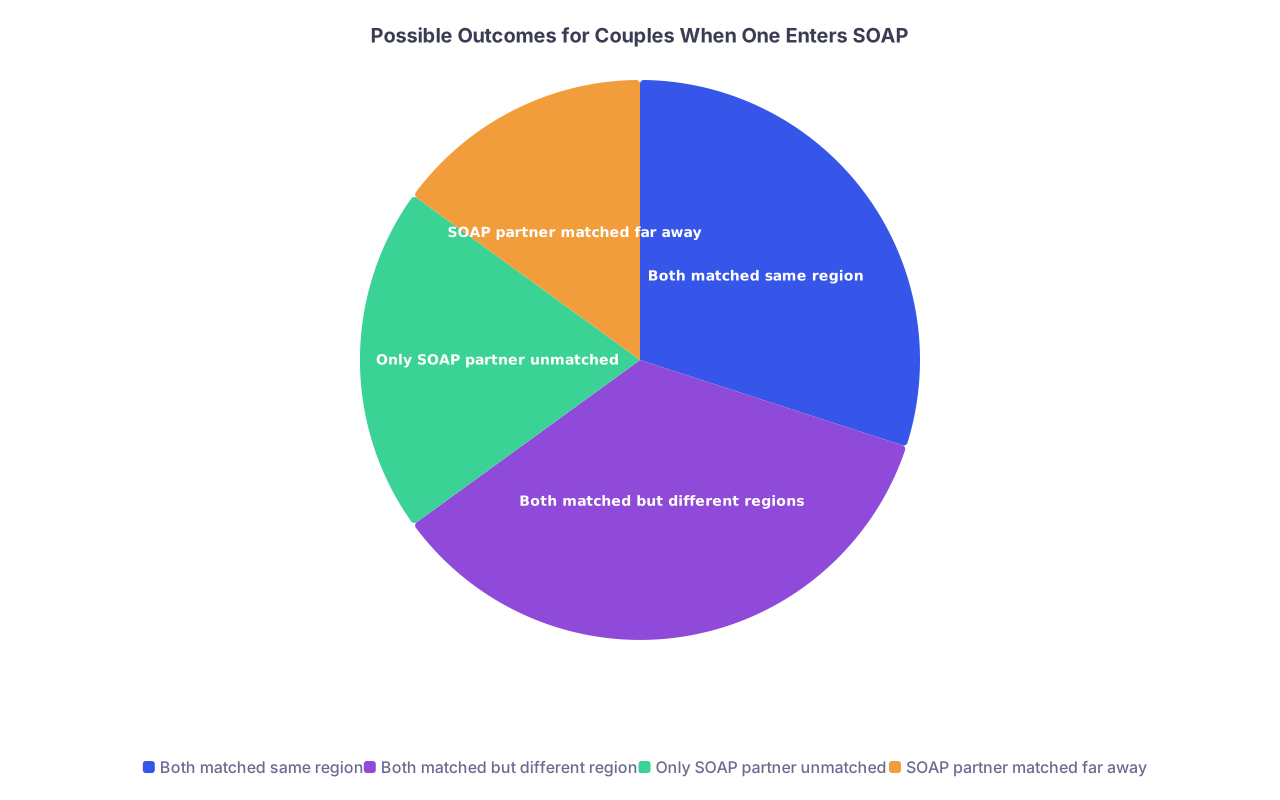
| Category | Value |
|---|---|
| Both matched same region | 30 |
| Both matched but different regions | 35 |
| Only SOAP partner unmatched | 20 |
| SOAP partner matched far away | 15 |
If the unmatched partner matches via SOAP
Now you have:
- One standard match position.
- One SOAP position (often community or less‑desired on paper).
Your job as a couple:
Commit publicly and privately.
No “fallback” language. No “I’ll just try again next year immediately.” Give the SOAP program at least a year of full effort. Your reputation travels.Start planning housing, commuting, and support with reality, not fantasy.
Maybe you end up 1–2 hours apart. That is doable with planning:- Shared car schedule.
- Dedicated weekends.
- Creative vacation blocks.
Use the first year to build leverage.
The SOAP partner should:
Do not obsess over prestige. Obsess over performance.
If the unmatched partner does not match in SOAP
This is brutal. But it’s not the end. Here is what actually matters in the first week after:
Decide on one of three tracks – explicitly.
Immediate job/position track
Research year, non‑NRMP prelim, community job with clinical proximity.
Good if you need income or visa continuity.Pure reapplication optimization track
1‑year focused plan to fix what went wrong (scores, USCE, LORs, red flags).Non‑clinical or alternative path track
If you both realize that for the unmatched partner, medicine training might not be the right long‑term road anymore. Rare but real.
Protect the relationship.
The matched partner often feels guilt. The unmatched partner feels shame. Recipe for resentment.
You need explicit rules:
- No constant “What if I had…” loops.
- Scheduled times to talk about career planning vs times you do not talk about it at all.
- Shared therapist or couples counseling if you start to gridlock.
And yes, I’m saying that in an article about SOAP strategy because I’ve watched relationships implode from this exact situation more than once, and it derails careers too.
10. A Few Blunt Truths People Won’t Say Out Loud
Let me be direct about a few things:
- Programs do not owe you a couples‑friendly arrangement. Your job is to make it easy for them to say yes, not to guilt them into it.
- Long distance for part of training is not a relationship death sentence. I’ve seen couples do 3–4 years apart with clear rules and good communication and come out fine.
- Prestige is overrated during SOAP. Stability, visa security, and geographic feasibility matter more.
- If one partner consistently sacrifices their career entirely for the other, resentment almost always surfaces later. You have to share the pain as evenly as you can.
SOAP is about salvage and stability, not perfection.
Your Next Step Today
If you’re staring at an unmatched notification while your partner matched, do one concrete thing right now:
Open a shared document and write, in three bullet points each, your non‑negotiables and your flexibles as a couple for the next 3–5 years. Then put your laptop down, sit together, and read them out loud.
Once you know what you’re truly unwilling to sacrifice—and what you actually can bend on—every SOAP decision this week gets faster and cleaner.