
You can absolutely blow SOAP if you use faculty advocates the wrong way.
Most unmatched applicants either underuse their advocates or weaponize them blindly. Both backfire. The programs see the chaos. They can smell desperation through the phone.
Let’s walk through how to use faculty advocates well when you’re entering SOAP in a real crisis: few or no interviews, limited time, reputation and future on the line.
1. Get Your Head Straight Before Involving Anyone
If you pull faculty into your mess without a clear story and goal, you drag them down with you. They remember that next time you ask for help.
Very short checklist before you loop in advocates:
- You know your exact status (unranked vs unmatched vs “might match”).
- You have your ERAS materials open and editable (personal statement, CV).
- You’ve seen the SOAP list timing from NRMP/ERAS and know the windows.
- You have at least a rough idea of which specialties you’re targeting.
You don’t need everything perfect. But you must be coherent. I’ve watched students call an APD in tears saying, “I don’t know what to do, can you just help somehow?” That’s not a plan. That’s emotional dumping.
Here’s the mindset you want:
- Calm, even if you are not. Write your facts down before calling anyone.
- Specific ask: “I’m entering SOAP for prelim medicine and transitional year. I’d like your help in two ways: quick feedback on my revised personal statement and potentially calling 2–3 programs where you know faculty.”
- Time-aware: “I know you’re very busy, this would need to happen between Monday afternoon and Wednesday morning.”
You’re not begging. You’re collaborating under time pressure.
2. Identify the Right Faculty Advocates (Not Just The “Big Names”)
The biggest mistake: assuming only the chair or PD matters. Wrong. The right advocate is the one who knows you well enough to vouch for you authentically, and has at least some credibility with the programs you’re targeting.
Here’s how to map your humans quickly:
| Advocate Type | Best Use Case |
|---|---|
| Home Program PD/APD | Global credibility, quick emails |
| Clerkship Director | Detailed clinical endorsement |
| Research Mentor | Rescue your “trajectory” story |
| Community Preceptor | Strong work ethic, reliability |
| Dean/Student Affairs | Big-picture explanation, advocacy |
Do this on paper or a notes app:
List every faculty member who:
- Knows your clinical work directly, or
- Supervised your research/longitudinal project, or
- Helped you through a remediation or leave of absence.
Put a star next to:
- Anyone who is or was program leadership (PD/APD, clerkship director, site director).
- Anyone with strong connections to the regions you’re open to.
Cross out:
- People who barely know you and just wrote a generic letter three years ago.
- Faculty who you’ve had friction or awkward interactions with.
You might end up with 3–7 solid names. That’s enough. You don’t need an army; you need a focused team.
3. Be Honest About Why You’re in SOAP (And Script It)
If your advocates don’t know the real reason you’re in SOAP, they can’t help you effectively. And yes, they will ask.
Typical SOAP situations I see:
- Not enough interviews due to low Step scores / late scores.
- Switched specialty late and had weak application in new field.
- Significant red flag: failure, professionalism issue, leave of absence.
- International grad / Caribbean grad with limited interview traction.
- Overly competitive specialty with no safety net (e.g., applied to only derm + 3 prelims).
Give each advocate a short, clear version of your situation. Script it for them. Something like:
Score-related:
“I applied in Internal Medicine with a Step 1 pass and Step 2 of 217. I received 3 interviews but did not match. Feedback has consistently been that my clinical evaluations and letters are strong, but the Step 2 score limited my interviews.”Specialty switch:
“I pivoted from General Surgery to Anesthesiology very late, after my fourth-year sub-I. I secured a few anesthesia interviews but not enough, and I didn’t match. I’m now targeting preliminary medicine and transitional year spots where I can prove myself clinically and reapply.”Red flag (handled carefully):
“I had a professionalism concern in third year related to a miscommunication about duty hours. I completed remediation, have had clean evaluations since, and I’ve been very proactive about feedback. Programs may see that as a risk; I’m looking for someone who can speak to my growth and reliability now.”
You don’t need to confess every detail. But you cannot let your faculty walk in blind.
4. Decide Exactly What You Want Them To Do
“Can you help me with SOAP?” is a terrible question. Faculty don’t know what that means operationally. You need to define discrete, realistic tasks.
Here are the three main ways advocates can actually move the needle:
Strategic guidance and triage
- Help you decide which specialties and program tiers to prioritize.
- Reality-check your expectations. (“No, you are not going to SOAP into ortho with this profile.”)
- Identify programs where you may have a connection.
Targeted communication with programs
- Short, specific emails or calls to program leadership.
- Clarify red flags, emphasize your clinical strengths, note that you’ll take a SOAP offer seriously.
Internal support at your school
- Coordinate with student affairs to ensure your name is on any “priority list” the dean’s office sends to programs.
- Help fix or update your MSPE if there were errors or missing context.
When you reach out to each advocate, match the ask to their role:
- PD/APD: “Would you be willing to email or call 2–3 medicine programs where you have connections once the SOAP list is out, if my application is in their pool?”
- Clerkship director: “Could you be available for a short call with a PD if anyone reaches out to verify my clinical performance?”
- Research mentor: “Can I list you as someone who can speak to my long-term reliability and growth if programs ask?”
Do not ask each person to blast 50 programs. That looks uncoordinated and desperate.
5. Timing: When To Mobilize Advocates in SOAP Week
SOAP is a compressed war zone. Everyone is busy. You respect their time by understanding the timing.
At a high level, your week looks like this:

| Step | Description |
|---|---|
| Step 1 | Unmatched Monday |
| Step 2 | Contact Core Advocates Mon PM |
| Step 3 | Revise Materials Mon Night |
| Step 4 | SOAP List Released Tue |
| Step 5 | Share Target List Tue AM |
| Step 6 | Faculty Outreach Tue PM Wed AM |
| Step 7 | Interview Windows Wed |
| Step 8 | Offer Rounds Thu |
Practical timing plan:
Monday (Unmatched Day)
- Morning: absorb the news, meet with dean’s office.
- Afternoon: email your 3–7 key advocates with: status, brief story, and that you may request very focused help in the next 48 hours.
- Evening: revise personal statement(s), clean up ERAS.
Tuesday (List release)
- Morning: get the unfilled list, decide specialties and geographic range.
- Late morning / early afternoon: send each advocate a short email with:
- Your finalized plan (e.g., “prelim IM + TY, open to Midwest and South”).
- Your updated ERAS materials (or at least your new personal statement).
- A list of 5–10 priority programs, ideally with some link to them.
Tuesday afternoon / Wednesday morning
- This is the window where their emails/calls can actually influence who gets pulled from a SOAP application stack for interviews.
- After Wednesday afternoon, most of the meaningful selection has happened.
Do not ping them every few hours. One well-structured email plus one quick follow-up call (if appropriate) is enough.
6. How To Ask: Email Templates That Don’t Sound Desperate
Here is the kind of email that gets read and acted on.
Subject line ideas (pick one, keep it clear):
- “SOAP support request – [Your Name], unmatched in IM”
- “[Your Name] – entering SOAP for prelim IM, request for limited advocacy”
Email body template (adapt this, don’t copy-paste blindly):
Dear Dr. [Last Name],
I learned this morning that I did not match in [Original Specialty]. I received [X] interviews and unfortunately did not secure a position. After meeting with [Dean/Advisor], I’m entering SOAP primarily for [Target Specialty/ies – e.g., preliminary Internal Medicine and Transitional Year positions] and remain open geographically to [regions].
Briefly, I believe the main factor in my not matching was [concise reason – e.g., late specialty switch / below-average Step 2 / limited interview numbers], rather than concerns about my clinical performance. My clerkship and sub-internship evaluations have been consistently strong, especially in [relevant areas].
I know this is an incredibly busy time, but I wanted to ask for your help in two specific ways:
- I’ve attached my updated personal statement and ERAS CV. If you have time for a quick glance today, I’d appreciate any high-level feedback.
- Once the SOAP list is released tomorrow, I plan to target the attached list of programs where I think I could be a strong fit. If you know anyone at these institutions, or if you’d be willing to send a brief email on my behalf to 1–2 of them, that would be immensely helpful.
I understand if your bandwidth is limited and truly appreciate any guidance or support you’re able to provide.
Thank you very much,
[Name]
AAMC ID: [ID]
Cell: [number]
That email communicates: reality, insight, humility, a specific ask, and respect for their time. That’s who faculty want to help.
7. Equip Them With What To Say (So They Don’t Wing It)
Lazy faculty advocacy sounds like this: “X is a nice student, please keep them in mind.” Programs ignore that.
You want your advocates to be able to say three sharp things:
- What you’re good at clinically.
- Why you didn’t match, in a non-damaging but honest way.
- Why you’re a low-risk, high-yield SOAP pick.
Do the work for them. Send bullet points they can steal.
Example for a medicine applicant:
- “Strong sub-I in general medicine; functioned at early intern level.”
- “Excellent reliability – no missed shifts, good team communication.”
- “Step 2 score below our average but does not reflect clinical performance.”
- “Actively sought and incorporated feedback; clear growth over MS3 and MS4.”
- “Very motivated to match somewhere where they can work hard and prove themselves.”
For a red-flag case (e.g., professionalism incident), help them frame the narrative:
- “Had a professionalism concern in MS3 related to miscommunication about duty hours; completed formal remediation and has had no issues since.”
- “Deliberate and reflective about that experience; now proactive about expectations and communication.”
- “Our team would have no hesitation having them as a prelim or categorical resident.”
You’re not putting words in their mouth. You’re making it easy for them to be specific.
8. Program Targeting: Where Faculty Advocacy Actually Matters
Advocates are not magic. A PD email doesn’t teleport you into a top-10 academic program if your file doesn’t match. You need to aim where their word can plausibly tip the scales.
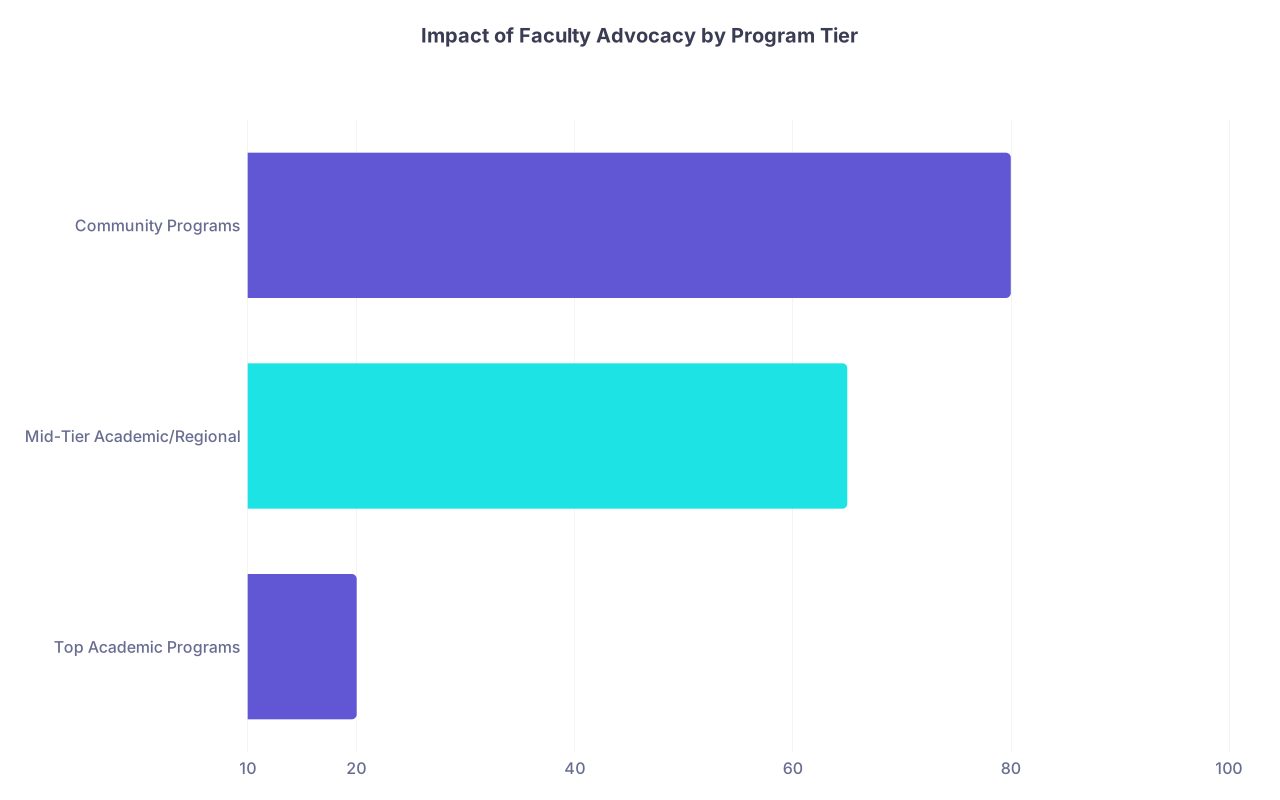
As you look at the SOAP list, think in three buckets:
| Category | Value |
|---|---|
| Top Academic Programs | 20 |
| Mid-Tier Academic/Regional | 65 |
| Community Programs | 80 |
(Values are “how often advocacy can actually move you from ‘maybe’ to ‘yes’,” not official stats, but you get the idea.)
Top academic programs
Advocacy can sometimes get your file read but usually won’t save a major deficit, especially in ultra-competitive specialties.Mid-tier academic / strong regional programs
This is the sweet spot. A trusted PD or clerkship director saying “We trained this person, they’re solid, you won’t regret a prelim spot” can matter a lot.Smaller community programs
Phone calls here can be powerful if the advocate has any preexisting relationship. Even a “we know this school and its training is reliable” endorsement can help.
Strategy:
- Develop a list of ~30–45 programs you’re applying to in SOAP.
- Identify 5–10 where:
- You have regional ties, and/or
- Your school has sent grads before, and/or
- Your faculty actually know someone there.
- Ask for advocacy only for those 5–10. Apply broadly, but advocate narrowly.
9. What To Avoid So You Don’t Backfire the Advocacy
There are ways to use advocates that will make you look worse, not better. I’ve watched applicants tank their chances by doing the following:
Mass, uncoordinated outreach
Five different faculty members emailing the same PD with slightly different stories about you. That looks sloppy and desperate.Fix: Coordinate. Tell your advocates who else is contacting whom. You can even assign: “Dr. A for Midwest programs, Dr. B for local community programs,” etc.
Over-selling yourself
If your transcript and MSPE are clearly average and your advocate says you’re the best student they’ve seen in 10 years, it smells wrong.Fix: Ask them to emphasize concrete behaviors: reliability, improvement, work ethic, specific rotation performance.
Pressuring them for guarantees
Any version of “Can you make sure I get a spot somewhere?” is a non-starter. They don’t control offers, and that pressure makes them pull away.Using them to complain
Never, ever use faculty contacts to criticize programs that didn’t rank you, complain about fairness, or argue about why you should have matched. That makes you the red flag.Disappearing after they help
If someone spends their political capital on you, then never hears from you again, they remember. And not fondly.
10. Managing the Emotional Side While You’re Mobilizing Help
You are in crisis. That’s real. But your crisis can’t spill unfiltered into every interaction.
A few practical things that help:
- Write the first draft of your “I didn’t match” explanation for yourself, not to send. Get the raw panic and anger out privately.
- Once you’ve written it, cut it down to a 3–4 sentence, emotionally neutral version you actually use with faculty and programs.
- Have one friend or partner who gets the unedited emotional version. Your advocates don’t need to hold that for you.
- Keep your phone accessible and volume on during SOAP days, but don’t hover. Go for short walks. Eat. You need your brain functioning when calls or emails come in.
Programs prefer someone who’s clearly disappointed but still composed. That reads as resilience, which they want.
11. After SOAP: Close the Loop With Your Advocates
If you want people to keep helping you in life, you close loops.
Whatever happens:
If you match in SOAP:
- Same day or next day: send a short thank-you email to everyone who advised or advocated.
- Later: a more detailed note or quick visit if local. Tell them where you’re going, what you’re excited about, and that their help made a difference.
If you do not match in SOAP:
- After the dust settles (a few days), send an honest update:
- That you did not secure a position.
- That you’re working with the dean’s office on a plan (research year, reapplication, etc.).
- That you appreciate their support and may reach out again once you have a clear strategy.
- Don’t vanish. That makes them less likely to go to bat for you next cycle.
- After the dust settles (a few days), send an honest update:
Long-term, these are the people who will write your reapplication letters, vouch for your resilience, and open doors when you least expect it. Treat the relationship like it matters, because it does.