
It’s 11:45 a.m. on Monday of Match Week. You’ve just seen the email: “We are sorry, you did not match to any position.” Your stomach is on the floor, your phone is blowing up, and someone is telling you to log into ERAS for SOAP.
Meanwhile, in a windowless conference room in a hospital you’ve never seen, three faculty members and a program coordinator are staring at a different screen: a list of 400+ SOAP applicants for 4 spots.
They know every single person on that list just failed to match.
They know this is your second-choice life, not your first.
And they absolutely do not read your application the same way they did two weeks ago.
Let me walk you into that room and show you how this really works.
What Changes In Their Heads The Minute You Enter SOAP
Here’s the first ugly truth: SOAP is not “second-chance ERAS.” It’s a different game with different psychology.
During main Match season, faculty read your file thinking:
- “Is this someone we want to invest 3–7 years in?”
- “How does this person compare to the rest of our rank list?”
In SOAP, the mental script flips to:
- “Can this person show up in 2 weeks and not implode?”
- “Why did they not match, and are we about to inherit that problem?”
- “Can they do the job safely and not make my life harder?”
They move from long-term fit to short-term risk management.
They know:
- You either went unmatched or partially matched.
- Your original specialty might have been more competitive.
- You might be applying to a specialty you didn’t show consistent interest in.
So they go hunting for three things:
- The story – what went wrong and whether it’s fixable.
- Evidence you can function Day 1 – SOAP residents hit the ground running.
- Your attitude – are you bitter and checked out, or hungry and realistic?
And they read every part of your SOAP application through those lenses.
How They Really Interpret “Did Not Match”
The biggest mental shift: during SOAP, every single candidate has a red flag by default. No one is “clean.” The question is what kind of red flag you are.
Let me give you the categories I’ve seen faculty literally use out loud.
Category 1: “Victim of the system” unmatched
These are the ones they feel ok about quickly:
- Applied to hyper-competitive specialties (derm, ortho, ENT, plastics)
- Reasonable but not superstar stats
- Back-up strategy was weak or non-existent
- Good letters, clean professionalism record
They say things like:
“Yeah, this is a classic ‘overshot their list’ situation.”
or
“If this person had applied IM from the start, they’d have matched easily.”
These applicants are salvageable in faculty minds. Strong chance of an offer if they otherwise fit the program.
Category 2: “Signal problem” unmatched
This is where they start to get cautious:
- Failed Step/COMLEX attempts
- Multiple leaves of absence
- Major USMLE delays
- Repeated poor clinical eval comments
- Inconsistent or strange specialty choices
Now the room starts asking:
“Why didn’t their home program rank them?”
“What happened during that leave? Was it performance, professionalism, or personal?”
“Is this person going to struggle on call?”
You’re now in risk territory. Not an automatic no, but you’ve got to counterpunch that narrative somewhere in your SOAP materials.
Category 3: “We’re not touching this” unmatched
These are usually immediate discards unless the program is desperate:
- Documented professionalism violations
- Very poor MSPE narrative (you’d be amazed what deans do actually write)
- Terrible or lukewarm letters
- Pattern of unreliability or boundary issues
In SOAP, faculty do not have time to do a rescue mission. If your file screams “drama,” you fall off the pile fast.
The File: What They Look At First During SOAP
During normal recruitment, faculty might browse your personal statement, then drift to your experiences, then ask you in person. SOAP is different. They’re triaging in real time.
In most rooms I’ve seen, the sequence looks like this:
- USMLE/COMLEX scores and attempts
- MSPE summary and any flagged concerns
- Transcript for clinical grades
- Specialty history and prior applications
- SOAP-specific personal statement
- Letters (often skimmed, not studied)
Let me break that down the way they actually think.

1. Scores and attempts
They are not hunting for perfection. They’re hunting for safety.
- Single attempt passes with modest scores? Fine.
- Fail with clear later improvement? Discussable.
- Multiple fails or no Step 2 when you’re already vulnerable? Problem.
You’ll hear things like:
“228/235, all first pass, I’m fine with that for SOAP.”
or
“They failed Step 1 and just barely passed Step 2. Are we comfortable with them under pressure night float month 1?”
In SOAP, you don’t need to wow them with numbers. You need to not scare them.
2. MSPE summary
The MSPE (Dean’s Letter) becomes more important once you’ve unmatched. During regular season, some faculty barely skim it. During SOAP, they’re actively hunting for:
- Words like “concern,” “slow to improve,” “requires close supervision”
- Repeated references to professionalism issues
- Patterns: multiple “pass” or “low pass” in core rotations
They’re trying to answer one question:
“If this person struggled as a student, is that going to explode when they’re holding a pager?”
3. Clinical grades
Then they look at how you did on rotations that matter to them.
For medicine SOAP:
- How were IM, surgery, ICU, sub-I?
- Any “Honors in Medicine,” “High Pass in Sub-I”? Bonus.
- A long string of borderline passes suggests struggle with clinical performance or knowledge.
For prelim/TY programs, they’re a bit more forgiving, but still: they want to know you can survive the floor.
Your SOAP Personal Statement: The Truth Serum They Actually Read
Here’s the twist: during main Match, your personal statement is often skimmed. During SOAP, it becomes a psychiatric evaluation in 800 words.
Faculty sit there asking:
- “Are they devastated and resentful?”
- “Can they accept this specialty honestly, or are we a rebound?”
- “Do they understand what this job actually is, or are they applying blindly?”
And they are ruthless about insincerity.
If you were aiming for orthopedic surgery and now your SOAP PS for internal medicine says, “I have always been passionate about longitudinal patient care”… nobody buys it.
They’re not angry that you had a different first love. They just want a coherent story that:
- Admits reality without self-pity.
- Explains your red flag(s) without blaming everyone else.
- Shows genuine respect for their specialty.
- Makes clear you understand what you’re walking into.
The statements that land well during SOAP sound something like this:
“I applied to orthopedic surgery in the main Match and did not match. In retrospect, I should have applied more broadly and considered my fit for other fields more thoughtfully. My strongest clinical evaluations were in internal medicine and sub-internship, and I’ve consistently been drawn to diagnostic reasoning and longitudinal care. While this was not the path I initially envisioned, I’m committed to bringing the same work ethic and humility to an internal medicine residency and to being an asset from day one.”
Notice the elements:
- Direct admission: what you applied to and that you didn’t match.
- Some ownership: “I should have applied more broadly.”
- Evidence: “strongest evaluations were in IM.”
- Respect: speaks about IM in specific, grounded terms.
- No melodrama, no begging, no bitterness.
The ones that bomb?
- “Matching doesn’t define me…” rants
- Overly emotional, diary-style entries
- Blame-heavy narratives about advisers, schools, “the system”
- Cartoons of passion for a specialty you clearly just pivoted to yesterday
SOAP faculty are not in the mood for theater. They want a sane, composed adult who just took a hit and can still think clearly.
The “Why This Specialty Now?” Problem
Programs are acutely aware: SOAP is full of people applying to a specialty they did not court originally.
So they read your file like a detective.
They look for:
- Did you ever do a rotation, elective, or sub-I in this field?
- Any meaningful exposure: research, interest group leadership, shadowing?
- Any letter from someone in this specialty at all?
If your file shows:
- Applied derm → now applying FM, with no FM rotations, no FM letters, no mention of FM previously…
The room says:
“They’re just trying to land anywhere. Will they leave after a year? Will they be miserable here?”
If instead they see:
- Applied EM → now SOAPing into IM
- You have strong IM evals, an IM sub-I, and an EM doc letter that says “They’d be a fantastic internist as well.”
Now they can build a believable narrative in their heads. They can defend you to colleagues.
| Original Specialty | SOAP Specialty | Typical Faculty Reaction |
|---|---|---|
| Ortho/ENT/Plastics | IM/FM/TY | Seen as reasonable pivot if PS and evals support it |
| EM | IM/FM | Often acceptable; significant overlap in skillsets |
| Derm/Rad Onc | IM/FM | Questioned but salvageable with good story |
| Psych | IM/Surg | Raises concern about realism and fit |
| No clear pattern | Any | Viewed as scattershot, higher risk |
They’re not demanding a lifelong love story. They just want:
- Evidence you’ve thought about this.
- Some credible alignment between your history and your new target.
If you have none of that, your only weapon is your SOAP statement and any emergency letter an attending is willing to crank out fast that says, “Yes, this person can do this job.”
How Attitude Leaks Through Your Application
Faculty can smell bitterness even on paper.
It shows up in:
- PS phrasing that constantly circles back to “what I deserved”
- Over-defensive explanations of failures
- Overcompensation: exaggerated claims, “always,” “never,” “perfect” narratives
I’ve literally heard an APD say:
“This reads like someone who’s still angry at the Match. I don’t want them announcing to my interns that they were ‘forced into’ this field.”
During SOAP, your emotional tone is almost as important as your CV.
The best vibe?
- Grounded
- Respectful
- Slightly humbled but not broken
- Oriented toward the future, not stuck dissecting the past
What Happens In the Room: How They Decide in 10–20 Minutes
Picture the faculty side. It’s chaotic.
They have:
- A list of hundreds of apps
- A few predetermined filter criteria (Step cutoffs, graduation year, etc.)
- Maybe 60–90 minutes to triage and generate a call list
This is the rough process I’ve seen in multiple programs:
- Pull all SOAP applications.
- Auto-filter out those who don’t meet bare minimums (scores, grad year, citizenship status if relevant).
- Rapid review of remaining files focusing on:
- Reason for mismatch (they infer it from specialty and background)
- Academic red flags
- Specialty pivot plausibility
- Overall gut feel from PS and MSPE
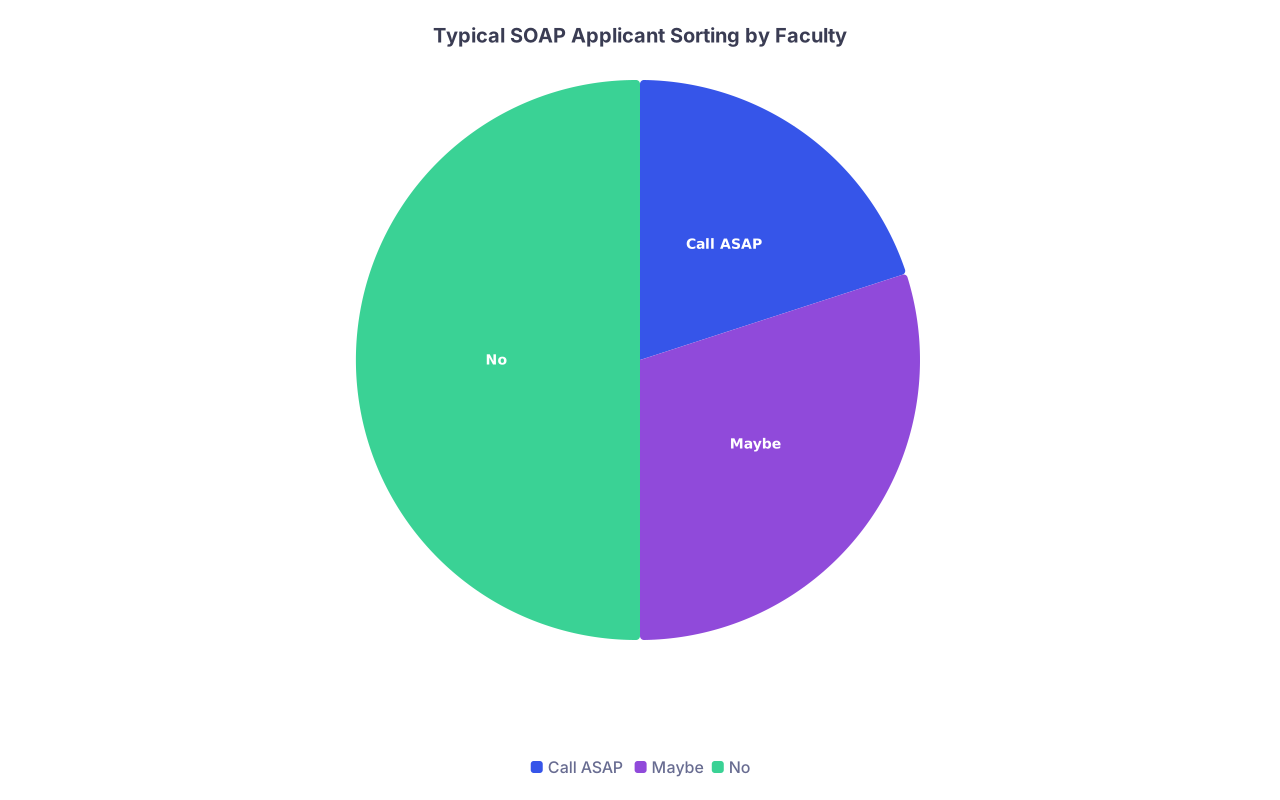
- Build three buckets:
- “Call ASAP”
- “Maybe if we don’t fill from group 1”
- “No unless desperate”
You want to be in Bucket 1. The people in that group usually share three traits:
- They look safe academically and professionally.
- Their unmatched story makes sense and doesn’t scream catastrophe.
- Their SOAP statement makes the pivot look mature, not panicked.
| Category | Value |
|---|---|
| Call ASAP | 20 |
| Maybe | 30 |
| No | 50 |
So when you’re editing your SOAP materials, you’re not writing “the perfect essay.” You’re crafting something that says in big bold subtext:
“I am a low-risk, high-yield salvage. You will not regret picking me.”
How Interviews Change: SOAP vs Main Match
SOAP interviews are speed dates under fluorescent lights.
During main season, faculty chat about your hobbies, research, five-year plans.
During SOAP, they have three questions in their heads:
- “Can this person safely take sign-out in two weeks?”
- “Are they going to resent being here?”
- “Is there some hidden disaster we are missing in the file?”
Expect the conversation to hit:
- Why you think you didn’t match
- Why you’re pivoting (if you are)
- How you see yourself contributing immediately
- Your honesty and insight into your own limitations
They’re not looking for a performance. They’re looking for someone who can say:
“I overestimated my competitiveness in X. Looking back, I should have…
Here’s what I learned from that.
I know your program will expect A, B, and C from day 1. I’ve done Y and Z that show I can step into that quickly.”
Confidence without denial. Humility without self-annihilation. That’s the sweet spot.

| Step | Description |
|---|---|
| Step 1 | Review SOAP List |
| Step 2 | Reject |
| Step 3 | Check Scores and MSPE |
| Step 4 | Read SOAP Statement |
| Step 5 | Maybe List |
| Step 6 | Call ASAP |
| Step 7 | Meets Basic Filters |
| Step 8 | High Risk Red Flags |
| Step 9 | Coherent Story and Attitude |
How To Quiet The “Why Didn’t They Match?” Voice In Their Heads
You cannot stop faculty from asking why you didn’t match. That question will be sitting in front of your name on every screen.
What you can do is pre-answer it so well they lose interest in digging deeper.
You do that by aligning three things:
- Your history – previous specialty target, rotations, performance.
- Your explanation – brief, honest, not melodramatic.
- Your pivot – what you want now, and why it makes sense for who you are.
When those three line up, faculty relax. When they don’t, they start inventing explanations. That’s where paranoia starts: “There must be something we’re not seeing.”
If you were a US MD with decent scores applying to a slightly competitive specialty and didn’t match anywhere, programs will assume:
- You had weak interviews
- Or you had red flags not obvious on paper
- Or your rank list strategy was poor
Your job is not to litigate the entire past. It’s to show them—through content and tone—that whatever happened will not replay itself on their wards.