
The way most applicants rewrite their personal statement for SOAP is dangerous.
Not just ineffective. Dangerous. As in: it actively signals to programs, “I do not understand why I went unmatched, and I will probably repeat the same mistakes in residency.”
You do not have time in SOAP to be “pretty good.” You either avoid the obvious red flags or you get quietly buried in a stack of 700+ emergency applications.
Let’s walk through the mistakes that kill SOAP personal statements and how to avoid them—fast.
1. Using Your Original Personal Statement With Light Edits
If you copy‑paste your main Match personal statement and swap two sentences, you’re doing it wrong.
Programs can often see your original PS and your SOAP one. Faculty talk. Coordinators remember. And they absolutely notice when your “new” statement is the old one with a fresh coat of paint.
Why this is a problem:
- It screams: “I haven’t reflected on what happened.”
- It suggests you think SOAP is just a second upload, not a second chance.
- It ignores the fact that SOAP is a different context with different stakes.
The original PS is usually written from the mindset of:
“Here is why I’d be an amazing resident.”
The SOAP PS needs to be:
“Here is what I’ve learned, how I’ve grown, and why I am ready and safe to invest in now, even after not matching.”
Common lazy-edit signs I see:
- Same opening story, same closing line, maybe one new paragraph wedged in.
- Same list of accomplishments, zero mention of the unmatched outcome.
- Same specialty-specific language used now for a different specialty.
Do not do this.
What to do instead
- Open a fresh document. No copy‑paste.
- Outline three sections only:
- What brought you to medicine and this specialty (brief).
- What you’ve proven you can do (evidence, not adjectives).
- What you’ve learned from this cycle and how you’re ready to show up on Day 1.
- Then—and only then—pull in 1–2 short sentences from your original if they still truly fit.
If your SOAP PS doesn’t feel noticeably different in tone and focus, you’re not taking SOAP seriously enough.
2. Pretending You Didn’t Go Unmatched
Acting like the Match just… didn’t happen? Big mistake.
Programs know you’re in SOAP. You know you’re in SOAP. Ignoring that reality reads as:
- Avoidant
- Lacking insight
- Possibly blaming others silently
No one wants to rank a resident who cannot name and process their own setbacks.
I’m not saying you write a confession letter. But a strategic, concise acknowledgement is powerful.
The two extremes to avoid:
- Overconfession: “I failed Step 1 twice, my rank list was a disaster, I was overconfident…” Now your entire statement is a guilt dump.
- Complete silence: No mention of any reflection, no evidence that you’ve processed anything.
How to acknowledge without self-destructing
You need 2–4 sentences. That’s it.
Bad version:
“I did not match because my application was not competitive enough, and I made mistakes with my rank list.”
Better:
“Not matching in the main residency Match was deeply disappointing. It forced me to take an honest look at my application, seek direct feedback from mentors, and clarify where I add value to a program. I used this time to strengthen my clinical skills, refine my priorities, and recommit to the day‑to‑day work of residency.”
Notice what this does:
- Names the reality (did not match) without dramatics.
- Signals reflection and feedback‑seeking.
- Moves quickly to growth and readiness.
If your SOAP statement completely erases the unmatched outcome, programs may assume you’re either in denial or being coached to hide it. Both are bad.
3. Writing a Generic, “I’ll Do Anything” Statement
SOAP with limited interviews is brutal. Applicants panic and start writing these:
“I am open to any specialty and would be grateful for any opportunity to train at your program.”
That one line alone can sink you.
Programs are not looking for “any warm body.” They’re looking for a believable fit who won’t quit, transfer, or fail out.
When you sound desperate and nonspecific, you raise three red flags:
- “Will this person be miserable in our specialty and bail?”
- “Do they even understand what this field actually involves?”
- “If we invest in them, will they still be trying to jump ship to another specialty?”
The right way to show flexibility
You can be realistic and open without sounding directionless.
Example if you’re pivoting from a competitive field (say, ortho) to internal medicine:
Bad:
“I originally applied to orthopedic surgery but I am now open to internal medicine, family medicine, or any other specialty that will consider me.”
Better:
“While my initial applications were in orthopedic surgery, my core clerkship experiences revealed that my strengths align more closely with longitudinal patient care, complex medical decision‑making, and team‑based inpatient medicine. Internal medicine offers exactly that balance, and I am now fully committed to pursuing training in this field.”
You’re allowed to pivot. You’re not allowed to sound like you’re shopping for whatever will take you.
Pick the specialty you’re SOAPing into and commit on paper. If you’re applying to multiple related specialties, you may need separate tailored statements, not one Frankenstein letter that tries to “kind of” fit all of them.
4. Overexplaining or Making Excuses for Red Flags
SOAP applicants almost always have at least one red flag:
- Low Step/COMLEX scores
- Failed or repeated exam
- Gaps in training
- Limited clinical experience in the target specialty
- Prior match attempts
The rookie mistake is either:
- Not mentioning any of it, or
- Writing 4 paragraphs of justification that make reviewers uncomfortable
If you spend half your statement explaining why your Step 2 CK score is low, you’ve already lost the plot.
Programs read red‑flag explanations all week during SOAP. They’re numb to long stories. They’re looking for patterns:
- Does this person own their part?
- Did they change their behavior?
- Can they now perform at a reliable level?
Tight structure for red‑flag mention
Use this three‑sentence framework:
- Name it briefly, without drama.
- State what you changed.
- Point to evidence that the change worked.
Example for a failed exam:
“I failed Step 1 on my first attempt. That experience forced me to confront ineffective study habits and a tendency to prepare in isolation. I worked with our learning specialist, joined a structured study group, and passed on my second attempt, then later scored [XXX] on Step 2 CK, reflecting the systems I put in place.”
Then stop. Don’t keep revisiting it in different words. Don’t apologize again in the conclusion.
If you keep circling back to your weakest point, you anchor the reader on it. Mention it, own it, show your correction, and move on.
5. Ignoring What SOAP Programs Actually Worry About
You’re writing from anxiety. Programs are reading from risk management.
In SOAP, especially with limited interviews, coordinators and PDs are asking:
- Can this person function safely on the wards?
- Will this person show up, do the work, and not disappear?
- Is this someone who will cause drama, remediation, or legal problems?
- Are they going to quit in PGY‑1?
Most SOAP personal statements do not answer these questions. They talk about passion and childhood stories. They don’t address reliability, teachability, or resilience with concrete proof.
Translate your story into risk language
If you say:
“I am hardworking and dedicated.”
They hear: “You and every other applicant.”
If you say:
“During my sub‑internship in internal medicine, I volunteered to take the lead on weekly follow‑up calls to recently discharged patients. Over four weeks, I completed 95% of calls within 48 hours and identified multiple medication issues that we corrected with the team.”
They hear:
- Follows through
- Handles responsibility
- Cares about safety and details
You want 3–5 very specific examples like that. Not vague character claims.
Look for:
- Times you took ownership of a task
- Times you responded well to feedback or criticism
- Times you did unglamorous work consistently
- Times you handled stress without falling apart
SOAP programs are risk‑averse. Give them reasons to believe you’re a low‑risk, high‑reliability choice.
6. Letting Panic Write the Tone
I’ve read SOAP statements where the emotional tone did more damage than any score or exam failure.
Common tone problems:
- Begging: “I am humbly and desperately asking for any opportunity…”
- Bitterness: Subtle jabs at the system, previous programs, or “unfairness.”
- Overcompensating: Overly grand language, heroic self-descriptions, emotional oversharing.
- Flat affect: Totally generic, robotic, reads like a filler template.
Programs can smell panic. They’re already overwhelmed. Emotional volatility—even on paper—feels like a future headache.
How to reset your tone
Use this quick filter:
- Cut any sentence that sounds like a plea.
- Cut any complaint, even if you think you’re being “honest.”
- Cut long emotional backstories unrelated to residency performance.
- Replace “I always knew,” “I have always wanted,” “deep passion,” with concrete experiences.
Read your statement out loud. If you’d be embarrassed to say a sentence to a PD’s face, do not leave it in.
You want a tone that is:
- Steady
- Grounded
- Realistic but hopeful
- Focused on what you offer, not what you need
7. Reusing the Same Lengthy Narrative Structure
Another big SOAP mistake: trying to squeeze in the whole “classic” personal statement structure when you have neither the time nor the audience patience.
You do not need:
- A long childhood anecdote
- A poetic story arc
- A big “full circle” closing metaphor
You’re in SOAP. PDs and faculty are reading on overload.
Aim for simple and tight:
- Short hook (2–3 sentences)
- Evidence of readiness and strengths (2–3 short paragraphs)
- Brief mention of unmatched reflection and growth (1 paragraph)
- Specialty‑specific commitment and what you bring to a team (closing paragraph)
If your opening paragraph is more than half a page, you’ve already lost most SOAP readers. They skim. They are too busy running a program and a SOAP process at the same time.
8. Failing to Tailor by Specialty (or Program Type)
One of the sloppiest errors: a SOAP statement that tries to work for any specialty or any level of program.
Internal medicine, family medicine, prelim surgery, TY, psych—these all read differently to faculty. They look for different types of fit.
Uploading the same generic statement everywhere because “there’s no time” is a fast way to waste the one document they’ll actually read.
Minimum tailoring you must do
At least address:
- The specific specialty name you’re SOAPing into.
- One or two features of that specialty that match your strengths.
- Skills you already have that obviously transfer into that field.
For example, family medicine SOAP vs internal medicine SOAP:
- In FM, emphasize continuity, community care, breadth, outpatient comfort.
- In IM, emphasize complex medical management, inpatient work, critical thinking, subspecialty exposure.
If you’re SOAPing into prelim or transitional year spots:
- Acknowledge you’re seeking a strong generalist foundation.
- Emphasize reliability, adaptability, willingness to do heavy floor work.
- Avoid sounding like your “real” goal is something else and this is just a placeholder.
You don’t need 10 versions. But you cannot fire off one universal statement and call it a strategy.
9. Ignoring Basic Red-Flag Presentation Issues
Some SOAP applicants are actually competitive enough on paper. They lose ground on pure sloppiness.
Programs read this as: “If you’re this messy when your career is on the line, what will your notes and orders look like at 2 a.m.?”
Common presentation mistakes:
- Typos and grammar errors (yes, still happening—even in SOAP).
- Wrong program name or specialty because you reused a draft.
- Rambling 1.5–2 page statements that never get to the point.
- Obvious copy‑paste seams (“As a future pediatrician…” in an internal medicine SOAP).
- Inconsistent formatting, weird fonts, random bold or underlining.
You do not win points for style in SOAP. You only lose points for errors.
Take 15–20 minutes for:
- One focused edit pass for content (cut fluff, tighten, clarify).
- One pass for mechanics (typos, grammar, names).
- One pass for alignment (specialty name, tone, no leftover lines from other versions).
And if you have any mentor, chief resident, or reliable friend who can do a same-day read, use them.
10. Overestimating What the Personal Statement Can Fix
Here’s the harsh truth: your SOAP personal statement will not rescue a fatally weak application.
What it can do:
- Keep you in contention when your numbers are borderline.
- Reassure a PD that you’re stable, teachable, and have insight.
- Differentiate you from other SOAP applicants with similar stats.
- Prevent you from being tossed out for obvious red flags in tone or content.
What it cannot do:
- Turn a 3‑time Step failure into a non-issue.
- Erase years of professionalism problems.
- Compensate for no letters, no clinical performance, no evidence of reliability.
Your goal is not to become someone’s “wow” story. Your goal is to be the safe, reasonable, thoughtful choice when they’re sorting through chaos.
If you understand that, you’ll stop swinging wildly for emotional impact and focus on the basics:
- Clear
- Honest
- Specific
- Stable
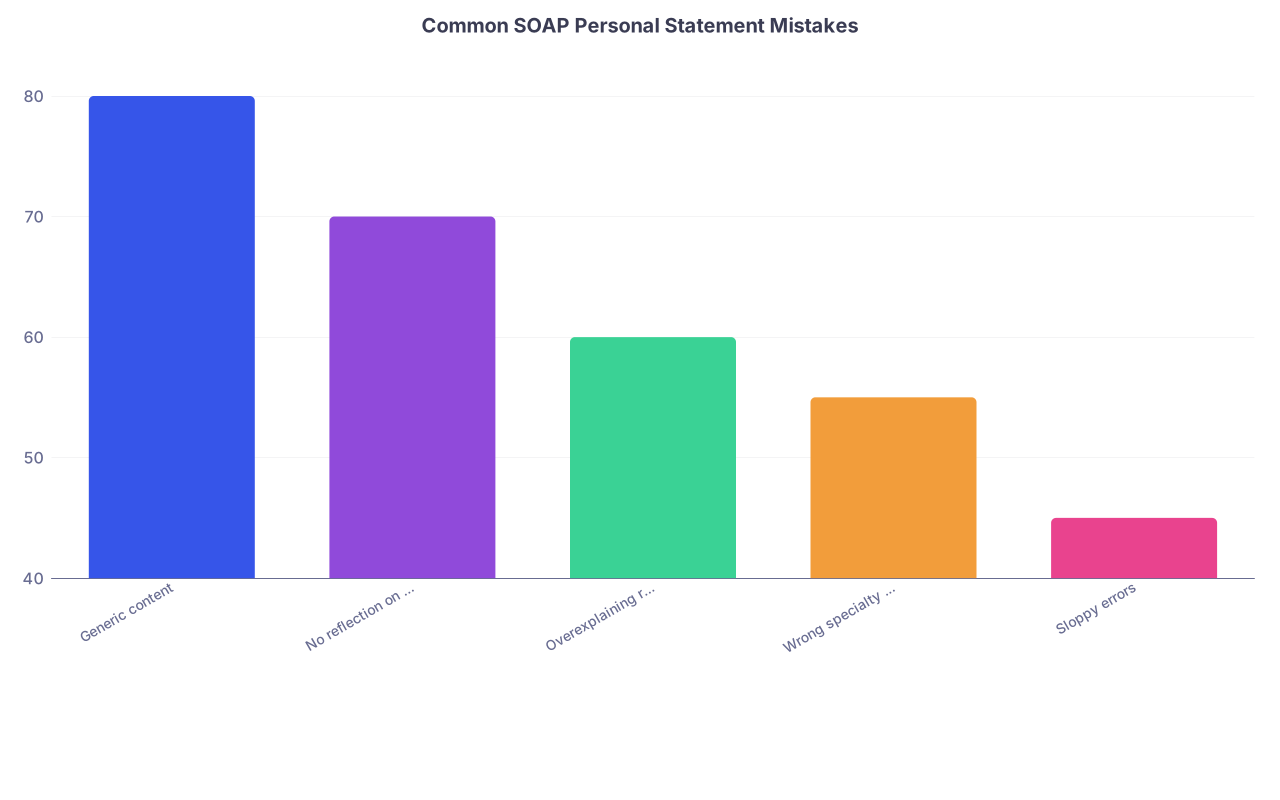
| Category | Value |
|---|---|
| Generic content | 80 |
| No reflection on not matching | 70 |
| Overexplaining red flags | 60 |
| Wrong specialty focus | 55 |
| Sloppy errors | 45 |

| Step | Description |
|---|---|
| Step 1 | Start New Draft |
| Step 2 | Rewrite to commit to one field |
| Step 3 | Outline key strengths |
| Step 4 | Add brief unmatched reflection |
| Step 5 | Address major red flags in 2 to 3 sentences |
| Step 6 | Cut generic phrases and begging tone |
| Step 7 | Proofread for errors and wrong names |
| Step 8 | Upload to SOAP |
| Step 9 | Specific specialty chosen |

11. Concrete Rewrite Blueprint (So You Don’t Freeze)
You’re probably tired, stressed, and low on time. So here’s a direct blueprint that avoids most major mistakes:
Paragraph 1 (3–5 sentences):
- One brief, real clinical moment or rotation experience that pulled you toward this specialty.
- One sentence linking that moment to your motivation now.
- No childhood, no drama, no grand statements.
Paragraph 2–3 (5–8 sentences total):
- 2–3 specific examples of you functioning like an intern:
- Taking ownership of patient care tasks.
- Communicating with teams.
- Handling responsibility reliably.
- Make it clear you understand the day‑to‑day work of the specialty you’re applying into.
Paragraph 4 (3–4 sentences):
- Acknowledge not matching in 1 line.
- Briefly state how you reflected and what you did to improve (feedback, study systems, clinical engagement).
- One concrete example showing improvement or resilience.
Paragraph 5 (3–5 sentences):
- Reaffirm your commitment to this specialty/program type.
- Mention the type of training environment where you thrive (team‑oriented, high-volume, underserved populations—whatever matches you).
- End on something grounded, not poetic: a clear statement of how you plan to contribute as a PGY‑1.
If you stick reasonably close to that structure and avoid the big pitfalls above, you will be miles ahead of the average SOAP statement that lands in program inboxes.

Core Takeaways
- Do not recycle your original personal statement with cosmetic edits or pretend you never went unmatched; SOAP programs notice and read that as a lack of insight.
- Avoid desperation and generic “I’ll do anything” language—commit to a specific specialty, give concrete evidence of reliability, and acknowledge red flags briefly with proof of growth.
- Keep the tone steady and the structure simple: short hook, specific examples of readiness, concise reflection on the unmatched outcome, and a clear, specialty‑focused commitment that makes you a safe, teachable choice.